

Here are my Top 10 links from around the Internet at 10 to 8 am (shocking outperformance!), brought to you in association with New Zealand Mint for your reading pleasure.
I welcome your additions and comments below, or please send suggestions for Thursday's Top 10 at 10 via email to bernard.hickey@interest.co.nz.
I'll pop any surplus suggestions I get into the comment stream.

1. 'We've learnt nothing' - Former US banking regulator William K Black argues at HuffPo that banks need to be regulated and the new Congress' moves to let markets regulate themselves is sowing the seeds of another disaster.
This is a must read for the Libertarians in our audience.
I'm thinking of you Tribeless.
Today's must read for the cynics and banking regulators out there too.
They need to be controlled.
If we have learnt anything in the last 10 years it is that.
William K Black wrote a book called "The Best Way to Rob a Bank is to Own one"
All power to the Reserve Bank here.
Representative Paul's claims epitomize the triumph of ideology over fact: "The market is a great regulator, and we've lost understanding and confidence that the market is probably a much stricter regulator." No, the "market" is not a "great regulator" and the ongoing crisis is only the latest example of that point.
Efficient, non-fraudulent markets would be a very good thing. Inefficient, markets with fraudulent participants can be a catastrophically bad thing.
The "market" also does not deal effectively with externalities (and they can be lethal) and with market power. The neoclassical claim that cartels cannot persist and that potential entry solves prevents all serious ills proved false in the real world.

2. The problem with CEOs - Prominent US Democrat and former Labor Secretary under Clinton, Robert Reich, has some tough things to say here in his blog about the influence of big business in America and how a more pro-business Obama isn't actually creating any jobs in America.
He makes some powerful points that cut to the heart of the problem with globalism. It's great for the CEOs and Hedge funds, but bad for employees and economies.
Reich illustrates the point by explaining how much of Apple's iPhone accrues to American workers.
The White House caved in on the Bush tax cuts for the wealthy, and is telling CEOs it will be on their side from now on. As the President recently told a group of CEOs, the choice “is not between Democrats and Republicans. It’s between America and our competitors around the world. We can win the competition.”
There’s only one problem. America’s big businesses are less and less American. They’re going abroad for sales and employees. That’s one reason they’ve showed record-breaking profits in 2010 while creating almost no American jobs.
Consider one of most popular Christmas products of all time – Apple’s iPhone. Researchers from the Asian Development Bank Institute have dissected an iPhone whose wholesale price is around $179.00 to determine where the money actually goes.
Some shows up in Apple’s profits, which are soaring. About $61 of the $179 price goes to Japanese workers who make key iPhone components, $30 to German workers who supply other pieces, and $23 to South Korean workers who provide still others. Around $6 goes to the Chinese workers who assemble it. Most of the rest goes to workers elsewhere around the globe who make other bits.
Only about $11 of that iPhone goes to American workers, mostly researchers and designers.

3. A ludicrous continent facing Eurogeddon - Jim Saft at Reuters nails the European predicament on the head in this excellent summary of the problems the various powers-that-be are trying to deny. Europe is insolvent. The market knows it. The politicians won't accept it. It will all end in tears.
Read this piece fully to truly understand how nuts the Europeans are.
You can lie to taxpayers or you can lie to creditors, European authorities are learning, but doing both at the same time is very hard.
The proposed policy that current senior creditors to troubled states will not face losses on their loans but future private lenders will be forced to share in losses with taxpayers is so irrational, so bound to fail that it falls out of the realm of economics and into the ambit of brain injury. The only way you could make this policy mix work was if you could find a very rich lender with no ability to conceptualize the future.
Hmm, let’s see a rich entity with limited ability to fully imagine a future state – it must be the European Union!
Few private lenders will stick around, they will sell their bonds and the only buyers will be the EU or ECB, which itself as it understands this predicament is hugely unwilling to play along.
Private money is quite happy to keep funding a bankrupt entity but only so long as the moral hazard play, the implied guarantee from on high, is still in force.
Why then haven’t spreads on weak euro zone bonds risen even higher? Well, besides the fact that the European Central Bank is actively buying, it is the fact that investors can’t quite believe that the European Union is serious. They know that getting out will be a disaster and a humiliation but that forcing private creditors to take haircuts could cause a banking crisis.
So, no haircuts and no reckoning. Investors are betting, at least for now, that the EU is lying to taxpayers, or to itself, rather than to them.
My guess is that we go on like this for a while; periodic crises that force the EU to pledge ever more money to member states without ever acknowledging that they are insolvent or forcing their private creditors to swallow losses.
That ends only if one of three things happens; the market decides that it won’t lend to Germany and France anymore, the weak nations revolt from austerity or the taxpayers of Germany and France decide that euro-geddon is better than picking up every check.

4. Debt of 1,000% of GDP - No wonder financial markets don't believe the Europeans or the Irish. FTAlphaville reports here what the IMF said about Ireland. Startling stuff.
Ireland’s external debt is the highest of recent exceptional access cases, with private sector debt accounting for the largest share. Ireland’s total external debt is projected at over 1000 percent of GDP at end-2010…
While a substantial portion of gross debt is accounted for by the liabilities of International Financial Sector Center (IFSC) participants, which do not reflect Irish risk, excluding an estimate of the bank component of this IFSC debt would still leave total external debt at almost 800 percent of GDP, with banks’ external liabilities accounting for about half…
At end-2010, Ireland’s total stock of private short-term external debt is projected at approximately 370 percent of GDP, of which about a fifth consists of banks’ repos with the ECB.
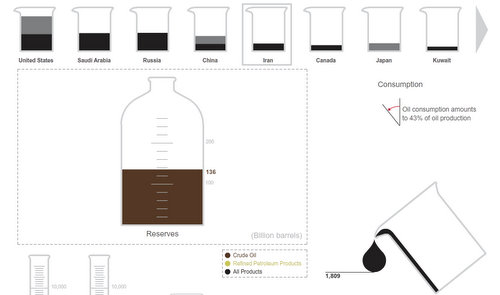
5. Very cool interactive graphic - Forbes has produced this great interactive graphic showing how much oil is produced, reserved and consumed by countries. It shows perfectly the huge imbalances in the world economy. Click on the chart or this link to get the graphic.
5. Debt pyramid scheme - Roger Lowenstein writes at Bloomberg how the debt pyramid scheme is now the norm in America. He makes the point that income tax cuts don't necessarily boost the economy. The key is whether the budget is balanced at the time of the cuts. A lesson for New Zealand perhaps?
Republicans claim that higher taxes translate to lower growth. Recent evidence is to the contrary. In the 1990s, the top tax rate was 39.6 percent. The U.S. enjoyed a booming economy, warmed by the balmy breezes of a balanced budget. In the 2000s, George W. Bush cut the top rate to 35 percent. Deficits ballooned, and the economy was mostly lousy.
Going back further, the connection is murky at best. In the 1960s, marginal tax rates were extremely high -- 70 percent and in some years even more. The economy roared. In the 1970s, taxes remained high and the economy slumped. In the 1980s, President Ronald Reagan slashed taxes: By 1988, the marginal rate was only 28 percent and the tax code was greatly simplified.
Clearly, those giant tax cuts, plus the elimination of many loopholes, stimulated a boom. Though that decade-by-decade synopsis inevitably simplifies, the evidence suggests tax rates should be as low as possible subject to the constraint that the budget IS roughly in balance in good times, and even in bad times avoids the risk of runaway deficits. But with the government borrowing equal to 9 percent of gross domestic product, and with large entitlement- spending increases looming, we are well into runaway territory already.
With the private sector recovering, albeit slowly, and public finances worsening, the time to restore our public finances to health is now. And if doing so delays the economy’s return to full and robust growth, then let the recovery come more slowly -- and let it be built on sound financing and not on a new pyramid of debt.

6. The dark heart of the American collapse - I'm going to Las Vegas in early January for a work conference with my wife, who exports digital designs through a US website. I'll be babysitting, but hope to have a look around. Here's a sneak preview from the Las Vegas Sun of what I might see.
A land of ghost suburbs and half finished eyesores on the desert. Should be fun.
Might go to a few open homes.

7. China's Finance Companies - Many are watching what is happening inside China's banking system very closely. Many are worried that bad loans are mounting up after an explosion of lending to dodgy property developments in 2009.
The government has cracked down on lending by banks, but may not be able to control the institutions outside the banking system that are still on the lending warpath. The Wall St Journal has the story.
China's government has traditionally used its control of the largely state-owned banking sector to regulate the country's pace of economic growth, directing it to pump out cheap credit in good times and restricting the volume of new loans to prevent overheating. But controlling credit has become more difficult as the financial system gets more sophisticated, analysts say, complicating Beijing's efforts to bring the economy in for a smooth landing in coming months.
China has a long history of gray-market financing flowing from small, informal and unregulated groups, to sectors not well covered by banks. A number of formally incorporated entities, including trust, leasing and guarantee companies, have also emerged, with the scope to provide alternative financing.
As banks labor under stricter limitations on how they can lend, they have been looking to trust companies in particular to trim their balance sheets and lessen their regulatory burden. In a report Fitch Ratings estimated that China's banks already have blown past the 7.5 trillion yuan ($1.126 trillion) limit that regulators set on new local currency lending for this year and extended more than three trillion yuan in credit that hasn't been recorded on their balance sheets.
"Lending has not moderated, it has merely found other channels," Fitch said in the report. That "helps explain why inflation and property prices are still stubbornly high, why [third-quarter] GDP growth was stronger than expected, and why Chinese authorities have voiced so much concern about further quantitative easing in the U.S."
This following bit is particularly alarming and looks a lot like our finance companies or the sub prime vehicles that exploded in America.
Trusts—which are investment vehicles unique to China with little in common with Western-style trust firms—enabled banks to stay below their loan quota by using an informal type of securitization to repackage bank loans as investment products.
With banks' deposit rates so low—at 2.5% for one year, the rate is below the level of inflation—banks had no trouble finding investors seeking a higher return.

8. The real worry in China - Further to this meme about the problems in China's banking system, here's a piece from Alan Abelson at Barrons reporting on comments from fund manager Harald Malmgren about China's banks.
He notes that while investors everywhere have been uneasily eyeing the rise of the inflation dragon in that nation and have anticipated that Beijing would hike interest rates to contain the beast, it hasn't. And the reason why it hasn't, he posits, is that profit margins for many Sino businesses are razor thin, and an abrupt rate boost would mean appreciably higher debt-service costs, really putting the kibosh on profits.
Despite all the global focus on inflation, Harald contends, the big challenge confronting China can be found in the nonperforming loan portfolios of its banks and kindred financial institutions. That enormous pile of deadbeat loans is the legacy of late 2008-2009, when exports dried up and the spooked rulers of the command economy ordered the banks to seriously step up their lending -- no ifs, ands or buts. The banks dutifully complied with an awesome $1 trillion in fresh lending.
Much of that huge mountain of loans has fallen into the nonperforming category, which translates from the polite banking parlance into delinquency, big time. To avoid a financial meltdown, Harald expects, Beijing will raise capital-adequacy requirements substantially during the first few months of 2011, conceivably in incremental steps to cushion the pain. Since he anticipates Chinese banks will have trouble raising capital, he expects a large-scale shrinkage in lending.
Chinese banks, he emphasizes, aren't suffering from insufficient liquidity. Rather, he warns, the danger to the country's banking system is insolvency. In the current lineup of problem banks around the world, he would rank Chinese banks as the most troubled, with European banks next, followed by U.S. banks and Japanese banks probably holding down fourth place.

9. The end of consumerism - John McCrone at The Press has written this nice summary of the thesis that peak oil and growing population will force the global economy to slow consumption growth. Here's the detail. It's well worth a read.
A change is about to be forced on society because energy consumption pretty much is the economy. And we are about to run short of the cheap energy which has been driving the past century of unchecked economic expansion. There is this myth going round, says Krumdieck, that with every decade we have grown wealthier because we have collectively become smarter and more productive. If everything is bigger, better, brighter, well, it has been earned.
Yet actually we have just been digging up and burning more fossil fuel. Graph the world's energy consumption against its gross domestic product (GDP) and the two lines track. So get down to the nitty gritty and this is what it has all been about. Converting oil or coal into shoes, hamburgers, cellphones and SUVs.
However, a reckoning is coming. The ecological limits on growth have come into view. Climate change and over- population. But peak oil most immediately.
Totally last Jon Stewart video of the year - He is angry. Fair enough. America is descending deeper into a plutocratic state and few there seem to care or know.
| The Daily Show With Jon Stewart | Mon - Thurs 11p / 10c | |||
| Worst Responders | ||||
|
||||
And this is Jon Stewart doing some journalism that no one else in America seems to be doing.
| The Daily Show With Jon Stewart | Mon - Thurs 11p / 10c | |||
| 9/11 First Responders React to the Senate Filibuster | ||||
|
||||
61 Comments
"Britain's public borrowing hit a shocking new record as Government spending surged in November, sounding alarm bells .....Public sector net borrowing jumped to £23.3bn in November ...IHS Global Insight, said the figures were "truly horrible"....
So NZ wasn't alone in it's 'shock' November pubilc debt blowout. The difference is: "We're not worried..."!
So much has been said about China and nothing ever happens. It just keeps going.
A lot was said about finance companies in New Zealand too . . and nothing happened . . . until one day a long long time ago.
The thing i do not understand is with all the debt, there must be some people who are owed a lot of money - are they really happy?
I was worried as early as March 2005 about finance companies. They didn't start falling like flies until mid 2008.
cheers
Bernard
That's true of many economies Michael....there is little left to do for others but......keep going.
However...China will experience the downside of greed and corruption.....and I believe it will have a detrimental effect on their economy....big enough to send a global shockwave......either through the CPPCC 's desire to regain control of an economy expanding too fast.......or what may be uncovered during that process.
There are interests at work on a daily basis to destabilise the internal political structure....and feeding the greed....seems to be working.
Make no mistake the fact that the regime has gone public and announced it's need to tighten the grip....understates the gravity with which they view the matter.
If history is a guide.....they will seek at some point to lock it down ...before they "clean it up"
The alternatives to the inevitable clash with the "Free Market" are a much more dire proposition.
I agree with you on the greed and corrupton story.
Bernard, Bernard, Bernard. Our fractional reserve crony capitalist banking system: that is no part of a free market. Only under crony capitalism can these banks create monopolies that would not exist under laissez faire. Many of the banks you report on in (1) should not be there at all, still, as the bailouts in the US would never have happened, would they, if that were a free market.
To make a statement such as you do here, you need to understand what a free market is surely?
But, back at ya. I reckon regulation in NZ in destroying our sharemarket, and innovation. Why? Because I don't believe a company like Twitter, which we both rely on and use constantly, could ever get off the ground here:
http://tribelesshispursuitofhappiness.blogspot.com/2010/12/over-regulat…
Hey, you have a good Christmas.
Tribeless,
Many thanks for rising to the bait ;)
If only markets were truly free we might be alright. But the big players can't help themselves from trying to buy protection or markets, and screw the scrum.
That's why you need a strong referee able to blow the whistle and send people.
Have a good Christmas too.
cheers
Bernard
The stock-standard laissez-faire riposte (...it didn't work because it wasn't a truly free market, not because of lack of regulation...).
you need to understand what a free market is surely?
Tribeless I haven't read your blog, but please educate us by pointing to an example of a functioning "free-market", where laissez-faire is working.
Thanks + Merry Christmas, neco
Um, there is no functioning free market anywhere: that is the point of just about every blog post I make (if you did care to read them).
OK so wrt you need to understand what a free market is
I'm thinking free market = symmetrical information available to all participants, immune to manipulation etc. etc.
But: no functioning free market anywhere
So maybe it doesn't exist because it CAN'T exist (human nature = greed = manipulation etc. etc.) in which case I really can't see the point of laissez-faire.
Cheers + over 'n out, neco
Moreover because information is expensive (asymmetrically), inaccurate, and mostly not even real, a free market is, at best, a vague approximation.
I don't think Tribeless has to demonstrate that a free market is possible, or that a market will deliver a perfect outcome even though it is inevitably imperfect. He has only to demonstrate that it will deliver a better outcome than a Government regulator or a state monopoly, and there is plenty of evidence for that.
I don't think Tribeless has to demonstrate that a free market is possible, or that a market will deliver a perfect outcome even though it is inevitably imperfect. He has only to demonstrate that it will deliver a better outcome than a Government regulator or a state monopoly, and there is plenty of evidence for that.
Check the company failures we've had in the past. There's been a few.
All about government regulation? Or unrestrained greed and criminality?
http://www.teara.govt.nz/en/business-failures-and-corporate-fraud/4
The last 10 years proved the Manhattan bankers, investment bankers and property financiers can't be trusted.
They had a party and blew up the world for short term gains.
Now comes the reaction.
Fair enough.
cheers
Bernard
By the way, the angriest people over the big bailouts, were the bankers all over the USA who had stuck to honest banking and were looking forward to the wreckers of their sector being cleaned out. Instead, a whole new layer of moral hazard has been created, to such an extent that I now doubt that the free market West is going to survive. Honest banking, honest "anything", is now a mug's game.
You are quite right about "reaction" setting in. But I presume that doesn't mean you think the reaction is going to be any better than the initial problem.
I would put the same question to you that I have to someone else on here; what makes you so sure that if the USA's Finance Sector had been entirely government run, anything would have been different? Having a totalitarian State hasn't stopped China from having a runaway bubble, has it?
In the almost total absence of correct analysis on the part of government officials from Greenspan down, what gives anyone any justification for saying that a whole bunch of government bureaucrats in total control, would have ensured better outcomes? In fact, all these people made the same false assumptions as the Wall Street wide boys - "property prices can never fall".
Do you reckon that leaving "Smart Growth" Urban Planning untouched, as the politicians and bureaucrats are doing, is a sign of intelligent leadership? Do you understand what I have said on other threads about "Spatial Distribution of Density" and the reasons that "Smart Growth" doesn't even bring its claimed BENEFITS let alone enough benefits to offset unaffordable housing and speculative bubbles?
The recent bureaucratic mush condemned by Hugh Pavletich got an initial point right; cities are central to economies. The rest of the document just perpetuated the economic illiteracy of the urban planning profession.
In a just world, US economic policy would now be getting made by the people who almost to a man, did pick the bubble - the Austrian economists. And Wendell Cox / Peter Gordon / Randall O'Toole et al would be in charge of a massive overhaul of urban planning policy.
"By the way, the angriest people over the big bailouts, were the bankers all over the USA who missed out on the big bailouts."
Fixed that for you.
No no, that's okay, you're most welcome.
How can you ever hope to have a truly free market? I know its stupid to compare ourselves to America, but in their case you've got the highest instution in the country, the government, distorting the market with massive bailouts so that inefficient banks can continue to carry on they same way they always have and destabilise the financial systems of the entire world.
Would anyone suggest that the government appoints a regulator to regulate themselves? Sounds like something Kim Jong Ill would do, and then promptly execute all the regulators if they disagreed with him.
Seems like the problem is more to do with a too greater concentration of money and power and a few of the piggies at the top getting very very greedy.
“I don't believe a company like Twitter, which we both rely on and use constantly, could ever get off the ground here”
That is an absurd statement. There is no infrastructure or capital reason why companies like Twitter couldn’t be both incubated and thrive here in New Zeeland. The reason why Twitter, Google, et al. isn’t here is because Kiwi’s have a very myopic world view and are too risk adverse to spend the money.
Where is the seed funding and angel investors? I hear, ad nauseum, that New Zealand is too small for any angle investing to work here. That is the lamest excuse I have ever heard. Just because there are only 4-5 million people here isn’t a legitimate excuse to not man up and innovate. If you want to innovate, truly innovate, you need to drag Kiwi’s into he future kicking and screaming.
The only way to do that is to create the market from scratch and show them it’s something they want. Stop playing the “wait and see” game. Sure there is money to be made in waiting and see how innovation works overseas then applying it here, but you will never innovate that way. True innovation requires people to put thieve money where their mouth is.
True innovation also requires access to funding: that was the point of my blog post (which you obviously never read before calling it absurd).
Mark - I think you are wasting a lot of positive energy, trying to convince good people not to think bad about bad people increasingly running the world.
I understood just fine. I took umbrage with the point that somehow Kiwi’s are genetically unable to innovate. Twitter isn’t that mind-blowing an idea…now Word Lens is truly a fantastic idea. And there is no reason idea like that could not be fostered here. In fact, engineering talent is relatively cheap here and they speak English. Also, there is plenty of funding and plenty of ideas, what is missing is the connection of the two. Kiwi’s are determined to get it done by themselves because it tells a better story. So stop watching the World’s Fastest Indian and ask for help already!! New Zealand is no longer a bit player.
Here is an idea…I’ll give it to you for free. How about you start a no loss saving account that marries micro-lending and bonus bonds . Kiwis can place their “savings” in a non-interest bearing account which they then micro-lend to ideas they want to see developed. Think of it like” i-predict” on steroids. You can even call it “i-angel”. People submit their ideas and the amount they would need for angel investing. The ideas that get approved give 60% of the company back to the I-angel community so the ones that success (1 out of 10 on average) the proceeds will then be split up to the ones who invest in the idea while simultaneously subsidizing the 9 ideas that fail.
re 9 - that's what I've been sayin'. Well put, a 'must read' for all the 'no limits' brigade here.
If there's a feeling I take from this year, it's the inability of a certain section to accept facts when presented, and their ability to just repeat their cherry-picked figures/places, mantra, unchangingly.
Like Texas - note the correlation with plentiful energy.
It's probably too late for society to change en masse now - the debt is actually the overshoot, and I don't see anyone with any answers, not even Merkel (who knew it was coming), nor do I see the cornucopians acknowledging it any time soon. And we have a Minister of Economic Development currently in a situation not dissimilar to that which Nixon found himself - hardly looking like a credible Pied Piper.
It may be that existing outfits like the Greens, are hamstrung by the very system they know to be flawed, and that it will take a collapse to allow the construction of a sustainable order.
Sad indictment on humanity, I reckon.
Still, maybe we could consult multiple mediums - "Is there anybody out there?"
PDK...said...." Sad indictment on humanity, I reckon."
Humanity.... PDK is guilty as charged and due it's reckoning....an abstract view of the phrase
"take the good with the bad"
FYI Ernst and Young being sued for its performance as Auditor of Lehman Bros.
I wondered when the proverbial would eventually hit the spinning disk for EY on Lehman.
cheers
Enron became the epitaph on the grave-stone of Arthur Anderson. Once upon a time there were hundreds of small to medium sized auditing firms around the world. They progressively merged to become known as the "big six". The SEC caught Arthur Anderson with its thumb in Enron's pie, and they became 5. Now in 2010 it's the "big four". Will Lehmans become the epitaph on Ernst&Young's gravestone. Will the big 4 become the big 3
US city and state debt markets are in turmoil. Bankruptcy seems likely for some
http://www.creditwritedowns.com/2010/12/muni-bond-crisis-what-kind-of-numbers-are-we-talking.html
cheers
Bernard
Two Hindenburg omens..and the baltic Dry under 2000...The Sharemarket taking off to the sound of sleighbells.Good luck!!
Bernard, your footy analagy is bang on. I used to ref the game at rep level and coaches always spent countless hours with their players on how to get around the laws to get a competitive advantage. The IRB was constantly trying to regulate this with clarification rulings, new laws to address the problems, and the like. Basic problem has never gone away though- how best to cheat to gain the edge, and yes, a strong ref always was needed.
Sounds like the whole financial scenario!
Why the European debt solution won't work, according to Brian Yelvington
"This latest band-aid solution obfuscates the issue that the EMU needs the ability to print money and tax across member states in order to match its common central bank and currency. There might well be a rally in spreads commensurate with what we have seen for other band-aid like packages over the past two years. Once the measure has been revealed to be inadequate by the market, discussions around size will begin to emerge. Our view has been that the facility was flawed from the start and we believe that view has become more widely held during this most recent spread widening. Future upsize discussions will no doubt see the specter of haircuts raised again – this time more seriously – and this will serve to push sovereign spreads wider."
cheers
Overdrawn American cities could face financial collapse in 2011, defaulting on hundreds of billions of dollars of borrowings and derailing the US economic recovery. Nor are European cities safe – Florence, Barcelona, Madrid, Venice: all are in trouble. Wonderful Venice under water ???
http://www.guardian.co.uk/business/2010/dec/20/debt-crisis-threatens-us-cities
Small nations have to think small, but with bigger ideas - "100%NZpure Economy" in order to make real money for our future – the next generation.
One upside of the GFC is that it has spawned some crackingly chuckleable cartoons. The couple in the debt shark; brilliant!
Looks like 011 will open to a spate of bloodletting in Europe as the piigs are slaughtered by the bond market. Can't see the Germans exposing themselves. Pommy inflation will see rates rise. Bernanke bullshit will lead to QE3 by july. Beijing set to sing the benefits of less bling. Jewleya looking into a fiscal hole. Bill English busting a gut to catch up with the Piigs and prove NZ govt is just as stupid.
#1
http://www.youtube.com/watch?v=xa3wyaEe9vE
(old stuff now!)
Not a particularly good film...
But I do think the theme deserves more consideration.
It suggests that there is a fundamental disconnect between the 'actions of individuals' and their actions within the 'corporate workplace' i.e. that the regulatory framework may be much more important than we acknowledge (my interpretation).
I'm not excusing individuals...just trying to understand how it can be so.
"In the mid-1800s the corporation emerged as a legal "person." Imbued with a "personality" of pure self-interest, the next 100 years saw the corporation's rise to dominance."....
"To assess the "personality" of the corporate "person," a checklist is employed, using diagnostic criteria of the World Health Organization and the standard diagnostic tool of psychiatrists and psychologists. The operational principles of the corporation give it a highly anti-social "personality": it is self-interested, inherently amoral, callous and deceitful; it breaches social and legal standards to get its way; it does not suffer from guilt, yet it can mimic the human qualities of empathy, caring and altruism. . Concluding this point-by-point analysis, a disturbing diagnosis is delivered: the institutional embodiment of laissez-faire capitalism fully meets the diagnostic criteria of a "psychopath.""
http://www.thecorporation.com/index.cfm?page_id=312
I look at certain ex finance directors on the telly - they seem to have a fundamental disconnect between the actions of their company (a legal entity) and themselves - almost sociopathic...
or, in more populist terms.... the corporation as in
http://www.youtube.com/watch?v=WZEJ4OJTgg8&feature=related
Daleks scared me more....
Bernard,
Make sure you have a look around the nice parts of Vegas too while you're there, it's an amazing place. It would be a shame to completely ignore all the (tacky) splendor there whilst spending all your time nosing around derelict building complexes and ugly housing suberbs.
Mark,
Cheers. Will be spending some time on the strip (but not the strippers).
My aim is to have as much fun as possible without spending any money.
cheers
Bernard
If you get the chance, check out who is right on the following:
Was Las Vegas a counter-example to the rule that there was no bubble without urban growth boundaries (or proxies for the same); OR were the same conditions introduced without Las Vagas itself having growth boundaries, by the fact that the Federal Government owns most of the surrounding land and the process of selling it tends to be "inflationary"?
iPhone wholesale price US$179. NZ iPhone4 RRP NZ$1123. Nice mark-up. Not unusual for many electronic goods in NZ.
i've been away but did i miss all the discussion on the Nat's plan to privatise ACC?
in tribeless' utopian ideal universe this might work, but it will be a complete disaster. R.Hide said the case for privatisation is "undeniable"
that's all the reason you need right?
On ACC, I believe that the constituency for a State-run monopoly, is a ideologically driven sector of politics who are knee-jerk anti-free enterprise. I believe that only a miniscule fraction of people who actually have to DEAL with ACC as a monopoly "service provider", would regard it as even remotely acceptable in its performance or non-performance.
It is doubly ironic that leftwingers agonised over the possibility that somewhere, sometime, a free enterprise MIGHT become a monopoly and rip people off; and THEY themselves are responsible for very much worse. In fact, monopolies protected by the State, ARE nearly 100% of all monopolies in history, and they are far worse than any free enterprise monopoly in that they never NEEDED to provide a fair product or service at a fair price AT ANY TIME, so as to achieve a position of power in the market.
Matt Ridley, in his latest book "The Rational Optimist", points out that ALL the so called "robber barons" in economic history, made money by making a product or service CHEAPER AND CHEAPER. ALCOA got prosecuted by the US Government for "monopolistic behaviour" because they continually lowered prices so fast that no competitors could get established. Seeing I possess a shred of moral sense, I agree that Ayn Rand was right to be one very, very angry writer about this point (while I disagree completely with the objectivist libertarian condemnation of all "altruism" per se).
It is actually fair to say that most of the most hated "robber barons" actually did some of the greatest EVER work in advancing the state of humanity; FAR more than any touchy feely liberal politician ever did. Bill Gates' PROFIT-making activities have provided MANY TIMES as much benefit for humanity as his charitable activities, as Matt Ridley patiently explained to him in the Wall Street Journal recently.
Actually, liberal left wing politics have been a substantial net curse for humanity. Even the criticisms that are being made about the financial sector today, are misguided to the extent that the role of "big government" is being ignored. I would go as far as to say that having the government running "finance" would have made NO DIFFERENCE AT ALL in the bubble and the crash that has occurred. The Chinese Communist Party rigidly controls every aspect of their economy, and THEY have engineered a similar, possibly even WORSE property bubble; that will possibly end in an even more calamitous crash.
Who saw the bubble and recommended the right policies to forestall it? Back in, say, 2003? Which Reserve Bank officials? Which Treasury officials? Which politicians? Which SEC regulators? (Who is aware that the number of financial system regulators ballooned during the period 1997-2006?). Which Government Sponsored Enterprises (or SOE's)? If there was any honesty at all in politics, the running of the world's various important economies would now have been turned over to "Austrian Economists", not Keynesians. "Big government" conceits have only let us down so far, and WILL get us into an even bigger mess. That I can promise you. Snap out of it, Bernard.
my vote is for William K Black's take rather than the tribeless / Mark Hubbard view
http://www.huffingtonpost.com/william-k-black/congress-threatens-to-sow_b_799016.html
UN evacuated because the cellar filled up with sewage.....no dunnies it would seem....haha.
I didn't realise that contractors from India had built the UN.
Reading your posting Philbest, seem to detect you are fairly ideological also. Ideologues, be thet left or right, are dangerous as they are so convinced their ideology is so correct. No better than religious fundamentalists. Spare me!
Accusing someone of being "ideological" is a typical ploy of people who cannot face basic historical proof. I defy anyone to disprove anything I say above about the actual historical facts, including the recent ones.
Tribeless at 9.22AM, touches on the same point as I touch on above.
The "Austrian" economists who see monopoly fractional reserve banking as "the problem", happen to have to a man, identified the bubble, while NO Keynesian or "statist" of ANY description did. As for the regulators, a tiny minority of them saw it and were stifled by their own superiors. Contrast this with "Austrian economics" experts, Peter Schiff for example. I have posted a long list of names on here before, it is not just a "lucky 1 or 2".
The idea of an international "gold standard" is actually starting to get discussed in mainstream circles today, because it is becoming more and more obvious that "more of the same" isn't working and never will.
I repeat what I said, there is NO EVIDENCE that government-run finance would have made 1999 - 2007 ANY DIFFERENT to what it was. There is every ground for me to believe that the government interferences to "fix" the mess "created by the untrammeled (bullcrap) private sector, IS going to be far worse than just "letting it alone" would have been. If Reagan had been President, or Jefferson, for example, the finance sector would have been given a swift middle finger and made to sit down and thrash out their own salvation - involving some unpalatable mergers and takeovers and job losses and many bonus-free years. Even if the finance sector wide boys KNOW that there IS a "tough love" solution, OFCOURSE they will try their luck with conceited, hubristic politicians so as to extract themselves at the pain of the taxpayer instead of themselves.
Reagan DID this during his term, we heard all this stuff before, about systemic risk and so on. Reagan called their bluff. George W. did not, neither has Barack Hussein. The mess we are NOW in, is because the political interference has not solved anything, and has rather introduced new layers of problems. The aftermath of Reagan calling their bluff, was by contrast the beginning of a log period of sustained real economic growth, with the finance sector wide boys sadder and wiser.
Can usually spot ideologues (and fundamentalists of any persuasion) by the certainty that their postulating is incredibly accurate, they tend to use fairly emotive language, somtimes with EMPHASIS and can get pretty annoyed with anyone who doesn't get what they so clearly see as the simple 'truth of the matter'
Regarding #2 American bug businesses where the majority of profits go overseas.
Actually isn't this what futurists deamed of fifty years ago; where man would sit around and do what recreation he wanted to while robots did all the meanial work, and everyone would be happy. Except instead of robots we found the Chinese. Except instead of recreation it's called unemployment.
And yes, they forgot the biggest chunk of all, the $500 that goes to the NZ importer for the phone.
Regarding #5, the link for the interactive graphic is broken; chop off the bit before www.forbes...
Regarding #9, the end of consumerism.
Remember that as someone put it, land is the catalyst for turning oil into food. Many people think no further than expensive oil meaning paying more at the fuel pumps. Well take a look at the prices of food in the supermarket. The question is, how does one best adapt/survive given that there may well be systemic failure - banks, financial institutions, governments, infrastructure and societal collapse?
Also re 9: I finally got round to reading James Howard Kunstler's The Long Emergency. Written in 2005, it could've been yesterday (he was picking the GFC and associated bubbles back then too, PhilBest). Interestingly, he paints a picture of Las Vegas not too dissimilar from the one you have posted here, Bernard. I wouldn't be in any rush to buy land there - no matter how cheap - the area only developed in the first place due to cheap oil; it won't stand a chance once oil is in short supply.
Oh, to see Peak Oil become a serious subject for discussion in 2011; perhaps even an Election issue - there is such a short window of opportunity to prepare even slightly; our children will despise us if we sit back and do nothing.
Quote: "Actually isn't this what futurists deamed of fifty years ago; where man would sit around and do what recreation he wanted to while robots did all the meanial work, and everyone would be happy. Except instead of robots we found the Chinese. Except instead of recreation it's called unemployment."
Just to quote myself, and update :-) it seems they're still busy designing robots aimed at replacing basic labour. This one is going to be cheap, perhaps only US$5K.
http://www.boston.com/business/technology/articles/2010/12/06/heartland…
Probably not relevant now I think about it as we're not a manufacturing country but follow a more 'enlightened', debt fueled consumption path... :-/
Bernard, you are obviously bearish about China...Have you got any predictions on China's downfall?? We all know you made the 30% prediction for NZ, and must be harbouring thoughts about how one day you will be proved right god damnit...but come on mate - have a go at China!
Chinese bank problems in 2011.
Economic slowdown in 2012.
Slide in iron ore and coal prices.
Australian economic slump in 2012.
Australian housing slump in 2012.
But who knows...
Predictions a mug's game ;)
cheers
Bernard
Prediction's a mug game , Bernard ? After that hair cut , you've got a bigger mug than we thought .
But did you getcha 15 % decline in NZ house prices this year ?
[ we'll politely gloss over Gummie's January prediction that Goldmoney Sacks stock ( GS ) would surpass $US 250 / share by end of 2010 ,........ ahem ! ]
Prediction that the NZ economy will get another negative GDP figure , putting the country in a recession ?
Pongo is correct , that Alan Bollard's decision to raise interest rates is lookig pretty stupid now . And as I recall one BH called for even higher rates , and Les Rudd argued against the rate rises ........ Hmmmmmmmmm !
...... . Here in the Philippines , there is no political correctness ( murdering your election opponents is de riguer ) , so it is safe to wish one and all Merry Christovmas !
Here's why the European Financial Crisis is far from over. It's a fully fledged banking crisis in Ireland that is threatening to spread.
Allied Irish Banks' (ALBK.I) junior bondholders will have to take a big hit in a future restructuring, the European Commission warned on Tuesday as it rubber-stamped billions of euros in state aid for Irish banks.
Brussels' threat triggered a fall in Irish sovereign debt, stoking fears the continuing financial crisis means more pain, including the spectre of forced discounts for investors, despite an 85 billion euro ($112 billion) EU/IMF bailout.
And another reason why a European banking crisis is not out of the question sometime soon...
European banks currently have an estimated funding gap of about $500bn, which means they have to raise this amount from the markets to fund dollar loans, meet swap arrangements and pay for trading book transactions that require the US currency. The dollar funding gap was estimated at more than $1,000bn at the time of Lehman’s bankruptcy.
The Institute of International Finance, which represents more than 400 financial services groups around the world, warned in a report last week that some European banks appeared to be facing dollar funding pressures…
cheers
Bernard
Oh and another thing regarding the end of consumerism. When the energy crisis really takes hold we will have to make do with what we have now. No buying more stuff. Think about that. It means the computer you are using now will have to last indefinitely. The phone you are using now will have to last indefinitely. Anything electronic will have to last indefinitely. Think about how long the battery in your phone will last; 2-3 years? How about your PC? With the dodgy capacitors resulting from incorrect electrolyte and other manufacturing short-cuts, it's unlikely the motherboard alone will last more than a few years. What about infrastructure, telecommunications and the like, and reliable power supplies? Well, at best, when used in standby mode a lead-acid battery will last maybe five years. If it's discharged regularly it's lasts nowhere near as long. What about all the low quality junk product we buy these days that will simply not last; the microwaves that fail shortly after their two year warrantee expires, or the ignition pack in your car. When systems break down these will no longer be available. New Zealand is incredibly reliant on other countries for all these products, and soon we will really be at the end of the supply chain.
By the way, the angriest people over the big bailouts, were bankers who had stuck to honest banking and were looking forward to the wreckers of their sector being cleaned out. Instead, a whole new layer of moral hazard has been created, to such an extent that I now doubt that the free market West is going to survive. Honest banking, honest "anything", is now a mug's game.
FYI from Ambrose at The Torygraph
Citigroup has warned of a fresh wave of bank failures and sovereign defaults in Europe unless EU leaders come up with a credible response to the crisis.Prof Willem Buiter, the bank's chief economist, said the eurozone was paralysed by a "game of chicken" between the European Central Bank and EMU governments.
No:6
Bernard, You will find loads of whole EMPTY suburbs fenced off by the US banks and private security guards on patrol. Like some huge movie set
Mark Twain had it all sorted:
" Make predictions - but never about the future "
'Mark Twain had it all sorted'
Yes, on reading publication of his death notice, he said 'indications of my death have been greatly exaggerated' and this might be an analogy for those who curently predict our demise!
We welcome your comments below. If you are not already registered, please register to comment
Remember we welcome robust, respectful and insightful debate. We don't welcome abusive or defamatory comments and will de-register those repeatedly making such comments. Our current comment policy is here.