
Bernard Hickey details the 6th chart in our Top 10 charts for 2010 in association with Bank of New Zealand.
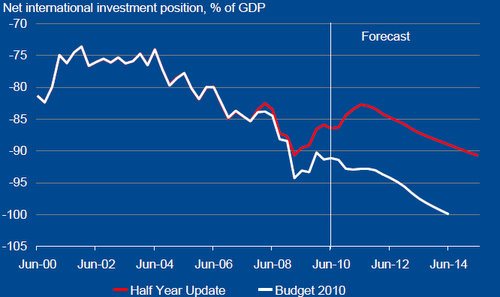
This chart from Finance Minister Bill English's presentation of the government's fiscal and economic update on December 14 shows New Zealand's net international investment position improved significantly between the May budget and the December half year update.
The net international investment position measures a bunch of things and wobbles around a lot.
It includes the value New Zealand owned assets overseas, New Zealand lendings overseas, foreign owned assets in New Zealand and foreign lending into New Zealand. It includes both private and publicly owned assets and debt.
The net position improved in New Zealand dollar terms in part because the value of New Zealand owned assets overseas rose (particularly in Australia) because the New Zealand dollar fell to a 10 year low vs the Australian dollar.
Also, the foreign owned banks booked much lower net profits and repaid fewer dividends over the last year because of a big win for the Inland Revenue Department in a series of court cases.
Slower economic growth also softened demand for imports and stronger commodity prices boosted export returns.
Also, weaker profits from other foreign owned companies, because of the weaker economy, reduced the outflow of dividends.
However, this improvement is seen as temporary before New Zealand's national savings problem eventually starts driving the debt up again as a percentage of GDP to over 90% again, putting New Zealand in the same vulnerable position as Greece, Ireland and Portugal.
This is not as bad as forecast in May because of the factors mentioned above, the long term trend is disturbing for foreign investors.
New Zealand may not have the same government debt problem as these three PIGs countries do, although it's notable that neither did Ireland in 2008 before the Global Financial Crisis. Ireland's mistake was to guarantee its banks, which then collapsed and forced the Irish government to take on much more debt because of it.
New Zealand also guaranteed its banks and finance companies. Luckily for the government, the banks have not collapsed, although the collapse of the guaranteed finance companies has already cost more than NZ$2 billion.
We welcome your comments below. If you are not already registered, please register to comment
Remember we welcome robust, respectful and insightful debate. We don't welcome abusive or defamatory comments and will de-register those repeatedly making such comments. Our current comment policy is here.