

Here are my Top 10 links from around the Internet at 10 past 3 pm, brought to you in association with New Zealand Mint for your reading pleasure.
I welcome your additions and comments below, or please send suggestions for tomorrow's Top 10 at 10 via email to bernard.hickey@interest.co.nz.
I'll pop any surplus suggestions I get into the comment stream.

1. The problem with Egypt - The world's markets woke up last night to the civil unrest in Egypt and the uncertainties that generates. Reuters reports the Dow suffered its biggest one day loss in 6 months.
The market drop ended the Dow's eight-week winning streak and pushed the S&P 500 below its 14-day moving average for the first time in two months. Disappointing results from Amazon.com and Ford further added to the gloom. Developments in the Middle East could be a trigger for investors to sell at a time when many expected a correction after a market rally of about 18 percent since September.
"I think the next two to three weeks, the crisis in Egypt and potentially across the Middle East, might be an excuse for a big selloff of 5 to 10 percent," said Keith Wirtz, president and chief investment officer at Fifth Third Asset Management in Cincinnati, Ohio.
2. Yet still Helicopter Ben is tipping the money out the door - Reuters reports America's economy grew at an annual rate of 3.2% in the December quarter, driven by a rebound in consumer spending and exports. But the problem is it's a somewhat jobless recovery. Corporates remain cash rich and reluctant to invest in creating American jobs. Instead they are investing overseas in markets with cheaper labour and stronger economies.
So America keeps printing money, flooding the engine. That petrol is now spilling out the sides and sparking inflation fires in emerging economies.
Part of the reason for the civil unrest that is sweeping places such as Tunisia, Yemen and Egypt is the sharp rise in commodity and food prices in recent months.
Even with growth quickening, progress reducing unemployment has been painfully slow, and the report is little comfort for the millions of unemployed Americans, or for U.S. central bank officials on a jobs-creation vigil.
On Wednesday, Fed officials voiced concern the pace of the recovery was still not strong enough to significantly lower unemployment and reiterated a commitment to a $600 billion stimulus effort through the purchase of government bonds. Businesses have been hesitant to hire but have used their vast cash reserves for investments, and spending on equipment and software notched a seventh straight quarterly gain.
3. America's budget deficit - If John Key thinks we have problem, then it's nowhere near as bad as the one in America where Congressional Budget Office has forecast a deficit of 9.8% of GDP or US$1.5 trillion this year, BBC reported.
It warned that its forecasts assumed Congress would not pass further legislation that adds more to the deficit, something that has not been borne out in recent history.
"[The forecasts] understate the budget deficits that would occur if many policies currently in place were continued, rather than allowed to expire as scheduled under current law." Even if these assumptions turn out to be correct, the CBO said US government debt would rise from the current 62% to 77% of economic output by 2021.
And with interest rates likely to rise as the economy recovers, the Office said the cost to US taxpayers of the interest payments on that debt was "poised to skyrocket over the next decade" from 1.5% to 3.3% of output.
The budget watchdog also reiterated its concern that the outlook beyond 2021 for public finances remained unhealthy. "The ageing of the population and rising costs for healthcare will push federal spending as a percentage of [gross domestic product] well above that in recent decades," the report said.
4. Why America seems broken - Here's how ugly the health system in America is. A Vietnam veteran with cancer lost his insurance coverage after his wife accidentally underpaid a premium online by 2 cents, which mean he was bumped off the list for a life saving transplant.
This is obviously a story of an adminstrative cockup, bit it tells you a lot about how America operates on the ground.
The guy's biopsy was about to start, but was cancelled when the nurse received a phone call to say he wasn't insured. ABC News has the story. The veteran was reinstated when the media found out. HT Troy via email.
Doctors at Presbyterian/St. Luke's Medical Center in Denver, where Ron Flanagan was undergoing treatment, had a stem cell donor at the ready and had told Flanagan they needed to complete the transplant before the end of February, that was before he lost his insurance.
As of today Flanagan is trying to get back on the transplant list. Flanagan was at the hospital preparing for a bone biopsy when his wife orignally delivered the disappointing news.
"The nurses were just getting ready to do the biopsy when my wife popped into the office and told them, 'Stop. We don't have any insurance,'" Flanagan told KMGH.
Ceridian's First Statement In a written statement to KMGH prior to be contacted by ABC News, Ceridian said, "We did not receive a full and timely payment and [Mrs. Flanagan] was provided several notices of the shortage and a grace period reminder notice on the last invoice, along with extended grace dates as provided for under COBRA regulations.
"Since the payment was not full," the statement continues, "it fit into the definition in the regulations of an 'insufficient payment.' ... Ceridian understands nothing is more important than one's health. ... Unfortunately, we simply do not have the capacity to be able to personally call continuants and remind them of the status of their Cobra benefits."
5. When the props are pulled out - The big problem with the immediate response to the Global Financial Crisis was that all that was needed was a few props, a bit of time, some band aids and then everything would come right. Governments jumped in to fill the hole created by the collapse of housing markets and the pain from too much debt.
Reality hits home and the inevitable contraction comes when the government either chooses or is forced to stop pumping fresh public money into the hole. British consumer confidence has collapsed in the last month as the realisation of the new government's austerity plan hits home. Britain has also just increased its GST (VAT) rate.
When the government spending is pulled back there is no 'natural' replacement. So values and economies have to subside to repair. It's impossible to trick away or delay the debt. If it's too high, eventually it will get you.
Unless you either choose to restructure or inflate it away...America is trying to inflate away their debt using the monetary weapon of mass destruction they have at their disposal -- the power to print the world's reserve currency.
The only problem with printing money to reduce the real value of debt is the inflation can lead to higher interest rates, which makes servicing the debt difficult.
Even the US Federal Reserve can't keep long term interest rates low forever. Although the Japanese have tried for 20 years. Japan did get another credit rating downgrade this week...
The first taste of the fiscal tightening to have a widespread impact on consumers appeared to have hit sentiment hard, researchers said, even before the full impact of the public spending cuts is felt. "In the 35 years since the index began, confidence has only slumped this much on six occasions, the last being in the midst of the 1992 recession," said Nick Moon, managing director at GfK NOP Social Research.
"Today's figures, when combined with the bleak economic forecast, will make talk of a double-dip recession unavoidable."

6. How not to do a PPP - Prime Minister John Key again mentioned in passing this week the idea of public private partnerships where private money is used to build public infrastructure such as roads and schools and hospital. The asset is built and operated by the private sector and then leased back to the government. In Britain they are called Private Finance Initiatives.
Now the Telegraph (of all papers) is running a series of articles about how PFIs have delivered super profits to private companies and their owners at the taxpayers expense. This has been an issue in Australia too where the Macquarie Millionaires have done well out of the PPPs over the Tasman. HT Kokila via email.
The ski resort of Chamonix, dramatically overlooked by Mont Blanc, is not quite the most expensive in the Alps – but it keeps its end up. The flashiest restaurant, La Cabane, charges £19 for a starter and £33 for a main course. The best room in the top hotel, the Relais & Chateaux Albert the First, costs £420 a night. All this week, The Daily Telegraph has been exposing a different kind of spending – the amazing sums taken from the taxpayer under the Private Finance Initiative.
And all this week, eating in that restaurant and living in that hotel room, has been one of the principal beneficiaries. His name is David Metter. He is 58 years old. You have almost certainly never heard of him – he keeps an extremely low profile – but he has made his fortune, conservatively estimated at £60 million, out of you. Under the PFI, Innisfree and other private investors build and operate such facilities, then effectively rent them to the state – at a substantial premium.
The Daily Telegraph disclosed this week that for an NHS hospital in Bromley which cost £118 million to build, taxpayers will end up paying 10 times as much – £1.2 billion – to the PFI owners. It owns four-fifths of the PFI school in Clacton which has now closed – but for which taxpayers must still pay it £1.4 million a year, Innisfree’s share of the deal, until 2035.
It owns the Birmingham school where parents couldn’t start an after-hours club to keep their kids off the streets – because Innisfree charged £70 per hour for a caretaker. It had a 50 per cent stake in the calamitous Defence Animal Centre deal, where each dog kennel cost more per night than a five-star hotel room (though admittedly not as much as Mr Metter’s suite in Chamonix.)
7. That downgrade - Ambrose Evans Pritchard at the Telegraph writes about what the Japanese credit rating downgrade means for Britain and America, both of whom also have budget problems, bit debts and ageing populations.
The move is a chilly reminder that sovereign debt woes continue to fester across much of the industrial world, and still pose a threat to the fragile global recovery. The US rating agency cut Japan's $10.6 trillion (£6.6 trillion) debt one notch to AA-, warning that the mix of government paralysis, a shrinking workforce and a fast-rising interest burden have left the country's debt dynamics on an unsustainable footing.
Julian Jessop, from Capital Economics, said the unfolding drama in Tokyo has global implications since Japan is the world's top external creditor with $3 trillion of net assets abroad.
"This is potentially a much bigger story than any default in Greece," he said. The concern is that Japanese banks, pension funds and life insurers may forced to repatriate large sums to cover losses at home if the fiscal crisis triggers a jump in bond yields. This could set off a worldwide fall in asset prices. The Bank for International Settlements has warned that simmering fiscal problems in the rich countries are nearing "boiling point", with a risk of an "abrupt rise" in bond yields as investors choke on excess debt.

How is it one man's work for the year can generate value for himself worth US$5 billion in one year. How much value has this one man effectively skimmed, gamed and traded away off the work of millions of other people producing the goods and services underneath the debt and equity he owned?
Is this how capitalism should work?
The Wall Street Journal first reported Paulson's payout in its Friday edition, and investors familiar with Paulson's portfolios said the number is likely correct given the manager's asset size and his recent profitable bets on Citigroup (C.N) and gold. More generally, Paulson's eye-popping payday confirms that hedge funds are still Wall Street's gold mine, where hefty fees make hundreds of managers extremely rich.
But it also underscores concerns among investors that they may not always be getting their money's worth, especially when hedge fund returns lag behind the broader markets. For Paulson, who now ranks among the likes of Warren Buffett and Pimco's Bill Gross as the world's most closely watched investors, the payday comes after he reversed deep losses in his funds halfway through the year. And it may finally put to rest speculation that his investing prowess was limited to one lucky bet during the subprime era.

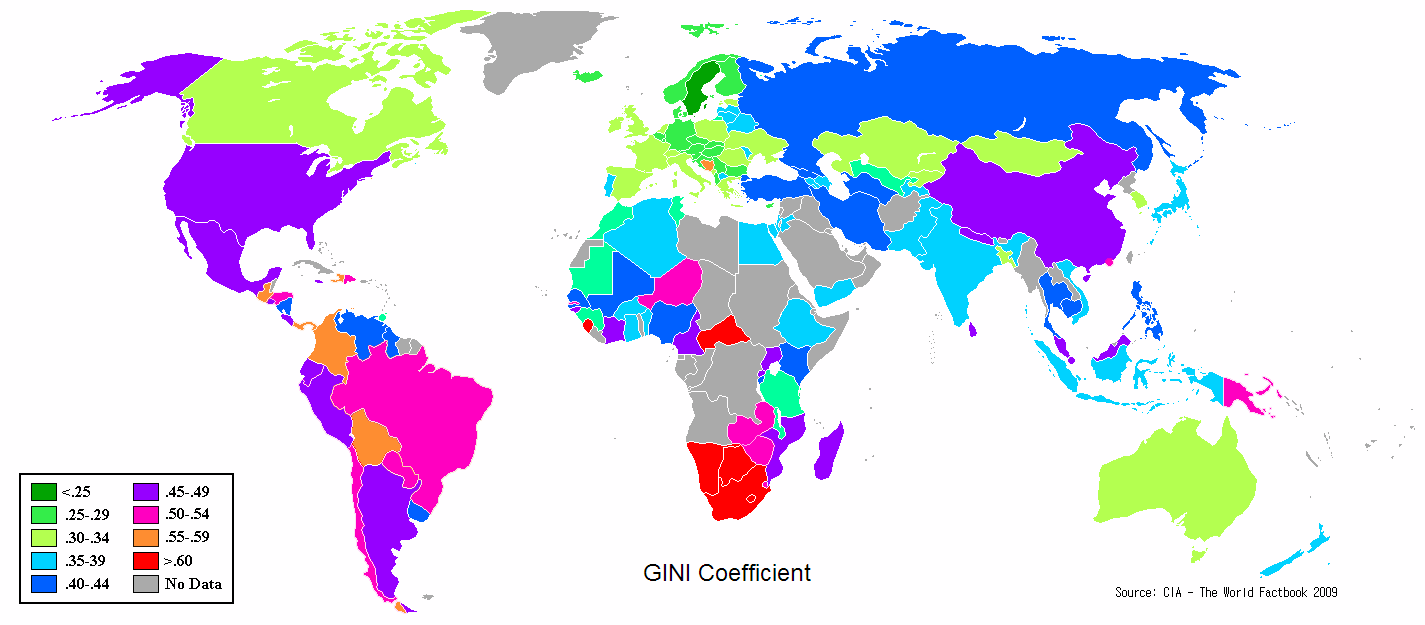
9. Inequality in America is worse than in Tunisia or Yemen or Egypt - Washington's Blog on Naked Capitalism points out America's record on equality, in particular its gini coefficient, which is the widely accepted measure of equality. New Zealand is less equal than Australia, but not as bad as America.
Egyptian, Tunisian and Yemeni protesters all say that inequality is one of the main reasons they’re protesting. However, the U.S. actually has much greater inequality than in any of those countries. Specifically, the “Gini Coefficient” – the figure economists use to measure inequality – is higher in the U.S.
So why are Egyptians rioting, while the Americans are complacent? Well, Americans – until recently – have been some of the wealthiest people in the world, with most having plenty of comforts (and/or entertainment) and more than enough to eat. But another reason is that – as Dan Ariely of Duke University and Michael I. Norton of Harvard Business School demonstrate – Americans consistently underestimate the amount of inequality in our nation.
10. Totally relevant video - Here's how to milk a cow Chinese style. Something for the workers at Crafars to watch... Not really.
But it sure made this son of a dairy farmer laugh harder than I have for a long time. I'm easily pleased.
68 Comments
Exactly!
"Deflation is a sign of economic activity, not inflation. Competition, innovation, productivity gains, capital expenditure, savings … all the things associated with economic progress and wealth are deflationary. Lower prices are a sign of a competitive economy that’s delivering more of what people want. Inflation is a sign of trouble. .... That’s why countries like Russia are implementing price controls to keep prices lower. If inflation were good, they’d be decreeing higher prices.
True Nicholas, but if a reserve bank lends $100 they charge interest so that the borrower has to pay more money than they have available to clear the debt.
This is inflationary and now you know who is milking the cow.
Yes; And we get back to the, ' but if the farmer borrowed the $100, plus $10 interest, and his cow produces enough 'new' milk to repay the $10 interest with a pail, then the debt can indeed be repaid ' , as long as the interest component is retired. But, it never is! ~ or hasn't been. That's why 'this time' it is different! It is an accummulation of all those 'no-retirements' coming home to roost. This time there is not enough milk in the barn, and the farmer has to sell his wife! To avoid that he will sell....his farm
I must agree Iain.
Nicholas, don't think of the fiat money supply growing in terms of the farmer sells his milk to the city and they pay the interest to the farmer, instead think of $100 being lent into existence as the total monetary supply in the economy.
$100 lent @ 5% interest means that $105 needs to be paid back and there is not $105 in existence so to cover the principal the borrower (the people in the city), need to go back to the bank who then prints $5 which is lent @ 5% interest and this creates an exponential curve of growth and profits for the bank.
The exponential growth curve initially looks manageable so people in the city don't complain for they have more money in circulation but as with all exponential curves this becomes more stressful to the people until we reach the point where we are at today in countries like America.
#8 - Is this how capitalism should work?
$5billion in income in one year?
Wow - I wonder what he paid in tax?
Which makes me wonder whether income tax should be set at 100% for say earnings of more than $1 billion per annum?
It's a crazy world.
Kate
It is strange and part of human nature, interestingly we not only tolerated these leeches but actually venerated them (Read Debra Hill-Cones latest in the <a href="http://www.nzherald.co.nz/business/news/article.cfm?c_id=3&objectid=107…">herald</a>) But when they make money on the downside or when the hoi polloi are suffering the true nature of the beast is realised, they are simply sociopathic greedy bastards that offer nothing to the world except targets for our envy
Neven
Yes an interesting read by Debra.
And your last line - well that certainly got me thinking;
New Testament (1 Timothy 6:10), "The love of money is the root of all evil"
Those guys that wrote the Bible sure were amazing.
I seem to remember something about throwing the money-lenders out of the temple.
Wrong..they were doing what JK did...buying and selling currencies. Nothing bad about that but they represented a great target. They were not the banks. There were so many variations of currency in a trading centre that without them bugger all trade would have happened.
The John Paulson story shows us how far from capitalism Bernard has moved his thinking . And that is sad . Paulson could have just as easily blown up the fund , and lost himself and his investors vast swathes of their money . You have to risk it , to make it . And some of these hedge fund managers ( George Soros for example ) have gambled losing many times their personal net worth .
.......... Typical of the small minded Kiwi attitude to rip into a guy who was successful . ...... Toss-pot losers slag off at " tall poppies " ( as many do here , towards Uncle Olly ) .. ...
And when we start quoting the bible , badly out of context , then we really are scraping the bottom of the barrel .
The innovative ideal of capitalism has nothing to do with being a "good gambler".
But at least in trying to defend these blood suckers you prove to understand that they are just gamblers - there's no pride or innovation in gambling of any sort - just a selfish desire for high stakes and the big win.
" blood-suckers " ? ...... Who do you think you are , to label them as bloodsuckers .....
... Goofy / Klinger & Cunny are the bloodsuckers ......... They take and take from the system , for " re-distribution " to their chosen groups ...
..... Paulson has a combination of skill and luck to make his fortune , good on him . He is not " just a gambler " , don't assume you know what I understand !
The majority of hedge funds don't garner returns equal to the broader stockmarket indices , but they still operate on a 2 % fee and 20 % of all profits schedule .
Yes, blood suckers, parasites, gamblers - i.e. hedge fund managers earn a living through labour that doesn't produce a good that has any tangible utility - if framed in the ideal of capitalism.
Re-distribution of the fruits of labour, my good Gummy, is a natural human characteristic. Were it not, adults wouldn't have gathered food for the young of the species.
Get over it.
But don't you understand yet, Kate? Don't you get it?
To a Kiwi, gambling and business are indistinguishable.
It's why they lose so much doing both.
I'm not as smart as John Paulson ; so very very far from his level of intelligence , his skill , and his chutzpah .......
.... Which is why , not a single penny of the $ 5 billion that he made , came from the Gummster . Smart enough not to enter that shark pool ....
.... But others took him on . They lost . He won ............ Where's the problem with that ? No one had a gun thrust into their ribs , and was forced to take positions against Paulson's hedge fund , were they ?
Where's the problem with that?
Just because other gambler-come-bloodsuckers took a position against Paulson, doesn't make any of the participants in this ignoble way to earn a living any less a bloodsucker.
Had he made $5 billion inventing a time machine, which could say reverse all the environmental and economic destruction of the last few decades, I'd have no problem - he'd be a well rewarded hero.
But as it is - he's just a bloodsucker.
GBH
You really are clueless aren't you?, this is not an issue of ideology or big swinging dick machismo it is an issue of sanity, firstly the concentration of wealth on this scale will cause instability that serves neither master nor serf (as the recently deposed rulers or Tunis found out) and secondly the capital that this 'hero' controls is not conjurered out of thin air but is the result of millions of individuals labours, I don't care how smart Paulson is, no one should in the Einsteins paraphrased words, play dice with the universe
Neven
Yes - absolutely! Experiencing the ongoing distraction of the world by greed – how can people judge the success of people by money making – stupid isn’t ?
But maybe GBH is just "Sunday Sarcastic", because I don’t think he’s stupid.
Neven : Who said that John Paulson is a " hero " ? ...... He's a dude who made a bucket load of dosh . Nothing more or less .... Did he get some of your's , you seem more wound up and abusive than usual ?.....
..... If you read the full story , you'll see that he was underwater with his investments for so long , that many thought he was merely a lucky sod , not a shrewd player in the game .
You want to install a 100 % tax , as someone suggested above , to cut the Paulson's of the world from making any munny ? Do you know how much profit people ought to be allowed to make , give me the magic number ........ Michael Cullen thought that $NZ 60 000 / p.a. of income was enough for anyone ........... What's your ideas there , a ceiling limit on earnings or profits ? .....
..... I am beginning to think that you are even more clueless than me , and that really is an insult to you..........
GBH
A classic strawman reply, I expected better of you. You assume because I critique Paulson I must therefore condone the state dominance of the ecomony and wealth control, which i don't. I aso think your position is disingenuous, the use of words like "dude", "munny" and "game" are clues, this is far from a game, it is peoples lives.
People like Paulson, don't "invest", they extract, the whole derivatives market was created for their benefit, Interstingly the current divergence between the NYMEX oil price and Brent Futures contracts highlights this point, one requires physical delivery and one doesn't.
Think about it
Neven
Neven : I expect better of you , too ! Paulson is merely playing in a derivatives pool with other players . I don't , so I don't lose............ don't win , either .
........ and his " winnnings " are re-invested . The munny don't disappear , it re-emerges into his next foray ........ where's the problem with that , dude ?
Look at the bright side. Nobody needs $5b a year, or even $5m a year. I assume people with this kind of wealth invest a lot of their money for positive things like research & development and creating jobs and surely give a heck of a lot more to charities than any of us ever could. And they don't really deserve their money any less than say, members of royal families who still live in castles/palaces and expect to be called "Royal Highness" or similar :)
amazing..? Kate.....observation is the root of good science....you don't even have to be that clever....just observe long enough to draw a reasoned conclusion.
The fascinating thing about "greed" is that it is inherently attached to our survival mechanism...we are all prone...given opportunity...the justification for our behavior will follow from a remote part of the same mechanism.
If I recall correctly ..... he pays 15% tax.. ( long term capital gains tax )
Wouldn't it be ironic if the US, QE program was the cause of high food prices and inflation,thus causing civil unrest in the middle east and this in turn making oil prices skyrocket destroying the US economy, oh wait thats just whats happening.
>>>>>
From Prudent bear,
There’s been this festering dichotomy. Sentiment within the U.S. stock market has moved to bullish extremes. With the Fed still early in its QE2 program, participants perceive that the favorable market liquidity backdrop is safe for the near-term. As for the economy, the combination of some “animal spirit” green shoots and the massive $1.5 TN federal deficit seems to ensure that there is minimal downside risk to growth this year. Aggressive fiscal and monetary policies have bolstered the perception of systemic stability.
In reality, the world is an extraordinarily unstable place: unwieldy finance, extreme economic imbalances and related wealth disparities – along with acute inflation - have created a geopolitical tinderbox.
The unprecedented – and ongoing - global expansion of debt has created myriad risks and vulnerabilities. The ballooning of central bank balance sheets has over-liquefied markets and distorted risk perceptions worldwide. This liquidity backstop has also rejuvenated and emboldened the leveraged speculating community. Ignoring risk has been a fruitful tack throughout the global market landscape.
The combination of massive debt growth and central bank monetization has nurtured an enormous pool of speculative finance that fuels boom and bust dynamics across virtually all risk markets and economies. This backdrop has created what I have often referred to as “Monetary Disorder.” One facet of this monetary phenomenon is acute price pressures globally for food and energy. This inflation exacerbates unrest and social instability. Today’s developments in Egypt demonstrate how social instability has engendered political instability in a most volatile region of the world.
Today, crude oil surged $3.70 and gold jumped $23. Emerging equities, in particular, were under pressure. While unimpressive, the dollar did enjoy somewhat of a safe haven bid. For the week, sugar and cotton gained about 5%, adding to already spectacular gains. U.S. equities were under selling pressure, although most will question how street protests in Egypt can have much impact on our economic recovery.
Well, heightened unrest in Egypt and beyond adds additional uncertainty for susceptible global markets. Unstable currency markets now have another development to contend with. The possibility for safe haven bids for the dollar, Treasurys, and bunds has increased, which causes additional uncertainty all along the daisy chain of leveraged bond spread trades and currency “carry trades.” Moreover, spreading regional unrest increased the probability for spikes and instability for oil and energy prices. Recent developments also have the potential to exacerbate the trend toward price inflation and hoarding throughout the commodities complex, especially in the metals and agriculture commodities arenas.
No one knows what the weekend and next week holds for Cairo. What is clearer, however, is that this crisis is now unfolding at a juncture already demonstrating heightened market vulnerability. As I attempted to highlight last week, 2011 has begun with a number of markets moving abruptly against the “crowd” (i.e. euro, European CDS, precious metals, etc.). Additional uncertainty and related marketplace volatility has the potential to accelerate the process of de-risking and de-leveraging.
I would add that global Bubble Dynamics have been an unappreciated factor fueling U.S. equity prices. In an environment already demonstrating rising bond yields and incipient liquidity issues, the emerging markets may prove especially susceptible to the unfolding geopolitical backdrop. And a pullback in emerging bonds and equities would surely put significant additional pressure on the leveraged players. As such, I don’t believe it would take all that much for a bout of “risk off” trading to provide the catalyst for a long-overdue correction in inflated U.S. stock prices. Associated fragilities are an inescapable downside to Monetary Disorder and speculative excess.
Every time I see figures of trillions of dollars of deficit/total debt bandied about I cringe & can't really get me head around such numbers...so I have a question for you...if it takes a clock 32,000 years to tick a trillion times...isn't it just plain logic that us clever opinionated blog commenters would all be exchanging our hard earned dollars for something that can't be printed?
"....about how PFIs have delivered super profits to private companies and their owners at the taxpayers expense"
Does this come as a surprise to ANYONE?
Does NOONE read Private Eye, the lone bastion of true investigative journalism in the UK.?
Google "private eye pfi" and you'll find links going back to 2004, with analyses such as
"A shining exception to the media's failure to get to grips with the PFI scandal has been Private Eye."
Read it and weep....
Property listings on Trademe for Blenheim now up 21.4% since Jan first...up from 238 to 289! Rents in Marlborough down 10% over the previous year.
Ssshhh!
You're going to make SK, muzza, BigDaddy (aka Olly Newland) and all the rest of the last desperate PI holdouts cry.
JUST THINK POSITIVE AND EVERYTHING WILL BE ALRIGHT!
Just gently weep ~ this might make them howl, though!
"Evidence of a likely $100 million-plus mountain of overdue rent nationwide..."
Don't be condescending Malarkey or put myself in same category as Bigdaddy, I'm no big PI guru, only have 3 residential rentals and a commercial property - not into this negative gearing nonsense, in fact by mid 2012 will have no mortgages whatsoever. So I'm no wheeler and dealer that you obvious love to hate, just an ordinary boring person who has invested to have a pretty good passive income stream to live off, if I retire from my business interests (which I've no intention at present) now I've reached 50 years. I would cry if I haven't done anything by the time one's 50, presume you have?
Harrrrrrhaaaaahahahaa ahahahahhhaaaaaaaaaaaa
"Brown was joined by reporters on a train from Papatoetoe to Britomart on January 17 after releasing a statement saying he would "start taking the train to work on a regular basis as part of his commitment to public transport".
Brown has travelled from his Totara Park home by car every day since.
On only two of the nine days since his high-profile pledge has Brown's official diary contained events that could have been tricky to get to by train" herald
Have these guys never heard of Egypt?
That's where denial is, isn't it?
That's it! Of course!
Now we finally know the location of that village called Hope.
Good Laidlaw interview now (10-am on.....)
would have to be better than sunday business,no depth,no facts,figures or serious analysis.gaynor,easton?????
the fellow was Prof Garry Egger - presume he's Aussie.
Bernard should listen - and do an interview.
Interestingly, he 'got it' re the imposssibility of continued exponential economic growth, in 1974.
Beat me by a year........but then, he's a Prof.
Wonder what the Phil Bests and the Hugh P's make of it?
Well done, Laidlaw.......but then, he's a Rhodes scholar.
Good stuff.
I can't understand why people consider the socialists to be such a bunch of lying scamming swine. Labour offers a pretty simple solution for everyone. All they ask is that you vote them into office, and then they will organise and manage your life, taking away the worries about housing and food, clothing and schooling... you allow them to manage your income so that you pay the taxes needed to ensure the benefits you receive are what you need. And if by chance you should come into wealth, you agree to Labour taking what they want to be spread out for all to benefit. A life without worry. Now what could possibly be bad about that!
Goofy Klinger and Cunny are there to help you. They know what's best for you. Remember this, in November and send them a donation...you may even get yourself one of the jobs going in their expanded bureaucracy.
"A capital gains tax is part of the Green Party's solution to reduce New Zealand's debt.
Co-leader Russel Norman has included it in what he calls the "smart green economics" he's outlining in the party's State of the Planet speech today.
"The Greens are advocating a capital gains tax, excluding the family home, because we think that's an essential component of the tax system which is present in just about every developed country apart from New Zealand", he told Newstalk ZB.
"(It) would make a significant impact in fixing up the governments books."(no it bloody wouldn't)
Mr Norman says a capital gains tax would bring in over four billion dollars a year, enough to make a significant reduction to debt, and is also advocating capping government borrowing."herald
A shame Norman is only using the left side of his brain....the 4 billion he dreams of would shrink rapidly as the tax induced investors to opt for other ways to circumvent the debasement of the Kiwi$. As well he fails to understand that such a tax must include deductions on capital losses and PIs would say thankyou very much for that. Would a Norman greenfly/labour CGT apply to stuff other than property?...you bet it would. So capital gains tax on...shares...art....antiques...boats...cars....collectables.......where would it end?
"Capping govt borrowing"...an easy thing to say...dam sight harder to explain where he would get the billions needed to keep the benefit economy rolling along......why didn't you explain that bit Russ?
Capital gains tax is a financial nonsense if any exemptions are to be made and not even the Greens would not allow owner-occupied properties ( and does that include the family farm?) to be taxed. Not that the poltics of envy has much to do with economic realities.
Far better to do what Labour proposes (unless it gets pressed by a Greens coalition demand), and ring-fence the losses on investment properties/ businesses so can't offset any losses from other income sources
ASB
"The bank revealed that more than a quarter of its home loans were for rentals".stuff.co
At least they have suggested policy that porks such property demand should be removed. I think !
All this coming week we will wade through a bog of waffle emerging from the savings working group report ( the Beehive copy is destined for the round filing cabinet) when all we need to do is ask: would families be able to save more if housing were affordable!
The good news is, property values in the regions are falling like a shot duck...oh the listed prices remain stupidly high but that stuff then sits and rots unsold while listings explode...up over 20% in Blenheim since jan first.
Prepare for the next great saga in the working group story...put your bet down on a "privatisation working group"...same crew new name!
OK ,so don't invest in Blenheim
Not in property right now that's for sure Muzza. Sell you a vineyard?
Don't like wine much
Muzza, you are obviously not an employer, just an ordinary beer drinking block
Well Kunst not quite right on the first part of your comment, and as for the second part my favourite 'beer' is ginger beer.
LATEST UPDATE ON EGYPT:
WATCH VIDEO OF WASEEM WAGDI, EGYPTIAN PROTESTER, CHOKING ON HIS WORDS!
http://thelede.blogs.nytimes.com/2011/01/29/latest-update-on-protest-in…
The link obviously does not work directly, it leads to "Page not found - click on home page" on this "home page" at the end of the text.
Saudi Stock Exchange fell more than 6%
http://www.google.com/hostednews/ap/article/ALegM5hBM3tiQv9RM7JL2mWXCVK…
Sunday....everyday is Sunday when you retire!
..............or Monday...if you happen to be a cantankerous old malcontent...
I like to think it's Friday everyday....Friday has promise...and whatever is behind you.
Born to be, big C...just discovered something made of rubber that most blokes would enjoy using...indeed once on they wouldn't take it off!...trying to see if it's marketable or not.
....... the pneumatic blow-up sheep-sex-doll has already been invented , Wolly ........ popular down in Gore .......... ummmmmmmmm , so I am informed .
Hmmmmm.Gore you say...? do they come in a range of colors and personalized Baaaa..
wonder what Wally's up to now...it's rubber and I don't
want to remove it...?
ok I'm intrigued........even though I know silicone will have less reaction with most common skin types.
..... easy enough to find , just follow state highway 1 down through Dunedin , turn at Balclutha , and straight through to Gore .......
.... apparently only ewe-blow-up-sheep-sex-dolls are sold , no rams , 'cos the Gore boys ain't queer ..........
ta for that GBH...just loading it in to my GPS as we speak.....
the only problem I'm informed..with making love to sheep....is how do you get round to kiss them from there...?
We had this problem in Australia , with dingos , out on the gas refinery ........ It was most upsetting to break your lovers neck , attempting a kiss during coitus ......... Kiwi Gummy solved the problem , " menage e trois " , a three-some ! ........... Although smooching Brad the refrigeration mechanic whilst doing a dingo seemed to create a problem , rather than solve one.............
If i could give you two for that I would.....I gotta go change into something dryer.
Ewe two are sick...what I discovered cost nuffin, don't blow up and gets stuck on...and it solves a problem what you two probably have!
Hu's coup with oncle Sam - Why a tiny deal by a Chinese bank in America matters.
Full story: http://www.economist.com/node/18014596
Harrrrrrhaaahahahaha aaahahahaha
"U.S. Treasury Secretary Timothy F. Geithner said he’s becoming more confident that the most “acute” part of the financial crisis is over" bloomberg
Ohhhh shit....
"Cyclone Anthony has been upgraded to category two and could slam into Queensland's north coast as early as Sunday night.
Authorities are also warning a second, much bigger cyclone could also roar across the coast this week.
Cyclone Anthony has intensified and at last report was 360 kilometres east of Townsville and 245 kilometres east northeast of Bowen.
It's expected to hit the coast near Ayr between 11pm (AEST) on Sunday and 1am (AEST) on Monday, the Queensland Bureau of Meteorology says.
Destructive winds are expected to develop around coastal and island communities in the region on Sunday night as it approaches.
But Premier Anna Bligh has warned a much larger cyclone of similar intensity is tipped to cross the Queensland coast within five days" smh.com
Worldwide events are increasingly influencing our daily life’s.
Preparation for an easier less depended way of life.
This family is going to be fine no matter what happens with gas prices, food prices, or the economy in any sense. They don’t have jobs to worry about being fired from. No one can ever take away their standard of living – or their security. As the interviewer says: “You probably care more about the rainfall than interest rates!”
It is a reminder of just how mind numbingly stupid Human Beings can be..even those capable of thinking....you just gotta see the UK manufactured explosives detectors sold to scores of security forces worldwide and marketed by UK military...utterly incapable of detecting shite but sold for ten thousand pounds each...even worse was to see a retired UK Army officer defend them as good kit and decry the explosives experts who proved the devices were garbage.
So in future, if you wonder why it is that govts are so easily able to BS the public into believing whatever, about policies and economies...just recall the true story about these explosive detectors.
Pssssst...wanna know what the RE sprookers will be spewing out next?....here's how the Queensland sprookers are putting a gloss on the turd...soon to be the mantra over here!
http://www.goldcoast.com.au/article/2011/01/31/288025_gold-coast-real-estate.html
We welcome your comments below. If you are not already registered, please register to comment
Remember we welcome robust, respectful and insightful debate. We don't welcome abusive or defamatory comments and will de-register those repeatedly making such comments. Our current comment policy is here.