

Here are my Top 10 links from around the Internet at 10 to 2 pm, brought to you in association with New Zealand Mint for your reading pleasure.
Another what a day. Richie McCaw and Dan Carter now have no choice. They must remain injury free and win the World Cup...
I welcome your additions and comments below, or please send suggestions for tomorrow's Top 10 at 10 via email to bernard.hickey@interest.co.nz.
I'll pop any surplus suggestions I get into the comment stream

1. Could an economy exist without banks? - It seems heretical to ask, but could a modern economy survive and thrive without a sophisticated banking system?
An obviously curious Irish Times report asks that question on a trip to Argentina, where most people have lost faith in their banks and don't use them.
Yet the economy grew more than 8% last year.
The black or 'en negro' economy is a huge driver in Argentina.
This is one of the side effects too of having the government's tax raising activities embedded within the banking and payments system, as we have now with a higher GST.
How much of the NZ economy is being conducted 'en negro' now? .HT Brendan via email
Argentinians, by and large, conduct their lives without the assistance of daily banking, mortgages, car loans, overdrafts or credit cards. Judging by Argentina’s stellar economic performance in 2010 (reported growth of more than 8 per cent of gross domestic product), such a system has done the country little harm.
Argentinians have had a long and unhappy relationship with banks. Most recently they were badly burned during the economic crisis of the early years of this century, when banks shut their doors on customers to avoid a run on their reserves and the government converted dollar deposits at a rate of 1.4 peso to the dollar, a fraction of their actual worth.
“You’d probably find that a wide swathe of the population still has a healthy mistrust of banks,” says Peter Johnson, managing editor of the English-language Buenos Aires Herald . “They plough savings into property . . . into wheels or bricks, or whatever.”
2. Using economics to save your marriage - Jenny Anderson has written a book called 'Spousonomics: Using Economics to Master Love, Marriage and Dirty Dishes'.
Here Paula Szuchman at Newsweek wrote how she used Spousonomics to encourage her husband to shut the cupboard doors and do more housework. I make no comment, although my wife regularly does...fair enough.
This research, combined with experimenting on my own husband, has led me to recommend a few core principles for anyone looking to fix their marriage. One key area is incentives, the things that motivate people. Mortgage deductions spur home purchases; salaries entice people to work. My husband’s incentive to close cabinets—avoid nagging—wasn’t exactly “perverse,” but it was backfiring.
Turns out, there are better incentives. One is trust, which economists have found can be surprisingly motivating. In one example, people were more likely to donate blood if they weren’t paid than if they were. Who knew? So I tried having a little faith in my guy. I stopped nagging. And one day I came home to find CLOSE ME signs taped inside our cabinets as reminders to himself.
Another lesson: 50/50 isn’t the best way to divide housework. We want an egalitarian marriage (and anything else would betray the feminist principles my mother taught me). But Adam Smith famously noted that efficiency is maximized when workers specialize. Today, I gladly pay all the bills, and my husband—mostly gladly—does all the sweeping and mopping.
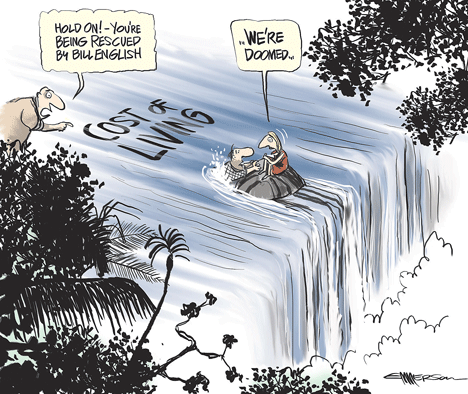
3. Obama's shift to the right - Barack Obama is signalling with his push for new trade deals (including our Trans Pacific Partnership) that he's keen to cosy up to Wall St and the big lobbyists that shove Congress around on a regular basis.
Here Kevin Gallagher at The Guardian's Commentisfree website points to the letter from 257 economists calling on the American government to allow others to use capital controls.
The coalition behind the economists' statement attests to the fact that there is broad support for reforming US trade treaties' terms on capital controls. The list includes prominent academic economists who have been supportive of free trade deals, former IMF officials, and some economists affiliated with the pro-trade Peterson Institute for International Economics.
The economists should be listened to: US trade treaties should not be tools for US financial policies that are not only outdated, but actually helped cause the financial crisis in the first place. Allowing flexibility for the use of capital controls to prevent and mitigate crises now has broad support. Our trading partners have been requesting such flexibility for years; granting it would represent one small step toward a more stable financial system. US banks and investment houses played a role in nearly destroying the global economy.
Why should the Obama administration ban the measures that prevent contagion, while giving those same firms the right to sue foreign governments for damages?

4. Fantastic inflation heat map - Here's a fantastic heat map graphic from WSJ.com that shows the inflation hot spots across the global economy and how that's changed over recent years. It's glowing dark red in a bunch of places. Yet the 30 year Treasury bond yield is still just 4.6%. It does not compute.
5. Who are the global elite? - Robert Guest, Business Editor of The Economist, discusses the rise of the global elite in this video below. It's all become more topical after this widely read piece on the global elite at The Atlantic.
6. How to tax the rich - Give them something in return. Scott Adams, the guy behind Dilbert, has written this fantastic piece at the Wall St Journal musing on the problem of how to convince rich people to let the masses increase taxes on the rich.
He hits on some pretty deep themes in a cool way.

In reality, fairness is not so much about the actual distribution of loot as it is about the psychology of how you feel about it. That's important to understand because the rich won't give up their cash unless they feel they are getting something in return.
And so far, saving the country doesn't seem to be enough of a payoff.
I can think of five benefits that the country could offer to the rich in return for higher taxes: time, gratitude, incentives, shared pain and power.

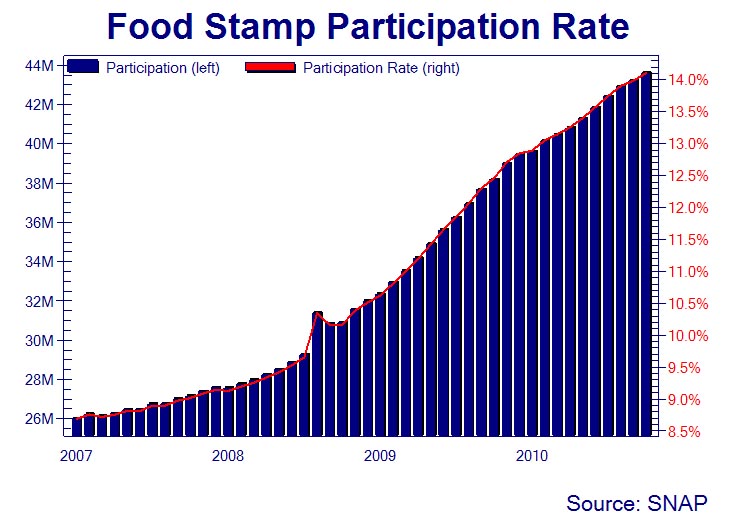
7. American might - An extra 400,000 Americans became so poor in November that they had to accept food stamps, this USDA document shows.
There are now 43.6 million Americans or just over 14.2% of the population on food stamps. This explains why there aren't mass protests in America. Bring me your huddled masses... HT Zerohedge.
8. This looks ugly - This photo below shows the current cyclone Yasi headed for Queensland on the left and Cyclone Tracy that devastated Darwin 1974 on the right.

9. Why are our troops still in Afghanistan? - This New Yorker story shows what really goes on behind the scenes in Kabul. It's a corrupt kleptocracy that our soldiers are defending.
Why?
Read this and be very angry.
The war in Afghanistan no longer appears to be a simple conflict with the U.S. and the Afghan government on one side and the Taliban insurgents on the other. When it comes to money—and particularly American money—allies and enemies often seem interchangeable. When American diplomats set up the Threat Finance Cell, in 2008, they charged it with severing the links between insurgents and their financing, much of which is believed to have come from drugs. Instead, they found that the lines that connected the Taliban and the drug smugglers often ran through the Afghan government.
When American investigators started examining a particular Islamic charity across the border in Pakistan for giving money to insurgents, they discovered that its director also maintained close ties to Afghan leaders. At Kabul Bank, according to a Western official familiar with the investigation, records show that Ruhullah, the head of a private security company and an ally of Ahmed Wali Karzai, the President’s half brother, transferred money into accounts believed to be controlled by the Taliban. (Ruhullah did not respond to repeated requests for an interview.)
Ahmed Wali Karzai himself, the head of the provincial council in Kandahar, has long been suspected of siphoning profits from the drug trade. Ahmed Wali Karzai has steadfastly denied such links. “People think it’s the Taliban versus the Afghan government, but, I’m telling you, the Afghans just don’t see it that way,” an American investigator told me last year.
“The Afghans look at this war very differently than we do.” Despite the deep skepticism that the Karzai government has prompted in Washington, the corruption appears to have got worse. One of the reasons is the war itself. President Obama’s deadline for beginning his withdrawal of American forces later this year confirmed for many Afghans that time is running out. “Right now, this country is all about raping and pillaging as much as you can, because there is no faith in the future,” an Afghan businessman told me.
10. Totally irrelevant video - This Brazilian Taxi Driver is much more talented than many of the Taxi Drivers who have driven me around...
19 Comments
A bank free economy....dirty filthy comment to use in earshot of the Stonecutters!
Every indication the peasants are rushing to join the black market.
Expect the black market police to stream out from wgtn any day now.
Granny will get her door kicked in for producing too many eggs and swapping them for home kill.
The Federal Reserve is getting ready for QE III (Quantitative Easing III). No wonder inflation in commodity prices and in emerging countries is rampant.
Here's the detail which has helped drive the US dollar lower in recent hours.
http://www.reuters.com/article/2011/02/01/usa-fed-hoenig-idUSN011183372…
cheers
Bernard
Perhaps in the same way the Zimbabwean runaway inflation helped teach people mathematics of large numbers* QE-II, QE-III will educate Americans about Roman numerals. QE-XII, QE-XIII, QE-XIV... Nah, what's the bet that QE-III will become QE-3, QE-4, QE-5...
:-)
*100 billion for bread, 150 billion for jam - hmm don't get much change from a 500 billion note these days!
Well then, that'd be 14 quadrillion for a house. Lucky the mortgage is only a few hundred thousand!
Bernard: The FED can print as much money as they please, we are nothing but collateral damage, our currencies, our economies,our governments, you name it.
Sorry Bernard didn't quite get that, was that QE3 or WW3?
Re # 5. I found it hypnotically distracting to see Helen Clark, holding court, in the background......
Fascinating. The world's most powerful socialist maybe?
FYI from Darryl via email
The 25 Countries Whose Governments Could Get Crushed By Food Price Inflation
...there's going to be a lot of angry people.
http://www.businessinsider.com/governments-food-price-inflation-2011-1#
Zerohedge on Merv Kings feeling sorry for crushing the middle class......
- “In 2011, real wages are likely to be no higher than they were in 2005… One has to go back to the 1920s to find a time when real wages fell over a period of six years.”
- “I sympathise completely with savers and those who behaved prudently now find themselves among the biggest losers from this crisis.”
Ivory coast defaults on Eurobonds....
Democracy cheap at the price...
"HOW much does it cost to bring down a prime minister? The answer: a tad over $22 million.
"That's how much the mining industry spent in six weeks last year on its campaign against Kevin Rudd's plan for a resource super profit tax."
http://www.businessday.com.au/business/a-snip-at-22m-to-get-rid-of-pm-20110201-1acgj.html
.... and worth every penny of it to get rid of that ruddy plonker .
Wonder if anyone still fails to understand the Fed is cooking the books and buggering the world commodities markets!....I spose there must be a few idiots remaining. Time to ask Bollard how long he plans to play lapdog to Ben...how long will he gamble with cheaper credit in the face of the cyclone of inflation on its way. Dam sure the unions can smell their chance on the way...with so many off to aus for fatter pay, the shortage of skilled labour in NZ will be a weapon the unions will not drop. I did say skilled....I did not mention the unskilled and unqualified and unwilling. They will remain WINZ clients...........for a very long time!
Meanwhile stagflation gathers steam...govt revenue is heading downslope and only the labour exodus is saving English from an even deeper hole. Property is in full retreat no matter how much RE sprooking and banking BS spews from the poodle media.
Best news was recognition by Bollard of the new age of thrift and prudent household financial behaviour...it needs to grow stronger and last longer. If you have a brain you will avoid the bank mortgage bait. You should also begin your journey into the black market that is expanding like Gerry's waistline.
Insurer Suncorp is talking about capping its exposure to cyclone Yasi at A$10 million before the cyclone has even hit even though damages are expected to be worth a lot more than that - http://www.businessday.com.au/business/suncorp-exposure-capped-at-10m-a…
Don't forget how Laissez Negro helped ease the effects of the GFC by providing liquidity to the markets. Black is the new black.
Housing affordability and all that - Cactus Kate puts it down to credit availability:
http://asianinvasion2006.blogspot.com/2011/02/turning-off-tap-for-housing.html#links
She's nearly right.
Actually, it's more income availability - ongoing lack of.
Incomes get smaller from hereon, so the ability to either purchase, or to pay rent, dwindles.
That is exascerbated by the increasing cost of energy and the stuff it ubnderwrites - like food.
Hear ye , hear ye : On this day , Punxsutawney Phil emerged from his burrow , and saw no shadow . ............ It's going to be an early spring !
........ Gosh , the news coming out of the USA just keeps getting better everyday , doesn't it , Bernard ! ........... Bernard ? .......... Stop grinding your teeth , bloke , that's really not good for them ............
Gummy old bean...you are right..the "news" coming out of the States is getting soooo good!....
Meanwhile the debts are over 14 trillion and rising another 1 to 2 trillion this year...countless states are flat broke...heaps of cities also...14% plus are now on food stamps...the unemployment bullshit reports say everyone has a job...Obama has changed sides...Bernanke has lost count of how many QEs he has had...the Dollar is shit....Zimbabwe's Gono is being asked for advice...but hey..."the news is good"
Come on Gummy...get with the real world....time to see the woods mate.
No woods left , they burnt them to keep warm ........ Have you seen the size of that snow-storm over Chicago ? Jeepers , that is a real winter !
....... America's debt level is no more or less a worry than any country's , emerging from a banking crisis . ......... Still chugging through " This Time is Different " by Reinhart & Rogoff .
We welcome your comments below. If you are not already registered, please register to comment
Remember we welcome robust, respectful and insightful debate. We don't welcome abusive or defamatory comments and will de-register those repeatedly making such comments. Our current comment policy is here.