

Here are my Top 10 links from around the Internet at 10 to 6 pm, brought to you in association with New Zealand Mint for your reading pleasure.
I welcome your additions and comments below, or please send suggestions for tomorrow's Top 10 at 10 via email to bernard.hickey@interest.co.nz.
I'll pop any surplus suggestions I get into the comment stream

1. Get ready for it - The New York Times reports that many economists expect the Chinese authorities to increase interest rates again within the month as they ramp up their battle to slow down inflation.
This of course raises the risk of a sharp drop in growth in China, and therefore less demand from the second biggest buyer of New Zealand exports and the biggest buyer of exports from Australia (which in turn in is the biggest buyer of New Zealand exports.
Few people realise just how explosive the expansion in lending in China was through late 2008 and 2009.
That explosion in money supply and the inability of China to slow things down through an automatic stabiliser of a floating exchange rate is now causing all sorts of grief with food prices and property prices.
The authorities in China are rightly concerned about the social impacts of this inflation and perceptions about a widening gulf between the haves on the coast (particularly those owning Shanghai property) and the havenots in the boondocks. The riots in Egypt will no doubt add some extra spice to the Chinese leaders' thinking.
Here's the New York Times on the issue, with the startling factoid that China's money supply is bigger than America's. Yikes.
Inflation lately has caused friction in China’s mighty export machine. Now, Beijing’s efforts to fight inflation, through higher interest rates and tighter restrictions on bank loans, could begin to slow segments of China’s domestic economy slightly — particularly the breakneck pace of investment in new factories, office buildings and apartment complexes. That, in turn, could weaken demand for industrial materials like steel and copper that depend heavily on Chinese purchases.
Much of China’s inflation is being fueled by the extraordinary growth in its money supply, broadly measured as so-called M2, which has soared a total of nearly 53 percent in the last two years. That is largely a result of the country’s aggressive monetary and fiscal stimulus program in 2009 and early 2010, as Beijing essentially printed money in response to the global financial crisis.
Although China’s economy is a little less than half that of the United States, its money supply is now one-quarter larger than America’s. Since the beginning of last year, Beijing has moved several times to start clamping back down on the money in circulation, by increasing the required amounts that banks must hold in reserve, leaving them with less money to lend.
The central bank has raised this requirement seven times in the last 13 months, with four of those increases coming in quick succession since mid-November. The bank has also been raising interest rates. The benchmark rate for one-year corporate loans is now 5.81 percent, up from 5.31 percent a year ago. The central bank has already raised rates twice since late October, and is poised to raise them again this month, the economists and bankers said.
2. Today's Must Read - Bill Gross runs PIMCO (Pacific Investment Management Company), the world's biggest bond fund with US$1.24 trillion (yes trillion) in funds under management.
Here he has written an extraordinary indictment of America's economy and financial markets. He argues America's central bank, government and Wall St bankers have done a devil's bargain to cheat long term bond investors by running low interest rates and creating inflation.
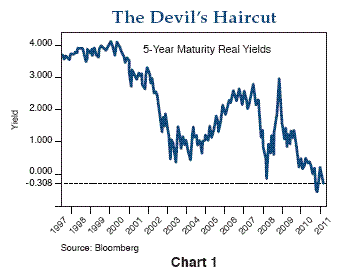 Gross also attacks a culture of excess on Wall St.
It's an amazing piece from someone at the heart of the system. It's as if he is saying modern US capitalism is broken and he has no choice but to invest in emerging market debt.
As a profession we have failed miserably at our primary function – the efficient and productive allocation of capital: The S&L debacle of the early 1980s, the Asian crisis, LTCM, dotcoms, subprimes, Lehman and the resurrection, instead of the reformation, of Wall Street, are major sins of the modern era of money. Hang your heads, moneychangers. And no, it is not yet time to move on, as many banking CEOs suggest.
How can bond traders make ten, one hundred, one thousand times more money than an engineer or social worker given their dismal historical performance? Why is it that some of today’s doctors are using food stamps while investment banking executives complain about millions of dollars in compensation that might be deferred in case of a future bailout? To rebalance debt loads and re-equitize financial institutions that should have known better, central banks and policymakers are taking money from one class of asset holders and giving it to another.
A low or negative real interest rate for an “extended period of time” is the most devilish of all policy tools. And the asset class holder that it affects, or better yet, “infects,” is the small saver and institutions such as insurance companies and pension funds that hold long-term fixed income assets. It is anyone who holds bonds with coupons that cannot keep up with inflation or the depositor in a local bank who cumulatively holds trillions of dollars in time deposits that don’t earn a real rate of interest.
This is the framework that has been created by modern-day policymakers who have innovated far beyond their biblical counterparts. To put it bluntly, they are robbing savers and taking money surreptitiously from longer-term asset holders who are incorrectly measuring future inflation.
3. What a difference competition makes - If only German supermarket chain Aldi would launch in New Zealand. The price of milk in Australia has fallen to the equivalent of NZ$2.58 for a two litre bottle while it costs NZ$4.80 here, Andrea Fox reports at Stuff.
The key difference is a price war in Australia between Coles, Woolies and Aldi selling their own brands and buying off multiple suppliers. Meanwhile in New Zealand, there is a supermarket duopoly and a milk supply monopoly in Fonterra.
Also, Fonterra can argue its prices are set more by the international commodities market, which is the major 'buyer' of our milk, rather than milk drinkers. That's great for supermarket shareholders here and Fonterra shareholders/suppliers, but not so great for consumers.
Is it any wonder food price inflation seems much higher here than in Australia and America? I certainly found food prices much, much cheaper in America than here when I was there over New Year.
Fonterra supplies the bulk of retail milk in New Zealand, including to its only competitor of size, Goodman Fielder, marketer of the MeadowFresh brand. But Australia, with about 22 million people, is enjoying a discounting war among its three main supermarket chains – Coles, Woolworths and Aldi – after Coles announced it was slashing its homebrand milk prices by up to 33 per cent.
About 55 per cent of milk produced in Australia goes to the domestic market. Australian farmers who produce retail milk year-round were paid A45c-A50c a litre for milk, Dairy Farmers of Australia said. Their colleagues in New Zealand are understood to be paid about 57.7c a litre at the current trans-Tasman exchange rate.
Dairy industry consultant Peter Fraser said New Zealand's higher prices were because the country had only two supermarket chains and "all milk is sold by Fonterra".
4. Never say anything interesting in an email - I have a personal rule with emails I write. I never write anything interesting in them. By that I mean I don't write anything I wouldn't want my boss or mother or wife or daughter to read. In fact, I don't write anything that I wouldn't want published on the front page of the NZ Herald.
Here's an email that is now featured on the front page of NZHerald.co.nz from a real estate agent....ouch...
Ocena (Maree) Clarke of Re/Max Latitude 36 in Albany was found by the authority's complaints assessment committee to have engaged in unsatisfactory conduct, in a decision released today.
Clarkes describes the vendor as "smug" before vowing to put her "in her place" in an email to a colleague in March last year. "I will sort her out - if they have taken it upon themselves to assume my buyers came in just for them well... they are totally wrong".
"Mrs V has NO reason to be sitting there smug - she'll only be setting herself and Mr V up for a huge let down. I know how Asians work!"
5. Civil war? - Here's the speech where IMF boss Dominique Strauss-Kahn said global imbalances and high unemployment might start civil wars. HT wonkmonk via twitter.
If we ignore these challenges—or take them only lightly—we face risks far greater than the recovery running out of steam.
As tensions between countries increase, we could see rising protectionism—of trade and of finance. And as tensions within countries increase, we could see rising social and political instability within nations—even war.
6. A coming commercial real estate slump - We've seen the residential real estate slump in America and a lot of losses by owners of retail stores. But the worst may be about to come, BusinessInsider reports US retailing expert Howard Davidowitz as saying.
The problem now is not a lack of consumer spending.
It's a lack of consumer spending in shops.
It's been interesting in recent days to see a rash of discount online retailers launching in recent days in New Zealand, not to mention the astounding growth (still) of traffic on TradeMe.
There is a sea change happening in retail, Davidowitz tells Aaron in the accompanying clip. Consumers are spending more now than during anytime in the last three years, but they are choosing to spend more and more online than in brick-and-mortar stores. Companies like Apple, Amazon, Netflix are doing gangbuster business while the aforementioned struggle to keep pace.
Why go to the store – be it record store, book store or movie rental store – when you can buy all you need right from the comfort of your own home and have it delivered to your front door or digital media device? The Walls Are Collapsing A coming collapse in commercial real estate has been looming for the last couple years, but Davidowitz thinks it has already begun.
“I think there has [already] been a partial collapse in the commercial real estate business,” he says pointing to the rising number of community bank failures. “I think retail real estate developers better start rethinking the use of their space.”
7. When Irish eyes are smiling - Michael Lewis, the author of Liar's Poker and The Big Short, has done his thing with Ireland in this Vanity Fair piece. His brand of financial disaster tourism reporting is fantastic. His pieces on Iceland and Greece were memorable. The Greek one was so good it is credited with blowing out Credit Default Spreads for Greek debt. Now that's a pen that's mightier than the sword.
I haven't read all this latest piece yet, but I've been recommended it by so many people I'm pretty sure it's good.
Here's a taste.
Even in an era when capitalists went out of their way to destroy capitalism, the Irish bankers set some kind of record for destruction. Theo Phanos, a London hedge-fund manager with interests in Ireland, says that “Anglo Irish was probably the world’s worst bank. Even worse than the Icelandic banks.”
Ireland’s financial disaster shared some things with Iceland’s. It was created by the sort of men who ignore their wives’ suggestions that maybe they should stop and ask for directions, for instance. But while Icelandic males used foreign money to conquer foreign places—trophy companies in Britain, chunks of Scandinavia—the Irish male used foreign money to conquer Ireland. Left alone in a dark room with a pile of money, the Irish decided what they really wanted to do with it was to buy Ireland. From one another.

8. British real wages falling - Britain is slumping as its government slashes spending to fix its debt problems caused by the government bailing out its banks. Here's Martin Wolf at FT.com detailing the problem.
It is foolish to consider monetary tightening, to drive wage increases even lower, with a view to offsetting imported and government-imposed price jumps. This makes even less sense when, as Mr King states, “the three factors described – higher import and energy prices and taxes – have squeezed real take-home pay by around 12 per cent.
Average real take-home pay normally rises as productivity increases – money wages normally rise faster than prices. But the opposite was true last year, so real wages fell sharply. And given the rise in VAT and other price rises this year, real wages are likely to fall again. As a result, in 2011 real wages are likely to be no higher than they were in 2005.” The squeeze on households is merciless.

9. The ceiling is near - Reuters reports that the US Government will run out of money between April 5 and May 31 when the current debt ceiling set by Congress is reached. A bunch of new Tea Partyist Republicans have vowed not to lift it, which would mean the government couldn't borrow any more and have to cut spending.
If Congress does not raise the limit in a timely way, the government could be forced to scale back operations. A failure to lift the limit could raise the specter of a first-ever U.S. debt default and push up interest rates sharply. Financial markets have not yet shown any nervousness over the debt limit, which has typically been raised after political grumbling.
Treasury yields rose on Wednesday as higher oil prices fueled inflation concerns, but the 10-year note remained below 3.5 percent resistance level. Still, there will be political skirmishes along the way. A number of Republican lawmakers have raised opposition to increasing the limit without significant concessions on spending cuts from the Obama administration.
A contentious debate is expected after the White House unveils its proposed fiscal 2012 budget later this month. "Given the history of debt limit fights, brinkmanship will rule the day, and nothing of significance will happen in February," said Pierpont Securities analyst Stephen Stanley adding that a resolution could drag out "to the bitter end."
10. Totally relevant video - Big Picture blog author Barry Ritholz says Fannie Mae and Freddie Mac is being used as a dumping ground for bad mortgages through which the banks are receiving taxpayer
"Ultimately the taxpayer is on the hook for every bad mortgage in America," he says.
19 Comments
Bernard : Surprised me that you missed media mogul Rupert Murdoch's launch of his " The Daily " pay-for-news service on iPad . .......... Well , it's an amazing thing , but not necessarily a bad thing ........ So I guess that it doesn't belong here at interest.co.nz
Gummy,
Sort of off-piste for me in the Top 10, but I've seen some interesting links.
Murdoch actually has a long history of Internet start up failures, mainly because he just doesn't get it.
Glad it's his money he's wasting.
Here's some history.
http://paidcontent.co.uk/article/419-a-news-corp-digital-history-lesson-for-the-daily/
http://www.techdirt.com/articles/20101219/22155912331/look-rupert-murdo…
cheers
Bernard
"Left alone in a dark room with a pile of money, the Irish decided what they really wanted to do with it was to buy Ireland. From one another.".....errrrr ummmmm...isn't that what also buggered the NZ economy !
Another example of just how useless the system is:
....Brown was on unemployment and sickness benefits for about 20 years, yet part-owned a bar on Auckland's Karangahape Rd and owned six vehicles - including a Porsche and BMWs - valued at $440,000." herald
#7 nice article "There is an iron law of house prices,” he wrote. “The more house prices rise relative to income and rents, the more they subsequently fall.”
Meanwhile in New Zealand, there is a supermarket duopoly and a milk supply monopoly in Fonterra.
I don't think it's lack of competition that's the problem because, in theory, the supermarket duopoly could import milk from Australia cheaper than what Fonterra are selling it. This would indicate that Fonterra and the supermarkets are working in collusion to keep local prices high. As the article says - we can't actually look.
As tensions between countries increase, we could see rising protectionism—of trade and of finance. And as tensions within countries increase, we could see rising social and political instability within nations—even war.
Very likely especially as resources become more constrained with Peak Oil.
Yeah, so are ours. BTW, if productivity increases and everything else remains the same then wages must decrease and deflation would be the norm rather than inflation. The only way that increased productivity would increase wages is if a) wages were tied to income and b) the market was expanding. Neither of these are true.
A bunch of new Tea Partyist Republicans have vowed not to lift it, which would mean the government couldn't borrow any more and have to cut spending.
Wonder what the Tea Partiers would do if they knew that better than 50% of the US economy comes from government spending? (James Galbraithe, The Predator State)
"Ultimately the taxpayer is on the hook for every bad mortgage in America," he says
Of course they are, the last 30 years has been a concerted effort to transfer US wealth into the hands of the few. Seems to have been very successful as well. Same thing is happening in NZ as well.
Pisssst wanna read what the world is reading about us?( and then laughing over)
"New Zealand’s finance minister signaled that his government’s steps to shrink a fiscal deficit should reduce the need for monetary tightening by the central bank and ease pressure on nation’s exchange rate."
"Steps to shrink the fiscal deficit".....doh ...he must be on about the short walk he took from his office to JK's....what other steps have there been?....what other real steps are planned?
Just for the record, I'm in Oz and Aldi has been charging me around AU$2.20 for 2L Full Cream Milk since opening near me 2.5 years ago AND just AU$1.79 for a sliced sandwich bead loaf AND that price for 2L Orange JUICE (not drink). Then theres toilet rolls..........This email would read like an Aldi advert if I continued on all the other permanent cheap prices for staples etc....
To me its no accident that after all this time our other supermarket chains have decided to be more realistic in their milk pricing and its only a matter of time before they move on other daily essentials. Lets face it they have been ge\tting away with ripoff pricing for years!
Paulg .. its not full-cream-milk .. raw milk straight from the cow is (minimum) 4% milk fat .. Casual Observer some weeks ago said he was getting 5% milk fat .. now check the fat content on the back of your Aldi PET bottle. I'll be most surprised if its more than 3.3%
No problem with fat content. Heres the Oz product range for yr ref...........
http://www.fitstyler.com.au/uploads/file/Health%20printouts/Choice%20Ma…
For the record: The only milk processor supplying Full-Cream-Milk into Victoria is Parmalat an Italian owned outfit. They offer Farmhouse Gold at AUD$2:00 per 1 litre carton at 4.9% milk-fat. Their 2 Litre bottle is AUD$5.39.
On 8 January I wrote - The AASA standards for milk allows milk to be 3.3% milk fat and still be called "whole cream" or "full cream" milk .. raw milk from the cow is 4+% milk fat .. and so it is exploited. 99% of all milk sold in AU supermarkets is diluted or extended with "permeate" to about 3% milk fat and still sold as "full cream" milk. Can you see the opportunity? NZ-100%-pure. And guess who one of the largest milk processors is .. you guessed it .. Fonterra.
Casual Observer wrote 08 Jan - Milkfat varies between cows and especially between breeds e.g. Jersey cows usually have a higher milkfat content than Friesians. Our farm milk for the last 10 days has milkfat readings of between 5.10% and 5.5% with no two days the same. We have mainly crossbreds in the herd.
Permeate is known in the industry as that stuff that remains after removing all the milk fat for butter and cheese. They add some calcium to it and market it as Calcium Rich Low Fat milk and charge $3 per litre, or package it as Non-Fat Milk or Skim-Milk and flog it for $2.50 per litre. The rest they use to extend real milk.
Don't just look at the fat content - you might actually be surprise to know that that fat is not from the cow. They take the cow milk fat out and often replace it often with vegatable fats which are cheaper!! The food chemist is a tricky bugger!!
Real interesting is the Synlait story which is not doing massive round - Sold expiring milk to the Africans. That company can not be doing well - its US$200/t extra just to transport it to Africa, why are they not dumping it in Asia?
a little extra reading.............
Milking it for all it’s worth — competition and pricing in the Australian dairy industry13 May 2010
http://www.aph.gov.au/Senate/committee/economics_ctte/dairy_industry_09…
cheers. great link
Bernard
Bernard
Cool missive from Gross. Thank you.
"you and your money are being “haircutted” by inflation at a much higher rate – core or no core."
Sound familiar anyone? It's the same the world over. And unless you want to purchase Alan Bollard wallpaper for your next house I suggest people start thinking in terms of 'how many weeks could the process of my sale pay for the essentials (not discretionaries) of life?'
Forget the crap statistics the govt, banks and reserve bank are forging. To me, the only measure that means anything illustrates: How long can I keep my family going at a basic level for 'x'? All the official stats are fudging.
Viewed in these terms, I'm seeing a huge reduction in the value of bricks and mortar, already, with more to come.
Talking in nominal or even 'inflation-adjusted' terms means absolutely ZILCH. Kiwis are arguing around the periphery of the essential problem: Fiat money in low interest and precarious times chases hard assets which make up and contribute to the essentials of life. Saw some bank economist on the news tell people that "now would not be a good time to ask for a huge wage increase". That's the kind of weasely, implied threat that people on his income often come out with.
The doomsayers need to take more zinc and Olly should really ease up on the Viagra.
NZ sovereign credit default swap yeilds are what? http://www.interest.co.nz/charts/interest-rates/swap-rates
"In the midst of the financial crisis of 2008, governments helped to prevent bank runs by guaranteeing bank debts. Yet as sovereign solvency itself becomes an issue, such guarantees quickly lose their value. If Ireland provides a rule of thumb, bank runs can be expected once sovereign credit default swap yields pass 3%. The figure below shows that when Irish government CDS yields first passed 3% in early 2009, foreign deposits fled the country. This happened again in late 2010. Now that Spanish CDS yields have broken the 3% threshold, there is reason to be concerned about the stability of Spanish bank deposits as well."
"Britain is slumping as its government slashes spending to fix its debt problems caused by the government bailing out its banks."
Wrong Bernard, only a small percentage of the British government's debt came from the bank bailouts. Most of it came from Labour's rampant increase in government spending.
The Warehouse has 4 litres of mik for $6.25.
FYI from a reader via email
Hi There,
Regarding point 3 in your top 10, I'd like to add that I spend a couple of weeks in The Netherlands last October (2010), and the situation there is pretty much the same as the USA, with food prices (dollar for dollar) being 30% to 50% lower there than what they are in NZ.
Interestingly enough, even the New Zealand lamb, Wine and Kiwifruit is around 30% cheaper there then what it is here, so how Fonterra (also owner of meat producers like TopHat and Brooks as far as I'm aware) can claim that it is charging international prices is beyond me.
If you take into account that the Dutch people on average earn in Euros what we earn in NZ Dollars, the relative difference is pretty disgusting, considering that all fresh food we have in NZ is pretty much produced locally.
Cheers,
We welcome your comments below. If you are not already registered, please register to comment
Remember we welcome robust, respectful and insightful debate. We don't welcome abusive or defamatory comments and will de-register those repeatedly making such comments. Our current comment policy is here.