

Here's my Top 10 links from around the Internet at 10 to 2 pm in association with NZ Mint.
I'll pop the extras into the comment stream. See all previous Top 10s here.
I welcome your additions in the comments below or via email to bernard.hickey@interest.co.nz.
I'm full of the joys of schadenfreude today. And I enjoy reading Rolling Stone.

1. Euro headed for the rocks - Closely watched British economist Roger Bootle writes at The Telegraph about the deep problems in Europe and concludes at some stage the Euro will break up.
He makes a compelling case.
In the end, everything is political.
It seems the people of Europe are much less convinced about the Euro project than the Euro elite.
Watch the elections and the riots. HT Colin via email.
Here's Bootle.
Debt is one facet of the euro's crisis. There are three others. The first is competitiveness. Since the formation of the euro, German unit labour costs have barely risen, but in the peripheral countries they have surged ahead – by about 30pc in Greece, Spain and Portugal. The result is that the peripheral countries are uncompetitive both inside and outside the eurozone, thereby shutting off strong exports as a route to recovery.
The second factor is the property market. In Ireland and Spain, house prices were driven up in a major property bubble. Although prices have since fallen a long way, the prospect is for further large drops.
The third factor is the weakness of the banks. Interestingly, some of the most serious problems lurk in that paragon of financial orthodoxy, Germany, where the state-owned regional banks have taken on oodles of dodgy assets.
The euro is supposedly cemented by unshakeable political will. Yet not only has the eurozone failed to establish workable union-wide political institutions, but the political situation in member countries has turned ugly.
Portugal and Belgium are without governments. Opposition to austerity is building in Greece and Ireland. President Sarkozy of France faces an uphill battle to be re-elected, not least against a revived, and euro-sceptic, National Front. In Germany, after recent electoral losses, Angela Merkel is in a weak position.
2. Oh the Schadenfreude - Stuff and NZ Herald report that Mark Hotchin gave evidence in the Rotorua District Court in 2004 that he was duped by Ponzi schemers the Papples and Tina West between 2000 and 2002. But the evidence was suppressed by a judge after he agreed that publication of evidence of Hotchin being duped would look bad to investors in Hanover Finance.
Hotchin was given permanent name suppression, which has only now been lifted after a challenge from the NZHerald. Strategic Finance boss Kerry Finnigan was also duped and also got name suppression.
If only the Rotorua District Court judge James Weir hadn't granted permanent suppression, thousands of Mum and Dad investors might not have lost over NZ$500 million in Hanover and over NZ$300 million in Strategic Finance...and counting. Thanks for that.
Here's what Hotchin pleaded in 2004 would happen if he was exposed:
# "There would be concern over the investment strategies adopted within the Hanover organisation because of the loss of credibility and damage to my reputation."
# "Investors and third parties with whom Hanover and its entities deal could well come to the conclusion that if one of the directors of Hanover was making inappropriate investment decisions personally then he could well be doing the same for the group. This in turn could cause a lack of investor confidence and support potential for a run on funds, the possible collapse or restructure of the Group with obvious impact on its 600 employees."
# "The commercial relationship Hanover has with commercial partners would also be placed under stress. In those circumstances I anticipate that my fellow shareholder [London-based Eric Watson] and director could well request my resignation as a director."
Ya don't say. Now Hotchin is saying he welcomes the lifting of name suppression:
''I was happy to assist the Serious Fraud Office and gave evidence at the trial. My name was suppressed at the time because we wanted to protect Hanover and its investors because it was made in a personal capacity, not an investment made by Hanover.''

3. 'Free trade doesn't work' - Ian Fletcher, the author of the book 'Free Trade doesn't work' has written a fascinating letter republished on HuffPo that details 8 areas of research on free trade that is needed to inform the debate about trade before it all goes pear-shaped.
Fletcher is worried that some sort of American collapse could result in a very politicised and populised trade policy. HT John via email.
Because mammoth U.S. trade deficits are not sustainable forever, a profound change in U.S. trade relations is inevitable during the next 3-8 years regardless of any coming policy decisions and independent of any particular economic theories. A transformative crisis, be it an acute shock like the 2008 financial crisis or a period of chronic turbulence like the stagflationary 1970s, is now basically inevitable on the trade front.
The better recognized are critiques of free trade when the probable crisis hits, the less likely is an uninformed policy response to crisis driven by a political firestorm. Addressing the issues completely and thoughtfully in advance will allow time for alternative analyses and policies to be developed and vetted.

4. The Do Nothing plan - US President Barack Obama is set to announce a new deficit cutting plan later tonight. Here's a plan from Annie Lowrey at Slate that says the US government can return to surplus within 8 years by doing nothing.
The key is not cutting taxes for the rich and not expanding spending.
You listening John Key? Too late. He has already cut income tax rates and refused to cut spending growth for health, education and social welfare. HT Brendan via email.
So how does doing nothing actually return the budget to health? The answer is that doing nothing allows all kinds of fiscal changes that politicians generally abhor to take effect automatically. First, doing nothing means the Bush tax cuts would expire, as scheduled, at the end of next year. That would cause a moderately progressive tax hike, and one that hits most families, including the middle class. The top marginal rate would rise from 35 percent to 39.6 percent, and some tax benefits for investment income would disappear. Additionally, a patch to keep the alternative minimum tax from hitting 20 million or so families would end.
Second, the Patient Protection and Affordable Care Act, Obama's health care law, would proceed without getting repealed or defunded. The CBO believes that the plan would bend health care's cost curve downward, wrestling the rate of health care inflation back toward the general rate of inflation. Third, doing nothing would mean that Medicare starts paying doctors low, low rates. Congress would not pass anymore of the regular "doc fixes" that keep reimbursements high. Nothing else happens. Almost magically, everything evens out.
5. Today's must read - Matt Taibbi at Rolling Stone has done it again. This time he has highlighted the extraordinary story about how the US Federal Reserve handed over US$220 million of bailout money to the philanthropist wives of two Wall St bankers to buy mortgage securities.
Read it. Please. You will laugh. You will rage.
HT Kevin.

Christy Mack is the wife of John Mack, the chairman of Morgan Stanley. Susan Karches is the widow of Peter Karches, a close friend of the Macks who served as president of Morgan Stanley's investment-banking division. Neither woman appears to have any serious history in business, apart from a few philanthropic experiences.
Yet the Federal Reserve handed them both low-interest loans of nearly a quarter of a billion dollars through a complicated bailout program that virtually guaranteed them millions in risk-free income.
It's hard to imagine a pair of people you would less want to hand a giant welfare check to — yet that's exactly what the Fed did. Just two months before the Macks bought their fancy carriage house in Manhattan, Christy and her pal Susan launched their investment initiative called Waterfall TALF. Neither seems to have any experience whatsoever in finance, beyond Susan's penchant for dabbling in thoroughbred racehorses. But with an upfront investment of $15 million, they quickly received $220 million in cash from the Fed, most of which they used to purchase student loans and commercial mortgages.
The loans were set up so that Christy and Susan would keep 100 percent of any gains on the deals, while the Fed and the Treasury (read: the taxpayer) would eat 90 percent of the losses. Given out as part of a bailout program ostensibly designed to help ordinary people by kick-starting consumer lending, the deals were a classic heads-I-win, tails-you-lose investment.
6. Is the new Chinese soya boom for real? - Bloomberg reports that Chinese Soya bean imports surged 51% in March from a year ago, while copper imports rose 29%.
Beijing based monetary economist Michael Pettis reports via his weekly email (that I can't link to) that he's hearing from commodity market traders that Chinese property developers may well be using soya inventories as another form of collateral upon which to borrow offshore cheaply and get around the local curbs on lending to developers.
Chinese property developers have already used this tactic with copper. Now they're apparently doing it with Soya beans. This is not a stable or sustainable situation...
Here's more from Bloomberg on China's insatiable demand for pork and the soya meal the pigs eat.

7. The one percenters - Joseph Stiglitz's epic Vanity Fair piece on how America is now governed by the richest 1% for the 1% has gone viral. I mentioned it in a top 10 last week. Now the Chicago Sun Times movie critic Roger Ebert has written his own take on this issue. It's passionate and well worth a read. Ebert is right on the money.
Day after day I read stories that make me angry. Wanton consumption is glorified. Corruption is rewarded. Ordinary people see their real income dropping, their houses sold out from under them, their pensions plundered, their unions legislated against, their health care still under attack. Yes, people in Wisconsin and Ohio have risen up to protest these realities, but why has there not been more outrage?
The most visible centers of these crimes against the population are Wall Street and the financial industry in general. Although there are still many honest bankers, some seem to regard banking and trading as a license to steal. Outrageous acts are committed and go unpunished.
The largest financial crime in American history took place and resulted in no criminal charges. Then the money industries and their lobbyists fought tooth and nail against financial regulation. The Republicans resisted it, but so did many Democrats. Partially because of the Supreme Court decision allowing secret campaign contributions, our political system is largely financed by vested interests.
We know that Bernie Madoff went to jail. Fine. No Wall Street or bank executive has been charged with anything. It will never happen. The financial industries are locked an unholy alliance with politicians and regulators, all choreographed by lobbyists. You know all that.
What puzzles me is why there isn't more indignation. The Tea Party is the most indignant domestic political movement since Norman Thomas's Socialist Party, but its wrath is turned in the wrong direction. It favors policies that are favorable to corporations and unfavorable to individuals. Its opposition to Obamacare is a textbook example. Insurance companies and the health care industry finance a "populist" movement that is manipulated to oppose its own interests. The billionaire Koch brothers payroll right wing front organizations that oppose labor unions and financial reform. The patriots wave their flags and don't realize they're being duped.
8. How a US bank laundered billions - Roger Ebert linked to this Observer article on how US bank Wachovia helped a Mexican drug cartel launder billions of dollars. I've been meaning to link to it for a week or so. Here it is now.
The details are shocking. And no one is being imprisoned...
Criminal proceedings were brought against Wachovia, though not against any individual, but the case never came to court. In March 2010, Wachovia settled the biggest action brought under the US bank secrecy act, through the US district court in Miami. Now that the year's "deferred prosecution" has expired, the bank is in effect in the clear. It paid federal authorities $110m in forfeiture, for allowing transactions later proved to be connected to drug smuggling, and incurred a $50m fine for failing to monitor cash used to ship 22 tons of cocaine.
More shocking, and more important, the bank was sanctioned for failing to apply the proper anti-laundering strictures to the transfer of $378.4bn – a sum equivalent to one-third of Mexico's gross national product – into dollar accounts from so-called casas de cambio (CDCs) in Mexico, currency exchange houses with which the bank did business.
"Wachovia's blatant disregard for our banking laws gave international cocaine cartels a virtual carte blanche to finance their operations," said Jeffrey Sloman, the federal prosecutor. Yet the total fine was less than 2% of the bank's $12.3bn profit for 2009. On 24 March 2010, Wells Fargo stock traded at $30.86 – up 1% on the week of the court settlement.
So why did Wachovia allow this?
At the height of the 2008 banking crisis, Antonio Maria Costa, then head of the United Nations office on drugs and crime, said he had evidence to suggest the proceeds from drugs and crime were "the only liquid investment capital" available to banks on the brink of collapse.
"Inter-bank loans were funded by money that originated from the drugs trade," he said. "There were signs that some banks were rescued that way."
9. The problem of moral hazard - A lot of people worry about how George Soros might beat up the Reserve Bank.
However, Soros seems to be one of the few in the global investment community who seems to care about how many of the instabilities in the global financial system have not been fixed.
Here Bloomberg reports on why Soros believes 'moral hazard looms larger than ever' over the system.
“The evidence is overwhelming that the first priority of the authorities is to prevent a market collapse, and everything else has to take second place,” Soros, chairman of Soros Fund Management LLC, said yesterday at a conference in Bretton Woods, New Hampshire.
Europe’s refusal to allow members of the monetary union to restructure their debt has added to moral hazard in the financial system, Soros said. Portugal will start negotiations with the European Union and the International Monetary Fund this week on a rescue package estimated at 80 billion euros ($116 billion). The country was forced to seek aid, following Greece and Ireland, after its budget gap helped drive up borrowing costs.
“Look at the situation in Europe, for instance, where authorities are insisting on no renegotiation or restructuring on outstanding debt because that could possibly provide a financial banking crisis,” Soros said. “At the present we bail out, but in the future we will bail in. It has absolutely no credibility.”
10. Totally Jon Stewart explanation of the US budget shutdown shenanigans. Entertaining.
53 Comments
Regarding (3), though it suits Bernard's purpose to slam freedom in his advocacy of a planned economy built on our planned lives (and planned by the likes of the Hughs, Jones and Goffs), Professor Don Boudreaux from the Austrian school puts paid to the false analysis offered by Ian Fletcher:
http://cafehayek.com/2011/03/my-continuing-conversation-with-ian-fletch…
(Nice try Bernard. When will you be announcing your run for the Greens in this years election?)
So what has the Australia-US "free trade" deal done for Aussie sugar farmers? And do you think in any US-NZ free trade deal they'd let our agriculture in lock, stock and barrel?
Gareth that shows a real economic immaturity. Are you trying to argue that protectionism is beneficial?
People do wake up eventually. At precisely this stage in the history of the US its peoples cannot afford to pay higher prices for their food, which they will do by their government protecting their farmers, so the politicians use such policy at their peril.
Due to the previous statutory marketing monopoly held by the Dairy Board, it's almost arguable that Fonterra works in a protected market for milk: not doing the consumer much good though is it.
Or are you happy, Gareth, paying more for your milk and cheese so that dairy farmers can make bigger profits?
[And I also note outside of the economic argument, there is the a piori philospohical one: a protected economy denotes a planned economy and I want the opposite, a free life.]
No, I'm not saying protectionism is beneficial. I'm saying free trade deals aren't all they're cracked up to be because of vested interests, lobbying and politicial opportunists.
Yes, all the reasons why to be free and properous we have to get Nanny State governments, with their protectionist yearnings, out of our lives. We agree.
free trade only exists between 2 free participants tribeless. modern society being what it is we only have varying degress of govt interference. that's the world we live in.
sure your austrian/chicago school economics promises freedom, but it really is very idealistic, just like communism. in the real world there will always be govt interference.
since we went all free market our manufacturing sector has been gutted, and real wages globally have been driven down to compete with wages in countries that basically have slavery in their manufacturing sectors. thats the reality and i don't think we are better off because of it. if someone is undercutting my manufacturing efforts by using slave labour i fully think it is within my rights to put a tarriff on those blood and tear soaked goods.
i'd like to have free trade, but, just like your ayn randian dreams, it's just an ideal.
Nice.....
regards
Your third paragraph shows you don't understand the workings of free markets, Vanderlei: it's all about productivity. And by the way, if the Old Crones running China want to enforce with their tanks slave labour rates on their people, so that at the expense of the people they make me a state of the art TV ludicrously cheaply, then fine, I'll buy the cheap telly, more fool them for putting up with the old crones - how am I worse off on my higher wages? And I know at some stage the slaves in China will revolt, if wages don't rise to give a growing middle class higher living standards.
And I've never understood the defeatist slave mentality that permeates your:
in the real world there will always be govt interference.
Well no, there only needs to be as long as people want to remain slaves. As the tyrants in the Middle East are finding, and as they will find in China, individuals, bottom line, want freedom, and after a certain point they'll risk everything to get it.
The only group arguing for slavery are the tyrants, crones, and the MSM in the West, such as is constantly argued on this very site. Figure that out: I can't.
tribeless, i'm not going to get into a long discussion with you because, well, arguing with idealists is futile. but:
"more fool them for putting up with the old crones"
what? really? dude if you think those chinese labourers have the resources/time/energy to fight the might lined up against them then i'd like to see YOU go over there and see what its like to try to fight back from a position of industrialised subsistence living. Go on. Put your fingernails where your mouth is.
Any political or economic system has to be able to work in the context of the modern world, which at present means meddling govts and big greedy myopic companies. Your austrian school has had a run for the last 30 years that is as good a chance as any ideology has had in the last couple of centuries and it has crapped out. i know you guys like to say "oh no this is crony capitalism, not libertarianism" but that just shows what a bunch of dreamers you are.
personally i'd love to see a really free market, where banks fail, financiers and politician really take responsibilty for their cockups, dairy farmers pay for their water and pollution, and useless teachers cannot stand behind their union, but its just not realistic.
Everything great about the West compared to everywhere else. Our relative prosperity over the rest of the world, and all points in history. Our freedom from persecution, our freedom of speech, our freedom of association, our freedom of movement.
All of that came from classical liberalism, and freer markets than everywhere else.
That's not idealistic. It's fact. Our Keynesian Nanny States are the result of socialist/collectivist creep, brainwashed into each generation through the State school system.
Our pursuit of happiness relies on us reversing this.
"oh no this is crony capitalism, not libertarianism"
Actually they usually seem to blame Keynes.....so if I undersatnd the Libertarian fundimentalism correctly, anything not purely libertarianism is a) communist and/or b) keynesian.........So its pretty obvious that when you are so far out there that everyone else is a raving leftie loonie well what is there left to say.
regards
Very easy to throw around notions like 'extremist', 'out there', etc, etc. But you do so to obscure the valid argument I have made:
Protectionism always harms the populace supposedly being protected, by increasing the cost of the items they need to live and to pursue their happiness, to the benefit of those crony groups who can suck up best to the politicians.
Now argue for the implementation of protectionism by the State, which is the topic being discussed here, and the position you are taking, on the facts, and in economic terms.
tribeless. here's your boy alan greenspan defending libertarianism:
"Atlas Shrugged is a celebration of life and happiness. Justice is unrelenting. Creative individuals and undeviating purpose and rationality achieve joy and fulfillment. Parasites who persistently avoid either purpose or reason perish as they should."
my argument for protectionism is that this kind of pull-the-ladder-up-behind-me selfish assholery is exactly what created the uncaring profit driven soup of misery we are drowning in at the moment and should be given a wide, wide birth.
That's not an argument for protectionism Vanderlei.I don't really know what that is, in fact, but certainly not any sort of reasoned argument for protectionism.
Try again.
(And Greenspan was a traitor to freedom. He headed the biggest single insitution in the US denoting the absence of a free market and the harm of planned economies, then when he stuffed up prosperity by distorting market signals around the cost of debt, and issuing fiat money, he blamed laissez faire capitalism. Dopey old man.)
When libertarians can only muster 1000 votes in an election and call centralist ppl like me "communists" etc etc then what do you but to be considered an extremist....
That protectionalism is wrong? I mostly agree...it is wrong....the trouble is that un-fortunately this is what we have....and its likely to get worse.....So my stance on the PPT is its a one way ticket for the USA to screw us over, better not to do it and let the pricing of our goods be the best reason for ppl to buy......Asia is rapidly growing in population and wealth, we dont even need the USA............
regards
"centralist people like me" too funny Steven
Yep....
regards
Given that the USA is a net food exporter , where is the advantage to us of a FTA with them ? .......
... They can ramp up production quickly , and swamp our traditional markets , if they chose to .
........... Luckily for us , their corrupt system encourages massive inefficiencies within their agricultural industry . .........
Long may they subsidise their farmers , and keep the blighters from fighting for efficiencies of production , as our farmers do .
GBH....take a closer look...
a) Yes they export some food, mostly corn which the US Govn subsidises...this means Mexican farmers for instance cannot compete.....and the mexicans end up eating GE Sh*te.
This of course flies up against triblesses purist attitude to free trade....free trade only works when its really free.
b) Apparantly US lamb is simply awful and as a result few americans eat it....but effectivley NZ lamb is blocked...
c) Our milk is cheaper so the US producers are blocking our imports and indeed are trying to get Fontera blocked internationally claiming we are dumping.....see a) for that...the US consumer then pays more of course.
Watch the future of food....GE injected into everything and a monoculture where nasty sprays are used en-masse....countries like Japan are blocking GE stuff....long may that continue...
regards
When libertarians can only muster 1000 votes ...
Here's a statement: the Earth is not flat, it is spherical, and it travels in an orbit around the Sun.
Whether 1 person, or 1 billion people 'vote' for the correctness of that statement, does it change the truth of the statement?
So you 'mostly agree' that protectionism is wrong, but ...
Yeah, but.
In the 'but' is chained a slave.
Hi,
This isnt a physical law of the universe we are talking about but a choice ppl make on the society they want.....99.99% of NZ reject Libertarianism...and want a mixed socialist/capitalist society.....
So its not a "truth", its an opinion/option.
"but" theory often fails when it meets practice....and as usual an extremist/fundimentalist only sees black or white, when in actual fact the world is all different sahded of grey.
regards
Coming from a left leaning background I quickly dismissed libertarianism as extreme right wing. After voting for Obama and feeling completely duped. I went looking for alternatives. The only person I've found who appears to be unwavering in his honesty is Ron Paul. I would say he is the face of libertarianism and I like him allot. When I think of the slippery slope we are all on I would choose liberty any day.
"...how am I worse off on my higher wages?"
Fool !!! Only as long as you have a wage and the jobs haven't gone 'free trade' overseas. Look at the stuffed US production base. Think before blabbering! Your handle should be 'brainless'.
God, this truly is the ADHD generation.
Try reading my posts, Witless: I've answered to that.
I think as per normal you take this purist/extremist libertarian viewpoint and just fly off on a tangent. The problem is theory v practice, its not that Free trade isnt the best way (and I for one and I think many probably think it is), its just that the reality of the entire world is there are many who dont want it, either because they cant or dont want to compete or because they want to make sure others cannot compete....hence free trade is mostly a failure....
Funny but Greens I know tend to be moderately Libertarian...its just they are not extremists....the world isnt black or white even if Libertarianistas think it is....
regards
How's the earthship going Steven?
For the record, lets put this low wage/high wage nonsense to the death at last. As I said, it's about productivity, if you care to understand economics.
Again, Professor Boudreaux states this better than I can:
http://cafehayek.com/2011/03/another-open-letter-to-ian-fletcher-2.html
Quoting:
Crusading against competition and consumer choice – that is, crusading against free trade – you today claim that low-wage foreign workers pose a “threat” to higher-wage American workers (“Dreamy Thinking on Free Trade,” sent to me, from you, via e-mail). You further suggest that the only response that free-trade proponents offer to this claim is to point out that the wages of foreign workers will rise over time.
As my 13-year-old son, Thomas, would say about your ‘argument’: “epic fail!”
The chief response that economically informed free-traders offer to calm the fears of those who worry that high-wage Americans can’t compete against low-wage foreigners is not to point out that foreign wages will eventually rise but, rather, to point out that the reason foreign wages today are lower than those of American workers is because the productivity of foreign workers today is lower than that of American workers. Therefore, foreign workers whose wages are, say, one-twentieth the wages of American workers are hardly a bargain for a producer if those foreign workers are only one-twentieth as productive as are American workers.
If you doubt that worker productivity matters – that is, if you really believe that employers seeking to hire workers look only, or even chiefly, at the wages workers request – I’ve an offer for you: the next time you need medical attention (Lasik surgery; a hip replacement; a coronary artery by-pass; whatever) give me a call. I’ll perform the procedure for you at a price that is a mere 1/20th of what you’ll pay should you patronize a skilled physician. Now I have absolutely no knowledge of medical science but, hey, my wage is really, really low! How can you resist?
Of course, if you would resist – if you’d actually choose to employ the higher-wage skilled physician – then you might want to rethink your suggestion that high-wage American workers can’t hope to compete against lower-wage foreign workers.
Tribeless
Total economist drivel, "productivity" is a euphanism for energy/resource consumption, Does it not interest you that the US consumes 25% of the world resources? The problem with your heros description is that as the limits of resource consumption are hit, such nebulous terms as "productivity" will be exposed and those economies with high "productivity" (read energy use) will be the hardest hit
Neven
What are you ranting about?
regards
Through my posts above I've made an entirely logical argument to the topic and comments at hand, Steven. Just read, and apply your mind. You'll get there.
I will repeat earthship? what are you smoking?
Sorry I wont be wasting my time trying to figure out the convoluting and illogical thinking of a fundi.
regards
Sorry Steven. Earthships are where the slaves live underground. I was just assuming ....
Steven, Mark - this might interest you both:
http://www.stuff.co.nz/sunday-star-times/opinion/4868793/Protect-capitalism-from-itself
"It is worth remembering, after all, that the great guru of the free market and the invisible hand, Adam Smith, did not believe in free-for-all banking. He knew that led to credit busts, and thought banks should be prevented from issuing paper debt to speculative lenders.
These regulations might be considered a violation of the speculators' liberty, Smith noted. "But these exertions of the natural liberty of a few individuals, which might endanger the security of the whole society, are and ought to be restrained by the laws of all governments."
Re 5.
I believe the phrase is "let them eat cake".
jeepers creepers that no.5 article is a good article...thank heaven for Matt Taibbi...these frauds are going to ruin America. Apart form the immediate damage to the economy, it guts the normal working person of their will to work....they're just duped, and these others are rolling in squillions of dollars for dishonestly gaming the system...it really is unbelieveable
There will be a time when lamp posts along Wall Street will find new new use. Every dog has its day. Remember that the US is not Syria. Mass protesest, once in swing, will look a bit different . There are over 200 million privately held firearms in the US.
Statesman of the year? Simple, clever, democratic words...
"Iceland's President Olafur Ragnar Grimsson has said that the UK and the Netherlands will get back the 4bn euros (£3.5bn) they paid when Iceland's banking system collapsed in 2008.
Mr Grimsson said that it was not an issue about paying or not paying, but a question of whether there is a state guarantee and how that would be interpreted under the European regulatory framework.
"I think the primary message [from the referendum] is that before ordinary people are asked to pay for failed banks, the assets inside the estate of these banks should be used to pay the subs," Mr Grimsson told Radio 4's Today.
"That is why the people of Iceland emphasised that Britain and the Netherlands are going to get certainly up to $9bn out of the estate of Landsbanki."
The first payment will be this December, and in all likelihood this will cover what was paid by Britain and the Netherlands two years ago.
"But to ask for a state guarantee and that ordinary people should shoulder the responsibility is highly doubtful and definitely can be disputed within the European legislative framework."
But he added that if the matter did end up in an international court, "of course" Iceland would abide by the court's ruling."
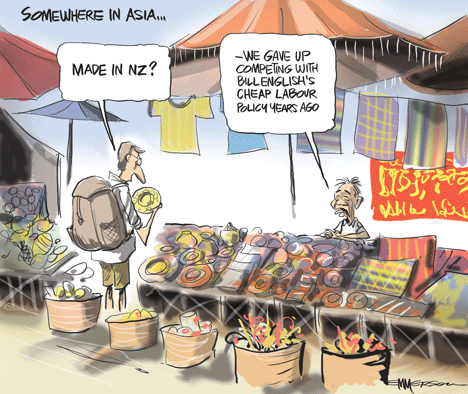
Seen today in the Mustafa Centre ( Singapore ) , entire rows of " Ashburton " brand shirts , thousands upon thousands of them , ... each proudly bearing a " Made in New Zealand " sticker .....
....... and we wonders , is they Chinese knock-offs ......... those scallywags ! .....
.... Mind you , 100 % cotton , and only $S 29.95 each ........ gotta assist the Kiwi export drive ...........
I hope there's no truth to the rumour that you're flying back into the Philippines to join the scramble for Tokey Geckos!?
I have a very large Tokay Gecko who has adopted me as his toilet ..... He pops out from behind the rafters each night , and wanders up the ceiling of the nipa roof to a point above where I sit ........ And cacks on me . Only me . He don't waste his geckky poop on anyone else ....
........ It must be love !
Only the one? We've got a family of Tokays in each of our bahay kubos. Ours are fully house-trained though and keep to the amakan walls. I assume you didn't see my previous comment to you about the Filipino rumour that a German collector is stalking the archipeligo offering up to P1M for a large Tokay? Davao is being stripped bare.
The trouble with standard distribution graphs, is that you get nutters like the libertarian above, at one end of the scale. I'd hoped the silence was a result of his understanding that physics outweighs cranially-held constructs.
Bernard a Greenie?
Where did that come from. From what I've see, he's yet to acknowledge that there are limits to growth, that economic activity is underpinned by energy, or that energy isn't 'a commodity'.
He's a long way from being a Greenie, in my book.
Free trade? It takes one sentence - "we will have free trade". The Australia - USA one runs to 1400 pages. So it ain't one, it's a 1399.9 page list of omissions.
That aside, it just lowers incomes in a country like NZ, to the lowest common global denominator. We have the right to choose not to go there. What we don't have, is the right to load our physical debt on our kids, and theirs.
Book your tickets , gang , B4E is coming to Indonesia soon . ......that is Business for Environment , a mega-conference promoting care for the environment .......
...... And such luminaries as UN big-wig Helen Clark and McMansion owner Al Gore will be winging in from the USA and other far-flung regions of the planet , to hector us all on the evils of unnecessary energy wastage and CO2 emissions ..
..... ( ahem , yeah , right ! )
I read something recently along the lines of "when did the seller ever win in a trade dispute"?
Lots of ramifications in that.
One word..Overshoot, Keynes is easy to understand from an engineering point of view, (read about PID Control). both the Austrians and Keynes rely on an upward path, the difference being that Keynes noted that as the state to a larger part of the economy it was best that it operated counter cyclic, The current money printing is pseudo Keynsian because if the ever upward path is unsustainable, I think the great man himself would have seen this
Neven
I think most new-keynesians do see this....and in fact when you read what keynes wrote (and in fact Ive commented on it in here) this is the case. The interesting thing is when you look other schools of economic thought they often make sense until they get corrupted by polictics.....Keynes in the 70s, and moneterist for the last 30 odd years.....are two great cases in point.
regards
"German unit labour costs have barely risen"
Increases in productivity, restraint in wage settlements.
Simple as.
..but I’m positive ours is safe – probably 20% - ranked under 17 – isn’t ?
With that massive historic gold rush - where did it go ? - sold cheap ? "Good as Gold" - yeah !
Keep an eye on the US energy policy with respect to Natgas...
http://www.nytimes.com/2011/04/12/opinion/12nocera.html?partner=rss&emc=rss
US is importing something like 70% of it's crude oil supply now, so this is about to become imperative, if it isn't already.
Hi ho hi ho... it's back to the banks we go.....
"Banks facing $3.6 trillion 'wall of maturing debt', IMF Global Financial Stability Report says
Debt-laden banks are the biggest threat to global financial stability and they must refinance a $3.6 trillion "wall of maturing debt" which comes due in the next two years, the International Monetary Fund said in its Global Financial Stability Report."
Is this the dirty little secret then...the reason Bollard has his OBR policy in play...are we also witnessing the emergence of a RBNZ willing to go in to bat for the country.....instead of for the bankers!....wait and see on that one.
Another hint here....a whisper...it's on the way....
"French inflation accelerated in March and German wholesale prices jumped the most in almost three decades, adding pressure on the European Central Bank to continue raising borrowing costs."
"I didn't take that pen"......!
Re 2:
So 2 of our business titans were witless enough to fall for a relatively straightforward ponzi scheme? Says all we need to know about NZ business really.
On a similar note when does Terry Serepisos latest time extension expire? Or has his magic $100 million loan come through?
We welcome your comments below. If you are not already registered, please register to comment
Remember we welcome robust, respectful and insightful debate. We don't welcome abusive or defamatory comments and will de-register those repeatedly making such comments. Our current comment policy is here.