

Here's my Top 10 links from around the Internet at 10 am in association with NZ Mint.
I'll pop the extras into the comment stream. See all previous Top 10s here.
I welcome your additions in the comments below or via email to bernard.hickey@interest.co.nz.
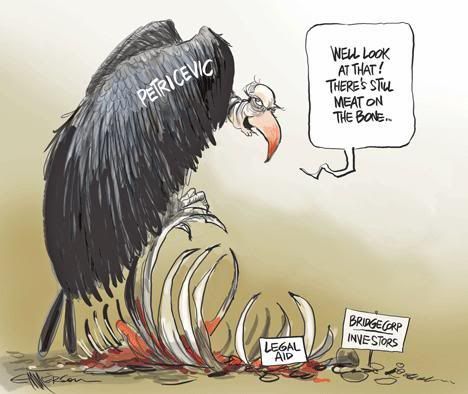
Great Rod Petricevic cartoon below.

1. AMI's board not up to it - Alan Wood at The Press reports company director Richard Westlake saying the non-executive directors on the AMI board lack insurance industry experience.
So why has the government left them there?
They should all have been sacked once it was clear they had failed and to ensure the government's interests were protected.
It's very clear now that AMI Insurance intends to use the government guarantee to protect its mutual status and the jobs of its managers and directors.
Why should taxpayers fund this?
And it turns out the government's director on the board won't even be attending any board meetings for another 5 weeks, by which time key decisions about capital structure and reinsurance will have been made.
The government looks asleep at the wheel on this one, just as they were through late 2008 and early 2009 when South Canterbury Finance under Alan Hubbard when ballistic with the 'get out of jail' free pass of a government guarantee.
Richard Westlake said it came as a surprise to read in AMI's 2010 annual report "that not one of the existing board members appears to have a background in either insurance or risk ... unless you count the ownership of racehorses in the latter category".
"I know, and have considerable respect for, some of the directors – an outstanding retired banker, a leading former retailer, a successful market gardener and so on, but nobody [with] any experience in the industry in which AMI operates."
His analysis showed that Balmforth's own career was mainly in corporate banking, not insurance, he said, and that some board members were long entrenched in their positions. When the company moved into the global financial crisis, the board had not adjusted to the new conditions.
2. How the Romans did it - Zerohedge points to a chart showing how the Roman monetary authorities inflated the away the value of their currency by diluting the amount of silver in the coins.
The nearly 100% devaluation of the currency in Roman times took just over 2 centuries.
This compares somewhat favorable to the 97% drop in the purchasing power of the US currency since the inception of the Federal Reserve.

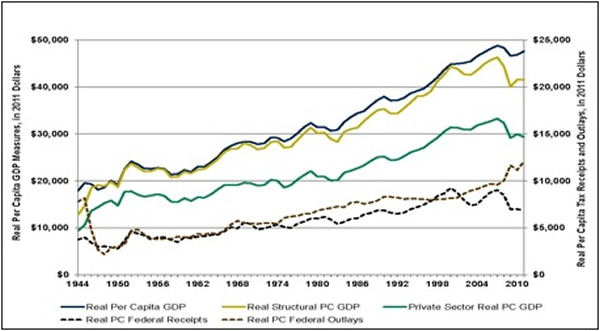
3. A structural problem - John Mauldin at Market Oracle has looked at what happened to US structural and private sector GDP (taking out the government bits) over the last decade.
If we continue to focus on GDP, while ignoring (and even facilitating) the decay of our Structural GDP and our Private Sector GDP, we'll continue to borrow and spend, mortgaging our nation's future. The worst case result could include the collapse of the purchasing power of the dollar, the demise of the dollar as the world's reserve currency, the dismantling of the middle class, and a flight of global capital away from dollar-based stocks and bonds.
Few would argue that a healthy economy can grow without the private sector leading the way. The real per capita "Private Sector GDP" is another powerful measure that is easy to calculate. It nets out government spending -- federal, state, and local. Very like our Structural GDP, Private Sector GDP is bottom-bouncing, 11% below the 2007 peak, 6% below the 2000-2003 plateau, and has reverted to roughly match 1998 levels.
4. How Australia is bettting on China - William Pesek at Bloomberg points out just how dependent Australia's growth forecasts are on unbroken and strong growth in China.
All in.
That’s essentially the message Treasurer Wayne Swan is sending about Australia’s odds-defying bet on Chinese growth. The government’s latest budget pledges to deliver the quickest improvement in the nation’s finances on record -- without specifics about how that will happen.
The absence of such detail is telling and can be boiled down to one thing: an even bigger gamble on China’s 10 percent growth and its voracious appetite for Australia’s resources. It’s risky to so fully hitch the hopes of 23 million people to a single nation that’s still developing.
The defining characteristic of crony capitalism is the ability of favored elites to loot with impunity and the failure of regulators to do their jobs.
We have seen this in the financial crisis that started in 2008 and in an earlier era, when the savings-and-loan industry collapsed.
Nobel laureate George Akerlof and Paul Romer wrote a classic article in 1993. The title captured their findings: “Looting: the Economic Underworld of Bankruptcy for Profit.” Akerlof and Romer explained how bank CEOs can use accounting fraud to create a “sure thing” in the form of record short- term income, generated by making low-quality loans at a premium yield while making only minimal reserve allowances for losses. While it lasts, this fictional income allows the chief executive officer to loot the bank, which then fails, and walk away wealthy.
6. Double dip - Bloomberg reports US retail sales grew at their slowest pace in 9 months after the rise in petrol prices.

7. Contagion to the core - Reuters reports the IMF has warned that debt contagion could spready from Greece, Ireland and Portugal to the core of the Eurozone.
"Contagion to the core euro area, and then onwards to emerging Europe, remains a tangible downside risk," the global lender's latest economic report on Europe said.
Finance ministers of the 17-nation single currency area are set to approve a 78 billion euro rescue plan for Portugal next Monday after Finland's prime minister-in-waiting clinched a deal to ensure parliamentary approval of the package.
But markets are increasingly concerned that Greece will never be able to repay its 327 billion euro ($464 billion) debt pile and will have to restructure, forcing losses on investors with severe consequences in the euro zone and beyond.
8. China commodity imports falling - FTAlphaville reports on commodity import volumes, which are being hit by higher prices...
China’s demand for imported commodities has weakened sharply. The value of China’s imports is still growing rapidly, but this is a reflection of higher global prices. Focusing instead on the volume data, China’s imports of many key commodities are actually falling outright.

9. Totally irrelevant video that makes me feel inadequate about my lovely but non-banjo playing 9 year old and 17 year old children.
10. Totally Clarke and Dawe on Australia's whimless immigration policy.
55 Comments
Re 4
I thought the same about the lack of details regarding the Aussie budget. Can't help but think that the Aussie economy is a stack of cards held up by continued China demand.
I'm thinking the their property market will tank along with any commodities correction.
re #1 i totally agree. any entity that accepts bailouts must be prepared to jump through some hoops.....weather it's AMI or SCF, or a school or dhb, they have proven tht they don't know what they are doing and deserve to be bossed around a bit.
They should also have to dress like pirates (complete with parrot) for 3 years after the bailout.
seeing as its election year i'll go a step further and propose that even some individuals getting personal bailouts (ie teenagers on the dole) should have to do 3-6 months of social service work (trapping possums, or labouring on public works etc) to be eligible for a year's dole.
Ad.2. It is known for centuries:
http://www.nzherald.co.nz/nz/news/article.cfm?c_id=1&objectid=10725384
Brash looks like he gonna target the Super age
And for your excitement, Here's Brash's letter to Key:
Dear John
It was with a very heavy heart that I felt obliged to resign my membership of the National Party and to seek the leadership of the ACT Party.
I reached my decision after watching with mounting dismay the performance of your Government.
You made great play of your ambition for New Zealand, and your determination to close the trans-Tasman wage gap and staunch the flow of our best young minds to more successful countries.
Yet you have done almost nothing to fulfill that ambition, and now appear to have given up on that goal.
I have not.
Why are you continuing Labour’s wasteful spending?
In Opposition, we both railed against the Clark Government’s squandering of our people’s hard-earned resources:
the waiving of interest on student loans, which Bill English rightly called “an election year bribe on an unprecedented scale”
the way the high marginal tax rates of Working for Families create an incentive not to work harder
the exorbitant cost of KiwiSaver subsidies
the unaffordable move from subsidizing doctors’ visits for the poor and chronically ill to subsidizing higher earners’ visits as well.
Yet your Government has done almost nothing to wind back this spending. Two and a half years on, the ratio of government spending to the size of the economy is higher now than it ever was under Labour.
As a result, the Government is borrowing over $300 million a week. That’s $300 added to the debt of every New Zealand family, every week.
That is totally irresponsible. It’s what Labour voters voted for, not National voters.
Why are you stopping young people from working?
In Opposition, National opposed getting rid of the minimum youth wage. One member, I recall, went so far as to suggest this was the route to communism.
You knew the worldwide pattern, as I did – that most employers will not hire teenagers if they’re forced to pay them the same as adults.
Yet in Government, you actually voted against a bill to bring back youth rates. You deprived another 12,000 young people of the chance to get a foot on the job ladder. Instead of allowing them to work for $10 an hour, you consigned them to the dole for $4.50.
That’s what Labour voters voted for, not National voters.
Why did you change your position so completely on the Emissions Trading Scheme?
In Opposition, we both hammered Labour for seeking to be world leaders in combating greenhouse gas emissions. We argued on behalf of our farmers – the lifeblood of this nation – that instead we should be fast followers.
Yet in Government, you’ve introduced the world’s first all-sectors, all-gases Emissions Trading Scheme, sending farmers the message to turn wealth-generating farm land into idle forests.
That’s what Green voters voted for, not National voters.
Why are you ignoring reality on superannuation?
In Opposition, I argued the crucial need to gradually raise the age of eligibility for New Zealand Superannuation, so that it will still be there when people need it.
Every informed observer agrees with me on this. Many other developed countries, including Australia, have already bitten the bullet and announced plans to raise the age of eligibility.
Yet you have promised to resign as Prime Minister rather than face up to this need to secure New Zealanders’ future.
This is just as irresponsible as Labour’s interest-free student loans or middle-class welfare. You are condemning older workers to a sudden shock, or younger workers to intolerably high taxes.
That’s what New Zealand First voters voted for, not National voters.
Why are you widening, not closing, the trans-Tasman wage gap?
In Opposition, we both expressed grave concern about the widening wage gap between New Zealand and Australia.
You gave an excellent speech just before the 2008 election committing any government which you led to bridging that gap.
After the election, you agreed to set up a Taskforce to advise how best to achieve that goal by 2025. You appointed me as chairman of that Taskforce.
Yet to date, you’ve dismissed virtually every recommendation the Taskforce has made. I’ve asked several times if we could meet and discuss our two reports. Each time you’ve declined to meet me.
From time to time, you’ve reaffirmed your commitment to the goal. But there’s not the slightest sign that you’re taking it seriously.
Now you’ve abolished the Taskforce. And of course, the gap continues to grow.
Nobody voted for that – certainly not National voters.
Why did you abandon National’s commitment to equal citizenship?
In Opposition, successive leaders of the National Party have argued for treating all New Zealanders as equal before the law, and for abolishing separate Maori electorates.
Most of your voters would have assumed that a National Government would take those policies seriously.
Yet in Government, you have:
retained the privileged position of Maori under various statutes
ratified the UN Declaration on the Rights of Indigenous People (which even Helen Clark refused to do)
created an unelected Maori Advisory Board for Auckland
created a special Maori advisory committee for the Environmental Protection Authority
made no moves to abolish separate Maori electorates
pushed through the Marine and Coastal Area Bill, despite having pledged to pull the Bill if it did not have broad public support – which it certainly did not.
That’s what Maori Party voters voted for – certainly not National voters.
Why are you running New Zealand for our opponents?
And so John, I’m forced to agree with those who say you are not running the country for the benefit of all New Zealanders, but for the former Labour and Green voters who crossed over to you in 2008 for, effectively, a three year trial.
And, of course, for the Maori Party MPs, for whose support you seem prepared to trade away a vast treasure chest of our nation’s coastal mineral wealth.
Needless to say, honouring some of your commitments would have required courage. Reversing Labour’s immoral election bribes would not have been easy.
But you have spent the last three years building up probably the greatest reserves of prime ministerial popularity in New Zealand history. What’s the point of cultivating such influence unless you plan to use it to help our country?
And if you won’t use it now, in this time of crisis, when will you?
So many people hold you in high esteem. Surely you should easily be able to convince them of the urgent need for responsible economic management. After all, every New Zealand household is having to tighten its belt at the moment. I’m sure they’d support the need to cut wasteful spending, given that we’ve suffered the worst international economic crisis in three generations and two devastating earthquakes.
To be borrowing more than $300 million every week – most of it from foreign lenders – is unconscionable right now. New Zealand’s total overseas debt is already up there with that of Spain and Portugal, and continues to rise.
The electorate gave you a mandate to reverse the excesses of the Labour Government. You had an international environment which demanded firm action.
With ACT’s five MPs, you had a comfortable majority in Parliament. You could have implemented all your pre-election policies.
And so, with deep regret, I felt I had no alternative than to resign my membership of the National Party.
Sincerely,
I have now posted it in full here - http://www.interest.co.nz/news/53439/new-act-leader-brash-questions-pm-…
PLEASE READ CAREFULLY
Hi, as a rule, I don't pass along these "add your name to the list" e-mails, BUT this one is really important.
It has been circulating for a month now and has been sent to nearly 2 million people.
We don't want to lose any names off the list so just add your name and then forward it on to your friends.
Please keep it going!
Your support will make big difference!
Scroll down for list.
To show your support for the MP, Hone Harawera, and the job he is doing please go to the end of the list, add your name and then forward to your friends for them to do the same
1. Titiwhai Harawera
2.
"But you have spent the last three years building up probably the greatest reserves of prime ministerial popularity in New Zealand history. What’s the point of cultivating such influence unless you plan to use it to help our country?
And if you won’t use it now, in this time of crisis, when will you?"
So its OK to go back on the mandate you got elected on in a lurch to the right Labour foretold....on the pretext of the first suitable opportunity that comes along....
"help our country" a view of maybe 4% of the population....throw in some National voters, say 10% its still only a minority opinion...what he really means help the 1% of the population and the next 9% who want to get into that 1%....by screwing the other 99% over....
regards
Steven, sorry but that is a load of crap. Don is clearly the most articulate, considered, and honest politician in NZ today. Practically everything he says makes perfect sense and it is obvious that he is here because he wants to effect real change for the betterment of NZ society.
Just because his views are not shared by the majority does not change the fact that they are right. People want to bury their heads in the sand and pretend that everything will be alright without taking their medicine. Sorry but it aint going to happen. Fiscal responsibility is needed NOW.
I had high hopes for a John Key led National government. But it is clear now after three years that National under his leadership are exactly what Don has set out in his letter. I am glad that he sent this open letter because it is completely on the money.
Congratulations Dr Brash. This country needs to hear your message.
i get what you're saying superman, but the act platform is a continuation of the neoliberal policies that have got the world into this mess.
i agree with balancing the budget - that's sensible - but i do not agree that someone who has been such a part of the establishment that created this mess is the right man to dig us out. brash does stand out as someone who is ready to make some tough calls and possibly only be in for one term, but his history is one of banking and bankers, and they are a large part of the mess we are in.
we agree nz and the world is in a terrible mess, but is that the fault of the hotel cleaners on $12/hr, or the 27% of youth who can't find a job, or the thousands of small business owners who fight to match the political influence of the comfy duopolies this govt so adores? or is it the fault of the people with their soft little hands on the levers of power who have had 3 decades of neoliberalism which resulted in widening wealth inequality, crap-filled rivers, and an eviscerated manufacturing sector.
like i say superman i agree we're in a parlous state, but i fear many people will vote for a party who cannot see the wood for the trees, blames the patient for the illness, and drives the ambulance full-tilt into said trees. (sorry about the mixed metaphor)
"what are the better options?" i hear you ask, in desperate attempt to avoid the fact that i am fundamentally correct. pass. all options are terrible, but i really doubt brash has the answers you are hoping for
And the following.. Vanderlei is exactly what got me started up the other day.
"what are the better options?" i hear you ask, in desperate attempt to avoid the fact that i am fundamentally correct. pass. all options are terrible, but i really doubt brash has the answers you are hoping for"
It's a nicely penned collection of thoughts that offers no conclusions........that could have easily ended with...Oh Well....?what ..can I do.
I really think you should stay involved make some decisions and run with them if you believe they are nearest to your values.........but to disect....and not draw some conclusion leaves the frog dead and no one laughing.
Apathy is the enemy standing closest to us all the time.
fair point christov. i send many emails to mp's but have young kids so lack the time to do a great deal more at present. i agree involvement is important though and we are lucky in that we can largely get political without risking our lives.
i do like this forum though...most respectful and a good left/right spread
my idea for today is re mp's pay : what's the budget of the rumuneration authority? save that money by scrapping it and holding mp's pay at current rates then pegging it to annual rises or falls in the average wage. that way they have a real incentive to get wages up across the board.
"but i do not agree that someone who has been such a part of the establishment that created this mess is the right man to dig us out"
This is typical of the unfounded criticism that keeps getting thrown at Dr Brash.
As governer of the Reserve Bank Dr Brash did an excellent job of meeting the policy targets that were set by the government of the time. If I recall correctly the inflation target was 0-2% and he kept inflation at a steady 1% for almost the entire time he was there.
Dr Brash has never been in government, so has never had his particular blend of policies enacted.
It is completely unfair to blame him for others failures.
The main flaw I see in your argument is Brash's continued assertion that was need New Zealanders to be treated as one people. One law for all.
Well I used to believe that once, but the reality is that we have two cultures in this country that are polar opposites. You will never make one people.
Some other solution to the problem needs to be created. Not that I have it.
His brand of policies are not unique....and as we can see from the GFC are not only a failure but are shaping up to the worst failure in living memory...
regards
Brash articulate, considered, honest? WTF? What did you have for breakfast. Can I have some?
This is the Don Brash of the Hollow Men, the Don Brash of failed economic ieology, the Don Brash of racsist sentiment ......
What are you smoking?
Articulate....hahaha
Considered? he who opens his mouth to insert foot? kidding right?
Honest? butter wouldnt melt in his mouth? I dont think so somehow...
"right" no, a society makes choices...there is not right or wrong in this context.
Fiscal responsibility, we agree here, taxes need to go up.....simple.
"hear your message" totally agree I think its great....he'll rob votes from National and the double whammy is that will cause loss of votes for National at the centre, where the swing voters are who voted JK in, just needs 4 seats worth of losses, this above all else has put Labour back in the running.....not that I want a Labour Govn, but its the lesser of two evils, if the result is a drag to the right, which with idealogues like Brash is the only way is the alternative.
regards
Hey Christov, I was struggling where to put my vote and had pretty much made up my mind that nobody was going to get it. I don't agree with all of Acts policies (specifically asset sales) and probably need to read them in more detail but after reading the above letter, Don gets my vote.
Mine too
probably mine too - it cannot get worse than it is.
Good for you meh........it's much better to know.....its much better to do......stay involved.
While the Good Doctor has many detractors.......I think his letter of resignation from the party echoes the thoughts and feelings of those who voted for Key ...and for exactly the reasons he outlines....
His letter is a thoughtful ...articulate summation of disapointment...disillusionment...and regret... that so many of us ,held some confidence in someone who has behaved only a little short of Judas Iscariot......to National's core policy. .
I said the other day ...I believe key has a real ...need...for approval...to be everything to everyone.....and he behaves in exactly that way.
Christov - there are a lot of folk, some who comment here, who haven't the cranial ability to grasp what is really happening in the world.
I regard Hugh, for instance, as one such. Claims the right to an opinion, while simultaneously claiming the right to 'leave it to the experts'.
Those folk are just invalid, so too are those of small-enough mind to vote for their hip-pockets, ie vote for "tax cuts", somehow failing to associate the vote with the fact that their health insurance, private tutors and private security guards would take up the fiscal slack.
You, however, seemed to have a brain. To understand what is ahead - and clearly, the Brash approach is not going to address limits to growth, sustainability, or the sad fact of a gaussian curve. For a start, the words are all too big.
Eh tu, Boris?
Et Tu...PDK.....for if he were slain for his ambition ...then ambition should be made of sterner stuff.
My point PDK has been to encourage people to at least be decisive...whether or not I support that political persuasion is of no consequence at all...
through involvement ...not apathy...we will begin dialogue between different interest groups that will include and involve us......and so I make no apologies for supporting people who at least are making judgement calls.........for THEMSELVES...right or wrong .
For my own interests there is no party that campaigns on Human depopulation....There is no party...that does not attach growth and prosperity without Human increase.
Your a smart guy......I don't need to be all that smart to see that......but for me I'd like to attack the cause before the effects.
You have my respect for your committment as always....P.S. Steven too in a funny way...he's ok that guy.
How do you campaign on depopulation?
Even zero growth would be a huge start....however when you look at food production problems in the last year which are amongst the worst ever and how this year seems to be shaping up (not good) and biggest of all 2012 and/or 2013 will probably be the hottest year(s) so far on record you have to scratch your head on just where food is going to be coming from.....because if Russia has another 2000 year event in 2012/13 and the US's small problems in Texas ballon we have a serious food shortage scenario.....and Wolly will go balistic because food will just rocket.....
regards
When you can find a pallatable answer to that Robby217...i'll be there before you can blink.
pallatable? ouch terrible choice of phrase IMHO...the way population is going, rapidily its looking like there wont be much left to eat.
regards
Touche Steven.....even shish kabob...
Not sure a party campaigning on human depopulation would help NZ that much. I'd say NZ was depopulated enough...
But globally speaking I agree, just not here. NZ is 137th/140th on the "birth rate list" http://en.wikipedia.org/wiki/List_of_sovereign_states_and_dependent_territories_by_birth_rate. Hardly the worst offender.
Agreed Elley ...but the thought has to be beyond our shores and our inability to think beyond our own mortality.
here's something really disingenuous - Olam blaming the 'surprisingly high Fonterra milk price' for Open Country Dairy about to post a loss, and then saying if the inquiry into milk prices doesn't lower the price they may pull the plug on their Open Country investment.
Errr..... Open Country Dairy is the second largest milk processor in NZ. They have their own supply base. If they are paying their farmer suppliers too much, just admit it. No one is forcing them to buy cheap Fonterra milk. They knew the rules when they greedily sought out the 'cheap' milk from Fonterra. Given that they do not compete with Fonterra on the fresh milk market, they should just suck it up guys.
DIRA milk should only be available for NZ domestic consumption. The Greens are voting against the changes going thru parliament to DIRA because they don't believe Fonterra should have to supply milk to its competitors to compete with them on the export market. Didn't think I would be congratulating the Greens on their commensense. At least they can see through all the rubbish that the milk price is really about - supplying exporters with cheap milk, it has nothing to do with the domestic market. Pity National and Labour can't also see it - too many matey snouts in that trough.
http://www.nzherald.co.nz/business/news/article.cfm?c_id=3&objectid=107…
Don't be surprised for Fonterra to make an operating loss this year.
The payout is grossly scewed above sustainable levels. Henry is helping out highly leveraged farmers, but also lowering the share price, so he can buy up.
The payout is being forced up which massively damages the highly leveraged competitors. They can not win.
love to see keys letter of reply,bit hard to write when you're waving.if aussie crashes we'll still have a great welfare system waiting for our returned countrymen/women.
I agree completely Hugh.
John Key is a classic example of the tail wagging the dog.
I should vote for Don Brash given my cicumstances as he is really only interested in making things good for those at the top of the economic tree by slashing and burning the hopelesss and the helpless. But I don't like these politics, a vote for the Roger Douglas ACT movement would just be supporting the one (right-wing) extreme ,flip the coin and then you're voting for the other (left-wing) Hone-Greens movement. Can still remember the Douglas era and thanks but no thanks on them rising from the ashes again in another guise.
I too can remember the Douglas era. Your comments are the typical cr*p that is infecting this forum.
NZ was practically insolvent, on the verge of a sovereign default, and that was caused by none other than Robert Muldoon.
Douglas, Prebble, and Richardson did what was required to prevent a complete collapse of this country's economy.
But people only remember the pain and associate the pain with those who enacted the tough policies to bring us back from the brink.
I only wish that more people actually educated themselves to NZ's economic history.
You could start educating yourself about NZ's economic history under Douglas/Prebble/Richardson and how much it put us back by reading Brian Easton.
From what I have read Muldoon was only taking advice from Treasury. You know those people that we don't get to vote for.
Anyhoo....It's Friday time for a smile....FCM's was a goodie!
In honour of the Good Doctor who may now be a little older...a little wiser..
A guy is 74 years old and loves to fish. He was sitting in his boat the other day when he heard a voice say, ' Pick me up. ' He looked around and couldn ' t see anyone. He thought he was dreaming when he heard the voice say again, ' Pick me up. ' He looked in the water and there, floating on the top, was a frog. The man said, ' Are you talking to me? ' The frog said, ' Yes, I ' m talking to you. Pick me up then, kiss me and I ' ll turn into the most beautiful woman you have ever seen. I ' ll make sure that all your friends are envious and jealous because I will be your bride! ' The man looked at the frog for a short time, reached over, picked it up carefully, and placed it in his front pocket. The frog said, ' What, are you nuts? Didn ' t you hear what I said? I said kiss me a! nd I will be your beautiful bride. ' He opened his pocket, looked at the frog and said, 'Nah, at my age I ' d rather have a talking frog. ' 7
So, 'the frog' is a metaphor for the ACT Party, right!
if that works for you Snarlypuss.....why not.
FYI from Stuff
http://www.stuff.co.nz/business/rebuilding-christchurch/5001222/Christc…
More than 1000 quake-hit buildings are expected to be demolished in Christchurch, including up to 900 in the central city.
On a tour behind the inner city cordons this morning Cera interim deconstruction manager Warwick Isaacs said about 900 building were expected to be demolish in the central city, with another 300 commercial buildings in the suburbs.
He did say "more than 1000"
.
"not where Key has taken it, somewhere to the left of Labour." Key is a little right of centre IMHO....me thinks you are confusing the centre with where you are and not where most ppl are.
Brash messages.....quite the reverse....its more likely the floating centre that put Natioanl in will run back to Labour, sure some in National will go to ACT, National /the right only need to lose about 4 seats....not a huge ask. Splitting the right and where one half is clearly a far right party has in the past been one sure way to guarantee opposition benches and political obscurity........Im sure Natioanl core voters will be s impressed if thast the case.
Liberals, in the UK liberals are actually a centerish party though can have quite leftie or right wing parts/policies, more like NZF than a re-born ACT....I cant see ACT being anywhere near a liberal....he's just out there right wing....
"into Government"? you talk like Brash will become PM....cant see it somehow...
"very carefully" he's always been a bull in a china shop....I see nothing to change that...
Playtime is over....indeed it is, but I dont think you realise yet just how obsolescent urban planning etc will become....at least in your context.
OZ bubble bursting.....indeed but you miss our burst maybe? as if we can survive if OZ goes...
regards
"United Kingdom
"Liberal" in the United Kingdom is customarily used to describe political beliefs in the classical liberal tradition of the old Liberal Party, rooted in a belief in freedom of the individual. It is also used as a short hand to describe policies of the modern Liberal Democrats." Liberals as such have not been around for well over 100 years.....Labour ate their political base.....
Key needs Brash like he needs a hole in the head.....do you really think Brash will win voters (except from National) or even see National keep voters from the middle ground? I cant see it.
In terms of policy from National we have just gone into the greatest financial crisis since the first Great Depression. In those circumstances the policy is one of flexibility and keeping options open....if we had had Brash /Rodney near the helm we would have a depression on our hands and huge housing losses.....Labour would have probably gone into far larger debt instead and collapsed our standing/rating which probably would have kead tot he same thing eventually. So generally I give JK and BE a big tick for keeping us afloat remarkably well...helped by Dr Bollard as well I shall add.
So what ou see as a failure, I see as a) keeping to the mandate JK got elected on and b) protecting our Nation from what easily could have been far worse....
Not that I think we are out of the woods yet, far from it....its only just begun.
regards
Im staying with friends in San Jose just had dinner at Santa cruz only $100 for 4 of us to eat so cheaper than NZ. My friends are in the tech world and `google are looking at employing 25,000 people in the valley so optimistic around here.
Elley have you seen this `dilbert?
I have now, and had a good laugh :) Good one. Seriously, being an engineer is not all that bad (and we're not that different!).
I'm optimistic here too btw. If anything, we have trouble juggling all our "tech world" projects at the moment (and I doubt it'll change anytime soon). Have to be disciplined about not working too much.
And Radio NZ says CERA reckons 1,200 buildings will be demolished in commercial areas...
A post by Me says Brash is going to reincarnate the Roger Douglas brigade. What about Ruth Richardson who followed? She espoused the same nonsense Brash is now touting, and all I can say some people must have short memories how disastrous the plans proved in practice.
Remember that bit about NZ being flea on the arse of a dog that had its teeth into a dragons tail...
. "Those looking for bad news can find plenty of it in Australia, which in my opinion is soon headed for recession and rate cuts"
"Driver wins battle with Wellington council parking spies"
http://www.stuff.co.nz/national/5003401/Driver-wins-battle-with-Wellington-council-parking-spies/
Some brainless WCC bureaucrat thought this spy car business would be a money winner....turns out to be a load of thieving....why should wgtn drivers put up with this...me thinks the WCC will soon need to hire an army toy tank to do its thieving....At the very least the WCC should refund this driver the costs she had in proving she was not bloodywell parked....to raise the funds for that the WCC will no doubt send out its thieving spy to steal more.
This is actually an interesting read. Not really economic, but still related in a round about way. http://app.response.stratfor.com/e/es.aspx?s=1483&e=290046&elq=c4808fb609b541bcb6322b3ea696f532
The exterior lines of Israel's neighbors prevented effective, concerted action. Israel's interior lines permitted efficient deployment and redeployment of force. It was not obvious at the time, but in retrospect we can see that once Israel existed, was united and had even limited military force, its survival was guaranteed. That is, so long as no great power was opposed to its existence.
#1 AMI's governance failed to manage a risk that has been known for decades. The impacts of a large scale quake on Christchurch were studied in the early 90's and all the issues of liquefaction in the eastern suburbs were identified then.
As to the likelihood of a large-scale quake. Look no further than documents compiled by the Ministry of Civil Defence and Emergency Management in 2001 advising the incoming government that there was a 50% chance of a M8+ scale quake in the Alpine Fault before 2021.
In response to bernard's headline all I can say is "hear hear"
We welcome your comments below. If you are not already registered, please register to comment
Remember we welcome robust, respectful and insightful debate. We don't welcome abusive or defamatory comments and will de-register those repeatedly making such comments. Our current comment policy is here.