

Here's my Top 10 links from around the Internet at 1.30 pm in association with NZ Mint.
I'll pop the extras into the comment stream. See all previous Top 10s here.
I welcome your additions in the comments below or via email to bernard.hickey@interest.co.nz.
This goes with my bearish party piece from yesterday.

1. 'Borrow, borrow borrow' - Westpac, the bank that is advertising 95% home loans again most prominently, is telling staff in Christchurch to get on with the business of lending, Stuff reports.
Yet our Reserve Bank is perfectly relaxed.
It's true that lending growth is weak.
But it feels a lot like the banks are flogging a dead horse...and there's risk they over reach in that desperation to lend.
Westpac is very aggressive. As is CEO George Frazis, or as we like to call him, the NZ$6 million man.
To be fair, it's not the only one. ASB and BNZ are also very busy these days offering 90% plus home loans. ANZ and National not so much.
Here's Roeland van den Bergh reporting at Suff:
Westpac said yesterday that demand for lending had returned to levels before the September quake and it was recruiting more staff to meet customers' expectations.
Westpac said yesterday that demand for lending had returned to levels before the September quake and it was recruiting more staff to meet customers' expectations.
But Finsec legal organiser Oliver Christeller said there had been a disproportionate amount of concern raised by Westpac staff in Christchurch compared with other banks. Workers were calling on Westpac to follow the example of other banks and ease sales targets to reflect Christchurch's circumstances.
"Westpac tellers feel pressure to sell financial products where they don't always feel they are in the best interest of the customers," Mr Christeller said.

2. Inflation anyone? - NZ Funds CIO Michael Lang tells Stuff he expects inflation to go to 5-10% with in the next 5 years.
Mr Lang said the expectations in the June survey were a "20-year high" and the Reserve Bank's inability to curb it "is a precursor to inflation getting out of control".
"If businesses expect inflation to rise next year they will put up their prices in anticipation this year. This in itself creates inflation, validating their concerns and turning inflation expectations into a reality," Mr Lang said.
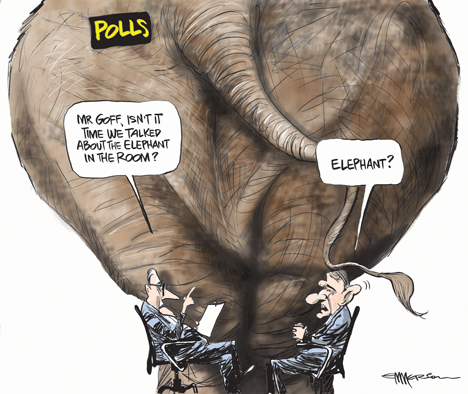
3. Does anyone see the irony in this? - Bloomberg reports Greece has started selling more of its main Telecom monopoly to Deutsche Telekom.
I suspect the Greeks don't (see the irony). The Germans might. Either way no one is really very happy. Some memories are long, particularly in that Greco-German relationship.
OME-OTE, the umbrella group for unions at the Greek company, said today that it would hold a series of walkouts to protest the state “retreating” from OTE. A three-hour walkout is scheduled for June 2, with a 24-hour strike called for June 9 and again on June 15.
The Greek operator saw the steepest annual loss in sales among all of Deutsche Telekom’s national units in the first quarter as phone-line users and mobile customers defected amid the country’s economic slump.
4. How the US middle class is being crushed - Businessinsider points to a new report.
The American middle class is being crushed by rising prices in everything from healthcare, to education, to food, while simultaneously suffering from a weakening employment and wage situation, according to the New America Foundation's presentation "The American Middle Class Under Stress."
The report, by Sherle R. Schwenninger and Samuel Sherraden, details how all of these factors are coming together to inhibit to damage the core of the American economy. It also details the decline in social mobility for middle class Americans and how debt is still playing a big role in the economic class' position.

5. Savers are at a disadvantage for years - Here's PIMCO boss Bill Gross on the outlook for inflation, interest rates and US debt. He's always worth a watch.
"What we're trying to do is find countries that are less financially repressed," Gross said.
“Savers are being disadvantaged” when compared with debtors, Gross said during an interview on Bloomberg Television’s “Surveillance Midday” with Tom Keene.
“What policy makers are trying to do is rebalance this imbalance, in terms of too much debt and too attractive rates on savings. It’s basically called financial repression. We call it pocket picking.”
He's talking about puting money anywhere but America, where interest rates are zero %.
How about NZ? Much higher here.
You'll have to compete with the Chinese....
6. The scale of things - Just in case you were wondering what's going on across the Tasman, the Herald Sun reports there are A$173.5 billion worth of resources projects on the go in Australia. That's equivalent to 100% of our GDP.
This figure represents 94 advanced projects -- including big iron ore expansions by BHP Billiton, Rio Tinto, Fortescue Metals Group and the $US16 billion Gladstone LNG venture.
Another 305 earlier-stage projects were in the pipeline, the Australian Bureau of Agricultural and Resource Economics and Sciences said.
"Commodities attracting the most investment are oil and gas, iron ore and coal and associated infrastructure, which collectively account for around 92 per cent of all committed capital expenditure," ABARES acting deputy executive director Terry Sheales said.

7. Not long - How long before Hong Kong drops the Hong Kong dollar in favour of the yuan? Simon Black at sovereignman has a view. HT Troy via email.
Yuan-denominated deposits in Hong Kong banks have more than TRIPLED this year as people look for ways to protect their purchasing power. Because the Hong Kong Monetary authority pegs its currency to the US dollar, Hong Kong ends up importing US inflationary monetary. This is acutely felt. Since Hong Kong is little more than a barren rock, nearly EVERYTHING is imported… so prices are rising in accordance with US dollar inflation.
To guard against this constant loss of purchasing power, many Hong Kong’s residents are converting their savings to Chinese Yuan. While the Chinese Yuan closely shadows the US dollar, it has steadily appreciated and is perceived to have significant future upside should the Chinese ever allow it to appreciate more quickly.
8. Will they or won't they? - Karyn Scherer at the NZHerald has a look at whether Jiang Zhaobai will be allowed to buy Crafar Farms.
She also looks at how farmers feel about encouraging such sales to foreign interests. Conflicted is one description.
Here's a sample.
"Where's that fresh capital going to come from? It's not coming in great speed from existing farmers because we're still a bit cagey about what we've been through, and we're not sure what's around the corner. A bit of stuff is coming out of the cities... but the big dollops are from those countries with the cash and the real drive to secure some more food assets."
As we have all learned in the wake of the global financial crisis, the bottom line is that far too many Kiwis - in the country and the cities - have borrowed far too much money and few are in any position to borrow any more.
"Sure, we've got to be careful of not losing too many of our assets offshore where we do have a competitive advantage, but we also have to recognise that we do need outside capital. We are over-indebted. We've seen what's happened to our forestry assets and our banking assets and we all look back in hindsight and say: 'What a shame we all let that go'. But basically it's our own fault. Whether we're going to learn this time, I just don't know."
9. Not so much oil - Remember the massive Brazilian oil find a year or two ago that was going to save us all?
It's not as big as we all thought, Bloomberg reports.
Brazil’s oil regulator reduced its estimate for the Libra field after conducting a drilling program at the site, director Magda Chambriard said.
The agency, known as the ANP, said the field likely holds 5 billion barrels and may contain as few as 4.5 billion barrels, Chambriard said today at the Latin Oil Week conference in Rio de Janeiro. That’s down from a previous estimate of as many as 15 billion barrels.
The agency said in October that the field may hold “gigantic” reserves almost twice as large as those of Tupi, which has since been renamed Lula and was the biggest discovery in the Americas in the past three decades. Brazil is counting on large discoveries in the so-called pre-salt region offshore to fund social programs aimed at reducing poverty in South America’s largest economy.
10. Totally Clarke and Dawe - Fred Dagg is in Paris covering the French Open. Not one of their best, but the patois is amusing
19 Comments
Here we go again. The first part is OK.
The second is unthinking mantra. Sorry Hugh - you've had the reasons.
When did you start down this this narrow road? That 'nearly 20 years' ago?
Brent Crude traded in the $18-22 a barrel range in 1991.
It's at 114 or so, at the moment.
If we take a global inflation rate of say 3.5% average Tthere are lots of set of figures out there - perhaps BH could pick it better) then we get a doubling in 20 years. That would equate to $ 36-44 a barrel.
The best figure then, has energy 2.5 times higher than it was, in real terms. Given that energy is required to make ALL the materials in a house and it's attendant infrastructure and construction, and that every development is 'further away' in both respects (further for the truck and the sewer) even as folk suddenly require three designer dunnies apiece, and double glazing became mandatory.............
But oh no, It's them dratted Councils.
Sorry, but you really should do some learning. I'm serious - those open-to-the public energy lectures at the Physics Dept would open your eyes. You're boxing at the wrong shadow.
Oh, and all incomes are related to energy being expended. Which is 2.5 times more expensive, as we know. Has your beloved 'median multiple' adjusted accordingly?
Seriously, there has been a paradigm change. Get used to it.
The cost of energy argument seems flawed - indeed it would affect the cost of housing, but shouldn't it affect everything else to a similar degree too?
PDK
Are these lectures anything along the lines of this?
http://www.youtube.com/playlist?p=PL6A1FD147A45EF50D (Prof. Albert Bartlett)
This is one lecture I pay great attention to anyway.
regards
Hugh - sorry, but 'respect' gets a little lost when any species goes into overshoot. In all cases, it ain't pretty.
This is the first time a cognitive species has had the ability to anticipate, and - dare I say it - to reason. It'd be a pity if we missed the chance, by failing to use that reasoning.
You and you mate PB, fail the 'reason' test. There was a Kim Hill interview of a similarly flawed cranium this morning - someone who noted the increase in population and the increase in living standard, but who then made the fundamental - and I chose the word carefully - mistake of assuming that population drove living standard.
Actually, access to cheap energy, enabling you and me to act as if we had a permanent force of 300 (NZ) to 1000 (US) permanently available to us each, no control or feeding needed, is what drove the comfort thing. We simply have to work less, physically. If we fail to fing an ever-increasing supply, that process no longer applies.
Andrew S - yes, energy drives everything, and as an incidental, the cost thereof. But beware of assumptions based on thus-far's: If energy is required for everything (it is) then if you peak the supply of it, is measuring it's 'worth' in $ terms, still valid?
Surely, the 'worth' has to be in terms of energy? It's the 'driver', not $. It's the underwrite. (I always get a chuckle from the thought that notes and coins are made with machinery.......) What I suggest, is that a fiat/levered/profit/interest fiscal system, only makes sense (can only work) if the supply of energy continues to increase, and/or you get more efficient using it. If your system can't get bigger/faster any more, the fiat falls over. Many of us reckon we're seeing that now, globally.
Al R - Yes, Bartlett is one of the smarter human beings:
"A thug who carried out horrific acts of torture for Zimbabwean dictator Robert Mugabe has been allowed to live in Britain - to protect his human rights."..Daily Mail...
No wonder so many Poms wanna leave the UK....unbloodybelievable....bet the shite is on welfare too.
There are two reasons those who can leave the UK:
1 The Weather
2 The Capital Gains Tax.
Pssssssst...wanna know the truth...YOU'LL NEED A GAS MASK !
http://www.marketoracle.co.uk/Article28324.html
Hugh said:
"......There is a world of difference in a city's capacity to recover, if its housing is already severely unaffordable...."
The same applies to economic stagnation. Look at Northern Britain. It's "Detroit with unaffordable housing". Some of the rust belt cities in the USA, like Pittsburgh, have bounced back. This would never have happened if their land hadn't bottomed out in price, enabling new ideas in land use to be put into practice very cheaply, both by the private sector and the public.
Northern Britain, in contrast, has had double digit unemployment for 20 years, yet house prices remain seriously unaffordable and the cost of land for business is still a disincentive to location there.
I think NZ is acting as the world's laboratory once again. Because we have such low population and weak industrial sector, land use constraints kill our economy much quicker than, say, Britain's one under the same conditions of constraint (kind of canary in the coal mine stuff). I'd say we can be northern Britain within 1 economic cycle. The ChCh issue is just another related illustration for the benefit of the rest of the world, about what heavy handed planning and inflated land prices do for disaster recovery.
As for Westpac, Roeland Van Den Burgh sure said it. Their staff are already getting a reputation all over the country, for trying to push non home owners into a home on 5% deposit. Shades of "Century Finance" in California.
The international hedge funds "shorting" Aussie banks right now are focused on Westpac, I read on some of those really informative Aussie business blogs. Shades of John Paulson and Steve Eisman.
While we love mocking the stupid Yanks and Wall Street greed, how much more stupid do people have to be to re-enact the same stupidity several years later. NZ actually "peaked" at the same time as the USA did, we have had a much more gentle deflation of our housing bubble so far, and if we just kept it going slow and steady we might rescue our economy better than most. But no, re-inflating the bubble is still subscribed to all over the place as a "good idea".
Question. There is a "productive" part of the economy and a "non productive" part. HIGH and inflating land prices represent "wealth" to ONE part, and COSTS to another part. Which way round is it? How smart ARE we all, from the Reserve Bank, the Politicians, and the Bank Chief Economists down?
By the way, Hugh, congratulations on "comment no.1". You even beat Wolly, which is no mean feat.
I'd be damn keen to read that article you're planning Hugh - I think it is a huge opportunity in Chch but one just as easily wasted - the more views on this that comes from the likes people with expertise such as yourself the better
Whilst I tend to agree with you, I'm a little bit uncomfortable with Westpac's approach, I guess there's only one thing worse, as we're seeing in the US and other places, a total cessation of lending. That said, good to see all the banks front with so much in cash donation, and probably Westpac in particular for the additional creation of the Westpac Business Hub beside the CBS Arena which will have cost them a pretty penny, and will be a big boost for some businesses.
undefined: undefined »
We get periodic reports from Braziers, who manage our investment properties. Immediately after the Feb earthquake the market went nuts as everybody (including us!) scrambled for a place to live.
This was short-lived, however, as many people left the city. Some tenants left leaving vacant rentals, and some home owners also left, becoming 'accidental landlords' as they put their now empty properties up for rent.
At present the count of available rental properties continues to rise, with more than 1400 properties listed on TradeMe. Nobody wants to rent in the east or in the middle of town, so moving those places is hard. Not to mention flats or apartments - everyone wants to live with their feet on solid ground!
Now landlords are having to resort to tricks and freebies to move properties. If the govt. builds these temporary homes, I wonder if anyone will move into them - it doesn't look like they're needed.
It won't last forever. The place will be rebuilt, if only because everything's insured. The earthquakes will settle down, and the place will probably be built to better withstand them. But until that happens we'll be seeing depressed rental levels for some time yet.
Auction of properties in the west seems to be going well after the earthquake, know a number of people that have been able to sell over that part of town. Interesting that the two offices I'm involved with that have moved out of town... one because of the Feb. earthquake and one had decided to relocate prior....both relocated staff after Feburary though...majority of staff have moved their properties on the market...
In addition the movement to North Canterbury has been substantial, Rangiora properties are selling quickly. I live on a block of land out North and note properties that have struggled to move over the past two year have all recently sold, expecially over the past six weeks.
Banking around the world is taking a bigger and bigger slice of the pie. In New Zealand you can see it in the Dairy industry. Banks create the cash, lend the money and overtime get more and more of the income from the Dairy Industry. New Zealand is in the middle of a massive commodities boom and has never felt poorer and the massive increase in debt is the answer. The other thing that this fantastical increase in debt has done- if you are a monitariest- is to cause a massive inflation/reduction in the value of the New Zealand dollar as with have folded the country with debt money - none of it in our control.
Meanwhile the government decides that it is all nothing to do with them. So we need to elect governments that thingk that it is something to do with them.
1. Get total debt under control- capital ratios/lending ratios for the banks
2. Control foreign ownership- why - we are not america- the whole country can be bought by a couple of soveriegn wealth funds, we simply cannot compete on the open market for our productive assests. It is impossible, so we need to come to terms with this fact and behave accordingly.
3. Invest in things that actually matter. People (health education, looking after the elderly the young)
4. Bring more of the Cullen fund home to invest here- over time bring it all back. Maybe iversifying does not work after all. At least not in the way we think. We as a country need to invest in ourselves, to diverify our economy, not simply throw the money at New York and London bankers to do the work for us (in between lap dances- these bankers simply piss our money up against the wall call us suckers and then tell us to be more prudent- give me a break)
5. Tax Land. It is simple to do, it wil have to be done eventually. It works in lots of ways. Moving to taxing rent seeking behavoiur - through a land tax rather than just taxing effort, enterprise and activity as we do now will actually help a great deal to increase the quality of life of everyone. We will work better, harder and faster. we will move to competeing in the world rather than siting back and waiting for the world to buy whats left.
6. Stop the stupid idea of selling off our Power Stations. we need power, reiable affordable power to run our economy, selling it off will not help us in this regard.
Getting rid of this stupid, useless government is the first step. They have had three years and have done nothing of any real use. So get rid of them. This is not a Labour vs National rant, it is a "We have to tell them what to do thing" otherwise they will sit on their hands, or worse listen to bankers and other fruadsters.
Plan B
Read bitly.com/gsctEY
Plan B, thats sounds like a good start.
Wonderful piece on the collapse of the US economic/democratic systems:
http://www.guardian.co.uk/commentisfree/cifamerica/2011/may/27/economic…
History suggests nothing of the sort.
History tells you that Britain got a jump-start on the world by being first out of the blocks using coal as an energy source. The USA overtook Britain, due to having an onsite source of a more compact form of energy - oil. Interestingly, much of it from Texas.
That peaked in 1970, Nixon uninned the USD from the gold standard, Kissinger was clever in pinning oil to the USD (he understood what the real underwriter was) and it's been downhill from there.
America isn'r coming back. Sure, you can cherry-pick the still-dry deckchairs (you do it with Texas ad infinitum, and we had Pittsburg here this week), but the ship, on average, is going down.
Back to your 'rights' and 'respect'.
Do you think that future generations have the same rights?
Hard to imagine anyone having the gall to say no.
So - they have rights to the house of their wishes, anywhere they want?
Made from resources, assembled with energy, as is done now?
Who makes sure there's something left for them to do anything with?
I suggest it's the RMA - which doesn't do enough, and I can't think of another. And you want to trash what? I suggest, you want to trash the chances of future generations.
That's not giving them rights, it's lobbying hard to take their options away, on behalf of yourself and your generation, while they have no councel, no advocate. That's pure selfishness, and ignorance (pretending that the planet is infinite - whether it be pretending to youself or to an audience - is ignorance any way you look at it) is no excuse
With respect..
OOp, in the wrong place.
We welcome your comments below. If you are not already registered, please register to comment
Remember we welcome robust, respectful and insightful debate. We don't welcome abusive or defamatory comments and will de-register those repeatedly making such comments. Our current comment policy is here.