

Here's my Top 10 links from around the Internet in association with NZ Mint.
I'll pop the extras into the comment stream. See all previous Top 10s here.
I welcome your additions in the comments below or via email to bernard.hickey@interest.co.nz.
This is a special issue from the Treasury's Macro Forum held in Wellington over the last couple of days. I've been focused on this so please accept my apologies for not doing Top 10s on Thursday and Friday. I've linked to all the papers.

1. New Zealanders' Woody Allen syndrome - New Zealanders are a bunch of negative whingers who don't know how lucky we are.
That was the opening gambit of UCLA Professor Sebastian Edwards in this paper he delivered to Treasury's Macroceconomic Imbalances - causes and remedies conference in Wellington Thursday and Friday.
I've been attending the conference and that's why I've been offline for a couple of days.
Edwards started the conference with this entertaining view of our economy and concluded quite sensibly with a caution that New Zealand probably needed to take out some insurance just in case the global economy and financial markets exposed some of our external vulnerabilities, in particular our high net foreign short term debt.
As Woody, many New Zealanders worry a lot. They worry about the economy and about the country’s position in the world. They are convinced that things are going downhill, and believe that the future looks rather bleak. And yet, by almost every possible metric New Zealand is a success
The similarity between New Zealand and Woody Allen goes beyond having a somewhat pessimistic outlook on life. As Woody’s movies progress, the viewers realize that, although he is sweet and lovable, he has certain traits that could be improved on. In fact, if he worked hard on them, he would end up being a much happier and successful fellow.
Similarly, and in spite of New Zealand’s wonderful showing in ranking after ranking, there are a number of areas where reforms would make the country’s position in the world even better.
Edwards did a nice job of summarising New Zealand's catch 22 situation where our reliance on commodity exports makes our currency volatile and our foreign creditors demand a high interest rate to compensate for the volatility, which in turn means our currency remains high and makes us more dependent on commodity exports, which makes our currency more volatile, rinse and repeat.
The chart below of our real trade weighted exchange rate since 1976 shows the end result: a volatile and rising currency.
The “Unofficial-Official” story has four fundamental elements:
(a) at some point the policy mixed became “somewhat loose fiscal-tight money”.
(b) This resulted in high domestic interest rates that attracted considerable capital inflows.
(c) This, in turn, generated a real estate boom, a strengthening of the currency (with the resulting loss in competitiveness), very low national savings, a very large current account deficit, and a highly negative NIIP (Net International Investment Position).
(d) As a consequence of the above there has been a decline in tradables output (both in absolute terms and relative to nontradables), and an increased degree of vulnerability to external shocks.
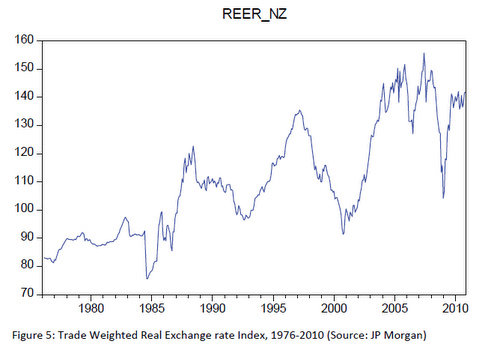
2. Theme of the conference - This rise in our exchange rate and the way fiscal and monetary policy worked together to increase interest rates, lift the currency and reinforce the commodity exports bias was the theme of the conference, I reckon.
3. Craig Burnside from Duke University made the point that our low growth and investment may not be linked to these high interest rates and high exchange rates. Australia seemed to have a similar problem with high exchange rates and interest rates. It seemed New Zealand had a lower savings rate and investment rate than Australia.
He said our high external debt was New Zealand's main source of vulnerability and he suggested changing the tax incentives for saving in financial assets relative to housing. Essentially he was saying we needed tax breaks for investing in stocks and the removal of tax breaks for investing in housing.
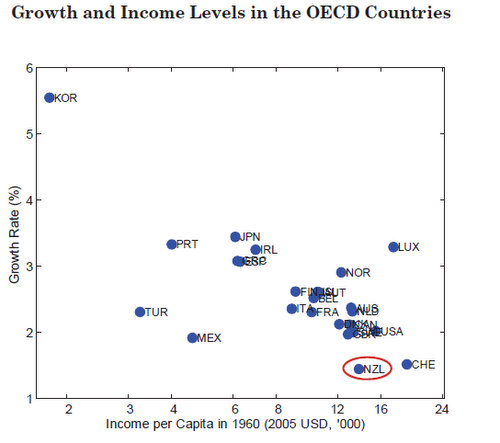
The chart below show NZ's growth rate has been the slowest in the OECD since 1960.
Here's Burnside.
The good news comes in two parts. In my introduction I stated that New Zealand had experienced the slowest growth in a group of OECD countries, and had slipped 18 places in ranking by per capita income within that group between 1960 and 2009. What I did not mention was that the most of the damage, if you like, occurred prior to 1990. New Zealand’s ranking by income has actually increased by one place since 1990, and its growth (ranked 9th out of 25) has been above average for the OECD.
Comparisons with Australia are perhaps inevitable, but it should be kept in mind that Australia has been one of the top performers. Second, New Zealand is in the fortunate position that a very substantial portion of its external debt is denominated in domestic currency. This means that the country is naturally hedged against the risk that I have argued is the source of its large risk premium.
The bad news, in the end, lies in the sheer size of the external position, and, perhaps, in the speed of New Zealand’s growth, given its location in the pacific rim.
It simply isn’t sustainable for a country with a large net debt position to continue to run large current account deficits and see its debt stock relative to GDP grow by 8% per decade.
I conclude that the central issue facing New Zealand is its substantial negative external position. Even if this position is largely naturally hedged through its cur- 21 rency denomination, it does not seem consistent with long run sustainability.
I argue, therefore, in favor of a balanced approach in which the New Zealand government continues policies aimed at increasing domestic saving, while moving away from policies that favor residential over other forms of investment.
4. The Irish guy - Trinity College Dublin Professor Philip Lane seemed a suitably chastened fellow, having witnessed first hand the implosion in Ireland. He was suitably cautious about New Zealand's own imbalances and made the good point that Ireland was a bit like New Zealand in that its government had also had relatively low public debt before the crisis.
That's before the Irish government bailed out its banks and was unable to rely on a floating exchange rate to help it cope with the shock of the Global Financial Crisis.
Here's his warning to New Zealand:
New Zealand’s external balance sheet still poses several macroeconomic problems. In particular, there are two primary reasons to be concerned about excessively-large external imbalances in net capital flows and accumulated net foreign liabilities. First, large imbalances may distort the overall structure of the economy, with a possible negative impact on long-term growth prospects. Second, large deficits and high external debt levels leave a country exposed to the risk of a sudden stop in capital flows, which in turn may generate a generalised macroeconomic crisis.
He also points out the risks in our banking system:
If the parent banks suffered losses in their home markets or elsewhere and/or experienced tighter conditions in funding markets, these negative shocks might impel the parent banks to withdraw capital from overseas operations and limit their capacity to provide funding to New Zealand affiliates. This is of particular concern in view of the common risks facing the Australian and New Zealand economies, such that any financial shocks in Australia might occur at the same time as similar shocks in New Zealand.
Finally, much of the external debt is intermediated through the banking system. These liabilities fund domestic loans. Accordingly, a possible trigger for an external funding crisis would be the emergence of significant loan losses and/or a decline in the quality of the collateral backing these loans. In terms of domestic risk factors facing the banking system, the elevated level of property prices (housing and farms) is a particular concern.
Lane pointed out how Eastern Europe suffered in the 2008/09 crisis when foreign owned banks restricted lending and that New Zealand had yet to see a real housing slump.
Property prices have declined considerably over 2008- 2010 in many countries that ran large current account deficits during the pre-crisis period, even if the adjustment in New Zealand has been very limited so far.
He looked at the options for macro-prudential controls to stop the banks from borrowing offshore, including such things as the Core Funding Ratio and any blocks on foreign borrowing. He points out companies and individuals could just borrow overseas themselves in foreign currencies if these controls were introduced or toughened.
Financial regulation on its own is not sufficient to tackle external imbalances, since corporations, the government and households may also accrue external liabilities directly. Indeed, over-regulation of the domestic financial sector increases the incentives to directly tap sources of foreign capital, via overseas banks, the international bond market and the issue of equity-type liabilities to foreign investors.
Lane also liked the idea of encouraging private savings and reducing the budget deficit to improve national savings.
Interestingly, he pointed to one idea the Irish government introduced in 2002 to take some of the heat out of the economy. It introduced a one for one incentivised savings scheme where savers locked up their money and the government put some of its surplus away for five years, hoping this would mature when the economy was in trouble.
Unfortunately the Irish economy was still booming in 2007 when the funds matured, adding extra fuel to the fire.
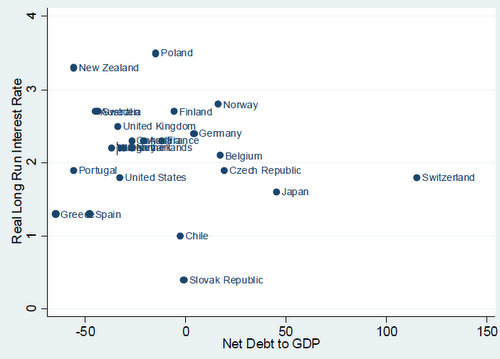
This chart of New Zealand's net foreign debt and interest rates showed just how high our interest rates are and how indebted we are. We're in the PIGS part of the chart but with higher long term interest rates.
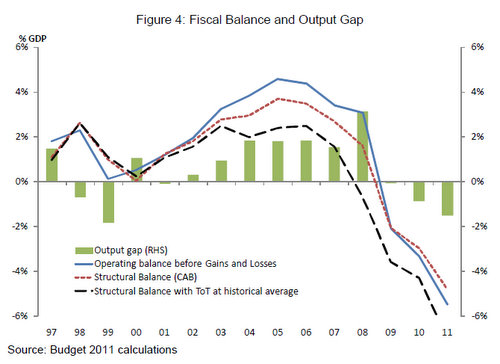
5. The government's fault - Treasury Principal Advisor Anne-Marie Brook was disarmingly frank in her paper on how the Reserve Bank and Government had combined over the years to jack up interest rates, given the government had run a structural deficit ran expansionary fiscal policy after 2003 which the Reserve Bank had to lean against with high interest rates. It crossed into structural deficit position from 2008, as the chart below shows.
Her suggestions to solve this included a look at a Chilean style stabilisation fund and an Independent Fiscal Commission to advise government on not running structural deficits.
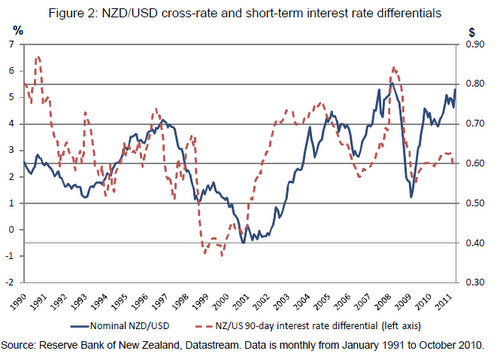
With the benefit of hindsight, it is widely argued that fiscal policy was insufficiently supportive of low interest rates and tradable sector activity over the 2005-2008 period. Because monetary policy was the primary tool for cooling the booming economy, higher interest rates ensued and the exchange rate was pushed up to unsustainably high levels, adversely affecting the tradable sector and exacerbating external vulnerabilities.
This chart shows just how connected the differentials between NZ and US interest rates and the currency are.
Brook also pointed out how much of a structural deficit the government is now running. It's at about 5% of GDP. My view is the Working for Families, Interest free student loans and the other bits of middle class welfare introduced in the last 7 years is responsible for most of that.
Brook is a bit more specific:
While increases in government spending did contribute to our structural deficits, I point out (page 25) that our large structural deficits today are due to a combination of the spending increases, the 2008 tax cuts and the downward revisions to estimates of structural revenues
6. Higher bank capital - Auckland University Economics Professor Prasanna Gai spoke about macroprudential policies and the need to look at toughening capital and funding requirements.
He particularly pointed out the need for systemically important banks to be targeted. He mentioned the need for banks to hold more capital and how the risks to society of bank blowups are not reflected in the banks' costs.
New Zealand’s large net foreign liabilities expose it to a possible rise in long‐term interest rates as a result of high funding requirements of banks and sovereigns in advanced economies.
The authorities should continue to strengthen their stress testing of banks and consider the merits of gradually raising bank capital to levels well above the Basel III requirements.
Staff recommended explicitly including funding risk in future scenarios, encompassing a disruption to bank funding and a large increase in longer‐term interest rates. The latter could come from a rise in global rates and an increase in New Zealand banks’ risk premium.
7. It's housing's fault - OECD economist Peter Jarrett talked about New Zealand's housing boom and its role in our macroeconomic imbalances.
It turns out our housing boom was bigger than in most other OECD countries.

And our household debt is now bigger than in other OECD countries.
 '
'
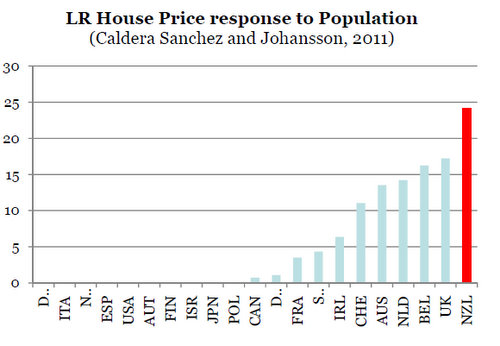
He also pointed out New Zealand had relatively high population growth over the last 10 years and a lack of new supply of housing saw that population growth push up house prices.
8. The Arbee's strange rituals - The funniest presentation was from Motu's Arthur Grimes who looked at the Reserve Bank's activities and the New Zealand economy from an anthropological point of view. He detailed how the Arbee sub-tribe of the Aotearoan society influenced the overall society.
He paid particular tribute to the role of the Arbee's high priest in conducting the OC (Official Cash Rate) ritual and responding to the demands of the Big Fella man or Big Fella woman.
Grimes told the conference that our own Alex Tarrant assisted him with field research.
Note to self: muct check on moonlighting employees and their dabblings in anthropology.
9. My overall frustration - I enjoyed the conference and meeting many of the attendees. Fortunately (and unfortunately) it was like being back at university and listening to a bunch of fascinating lectures. It was fun watching New Zealand's best macro-economists doing their intellectual gymnastic routines, but I got the feeling the powers-that-be at Treasury and the Reserve Bank either didn't think there were that many serious problems or did not believe they could do much about the problems.
There was a lot of talk about unintended consequences and finger pointing at politicians and voters. There seemed to be an awful lot of shoulder shrugging and a disturbing acceptance of our lot in life. New Zealand seemed stuck in a rut as a commodity exporter with a high currency, high debt and a reliance on foreign creditors.
Everyone seemed to agree we needed to lift our national savings rate and reduce our vulnerability to hot international money markets.
But there were few big ideas to solve the problems. A few tweaks and fiddles were suggested, but on the whole most believed the status quo was the least worst option. The unsustainability of a current account deficit running at more than 5% of GDP, a net foreign liability of nearly 90% of GDP and a foreign debt rollover problem of 50% of GDP stared everyone in the face from almost every slide, but there seemed little that could be done.
There was no discussion about high youth unemployment rates, migration rates and falling Gross National Income per capita, which are the ultimate results of our macroeconomic failures. The looming surge of spending on health and pensions for baby boomers was only briefly addressed.
My frustration culminated in the final session where two very senior figures in New Zealand's business and economic community questioned this status quo. They pointed out that our reliance on a floating exchange rate and an inflation-targeting central bank had led to high interest rates, low investment rates and higher foreign debts. They were essentially saying the orthodoxy adopted since the mid 1980s was not working.
Their points weren't even addressed by policy makers with their hands on the levers of monetary and fiscal policy.
The whole conference reeked of complacency, a lack of urgency and a sense of impotence.
Why it really matters
Perhaps I need to lighten up and 'get a life', as the Prime Minister told me via Radio Live a couple of weeks ago. Perhaps I need a transplant of my Woody Allen approach to life with a John Key type enthusiasm for the good things in the world and assumption that everything will work out in the end if we just accept the status quo.
My problem is I've worked overseas for a decade and can see how we are failing to really compete and prosper in this world of ours, despite our obvious gifts and resources.
The end result is most of my immediate family has left the country I returned to because they see better opportunities in Australia. We are losing our best and brighest, leaving behind a shell of beneficiaries and pensioners. This is unsustainable as we approach the retirement of the baby boomers. Those actually still working here and paying taxes will just revolt with their feet and those left behind will have to accept the fallout from a national bankruptcy.
I'll finish this with an anecdote.
On the plane to the conference a 17 year old Maori girl sat next to me and started telling me her life story. She was traveling back to Wellington from Christchurch where she had just attended the Limited Service Volunteer (LSV) 'boot camp' course at Burnham, which is run by the Ministry of Social Development and the NZ Defence Force.
She was fizzing. She just wanted to tell someone how great she felt about the course and the friends she made on the course and what she had achieved. She showed me all the pictures on her well-thumbed mobile phone. She was so proud of her mates and what they had done. She boasted of her early morning starts, the ironing of the uniforms and about all the physical exercise.
She was a real bright spark and I found her enthusiasm infectious so I started asking a few questions. It turned out she had decided to leave the six-week course a week early after a fight with a couple of other course attendees. She explained how she realised she needed to control her issues with anger and wanted to work to fix these issues when she got back to Wellington. The language she used to describe how she never backed down was colourful to say the least. She said she could go toe to toe with any of the boys and wouldn't put up with any 'sh-t' as she described. It was the main word in her vocabulary, along with the F word.
She told me about her childhood and how she had ended up at the course after years of involvement with CYFS and then WINZ. She told me about the drugs, the alcohol and the violence that surrounded her as she grew up. She explained how her life had gone off the rails a bit after the death of her grandparents a couple of years ago. She was no fan of her father and explained how her street-kid mother hadn't been around much to help. She was going to stay with an aunty in Wellington after she landed.
I asked her what she wanted to do with her life. She enthused about how she now wanted to join the army or the airforce. She wasn't quite sure what she could do in the armed forces, but believed she had the qualifications. Maybe she could work as a gunner, she said. She boasted how she was just as strong as the boys.
She said she was sure she would be allowed to do the course again after she had sorted her 'sh-t' out. She had a vague idea she could join the armed services after that. It wasn't clear to her what exactly she needed to do or who to approach, but she was confident.
She explained how she didn't want to end up like her parents and many of her friends. She had already spent some time in jail and didn't want to end up like that.
I admired her spirit. It turned out she loved Kapa Haka and touch rugby and was an excellent musician.
I asked her if she had travelled overseas and wanted to do an OE. She said she hadn't, but wanted to go to America to be a musician. She explained she could dance hip hop and was an excellent singer. She couldn't afford to go at the moment and it was clear to me she would find it much harder than most to migrate because she didn't have the marketable skills and resources.
She swigged from a 1.5l bottle of Coke throughout the flight and took a heaping handful of the boiled sweets from the Air NZ hostie as we descended into Wellington. She also had a full packet of smokes (and a lighter!) she had just bought at the airport for NZ$27 because she said she was feeling a bit down and wanted some ready-mades rather than roll your owns.
I explained to her that my parents had also smoked like trains, but I didn't and had a 17 year old daughter who didn't. She told me she had 16 brothers and sisters, many of whom smoked as much as she did. Her mother had three kids, including her, while her father had 13 kids with a variety of mothers.
I really felt for her. She'd had a tough start in life and now faced a struggle to find her way. Maori youth unemployment was 28.8% in the March quarter, the Department of Labour says.
She had such enthusiasm and hope. I wished her the best as the plane taxied into the gate at Wellington Airport. I only hope we can generate the jobs and wealth to help improve the social problems underpinning her story.
But if we can't this teenager and her 16 brothers and sisters will be among those left in New Zealand.
I thought about the futures of my 17 year old daughter and this 17 year old I had just spent 40 minutes with hearing her life story.
My daughter has already said she wants to move to Britain. She is young and has a British passport and I'm sure it's something she should do to experience life on the other side of the planet.
But will she come back? Is there a well paid and interesting job for her to come back to. What tax rates will she be paying by 2020 or 2030 when John Key and myself are retiring? Will the country be solvent and owned by its population then? Will my grand kids grow up here? Will I stay if they don't?
I hope we can hand over a better economy to these 17 year old girls in the next decade or so than the one we have now. After this conference I'm not so sure our current crop of leaders are either aware of the scale of the problem or have the will to solve it if they do. I hope they realise this soon and take some action.
I watched this 17 year old girl step out of the door of the Air NZ 737 ahead of me and stride up the air bridge with a real spring in her step. My last view of her was the cheap, bright yellow t-shirt she was wearing over the top of her jacket. It had the signatures and tags of her mates from the LSV course all over it in black marker pen. She was texting her mates as she walked.
Good luck to you, I thought.
And then it was back to work for me writing about real exchange rates and property taxation and net foreign debt...
10. Totally irrelevant Clarke and Dawe video - The voter is beaten up. Fair enough.
(Updated after emailed comments from Brook)

We welcome your comments below. If you are not already registered, please register to comment
Remember we welcome robust, respectful and insightful debate. We don't welcome abusive or defamatory comments and will de-register those repeatedly making such comments. Our current comment policy is here.