

Here's my Top 10 links from around the Internet at 6 pm in association with NZ Mint.
I welcome your additions in the comments below or via email to bernard.hickey@interest.co.nz.
I'll pop the extras into the comment stream. See all previous Top 10s here.
Please excuse my video #9 where the Cookie Monster pretends to be Tom Waits...or is that vice versa.

1. Finally it's working - WSJ reports with details on the ground how the Chinese government's moves to slow down the housing market seem finally to be working.
That's a good thing and a bad thing.
It's good because a housing bubble can't be good for anyone, particularly China's increasingly grumpy middle classes aspiring for home ownership.
But it's bad because the boom in residential investment in China over the last two years has spurred demand for concrete and steel.
That in turn has boosted prices for iron ore and coal, which in turn helped commodity prices generally, Australia in particular and us indirectly.
That Chinese growth has almost singlehandedly kept growth going in this part of the world.
When it stops we need to keep a close eye on it.
Here's the WSJ:
Business has gotten so bad for Shanghai real-estate agent Zhen Wen he's been forced to turn the lights out in his windowless office to save on electricity.
"We try to keep the lights and air conditioning switched off for as long as possible," says Mr. Zhen, dressed in a thin white cotton shirt on a sweltering summer day. His agency occupies an office in downtown Shanghai that was once a magnet for millionaire speculators, and is now almost deserted.
Cracks started appearing in Shanghai's property market after the government in October limited households to buying one additional home, on top of existing nationwide curbs on bank lending. Out-of-towners need to prove that they have paid social security taxes before they can purchase a home in the city, and if they are already homeowners, they aren't permitted to purchase additional homes.
Property analysts generally expect home prices to fall 5%-10% this year from the previous year in major cities, but say the market will likely avoid a full-scale crash due to the high household savings rate, and a belief that government will intervene to prevent disaster, either by easing restrictions or introducing stimulus measures. Real-estate investment is a crucial component of Chinese economic growth, equivalent to 12% of China's GDP.

2. Hugo Chavez does an FDR - The Guardian reports Venezuelan firebrand Hugo Chavez plans to confiscate Venezuela's gold industry and repatriate gold held offshore.
The moves will make the finances of South America's biggest oil exporter even murkier as the 57-year-old socialist leader gears up for next year's election battle. Chávez, below, has put large parts of Venezuela's economy under state control and is now targeting the gold industry. after his government quarrelled with foreign companies which had complained that limits on how much gold they could export hurt their efforts to secure financing and develop projects.
Chávez seems to have lost patience and decided to put the whole industry into state hands.
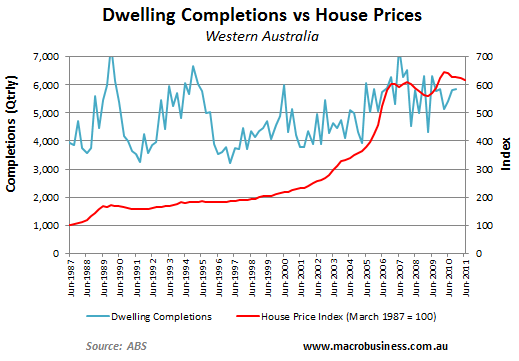
3. The problem in Western Australia - Leith van Onselen at Macrobusiness points out BankWest is now offering 97% LVR mortgages to help people buy houses...
Here's Macrobusiness' view on the supply problem:
Restricted land/housing supply is a double-edged sword. With supply unable to respond quickly to changes in demand, the housing market becomes overly sensitive to demand shocks, resulting in greater price volatility and boom/bust cycles as demand rises/falls.
During an upswing, the extra demand will automatically feed into higher home prices rather than new construction. In turn, the price rises and perceived scarcity will encourage speculative demand and ‘panic buying’ from first-time buyers, which helps to drive prices up even further. The opposite holds during a downturn, where unresponsive supply will help to accentuate price falls as new housing planned years ago continues to hit the market.
It’s a shame that our political leaders continue to promote failed policies – such as looser credit and first home buyer subsidies – as the answer to Australia’s housing affordability problems, rather than focusing on the underlying structural factors that are pushing-up the cost of housing and create the pre-conditions for housing bubbles to develop.
4. Austria may be the next domino to fall - Ilya Spivak at DailyFX points out Austria may be the next European nation to fall under the gaze of the bond vigilantes. HT Scarfie.
The danger is in Austrian banks’ exposure to Eastern and Central Europe. As we discussed in July, the region have borrowed aggressively in Swiss Francsto take advantage of Switzerland’s low interest rates. Stratfor – a global intelligence advisory – points out that, “currently, 53 percent of outstanding mortgages in Poland and about 60 percent of those in Hungary are denominated in Francs”.
The majority of those loans were made by the top six Austrian lenders: Bank Austria AG (owned by Italy’s UniCredit SpA), Erste Group Bank AG, Raiffeisen Bank International AG, Oesterreichische Volksbanken AG, BAWAG P.S.K. Bank, and Hypo Alpe-Adria International AG. Austrian borrowers themselves have also dabbled heavily in foreign-currency loans, which now make up almost a third of the country’s household debt, with most denominated in Francs.
5. FDR, Hitler and how they ended the Great Depression - Matt Yglesias writes at Thinkprogress about how The Great Depression was eventually ended.
Hitler, like Roosevelt, undertook what amounted to a two-stage monetary expansion before Europe slipped into total war. FDR’s first move was to devalue the dollar relative to gold. Hitler’s parallel move was devised by the very clever Hjalmar Schacht who (as you can read in hisNuremberg Trials indictment) essentially introduced a parallel currency called “Mefo bills” by setting up a government-backed shell company that issued scrip. FDR’s second move was to have people panic that Hitler was going to conquer them and shift their gold to the USA. Hitler’s second move, by contrast, was to conquer Austria and the modern-day Czech Republic and take their gold.
Then came the actual war, during which period all participating governments adopted what amounts to large-scale central planning of the economy. Centrally planned economies have a lot of problems, but since military supplies are always a case of monopsony purchasing by the government, if military supplies are the only thing you care about, this is what you do. Centrally planned economies have the useful side effect of essentially eliminating unemployment, because you’d have to be an extremely sloppy planner to simply not notice that 9 percent of your labor force isn’t doing anything.

6. Dissatisfied Americans - This Gallup poll shows Americans are less happy than they've been since the pit of the Lehman Crisis in late 2008 as they kicked out George W Bush.

7. The Four Bad Bears - This chart courtesy of Doug Short compares the four big bear markets of the last century.

8. A return to the 1870s? - Simon Johnson blogs at the NYTimes about whether the US economy is sliding back into a new Great Depression.
He doesn't see that, but he does wonder if we're returning to something akin to the very long and deep recessions of the late 1800s.
The relative decline of agriculture and the rise of industry and services over a century ago were long believed to have made the economy more stable, as it moved away from cycles based on the weather and global swings in supply and demand for commodities. But financial development creates its own vulnerability as more people have access to credit for their personal and business decisions. Add to that the rise of a financial sector that has proved brilliant at extracting subsidies that protect against downside risk, and hence encourage excessive risk-taking. The result is an economy that is at least as prone to big boom-bust cycles as what existed at the end of the 19th century.

9. Totally some light relief from the Cookie Monster and Tom Waits singing 'God's Away on Business'. I'm a big Tom Waits fan. And I love, love, love the Cookie Monster. It doesn't get much better than this.
10. Totally Clarke and Dawe - Ed Hightackle talks about Australian Coalition politics. It's funny.
76 Comments
US mortgage rates are now at 3.75%.
Yet still they won't borrow. Why?
Those ultra-low rates are only available to borrowers with stellar credit scores of around 750 and up. "For somebody who is unemployed or under-employed or upside on their hour, there is no way for them to take advantage of these rates," Ulzheimer says.
And that may explain why, despite plunging rates, new mortgage and refinancing loan volumes fell nearly 19 percent, to $265 billion, at the end of the second quarter, down from $325 billion in the first quarter, the lowest since 2008, according to Inside Mortgage Finance.
Not to mention at the rate house prices are falling in the US you would have to be nuts to buy.....I assuming renting is cheap?
regards
Its because its different this time
Mind the gap; bonds signal a depression
Equity is becoming scarcer, and therefore more costly, just at a time when large swathes of the banking and corporate landscape, not to mention the economy as a whole, need most.
http://www.telegraph.co.uk/finance/comment/jeremy-warner/8709692/Mind-t…
I read today that 191,000 students in the UK have applied for 40,000 places.
http://www.telegraph.co.uk/education/universityeducation/8710276/A-leve…
In depressions debt is a killer.
Steve keen commented that companies are pretty cash rich but consumers are sebt crippled, so its likely we'll so a long slowish slide instead of the three years that the GD took to hit bottom, so maybe 5 or 6 years maybe longer....than we have to bottom for a while and then climb out....its kind of looking like a 20 year (min) event...
regards
Strong 6.5 Magnitude Quake near the east coast of Honshu ,Japan, Tsunami Advisory Issued
Asian markets witnessed fresh bouts of selling after authorities issued tsunami warning for Northeast Japan coast.
Here's a measure of the European money market stress right. Not back to Lehman Levels, but headed in that direction.
In the euro/dollar cross-currency market, where a bank can swap euro interest payments with a lender for dollars, the three-month cross rate EURCBS3M=ICAP spiked to minus 84 basis points, the highest since the end of 2008 during the global financial crisis. This rate has doubled in three weeks, but it was still far below the peak of minus 300 basis points seen in the fourth quarter of 2008 when money markets froze after Lehman Brothers collapsed. Back in early May, it stood at about 18 basis points. http://uk.reuters.com/article/2011/08/10/markets-money-idUKN1E7791J520110810
More from the Macrobusiness blog on the Euro bank stress:
http://www.macrobusiness.com.au/2011/08/ecb-moves-into-fx/
We have known for some time that the ECB has been holding both the Euro-based interbank liquidity market and the sovereign bond market together with its balance sheet. But as I reported late last week the international liquidity being provided to banks is drying up and this is an achilles heal for the European banks. They have been borrowing short in US dollars to fund long term Euro-denominated assets. This means they constantly need a rolling supply of $US in order to meet the repayments on their prior short-term funding obligations as their Euro assets mature more slowly. If the holders of $US no longer think they are a safe bet then they are caught in a good old fashioned banking liquidity trap.
We have seen evidence of this over the last few weeks as European banks started to tap the FX markets for $US swaps
Excellent stuff here from Jeff Sachs via the FT.com
http://www.ft.com/cms/s/0/2b9dab2e-c817-11e0-9501-00144feabdc0.html#ixzz1VSDlDuXX
The simple fact is that globalisation has not only hit the unskilled hard but has also proved a bonanza for the global super-rich. They have been able to invest in new and highly profitable projects in emerging economies. Meanwhile, as Warren Buffett argued this week, they have been able to convince their home governments to cut tax rates on profits and high incomes in the name of global tax competition. Tax havens have proliferated even as the politicians have occasionally railed against them. In the end the poor are doubly hit, first by global market forces, then by the ability of the rich to park money at low taxes in hideaways around the world.
I'd like to see some honest data on how americans are migrating within the usa....I suspect heaps head south in the winter and slog back up north in the summer...and remain living in mobile campers, buses, trucks and old things on wheels. A bit like the 1930s in a way. Can they use their benefit stamps anywhere?
Iain,
Please drop the attitude and the bad language. This is your last warning.
Bernard
I am assuming something has been deleted because for the life of me I can't see any use of bad language by Iain.
Mangled language yes, but bad? Wasn't Wolly Wally back in the day?
No no no...err yes I wuz...an I still can't figure out why it happened....so I'm a Wolly Wally.
FYI Nomura's Richard Koo writing about balance sheet recessions in a letter to The Economist:
http://www.economist.com/node/21526289
In this rare type of recession, monetary policy is useless because people with negative equity will not borrow, no matter what the interest rate. Nor will there be many lenders when banks have such huge problems with their balance sheets.
In this environment, therefore, government must borrow and spend the savings generated by the deleveraging in the private sector in order to keep the economy from entering a deflationary spiral. But as John Maynard Keynes noted, it is almost impossible to maintain fiscal stimulus in a democracy during peacetime. It is this difficulty that prolongs this type of recession; it took Japan ten years to climb out of the policy mistake of premature fiscal consolidation in 1997.
The drama in Washington and other capitals is almost the exact replay of that confused policy debate in Japan. And the drama will continue until the public realises that this is a different disease requiring different treatment.
This is stunning from Ambrose:
http://www.telegraph.co.uk/finance/comment/ambroseevans_pritchard/87100…
Andrew Roberts, credit strategist at RBS, said investors are haunted by fears that European banks may have lost full access to America's $7 trillion markets, leaving them at imminent risk of a dollar squeeze.
Ewald Nowotny, Austria's central bank governor and an ECB member, told newspaper Wirtschaftsblatt there was a "growing reluctance" within US money market funds to finance the Europeans, though he blamed the cut-off on a change in US banking regulations.
The Bank for International Settlements said German, Dutch, Swiss and British banks together have a US dollar funding gap of around US$1 trillion. The global dollar gap is $5 trillion, reflecting the continued use of the greenback as the base for international finance. This means that severe market stress sets off a scramble for dollars, akin to a global margin call.
You're repeating your name Iain Parker , over and over ....... are you suffering from an identity crisis ?
........ stressed from all that interest money you gift to those usurious Aussie banks whom expect a profit from the mortgage they granted you ?
Parker's the name , team , Iain Parker ........... do we clap now , or just bow in humble awe ?
I think I upset Parky Gummy....can't understand how...he never really explains how handing pollies the power to print, would solve anything. He's right about the current private system being riddled with shites crooks frauds swindlers and general greedy scum out to line their pockets...and he's right about credit being at the heart of the financial failures, along with fraud corruption and political uselessness......But he continues to believe pollies or the like would be the way to go....how do I get through to him that interest rates are a safety valve, that business failure is part of capitalism, that pollies are a bloody nuisance at the best of times, that ...well...that the Dakota experiment will not work on a national scale where international marketing and money movements are part of the process....help me out Gummy....
I tend to agree Wolly.
Parky's piece is a substantial piece of work, and I link people to it if I want to get them to understand what is going on.
So Iain you are absolutely right about what is wrong.
But I am not convinced about your solutions, particularly about handing over control to pollies.
Seems the right solutions are somewhere between putting the current pollies and bankers and financial crooks up against a wall...and the voters throwing out the bums at every opportunity until the message sinks in and the govts start booting the reserve banks and banks up the arse with some serious regulations and very serious punnishments for running slack credit policies, while also hammering the voters with a message to stop expecting them to provide endless benefits and pork.
Wolly - do you know how long that "Dakota experiment" has been running? Do you know the outcomes?
As for Iain's suggested solutions, they could work if we had something like an independent monetary authority, not dissimilar to the kind of idea that has been described on here by some guest economisseds to deal with tax/fiscal management, rather than rely on government do it.
Or maybe we should just have an independent central bank manage the task? Yeah, that's an idea, an independent central bank .... I wonder if Bernard can get an economissed to describe how that might work?
What's the difference between most economists and an economissed? Zip - most miss the point and their forecasts are just as bad - they usually miss.
Cheers, Les.
Yes Les. And you are right to say "they could work if we had something like a...." and that's the very issue social creditors refuse to see would be just a wee bit dangerous when you look at the bloody mess politicians have made of national budgets....You are saying there exists within this country a group of what....super human financial whatevers...that we could trust not to be twisted and corrupt as time past and political pressures grew and salaries rose and bonus payments were made and perks as well and post employment positions of power turned up and knighthoods and .......get the picture Les?
There is no magic social credit solution that does not arrive right back at the start, with a total pile of manure because that's the way humans are.
This is also why only 1200 voted for social credit....even the peasants understand what printing leads to!
Interest rates charged on credit are there as a safety valve...and politicians meddle with it by giving bad instructions to reserve banks....that's why we have a currency being debased every year....
Govt would determine what infrastructure was...and as time went by the govts would see to it that what they term infratstructure, just happened, to be planned to be built in electorates that they needed to win to stay in power. Psssst wanna new bridge Les,,,vote Labour and it's yours!
I understand the cynical counter arguments and support the idea that such shouldn't be left to government. It's exactly the same reason we have a central bank, because we couldn't supposedly trust government with execution of monetary policy, even as is. So we have an independent central bank running to a transparent Act of parliament, so why not modify that Act to include some of the solutions Iain suggests? Sure, you and I are both cynics regarding the "independent" status because of how we interpret our observations. However, if we take it as read that it is independent then our CB is the logical vehicle to issue debt and interest-free money, in a way that is independent of polictical and other influences. You say yourself that robust regulation is required to manage credit and stiff penalties should be applied if not, so why not rely on the same to issue public credit as a specifcally formulated fraction of the money supply?
Cheers, Les.
It's ok Les..I don't mind if you join the 1200...but do ask yourself why govt and local govt needs to borrow money in the first place....can you not see that saving up a surplus means not having to borrow to pay for the infrastructure..?
The RBNZ is currently bending to the political will to allow inflation to eat away the value of the debts....what does that tell you ?
Hey, I have an idea, how about we leave the creation of our money supply up to private banks, they will surely have our best intrests at heart?
Of course history has shown there is no possible way that secession of our ability to create our own money to private entities has ever compromised our own soverignty.
(being sarcastic)
At one time Social Credit polled above 30% and achieved over 20% at an election.
The markets are getting a hammering in Europe and gold is close to $1900.
Gold in $US will continue towards $5000. In NZ/AUD it will not be as speactacular a rise, but still a rise. Money in gold now is better than inflation eating away your purchasing power for the next few years IMHO.
$5000 seems silly.....mind boggling maybe, investing in gold is a pure capital play it earns no income....and it can drop, when "everyone" is in it I just wonder, hell platinum looks a better bet in comparison. We might see inflation but right now deflation seems the better odds....so your purchasing power goes up if you have cash...
regards
I don't think either will be a bad thing. Cash is certainly more liquid.
I just had mentioned to me that $20,000 is a possibility. Lol. I had read $10,000 earlier in the year. I tend to think of the dollar terms as irrelevant, it needs to be related to something else.
One comparison I saw a while back now, what troy ounces of silver to the average priced house. Historically it is in the range of 2000-12000 in the USA. it has come of the high back to about 6000, and the commentator thought 1000 was a possibility.
At the peak in the 80s it was 816 oz silver for the average home.
Easy to see it going even lower this time, given the perfect storm of currencies, debt, systemic fraud, climate wild cards, etc.
I want to resond to two points you raised: (1) Gold earns no income. Well, neither does cash in the bank. Not when the nett interest rate is less than the rate of inflation. Gold is a store of wealth. Over a long period of time, an ounce of gold maintains its purchasing power, so it's the ultimate safety net in times of crisis. (2) The idea that "everyone" is in gold and that gold is in a bubble. Gold will be in a bubble when your mates at the pub are talking about their gold investments. None of my friends own any gold. They'd probably think I was some kind of wacko if I even brought up the subject. Today, gold represents a mere 0.6% of total global financial assets (stocks, bonds and cash). This is near the all-time low (0.3%) reached in 2001 and significantly below the 3% it accounted for in 1980 and the 4.8% it was in 1968. So its ridiculous to say that gold is in a bubble.
Ive got some bad news for you, gold is being talked about at the pub, my wife has been to meetings where the talk has been about how to buy gold from the NZ mint. Im thinking deflation, in which case gold won't do so well. If you are doing what everyone else is, its going to be the wrong thing, watch the debt destruction thats coming our way.
Fair enough, but are you and your wife Mr and Mrs Joe average when it comes to investing, or do you think you're more aware of wider economic issues than most people? I'd say you are, since you're posting on this blog :-) Mainstream media still only talks about property investment and the share market.
Im a big fan of Charles Hugh-Smith and the Automatic earth, im expecting a rough ride but not inflation, I think there is too much debt and commodities will crash soon. I listened to Nicole Foss on DVD and I think she is one smart lady, I dont think you will lose money in gold as long as you can hang onto it. Im looking to invest after the crash, with cash in productive business and not just NZ. Im also making myself as independent as possible. In a year or two my house will be all solar panels and wood burning stove, led lights and lots of new trees.
I think you under estimate the level of understanding in the general public, many people realise that the game is up and its time to pay. My wife was at our local church meeting, they were all talking about the best way to buy gold and the importance of taking delivery. I talked to a truck driver last week (not Iain Parker) he was going self sufficient on his life style block and paying down debt, if you look at the debt levels and income levels in NZ , it becomes fairly obvious that there is no way the debt can be payed back, so we must default, Im talking individuals first, after the government has sucked us dry to maintain its spending, we will sell assets. So Im gloomy about our short to medium term, optimistic about the long term.
I was amazed to read that 198,000 students have applied for 40,000 positions at UK universities, we will get very high unemployment levels fairly soon. These are not ordinary times and we need to change our thinking, just because it worked in the past doesn't mean its going to work in the future, Im expecting a very different future.
I think property investors are going to be in for 'interesting times' not a good place to be with any debt. I posted a link to the Automatic earth below.
In the 2008 GFC the price of gold plummeted along with everything else. This time the opposite is happening. What we're experiencing is a currency crisis. Every single currency in the world is losing value vs. gold. A while ago I discovered the writings of FOFOA and his explanation of a concept called Freegold. Talk about a trip down the rabbit hole! Unfortunately it's not a concept that can be explained in a few paragraphs, but here's a link to a brief introduction to Freegold and a recent follow-up. I'm expecting a short period of deflation, followed by massive inflation and eventually a new monetary system, with the Freegold concept being a very real possibility.
Well I think you are totally wrong....Im expecting a 20~30 year hard depression....we might see a continuation in volitile CPI for a while, yes, maybe even 4 years until Peak oil really bites, maybe....but at some point we will nose dive, however at the rate the EU is going its hard to see it being 4 months. So sure we will see a see~saw down and then up but an overall downward trend/decline...housing can easily lose 50% of its value it could be as bad as 90% (ikky)....I dont know where gold will be but its a bubble every crazy is buying it I wouldnt go near it myself. Have to wonder about Platinum instead as a wealth protection mechanism....but in a depression, cash initially at least.....maybe then move into Govn bonds....but right now, cash is king, everything else is a bubble, thanks Ben.
So, sure place your bets.
regards
Its all good until some clever scientists manage to make gold. Couldn't happen??? I wouldn't bet everything on it. You wouldn't have believed half the stuff they can do now 10 years ago. They only thing that gives gold a value is faith and scarcity.
That would only make "genuine gold" even more valuable.
Think your understanding of nuclear physics is a bit tarnished there LAJ....more research and less coro street crap old boy.
The only thing that gives paper currency value is faith full stop. Gold meets all of the requirements of money: it's portable, durable, divisible, sufficiently rare, fungible, non-essential for consumption, easy identifiable and a store of value.
Yup...all of those things greenlantern but you forgot one teeny weeny thing...on paper there is more gold owned than exists on the planet....how you like them apples!
I only buy physical :-)
But you miss the point GL...what happens when gold prices drop..as they do...and all those paper owners sell ...and discover as with "goldcorp" in the 80s, they own zip....
Now what you gotta work out is...would that raise the price of gold..or would it drop the price...good luck.
Then you gotta figure on Obama et al using the law to steal the us owned gold.... and let's not forget the power of the Feds to pressure every reserve bank on the planet into refusing to pay more than X for any gold....now if that were to happen, who would buy gold off you or take it in exchange for goods...or currency....and what if the feds organised that at the same time as triggering a drop in the price...!
...just bulldoze the remains of those hills into the sea and build yourselves a sheltered port to export the milk powder from the new factory that will service the vast area of dairying on the flat 'Gummyland' where the hills once were...
Anything's possible. We could have a currency devaluation, like what happened in Argentina. Cash in the bank isn't so good then, is it?
In the USA the population is a net seller of gold, so by definition if there are more people wanting to sell than buy gold is not yet in a bubble.
Buying gold is making a bet that Centeral Banks and governments will not be responsible with managing their currencies. As soon as Governments look like they are about to stop running deficits, and shrink Government, that is the time to trade into property or an asset.
No time soon.
If you go by our shonky government figures we have low inflation. If you need to buy power, any commodity or a capsicum we have high inflation.
I often wonder how Obama can sleep at night. Assuming he understands the deep crap his nation is in, he must be up all night strategising how to make sure history doesn't judge him as responsible for the start of WW3. If he was a man of true wisdom he'd probably resign and go fishing while he still can.
I often wonder how Barack Obama can sleep at night . When you've got someone as hot as Michelle Obama next to you ..... why sleep , every second counts when you're on a good thing .
ww3?
No energy to fight ww3....for long anyway.
I dont think he will get blamed for this mess, blamed for not getting the US out of it, sure......but into it when it was decades of mis-management before hand? cant see why myself.
regards
So by your reasoning Steven, the USA should be out of IRAQ, Afgan et al any day now right? I would love to believe that, but we know thats not happening, and anyone paying attention knows they will involve themselves elsewhere too, oh they already are, Libya silly me. WW3 has been running for some time already, it need not be the nulcear event movie watchers have been made to believe.
And your use of the word mismanagement if not toungue in cheek, is hillarious!, was it serious?
Oh, come on.
Even "Foreign Policy" Magazine is going on about the amount of new oil finds that are occurring.
http://www.foreignpolicy.com/articles/2011/08/17/how_the_west_was_drill…
http://www.foreignpolicy.com/articles/2011/08/15/the_americas_not_the_m…
Rule number one: Malthusians are always wrong.
Rule number 2: they always SAY they are going to be proved right this time - they will die chanting this
Rule number 3: Far too many people believe these Malthusian idiots and their incessant chanting (a la Goebbels - repeat a lie often enough....etc)
By Konstantin Rozhnov Of DOW JONES NEWSWIRES
LONDON (Dow Jones)--Major banks kept their closely watched oil price forecasts unchanged for this year and next despite the fears of a double dip recession that have gripped equities markets in the past two days and pushed U.S. oil futures down 8%.
The banks say that tight oil supplies and rising demand will keep prices high well into 2012. Some said oil price forecasts weren't changing because they were based on already quite weak economic growth projections.
"Our economists don't believe in a double-dip recession," Barclays Capital oil analyst Amrita Sen said.
"Slowdown is not recession and we don't expect demand growth to get negative," she added.
Barclays Capital forecasts Brent crude to reach $115 a barrel by the end of this year and spike to $121 a barrel in the last quarter of 2012.
Goldman Sachs said that while the risk of recession in the U.S. and the downside risk for its forecasts have increased, U.S. oil demand numbers don't show signs that the economy has slipped back into recession.
"U.S. oil demand over the past three weeks has risen to the highest levels for this time of year since before the financial crisis, and the oil market supply-demand balance remains firm," Goldman Sachs said in a research note.
Goldman Sachs had forecast Brent to reach $120 a barrel by the end of the year and $130 a barrel next year.
Morgan Stanley analyst Elga Bartsch said the bank still expects oil prices to rise, as its bullish forecast was already based on a "pretty negative growth number" for the global economy. Morgan Stanley had the same oil price forecasts as Goldman Sachs.
Nymex crude futures have plunged 8% since Wednesday's close, crashing through $80 a barrel to reach a Friday low of $79.17 a barrel, tracking pummeting stock markets and currencies. In the same period, Brent crude futures have fallen 4% to a low of $105.06 a barrel.
http://online.wsj.com/article/BT-CO-20110819-706298.html
Why Oil Prices Won't Stay Down For Long AUGUST 19, 2011
BY KEITH FITZ-GERALD, Chief Investment Strategist, Money Morning
Oil prices, like stocks, took a few big hits last week.West Texas Intermediate crude last week dropped below $80 a barrel before bouncing back up to $87 a barrel this week. Meanwhile, Brent crude fell to a six-month low below $100 a barrel before climbing back to $110 a barrel this week.
To hear the mainstream media tell it, much of the drop is based on the assumption that global growth is waning and oil demand is soon to follow.
But that couldn't be more wrong.
Energy is one of the most highly leveraged and most liquid trading vehicles on the planet. A good portion of the decline we've experienced in recent weeks can be explained by nothing more than trading houses raising cash to meet margin calls or redemption requests from hedge funds, pension funds, and other investors.
That's all there is to it. Firms simply need cash and are selling the most easily sellable assets they've got. In the past that's been gold, but lately it's been oil.
Longer-term, demand is still going up and $120 a barrel oil is our next stop, followed by prices of $150 or more in the years ahead.
What's happening now with the markets and energy prices is like being in the eye of a hurricane.
That is, it won't be long before we're once again caught up in the whirlwind growth of emerging markets and energy demand shoots sharply higher.
The Looming Demand Downpour
Global demand is still rising - and it's not going to slow down any time soon. There are huge swaths of the world now adopting gasoline engines.
Let me give you two examples.
Take the farmers in Cambodia. Many put up sheets in their fields at sunset. They then mount small incandescent light bulbs on sticks behind the sheets. The bulbs are powered by small gasoline generators to ensure they stay on all night.
In the morning, those farmers go back and harvest the thousands of crickets that have collided with the sheet after having been drawn to the lights. They wrap up the fallen bugs and head to the markets where they are sold as food.
It's much the same situation in Africa, where small villages require simple engines to pump water.
You may think bugs and small farm pumps are no big deal, but there's an even greater energy revolution going on in the transportation industry.
Auto sales in China, which overtook the United States as the world's largest auto market in 2009, rose 32% last year to a record 18.06 million vehicles.
The majority of China's 300 million middle class citizens don't care about what kind of car they get, just that they get something that helps them climb up the social ladder, move their products to market, or get them to the cities so they can have a better life.
Fatih Birol, chief economist for the International Energy Agency(IEA), says that 700 out of every 1,000 people in the United States and 500 out of every 1,000 in Europe own cars today. But in China, only 30 out of 1,000 own cars. And Birol thinks that figure could jump to 240 out of every 1,000 by 2035.
That's a big reason why oil demand in China is expected to grow 10.4% this year − the fastest rate of any country in the world. China's oil imports are growing at 12% a year. At that pace, China will use as much oil as the United States does, and their daily demand will equal our own by 2018.
You also have to account for India's middle class, which is another 50 million to 150 million people, according to Deutsche Bank AG (NYSE: DB). Then factor in Vietnam, Cambodia, Thailand and Latin America, and it's clear we're headed for a global supply squeeze.
Globally, we burn four barrels of oil for every one barrel we discover - and unless you've got a few million years to wait, Mother Nature is tapped out.
In recent years there have been massive new discoveries off the coast of Brazil and a few other places, but these aren't long-term game changers. Nor is oil shale, barring massive investments and dramatic increases in technological efficiency that may still be years away.
That's why China has been buying up resources for the last 10 years. It's why China is building up its refining and storage capacity in South America and other places around the world. And it's why the country just established a commodity futures market in Shanghai despite the fact that exchanges in New York and Chicago already trade all forms of energy.
Beijing knows that when there are 1,000 people trying to buy the last egg at the store, the price will inevitably go up.
And if that still isn't clear, just look at how much money you're paying for gasoline compared to just five years ago.
All the signs are there.
http://moneymorning.com/2011/08/19/why-oil-prices-wont-stay-down-for-long/
And in the long run, while oil prices have been rising, the potential cost per km of running a car, over its economic lifetime, relative to incomes, has steadily got lower.
Fact. Read Anthony Downs, "Still Stuck in Traffic".
I say "potential" cost because most people "bank" the advances in technology by buying a bigger, heavier, safer, more comfortable car. But the potential cost per km, has never been lower relative to incomes. The 10 year old 1300cc Honda will slaughter anything a 10 year old Mini could have provided 30 years ago, in cost per km relative to income.
Then there are other energy sources.
http://www.popsci.com/technology/article/2011-06/scorching-hot-plasma-i…
http://www.popsci.com/technology/article/2011-06/next-gen-nuke-designs-…
A few generations ago, the children grew up reading exciting, optimistic magazine articles about progress and the future. Now we feed them doom and gloom and Mathusian garbage that, as I say, is always wrong and always will be.
I have quoted numerous rational authors like George Reisman, "Environmentalism Refuted", and Jesse Ausubel, "Nuclear and Renewable Heresies", on here numerous times before. But I am fighting a losing battle with Malthusian trolls who seem to have nothing else to do with their lives but spread doom and gloom propaganda 24/7.
George Reisman rational? bit of a stretch on that one....yes cars are far cheaper to run per km compared to income, I can accept that on the face of it....but the difference between each generation of a manufacturer' cars is getting smaller and smaller....and petrol is getting more and more expensive because there are more ppl driving cars....scale or population is the problem.
"I say" indeed and you have nothing to back you up but wishful thinking and libertarianism and both are faulty....facts are what you need to base decisions on, not biased opinions by fruity loops like GR.
regards
Oil finds peaked in the 1960s, hello 50 years ago, right now we are using 3 barrels for every 1 we find.....is you maths that crappy you cant see its going to be empty at some point? oh wait yes of course it is....
The second piece is about hvy oils and shales, a nightmare to extract any meaningfull quantity out of.....the best Ive seen for fantasy land dreaming (or is that nightmare) is to use nuclear energy to extract the oil....plants that take 10 years+ to build being used to extract usable oil from crap.....if nothing else the fact that they are considering this should tell you the cheap easy stuff is all gone....
Think Texas is the place to be? where there is no option but a car? good luck....
Hint I'd suggest places like Maine where Methane can be got out (apparantly) at an almost sane price and used in a car almost as is....and even that's desperate...
"Far too many people believe" that the american way of life is not negoitiable....they are right, but not in the way they mean, they hold a crap poker hand, nature has the 4 aces.
regards
Steven / OMG
An interesting book was written by a guy called Linsdey Williams, title " Energy The Non Crisis", I think its available at Amazon. Having myself worked in the industry worldwide for over 25 years, i agree with quiet a bit of of what he says. On a related note, the evolving technology has enabled us to find more reserves over the years, some of them vast. We have returned to places we previously explored and wrote of as non viable and found huge reserves. The Russian fields are producing a fraction of their potential and as for Alaska and parts of the US, the same. The dependency on oil is also now slowing down with the major breakthroughs made in recent years to develop and transport safely around the world LNG. This is the big new energy source of the near future, infact its already started. www.png.lng just one example. The spiralling geopolitical situation in the world and manipulation in the markets does however pose a real threat to supply.

"Pastor" Linsdey Williams, the guy is a raving loon.....he makes the tin foil hat brigade seen sensible/mainstream/sane.
Try reading ASPO for instance....a lot of highly qualified oil geologists....things they say are totally different to you....
I dont know where you think the tech will come from, but basically just about the entire world has been surveyed....the bits that have not are deep down and offshore or in inhospitable areas....and they wont be giving us a Saudi Arabia every 4 years...and will cost a lot to extract and be dangerious....do you really think BP would have been drilling at the limits of technology if there was lots of big and easy oil?
The USA invaded iraq for its oil.....do you really think if there were more iraqs we would be in there on the lamest of excuses?
Just how many more ghawar's do you think there are to find? Bear in mind the biggest oil field ever was found in the 40s....so 70 years ago.....none more have been found and we need to find 1 every 3 to 4 years......and get them on stream....so ideally we would have 2 about now and be getting them on line within 5 years.
The Russian fields are about it.....if the info is accurate...given they are having a second wind and are probably being over-produced I suspect that they are close to their potential.
Alaska and the US is finished......except for shale and hvy oils....
" www.png.lng just one example" didnt work for me.

LNG etc has a limited life and huge questions arounds its costs and long term viability....
Dependancy on oil, for the developed world it may have peaked, probably because its foobared...developing world however is a different matter...
So to sum up we seriously dont agree, from my side I see ASPO, the oil drum, peakoil and energy bulletin sites as my data and analysis sources to back up my opinions or the IMHO kooky Pastor. Happy for ppl to read as they may.
regards
Eagle,
I put my money where my mouth is and have a huge investment ( for me any way ) in a private oil and gas company which has audited OOIP of 4.4 billion barrels equivalent. The company reports to me regularly and there is no question that peak oil has passed - 2005. NZ is very vulnerable to a price shock / supply disruption.
Our friends across the ditch are getting it - by 2015 their domestic supply will only be 25%
http://www.abc.net.au/catalyst/stories/3201781.htm
We all need to prepare for this. I know it's not comfortable to think about.
I dont think the actual peak is an issue so much that we seem to be on a rolling plateau....thats good and bad (probably), good we can stabilize the production at about where it is, bad because when we fall off it could be a huge drop initially.....I guess in hindsight a noticable peak and drop would have sent an irrifutable msg to Govns....with a plateau they can ignore it....which they are doing.
Oil and good gas plays would seem possibly good medium term investments....the problem is exiting....
regards
your god will provide, in him you trust, right PB?
He seemed to overlook the Moa - surely they're still finding more of them?
And we don't need fishing quota, there's more of every species, just cast your nets on the other side, right?
I've just ordered a truckload of gravel, to re-do the drive after the snows. Surprisingly, I did it because the last truck-load ran out. How can that be?
According to PB, none of the above should be.
We go through a billion barrels of oil every eleven days, on this planet, PB.
No amount of denial will change that. I've posted the graphs here - global discoveries peaked in the 1960's.
http://www.energybulletin.net/primer.php It's the bar graph
You can't produce what you haven't discovered, and you'd have to discover a billion barrels every eleven days, just to hold station, let alone grow. It would have to be of the same quality, and EROEI, too. Fat chance.
Denial, even if it is based on religious belief, is still indulging in ignorance.
Breakdown Crisis Out of Control: Urgent Appeal for a Global Glass-Steagall System by Helga Zepp-LaRouche
European banks worth less than apple
>>>>>>
Yup. Apple is the same size as entire eurozone banking sector – as measured by the free float of the Euro Stoxx banks index.
We’re not sure what, if anything, this means. Is Apple overvalued?Are Europe’s banks undervalued? Both, neither, or something else?
Actually here’s another way of thinking about things. Apple could buy both SocGen and Credit Agricole (at a 30 per cent premium to their current market value) and still have some change left over from its $76bn cash pile.
The US Federal Reserve wants you to believe it's lies are not lies at all....doh
"This is as silly as saying: ‘I am 1.8 meters tall. So since 1m = 3.28 ft, I am 5.9 feet tall. But now, I hereby declare that 1 meter is equal to 30 feet. And now look how much I have grown; I used to be 5.9 feet and now I am 54 feet tall!‘"
http://www.marketoracle.co.uk/Article29968.html
I guess if Americans swallow this BS, it tells us a good deal about them and where their country is going.
Ooops..the S&P did close below 1178 AJ...well below!....a good article/comment that....time to stock up the shelter with beans and ammo for sure.
Wonder what Obama's great new plan will be....maybe he will waggle his head and say it's a new deal..hahaharrrrrrrrrrrrrrhahaha. Or will he invoke the laws that allow the feds to steal the gold from all Americans...swap the gold for 'New Deal Bonds'......
steven i use solar power and it works really well and no power bills is alright too. So could you leave up on the power crisis. because you may be surprised how fast the world is changeing power source. See oil stuck in a range not to speed up the change.
You speak from the same ignorance as Philbest, and if you note I actually I replied to is mis-beliefs and I often do....I certianly will not cease replying to lies, or deceit....not unless BH kicks me off.....and if he cant handle some truths then no loss ofr me really.
1) Initially at least it will be a transport and food crisis...so solar panels simply wont matter significantly...have you considered how many homes there are and how many solar panels would be needed to make everyone as "happy" as you are?
2) I am an engineer, I also appreciate big projects.....like how long it takes to build power stations....
3) The above points will effect business tremendiously....it will be a crisis of finance first off and then economic and business.
"Surprised how fast"....no actually right now I am dismayed on how slow....I see nothing to replace transport fuels on the scale we use.....probably, ever.....that should worry business ppl, indeed it does the likes of say Richard Branson.
Now if you want to stick your head in the sand and wonder at some point what the large thing was that hit you from behind, its easy dont read my posts....its a free world.
regards
Wolly, I have no doubt its going to blow apart, just about timing. Buy lots of wiskey, good for trading one needs a dram when times are tough.
I see the Obamas are still completely out of touch
http://www.whitehousedossier.com/2011/08/19/michelles-separate-travel-c…
mean while the unemployed wait overnight for a chance of a job http://abcnews.go.com/Business/thousands-show-job-fair-jobless-rate-ris… I am starting to get a bit pissed with this government, especially after talking to some orchardists this week. An example was one grower who sold over 1.2 million dollars of fruit, he employed 140 people for thinning in December, because he was organic, then another 100 for picking, with 5 full time staff. He couldnt make a go of it and the diggers are going for it as we speak. His ACC bill was 60k his rates 45k yet he never got a break and now we lose that income to the country, what replaces the apples will be worth a 1/20th of his apple crop. Then we keep getting the news on SCF which we apparantley had to bail out for 1.6 bill, well if its good enough for the depostors in SCF why cannot we give growers a break? Look at Kiwi fruit, a government agency stuff up but no compensation they must be more deserving than SCF investors- taking a risk bathing in the glory of high returns risk free on the taxpayer. All they needed was a break from compliance costs Acc and rates. Then foresty, what a c*ck up, i remember looking at farms in Gisborne where they had purchased a station and then even planted the lawn around a two story station house, 7,500 ewes gone, 9000 lambs gone, 500 cows, 480 steers and heifers, 100 ton of wool, agents, fert reps vets freezing workers, fencers, shearers, all employed, now we get a foresty investment thats looks like about as much chance of success as buying a Lotto ticket, driven in part by tax incentives. Now I hear some big players in Gisborne are replanting with Gums and Mac's because pines are worthless and less. My rates 10 years ago were only $1100 now they are 5000, we are going back, is NZ ready for that?
In 14 years my rates have doubled, I can manage, in another 14 years they will have doubled again....that will be a big impact on my income, 14 years after that doubled again, I wouldnt be able to manage then mind you I'll likely be gaga by that age.
regards
Someone posted this I don't know who, but thanks its Brilliant. Needs to be in Mondays 10@ 10
http://www.rollingstone.com/politics/news/rupert-murdochs-american-scan…
http://www.businessinsider.com/moodys-analyst-conflicts-corruption-and-…
MOODY'S ANALYST BREAKS SILENCE: Says Ratings Agency Rotten To Core With Conflicts, Corruption, And GreedRead more: http://www.businessinsider.com/moodys-analyst-conflicts-corruption-and-greed-2011-8#ixzz1VWRsdCup
Ilargi: This is your reality. Not inflation, or hyperinflation. And not a flightFROM US Treasuries and the US dollar, but a flight TOWARDS them. Yes, gold is higher; a totally predictable knee-jerk reaction. Once the bank stocks lose another 10%-20%-30%, which could happen in a manner of days at the rate we're going, that will change too.
That is because the plummeting bank stocks represent the vanishing into nothingness of what I've named "zombie money". In other words, it's not a matter of people, investors, talking their money out of one place, asset, and into the other, it's instead a matter of -virtual- money disappearing. That will take down the price of gold. An important issue to wrap your brains around. More about that later.
http://theautomaticearth.blogspot.com/
I wonder on his analysis....re gold price collapsing....I tend to think it might hold up fairly well....after all markets are not rational...I'd like to see his reasoning on why, he's usually very good at it, but his timing isnt good....but then who is...
regards
There's a finite amount of gold, right? So in an inflationary world ( more money to gold) the price of gold rises/ money falls. But what happens when money (debt) is repaid/retired; it's deflated? Less money to 'the same' gold = lower gold price/higher money.
Yes but....to start with markets and ppl are not rational...
Hugh Hendry said when discusing risk, (paraphrase) I have set up for a small loss at the momment but a small one and highly protected....others will lose big, so if this happens I will be a giant amongst dwarfs.
What you suggest is so unless Govns for instance devalue etc....confiscate gold and other precious metals....so many variables...Also there is physical possession of gold and holding an IOU of gold, which frankly is crazy as thats probably highly leveraged...ie its not all there. Which disappears first in what you suggest? the real gold or the [companies issuing] IOUs?
Looking at the GD I expect gold to devalue and looking at it being a bubble now, severely....but it might well lose less than anything else....
Dunno, Nicholas I really dont, Im sure of some things, fundimentaly we dont have enough energy so that debt cant be repaid....so it wont be.....the next Q is with energy supply contracting at 4~8% per annum that suggests Global GDP collapsing at 6 to 10% per annum...got to wonder about social stability in that.....look at the riots now and we are not where started yet....Lots of manufactures are going to be out of business, so "essentails" might be worth their weight in gold.....
regards
Hellooooo...wakey wakey...come on John Key it's ...time for a PPP moment!
"The Committee has not seen any convincing evidence that savings and efficiencies during the lifetime of PFI(UK) projects offset the significantly higher cost of finance."
"This is a system in deep trouble and it is waiting to blow".
http://www.guardian.co.uk/business/2011/aug/14/larry-elliott-global-financial-system?intcmp=239
Did you get invited to the party at Jackson Hole with all the banksters?
We welcome your comments below. If you are not already registered, please register to comment
Remember we welcome robust, respectful and insightful debate. We don't welcome abusive or defamatory comments and will de-register those repeatedly making such comments. Our current comment policy is here.