

Here's my Top 10 links from around the Internet at midday in association with NZ Mint.
I welcome your additions in the comments below or via email to bernard.hickey@interest.co.nz.
I'll pop the extras into the comment stream. See all previous Top 10s here.
The Jon Stewart videos are well worth watching. And let's hope that was the last All Blacks loss in a long, long time.

1. Finally - New Zealand Winegrowers Association Chairman Stuart Smith has come out in this Stuff article criticising government policy on the exchange rate.
I've been stunned at how meek many exporters and business groups have been when talking about the currency.
Business NZ CEO Phil O'Reilly spoke recently in a bloodless way about winners and losers.
Is this because there are so few manufacturers left?
Or are they all so scared of upsetting their National mates.
The exception is the NZ Manufacturers and Exporters Association (NZMEA).
But the rest have been quiet. Until now.
Here's Smith:
Smith said there was only one issue on every winegrowers' lips this week and that was the exchange rate.
"It's been up, it's been down, but it's been over its long-term fair value for a considerable length of time and that's mainly due to Government policy," Smith said. Wine exporters traded largely in US dollars, even in Asia.
Smith believed the Government should intervene but was under pressure from banks to retain the high dollar because it helped keep their foreign debt costs down.
"The best place to start would be to encourage the banks to source more of their money from within New Zealand."

It's a sobering and wide-sweeping roundup of the global economic problems with an Australasian spin. He even mentions Bluff.
Here's 'Macca':
Three overriding problems block the view of happier days:
1) Further fiscal stimulus to support the world economy over its looming slump looks a very remote prospect. Most government balance sheets are now fully extended and those that still have capacity to make a difference to the world outlook (the USA, Germany, China) face high political barriers or other constraints.
2) The break up of the Euro-Zone now seems the most likely scenario and, as noted above this only offers lose/lose outcomes the scale of which is uncertain but surely very large.
3) Increasingly, the focus of investors and policymakers is turning to the underlying problem which is that the world faces a shortage of final demand. This is structural, not cyclical. Successive attempts since 2000 to reflate economies with “money dumps” have failed. The latest round of QE dollars simply went into asset speculation or bank reserves. Commodity prices rose (including oil which ironically bit the hand that fed it), and so did stocks. The real economy did nothing. No new lending, no new jobs, no signs of life. The Fed may still be forced into QE3-but they will not do so with any conviction that the real economy will respond in the short term. The objective will be inflation and further USD devaluation (upon which I comment below.)
So the big picture is that of a shrinking or static world economy, a developed world with no gunpowder left in the fiscal or monetary magazines and deep structural issues which remain unresolved.

3. Servicing our Narcissm - Neal Gabler writes at the New York Times how mountains of information and the use of Twitter and Facebook is blocking out the development of big ideas. HT Troy via email.
Here's the thinking.
No doubt there will be those who say that the big ideas have migrated to the marketplace, but there is a vast difference between profit-making inventions and intellectually challenging thoughts. Entrepreneurs have plenty of ideas, and some, like Steven P. Jobs of Apple, have come up with some brilliant ideas in the “inventional” sense of the word.
Still, while these ideas may change the way we live, they rarely transform the way we think. They are material, not ideational. It is thinkers who are in short supply, and the situation probably isn’t going to change anytime soon.
We have become information narcissists, so uninterested in anything outside ourselves and our friendship circles or in any tidbit we cannot share with those friends that if a Marx or a Nietzsche were suddenly to appear, blasting his ideas, no one would pay the slightest attention, certainly not the general media, which have learned to service our narcissism.
What the future portends is more and more information — Everests of it. There won’t be anything we won’t know. But there will be no one thinking about it.
4. The negative feedback loop - PIMCO's Mohamed El Irian writes about the need for policy action on both sides of the Atlantic to break a negative feedback loop of budget cuts and falls in GDP.
America has little time to waste if it wishes to avoid years of insufficient economic growth, devastating unemployment, rising income and wealth inequality, and eroding social cohesion. Let us hope that a refreshed President Obama will return to Washington willing to respond and lead; and let us hope that, for their part, members of Congress will return in a much more constructive mood, able to work with the President to break an increasingly damaging negative feedback loop.

5. Big swings something new - Barry Ritholz points out at The Washington Post that the big swings in stock markets are new and bigger than normal. He also points out there have been secular bear markets that lasted decades.
The rally that began in March 2009 looks to be running out of steam. Indeed, those gains have been among the best post-crash rallies of the past century. Only the 1932-33 and 1935-37 runs saw stronger rallies over a two-year period. The first saw the Dow Industrials double in two months. It gave back nearly all those gains by March 1933. From that low, the Dow once again doubled by July, only to give back about 26 percent by October 1933. And the next bear market rally — a two-year screamer from March 1935 to March 1937 — saw an astounding 135 percent in gains. That ended in yet another collapse, this time of 56 percent.
Over the past century, numerous “secular” long-term trends have played out. The results have been surprisingly predictable. After the 1929 crash and Great Depression, markets floundered. It took until 1954 — 25 years! — to return to the nominal market highs.
The long economic trend after World War II was very supportive of markets. Millions of servicemen returned home, married, had kids, created the baby boom. We created suburbia, built out the interstate highway system. And after years of footing the wartime effort, the private sector could once again refocus on peacetime production of goods and services. All of this begat a huge expansion, and from 1946-66 we had a 20-year secular run in stock markets with 500 percent in gains.
6. Where's the Libyan gold? - As rebels over-run Qadaffi's forces in Tripoli this morning, a few people at Zerohedge are wondering where Libya's 143.8 tonnes of gold might end up.

7. The case against credit rating agencies - Here's Michael Hudson at Counterpunch:
"In today’s looming confrontation the ratings agencies are playing the political role of “enforcer” as the gatekeepers to credit, to put pressure on Iceland, Greece and even the United States to pursue creditor-oriented policies that lead inevitably to financial crises. These crises in turn force debtor governments to sell off their assets under distress conditions. In pursuing this guard-dog service to the world’s bankers, the ratings agencies are escalating a political strategy they have long been refined over a generation in the corrupt arena of local U.S. politics."
"The tactics by banks and credit rating agencies have been successful most easily in cities and states that have fallen deeply into debt dependency. The aim is to carve up national assets, by doing to Washington what they sought to do in Cleveland and other cities over the past generation. Similar pressure is being exerted on the international level on Greece and other countries. Ratings agencies act as political “enforcers” to knee-cap economies that refrain from privatization sell-offs to solve debt problems recognized by the markets before the ratings agencies acknowledge the bad financial mode that they endorse for self-serving business reasons."
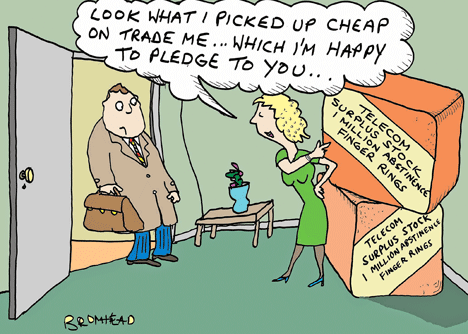
8. China's Redback - The Economist writes well here about whether China can turn its yuan into a new reserve currency. It has a long way to go. The detail around Dim Sum bonds is interesting.

Foreigners will be keen to acquire yuan, and reluctant to part with it, for as long as they think it is artificially cheap. That perception was only reinforced by China’s external surplus of $69.6 billion in the second quarter, a big jump from the previous three months. That may have prompted China’s central bank to let the yuan rise to a rate of 6.4 redbacks to one green.
9. Wall St Aristocracy - Bloomberg used the A word to describe how the Fed secretly channeled US$1.2 trillion in funds to America's big banks during the crisis of 2008/09. I suspect this will become an influential story.
Fed Chairman Ben S. Bernanke’s unprecedented effort to keep the economy from plunging into depression included lending banks and other companies as much as $1.2 trillion of public money, about the same amount U.S. homeowners currently owe on 6.5 million delinquent and foreclosed mortgages. The largest borrower, Morgan Stanley (MS), got as much as $107.3 billion, while Citigroup took $99.5 billion and Bank of America $91.4 billion, according to a Bloomberg News compilation of data obtained through Freedom of Information Act requests, months of litigation and an act of Congress.
“These are all whopping numbers,” said Robert Litan, a former Justice Department official who in the 1990s served on a commission probing the causes of the savings and loan crisis. “You’re talking about the aristocracy of American finance going down the tubes without the federal money.”
10. Totally Jon Stewart on the Warren Buffett call for the rich to pay more tax.
11. Bonus Jon Stewart on Class warfare. It says something about the state of American politics right now.
55 Comments
http://www.rollingstone.com/politics/news/rupert-murdochs-american-scandals-20110803
Rupert Murdoch's American ScandalsAndrewj
brilliant link
cheers
#1 - "Smith believed the Government should intervene but was under pressure from banks to retain the high dollar because it helped keep their foreign debt costs down."
What ratios?
Along with NZMEA the other exception is The Productive Economy Council:
Both organisations are completely independent of Business New Zealand and The Chambers of Commerce network.
Bernard - how about you get some honchos from these two orgs. and Fed Farmers on here to explain why they are not advocating for intervention?
Cheers, Les
In regards to point 2... ( Terry Maccas article ).
He talks about the Fed coming out with a QEIII... in order to inflate peoples debts away...
The point he misses thou.... is that peoples debts are only inflated away if their incomes are going up...
If we have 4.5% inflation and 1% wage growth.... that equals "disaster".
I do expect EQIII.... BUT I think the mkts will react very badly to it... because growth from inflation does not work unless the growth is in peoples wages.. ( and in the global world and stagnent economic environment that just aint going to happen )
Common sense..????? or am I missing something..???
cheers Roelof
It works, roelof, if you can convince people to borrow more, and ignore wages deflation, and hope that higher asset prices 'pay-off' the core debt. It does very much depend on the 'next sucker' theory to get you out at the time your debt had been 'diminished'. ( Note: those who do this are likely to be left with a net worth worth much less in real terms; but the nominal debt may have been discharged ie: they will be worse of in their daily lives, paying inflated prices for current goods and services, and still earning deflated wages. This, by the way, is what 'we' have been doing for 40 years...and has it worked? Or do 'we' just have more debt, still to be repaid)
What if the Bernanke had a brain fade and distributed QE3 directly to people or directly on infrastructure (including schools and health) instead of exclusively distributing it to his banker mates?
C'mon Andrew, give yourself a good shake please and start again - with a trickle-down strategy, because they are so, so, so effective. <sarc>
Les,
Fair enough Les. Here's the Geoff Bertram piece that refers to the problem of banks liking a high currency. http://www.interest.co.nz/opinion/54672/victoria-university-economist-geoff-bertram-argues-rbnz-should-force-nzs-banks-reduce-
cheers
Bernard
Indeed, it's a fairly obvious problem, with a fairly obvious solution, that would make a lot of difference to overvaluation and NZ's saving rate. However, I see no obvious leadership in the institutions responsible that are capable of delivering a solution. As Stuart Smith agrees:
"The best place to start would be to encourage the banks to source more of their money from within New Zealand."
So in addition to the honchos mentioned above, Bernard, how about get Alan Bollard (or maybe anyone on the SWG associated with RBNZ) in to explain why they won't implement some obvious regulation to solve this obvious problem.
Cheers, Les.
No 1 - I suspect Association members have pressured him to speak out. My take is the wine industry is hurting big time, a combination of the exchange rate, over supply and reduced demand in key markets such as the UK
MIA - When I emigrated to NZ in 1996, Montana varietals were $9.99 a bottle. They are now regularly $8.99 in supermarkets. Compare that to the large increases in Local Council rates over the same timeframe.
Not only that Andy but a blind tasting test will show the Montana stuff to be top shelf....I suspect quite a few local pollies will be out of a job come the next local body elections.
I heard that the growers sending fruit to Montana do things like harvest it on rainy days.
If you go over to Stratfor.com you will read that the news of the fight being taken to Tripoli is likely propaganda.
You will also read that taking Tripoli is something that is going to be very difficult to achieve. The rebels have relied on Nato air strikes, which they won't have because of the large civilian population. They, as well as Nato, are at the end of their supply chains which will make fighing a protracted urban conflict very difficult. The rebels are supposidly only several thousand strong.
Will be interesting to watch, but certainly had to get the real story.
The gummint cannot afford $2.50 petrol until after the election.
Yes there has to be lotsa cash for locally sourced term deposits if the interest rate is high enough.
But then the gummint does not want high mortgage rates before the election.
Higher inflation will happen with or without lower exchange rates.
But then the gummint does not want higher costs before the election .
And the gummint does not want big wage pressure before the election.
Roll on 2012. Smiley Wavey will have to find something to blame.
Well I see the opposite....The way things are going at the moment (like the meltdown in Europe) I wonder that $1.50 isnt more likely than $2.50, petrol futures are $20US down..interest rates might yet drop if the OCR stays where it is or goes down which is the most likely thing with a depression, which means deflation...Wage pressure, more like un-employment rising pressure...depends how fast....if it blows up after Novemember National will be laughing.....sort of...IMHO.
Poisioned challace anyone?
regards
Unemployment won't rise very much in NZ. However the numbers claiming the sickness benefit, disability benefit and DPB will skyrocket. I wouldn't be surprised if another benefit programme will be introduced in order to keep shifting the numbers away from the unemployment figures..
My guess is he don't that much to the banks or he owes so much that he owns the bank ??
either way, brave of him to point the finger at them for the hight NZ$....until he either suffocates from lack of demand from our "expensive " wines or goes to the docks when the bankers comes calling ...!!
#2 Western developed economies has no more road to run anymore and the cliff is getting nearer each day...Merkel seems to have found the guts to finally hit the nail into the coffin.
No Eurobonds means no rescue for PIIGS et el...Going to be interesting summer over here, and a long cold winter in the North.
Where are we...hmmmm....banks in europe are increasingly dependent on Bernanke lending them keyboard dollars by the hundred billion to prevent the hole opening up under Washington DC because the US banks are seriously exposed to the piigs and bigger piigs debts...all in secret you understand...wink wink....never to see the light of day as they say...no wonder gold is exploding higher...
Obama is working on a fresh round of BS and spin about his great plan..ho hum.
The UK is in a recession set to last for half the century. Not quite as long as that which the usa and Japan will cop.
Chinese property madness coming to an end..Demand for logs has been put through the chipper..Jewleeya soon to join Rudd....
What we have is a world market made up of China..India..Germany and the rest that are not in recession....all they have to workout is a currency mechanism in which the euro and the us$ are minor players.
Down here we better hope the govt doesn't come up with any stupid printing idea...and that they realise debasing the currency is a dumb policy.
Secret? I think investors see that as well....hence why Bank of America which I think has the biggest CDS exposure? is 50%+ down on where it was 6 months ago....so when this blows up....BofA will be trading in cents....bankrupt...
The french GS bank is now 58.5% down in six months....wonder if we'll see bankers jumping from window ledges in a few weeks...or if they get pushed....
regards
Some time back steven I said this current turn of the screw would not happen until the swine who caused the black hole had extricated their loot, their wealth from the hammer blow to come...I suggest to you that those with the inside word at those banks are away and gone...!
Porter Stansberry wrote today:
"In Europe, the problem is a bit different ... and slightly more technical. Most of the debt in Europe is held by the big banks, not the sovereigns. Look at just two French banks, for example. Credit Agricole and BNP Paribas have combined deposits of a little more than 1 trillion euro. But they hold assets of 2.5 trillion euro. Those assets equal France's entire GDP.
"And those are only two of France's banks. Right now, the tangible capital ratios of these banks have fallen to levels that suggest they are probably bankrupt - like UniCredit in Italy and Deutsche Bank in Germany. BNP's tangible equity ratio is 2.85%. Credit Agricole's tangible equity ratio is 1.41%. (UniCredit's is 4.42%, and Deutsche Bank's is 1.92%).
"These banks have long been instruments of state policy in Europe. They've funded all kinds of government projects and favored industries. Making loans is far more popular with politicians than demanding repayment for loans. As a result, these banks are left with nothing in the kitty to repay their depositors. If there's a run on these banks (and there will be), how will they come up with money that's owed?"
Turn it the other way around, Societe General leverage to shareholders equity is 50.4x - that's with Tier1 assets at 2.0%.
It can't last forever and that's with France sitting on AAA rating, which must be total nonsense.
Bernard’s - 10” and 11" - especially for David and Gummy the two other billionaires – the first step to be a decent member of our society and become a 100% NZpure social capitalists.
Kiwi$ debasement continues apace...your $1000 you saved into a bank a/c is earning you about 3% on which you pay tax and the $1000 will be worth just $800 after 5 years plus the piddling amount of interest the govt let you hold on to...QED, saving is for the fools....for most people the best option is to buy in bulk the stuff they need and which will keep. How many buy a leg of dry Bacon these days...tins of beans...a ton of dunny paper...store 1000 litres of diesel when it's cheap...a sack of rice...sacks of grain to make your own bread...How many have woken up to running a few chooks....sharing the price of a Predator with some mates....?
Finally a currency that could prove to be far better than the US$...Star Wars coins...solid silver...gotta be the future.
Great headline from the Economist here on 'Low rates, no interest' . This is the problem of record low interest rates but hardly any new lending.
This is the problem of deleveraging and interest rates being lower for longer.
http://www.economist.com/blogs/freeexchange/2011/08/housing-markets&fsr…
cheers
Bernard
So how are companies in China getting around the Muldoonist-style curbs on lending from the government?
Via Hong Kong, Bloomberg reports.
http://mobile.bloomberg.com/news/2011-08-18/hidden-money-from-hong-kong…
Chinese companies are borrowing record amounts from Hong Kong’s banks as the central government tries to bring the inflation rate down from a three-year high by reducing access to credit.
Financial institutions’ claims on mainland companies rose four-fold to 1.6 trillion yuan ($250 billion) between mid-2009 and the end of May, Hong Kong Monetary Authority data show. They will provide another 700 billion yuan to 1 trillion yuan of loans to mainland firms in the second half of 2011, according to Fitch Ratings. The money isn’t included in the central bank’s estimate of total lending in the economy. China’s loans fell to their lowest level in a year in July.
I found this interesting. A protest movement against migration is growing in Singapore. I lived there for a couple of years in 2003 and 2004. It's a closed place that doesn't tolerate much dissent.
Maybe not for much longer...
http://mobile.bloomberg.com/news/2011-08-18/singapore-curry-protest-hea…
The latest backlash against foreigners began when Today reported Aug. 8 on a migrant Chinese family’s complaint about the smell from curry cooked by their Singaporean ethnic-Indian neighbors. The case went to a community mediation center and the local family agreed it wouldn’t cook curry when the Chinese neighbors were at home, according to the second most-read newspaper published by state-owned broadcaster MediaCorp Pte.
Emotions have “run high” after the Today newspaper article this month, Law Minister K. Shanmugam said Aug. 16, explaining that the case happened six or seven years ago.
Singapore’s population has grown about a fifth since 2004.
Anyone who has endured the smell of dried fish frying , an Asian delicacy ( cough cough ) , ..... will swap neighbours and gladly have the Indian family next door , Gummy loves a curry .
.... so are Singaporeans willing to accept slave wages for cleaning their own toilets now , and for lugging cement around the construction sites , and for minding their own spoilt brat children ?....... hmmm , better think this through , guys !
The problem of Too Big To Fail is no smaller. And it's about to get worse.
http://mobile.bloomberg.com/news/2011-08-19/global-bank-capital-regime-…
Capital standards designed to fortify the global financial system are eroding as European officials, beset by a debt crisis, rewrite the regulations and U.S. rulemaking stalls.
The 27 member-states of the Basel Committee on Banking Supervision fought over the new regime, known as Basel III, for more than a year before agreeing in December to require banks to bolster capital and reduce reliance on borrowing. Now, as they put the standards into effect in their own countries, European Union lawmakers are revising definitions of capital, while the U.S. is struggling to reconcile the Basel mandates with financial reforms imposed by the Dodd-Frank Act.
Bernard,
Having seen you make this mistake several times and others have also pointed it out....
When will you learn the difference between positive and negative feedback???
Negative feedback leads to stability
http://en.wikipedia.org/wiki/Negative_feedback
Positive feedback leads to things getting out of control
http://en.wikipedia.org/wiki/Positive_feedback
Khyrsos
Quite right - though I suspect they are not using it as scientific nomenclature, rather as in "a bad" feedback loop. One usage describing a process, the other being a value judment.
Re ratings agencies.
We need to informally ask them to leave. Make them liable for their advice under NZ law. They won't like it so they will off shore themselves. They will still rate us off shore of course, nothing to be done about that but who cares. They have absolutely no idea what is going on anyway. People pretend to believe what they say because it is their interest to do so. But they are talking nonsense.
http://apod.nasa.gov/apod/ap110821.html
Feeling bummed out by the endless doom , gloom & despair of Bernard's worst financial stories of the day ? ... You are not alone !
.. Turn off CNBC , put down the newspaper , loosen off your bra ( yes , lederhosen too , Walter ! ) .. click the link . And feel the awe , the majesty , the calm ..........
..and the fact that neither Goofy Phil nor the Jolly kid are to be found there ......
Ahhhhhh ...... blissssssssss !
Beautiful pics Gummy. Cheers. Will pass on to my 9 year old daughter, who is a budding astronomer.
cheers
Bernard
The website has an archival system , which will give her access to years of awesome pics , and superb explanantions .
..... it is my quiet haven , when the Anti-Hickeystamines have run out ....
"Australian apple growers say they are unhappy at the sale of the first New Zealand apples in Sydney this morning for more than 90 years."tvnz
How you like them apples!
"Whether you rely on fundamentals, technicals, or a combination of both, investment analysis centers around looking at probabilistic future outcomes based on historic outcomes that occurred under similar circumstances. Given the weight of the fundamental and technical evidence we have in hand and in the context of history, the odds have shifted from favoring higher highs in stocks and risk assets to favoring lower lows. Until conditions improve, we will continue to err on the side of caution and treat the current market climate as unfavorable for intermediate to longer-term investing. We have minimal exposure to global stocks. We have positions in gold (GLD), silver (SLV), bonds (TLT), and cash"
The pinky green loony left........
"Horticulture New Zealand says the Green Party's new policy to tax water taken by irrigators would be a quick way to put large numbers of fruit and vegetable growers out of business.
Greens co-leader Russell Norman announced the party's 'clean rivers' policy last week, which includes a proposal to charge irrigated water users 10 cents for every 1,000 litres." voxy.co
This is the shite from Norman and fellow idiots....any doubts then that a vote for the pinky greens is like dumb!
but anyone wearing roman sandals,cardigans and beards will be exempt
Gonzo - can you please raise your game a little? There's aren't many here down at that level.
Wolly
He's on about the proper valuing of a finite resource, currently valued at opportunity cost only (if that).
You've had enough put up here, by myself and others, to make better apraisals than that. Perhaps you might spend the morning googling Natural Capital.
In your ear PDK....it's a Norman tax...we should have sorted those buggers out back in 1066.
Its a NZ "owned" resource, that's been used by many, but now its being corraled off for the use of a few, plus its finite and should not be wasted.....and its silly to highly irrigate crops that need it in areas that cant supply this rainfall naturally most of the time.
We also have a problems with run off and river damage, simple put a cost on that so a business knows it has to deal with it and the income is used to clean up any mess.
regards
Utter bollocks steven.
It's not "owned" but rather stolen by pollies who see a way to grab money.
"finite"...arhhhhh...no more water...arrrrrrhhh...end of the world.....bugger ...it's raining again.
Bet you flush every time steven...you wasteful sod you...can't you find a less wasteful way steven...huh...can't you!
"and the income is used to..." nope, not clean up the mess...to allow the pollies to slice more pork to buy more votes.
Wally - as a (claimed) ex-teacher, you should be able to recognise the signs.
There are strategies that teachers follow, when someone has learning difficulties.
Good teachers, that is.
What signs!...all you need do is wipe out a few billion humans and it's problem solved...or to put it another way, why are you not actively against feeding the millions in Somalia et al...
Bad teacher...bad teacher.....
What Wolly is an ex- teatcher only – I always sau him as a rich 65 od age hunting and snorckling milionaire for more, raped in coper wire, living into the Sounds doing the shares – daily - on his 15m luxuery boat PC in front of his 2 milion $ pergola.
Don't give up playing lotto Wally - you can do it again.
How true....I reckon it's a sexual thing goNZ...if it were old tarts with the blue hair turning up to protest in support of pinky green stuff....no other bugger would be interested!
Why should water be free when it is a limited and scarce resource? Establishing a price for water will discourage wastage and encourage efficient usage. The revenue from the tax could then be used to clean up some of our most degraded waterways.
It's not free if you have to fork out to store it,,,or extract it from sea water,,,or construct a race to divert it,,,or invest in equipment to distribute it,,,
What's the bet Simon P is on mains supply in suburbia dreaming up ways to raise the cost of everything that needs water in the production cycle...
Only a pinky green would think taxing it would lead to a better future....
It's misleading to say that distribution cost means that water isn't free. I would be quite happy to pay a surcharge (say 5 cents) per litre for my suburban supply of freshwater. This only becomes a large cost when you are using millions of litres.
I'm actually pretty right wing, I think a market price would encourage rational behaviour rather than the thoughtless destruction of a public good that we have now. Maybe fresh water rights should be auctioned, we would then discover the true market price of the stuff.
Dumb comment Wally.
Opportunity cost has already been mentioned.
Natural Capital has already been mentioned.
Yet you have neither addressed them, nor investigated them, have you? Just low-grade slanging-off. Think about it, eh?
"The Waikato Regional Council has the final say over whether the National Cycling Centre of Excellence will be built ... near Cambridge.
It has been receiving feedback from the public about whether ratepayers should shell out $6 million to the velodrome and Bike NZ headquarters.
The trust is relying on funding from the regional council and a further $1 million from Waipa District Council to help it get the 80 per cent or $22.8 million project funding." herald.
Doesn't it make you feel warm inside...spending other people's money...make work schemes...here have another sports centre...and a high rise carpark to be better than marlborough...and a pool that's deeper than their one...and a museum of old airplanes and such stuff...how about a museum of past criminal activities...and one for toys we have known...and knitting through the ages....the weaving museum....the carving museum...
How hard to rate payers have to bang local polly heads before the fat between the polly ears gells into functioning cells.
FYI I've updated with a corrected the link to the Ritholtz piece at the Washington Post.
HT Neville Bennett for spotting it and telling me.
cheers
Bernard
We welcome your comments below. If you are not already registered, please register to comment
Remember we welcome robust, respectful and insightful debate. We don't welcome abusive or defamatory comments and will de-register those repeatedly making such comments. Our current comment policy is here.