

Here's my Top 10 links from around the Internet at midday in association with NZ Mint.
I welcome your additions in the comments below or via email to bernard.hickey@interest.co.nz.
I'll pop the extras into the comment stream.See all previous Top 10s here.
What a match. I was lucky enough to go and yelled myself hoarse. I particularly enjoyed the 'Four more years' chant at the end. 'Were you listening George Gregan?'

1. Global trade falling fast - The New York Times reports on a 14.2% slump of imports into the Port of Long Beach in California in August from a year ago.
This is normally a month when supplies are arriving from China onto the West Coast ports to stock America's stores for the Christmas sales season.
A similar thing happened in late 2008 when the Lehman Brothers crisis hit.
Global trade fell around a third in the following months.
This is all crucial for China. The last time its exports to America dropped like this it unleashed a debt-fueled infrastructure building frenzy that boosted iron ore and coal prices as it pumped out steel and concrete for the boom, helping to protect Australia and therefore us.
This time around China is trying to slow its economy and may not take such drastic action to offset a slump in exports to America.
When retailers expect that Americans will be crowding into their stores, their orders pile into the nation’s ports in August and September for delivery to stores by late October. But logistics companies say that is not happening this year.
“We’re concerned, because usually at this time, you see this peak,” said Richard D. Steinke, the executive director of the Port of Long Beach in California. “We haven’t seen it.”
In fact, the five busiest container ports in the United States said that imports in August 2011 were lower than or even with 2010 volumes.
Joshua Owen, president of Ability/Tri-Modal Transportation Services, a trucking company based in Southern California, said the light volume and lack of a shipping peak did not surprise him. “In reality, when people aren’t able to even afford homes, and they don’t have jobs, they’re not going to be buying a lot of creature comforts,” he said.
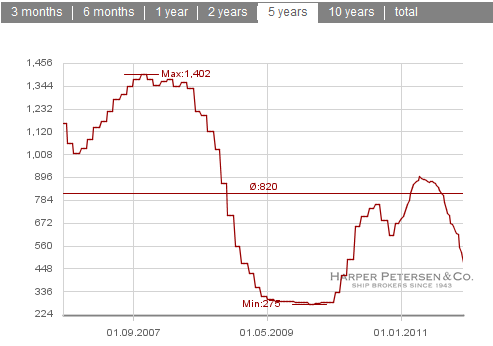
This chart below is from ship broker Harper Peterson Shipping in America, showing the last five years of brokered shipping rates and a sharp fall in recent months. HT Mish.

2. 'Would like milk with your fries?' - The Wall St Journal reports PepsiCo is planning a global push into dairy products with a joint venture with German company Theo Muller in America's fast-growing yoghurt market.
Fonterra already has a few global competitors/customers.
This may be one more of them.
It would no doubt be a buyer of Fonterra if it was ever put up for sale.
I love this line about Pepsi's ambitions to create new foods...
A key plank of PepsiCo's nutrition strategy involves "snackifying'' beverages and "drinkifying'' snacks and creating products combining fruit, grains and dairy. Already a major global player in fruit juice and oatmeal through its Tropicana and Quaker brands, PepsiCo recently launched a fruit purée in the U.S. that's thick enough to be a snack. It is testing an oatmeal-based drink in Latin America.

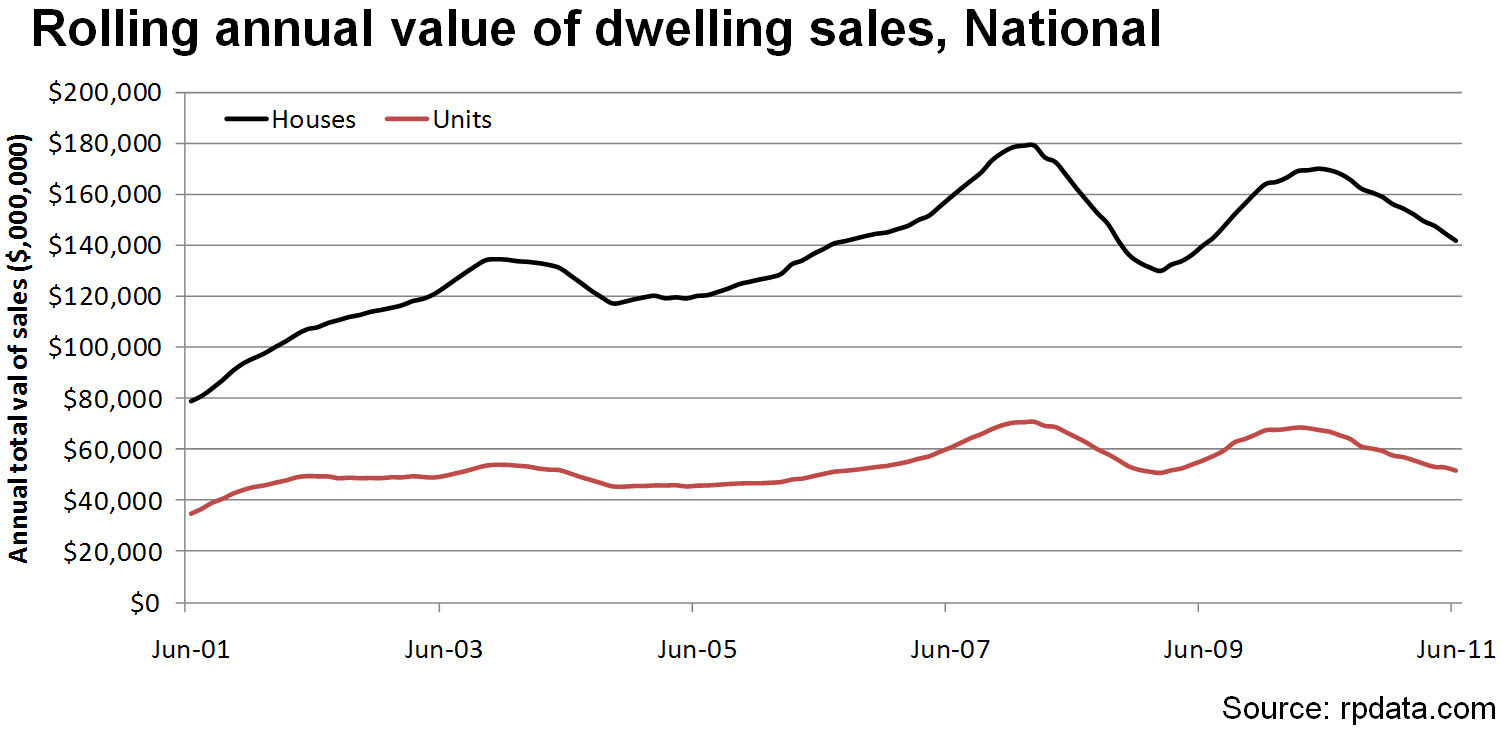
3. Aussie real estate agents nervous - Delusional Economics at Macrobusiness points to the largest fall in the total value of Australian house sales for at least a decade.
Surprisingly, he actually defends Keynes himself, rather than the things done and said in his name.
He's no big fan of neo-classical economics and details his view in his book Debunking Economics.
"If you want to head off fascism, you need a politician who will stand up to bankers," he said.
He wants a debt jubilee.
5. The Princelings speak - John Garnaut is writing some great stuff from Beijing for the Sydney Morning Herald. Here's the first detail I've seen reported of what the 'Princelings', the children of China's revolutionary leaders, are actually saying behind the scenes.
WHEN Ma Xiaoli arrived this month at the Hall of Many Sages with the sister of China's likely next president, she had no intention of speaking what was on her mind. After all, the Chinese Communist Party usually does not permit disgruntled citizens to gather in large numbers and challenge the party line.
But as she heard other children of former leaders push back at what they saw as the party's moral decay, its attack on civil society and its revival of destructive Cultural Revolution politics, she found that when she started talking she could not stop.
''The Communist Party is like a surgeon who has cancer,'' Ms Ma told this almost unprecedented unofficial gathering of powerful families that took place in a conference room at the China World Trade Centre on October 6. ''It can't remove the tumour by itself, it needs help from others, but without help it can't survive for long.''
Ms Ma was able to dispense with discretion because of her father's prestige as a leading revolutionary and because her family has long been intertwined with other elite families represented in that room, especially that of the anointed next president, Xi Jinping. The gathering was the starkest demonstration to date of how ''princelings'' are networking and rallying to influence personnel and ideology ahead of Mr Xi replacing Hu Jintao at the helm of the Communist Party at it's five-yearly congress a year from now.


7. This is good to see - Bloomberg reports America's Inland Revenue Service has launched an audit into Google's practices of shifting profit into low taxed offshore subsidiaries.
Google, owner of the world’s most popular search engine, has cut its worldwide tax bill by about $1 billion a year using a pair of strategies called the “Double Irish” and “Dutch Sandwich,” which move profits through units in Ireland, the Netherlands and Bermuda. Google reported an effective tax rate of 18.8 percent in the second quarter, less than half the average combined U.S. and state statutory rate of 39.2 percent.

8. Secrecy and Free Trade - Auckland University Professor Jane Kelsey says the various countries negotiating the Trans Pacific Partnership agreement have decided to keep the details secret for four years.
The parties have apparently agreed that all documents except the final text will be kept secret for four years after the agreement comes into force or the negotiations collapse. This reverses the trend in many recent negotiations to release draft texts and related documents.
The existence of agreement was only discovered through a cover note to the leaked text of the intellectual property chapter.

9. This is fun - A new Cato Institute study debunks the myth that US President Herbert Hoover was a hand-off small government type who did nothing as the The Great Depression deepened.
Politicians and pundits portray Herbert Hoover as a defender of laissez faire governance whose dogmatic commitment to small government led him to stand by and do nothing while the economy collapsed in the wake of the stock market crash in 1929. In fact, Hoover had long been a critic of laissez faire. As president, he doubled federal spending in real terms in four years. He also used government to prop up wages, restricted immigration, signed the Smoot-Hawley tariff, raised taxes, and created the Reconstruction Finance Corporation—all interventionist measures and not laissez faire.
Unlike many Democrats today, President Franklin D. Roosevelt's advisers knew that Hoover had started the New Deal. One of them wrote, "When we all burst into Washington ... we found every essential idea [of the New Deal] enacted in the 100-day Congress in the Hoover administration itself."
Hoover's big-spending, interventionist policies prolonged the Great Depression, and similar policies today could do similar damage.

10. Totally irrelevant video showing China really is the greatest - It has invented robots that play ping pong.
We welcome your comments below. If you are not already registered, please register to comment
Remember we welcome robust, respectful and insightful debate. We don't welcome abusive or defamatory comments and will de-register those repeatedly making such comments. Our current comment policy is here.