

Here's my Top 10 links from around the Internet at midday in association with NZ Mint.
I welcome your additions in the comments below or via email to bernard.hickey@interest.co.nz.
I'll pop the extras into the comment stream.See all previous Top 10s here.
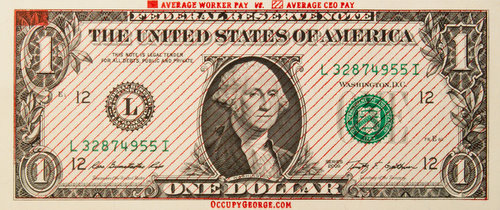
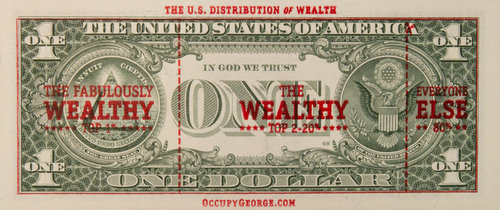
There's a great capitalist revolt at number 8. I've also sprinkled through some of the clever #OccupyGeorge protests where one dollar bills are printed with protests and then handed on into the money supply.

1. A deleveraging spiral - The crunch has arrived in Europe.
When debt is unsustainable decisions have to be made.
The banks that have made those loans must at some stage acknowledge that it won't get all that money back and decide to book a loss.
When they do book those losses they then have to decide (or be forced) whether to either bring in new capital to strengthen their books, or to reduce the size of the loans on the other side of its books to improve its capital rations.
That moment of truth has arrived in Europe.
The battle is on between bank shareholders and governments. Shareholders don't want to dilute their shareholdings by having governments inject capital or have their share values slashed by having haircuts imposed on the debt they hold. So one option for them is to deleverage their balance sheets by calling in other loans.
Governments don't want those balance sheets deleveraged for good reasons. A mass and sudden deleveraging would crash an economy.
So the battle lines are drawn. Eventually, if the bank balance sheets are precarious enough, governments win, if their voters allow them to bail out the banks.
Bloomberg reports that Eurozone banks have now threatened to call in 1 trillion euro of loans as the crunch arrives this weekend on how much capital needs to be injected into the banks.
Banks in France, the U.K., Ireland, Germany and Spain have announced plans to shrink by about 775 billion euros ($1.06 trillion) in the next two years to reduce short-term funding needs and comply with tougher regulatory capital requirements, according to data compiled by Bloomberg. Morgan Stanley bank analysts predict that amount could reach 2 trillion euros across Europe by the end of next year as banks curb lending and sell loans and entire businesses. A lack of buyers and the losses lenders face on loan sales are making those targets unrealistic.
“Asset sales are impractical in the current environment,” said Simon Maughan, head of sales and distribution at MF Global UK Ltd. inLondon. “Every bank is selling, and no bank is buying. It just won’t work. Beyond that, the magnitude of the cuts the banks are talking about is nowhere near the likely required amount of deleveraging. They need to reduce hundreds of billions more to adjust to the new world order. There has to be a recapitalization.”
2, Bank of America's sneaky switch - Yves Smith at Naked Capitalism has picked up on a clever move by Bank of America to dump some dodgy derivative assets into a government guaranteed division of the bank...sigh
I'm sitting in the Dunedin Art Gallery preparing for a presentation for an Otago and Southland Business Association conference. I'm looking out on a bunch of Occupy movement tents camped in the Octagon. They will know nothing about this latest US banking outrage, which is what is really driving the movement globally.
The same things are not happening here, and Occupy NZ seems more about environmental causes than financial ones, but their broad cause is right.
The world can't afford to privatise the profits of the financialisation of the economy and then socialise the losses.
It's economically destructive and just plain not fair.
Here's Yves:
The reason that commentators like Chris Whalen were relatively sanguine about Bank of America likely becoming insolvent as a result of eventual mortgage and other litigation losses is that it would be a holding company bankruptcy. The operating units, most importantly, the banks, would not be affected and could be spun out to a new entity or sold. Shareholders would be wiped out and holding company creditors (most important, bondholders) would take a hit by having their debt haircut and partly converted to equity.
This changes the picture completely. This move reflects either criminal incompetence or abject corruption by the Fed. Even though I’ve expressed my doubts as to whether Dodd Frank resolutions will work, dumping derivatives into depositaries pretty much guarantees a Dodd Frank resolution will fail. Remember the effect of the 2005 bankruptcy law revisions: derivatives counterparties are first in line, they get to grab assets first and leave everyone else to scramble for crumbs. So this move amounts to a direct transfer from derivatives counterparties of Merrill to the taxpayer, via the FDIC, which would have to make depositors whole after derivatives counterparties grabbed collateral. It’s well nigh impossible to have an orderly wind down in this scenario. You have a derivatives counterparty land grab and an abrupt insolvency. Lehman failed over a weekend after JP Morgan grabbed collateral.
But it’s even worse than that. During the savings & loan crisis, the FDIC did not have enough in deposit insurance receipts to pay for the Resolution Trust Corporation wind-down vehicle. It had to get more funding from Congress. This move paves the way for another TARP-style shakedown of taxpayers, this time to save depositors. No Congressman would dare vote against that. This move is Machiavellian, and just plain evil.

3. A warning from the Chief Economist of Citigroup - Willem Buiter is quoted as saying this by Bloomberg. It's more than enough to explain the gravity of the situation in Europe. His assessment of how close we are to a solution in Europe is also a worry. The markets are pricing in a solution this weekend. He says next year.
Willem Buiter said all banks in advanced economies could be at risk if European leaders lose control of the region’s sovereign- debt crisis.
“If things get out of hand in the euro area, no bank in the financial-integrated world will stand,” Buiter told lawmakers at a parliamentary hearing in London today.
Banks and other systemically-important financial institutions need to be recapitalized before any sovereign restructurings of euro-zone members with high debt levels such as Greece orPortugal, the economist said. “If they don’t, we are setting ourselves up for a financial crisis following the sovereign crisis,” he said.
4. Greece's public service - The New York Times reports on how bloated the Greek public service is with a few juicy details.
The government has about 700,000 employees and 80,000 more who work for government-owned entities like the power company. Thirty years ago, experts say, the public sector was about one-third that size. (Until a census was carried out last year, however, government officials admitted they did not really know how many employees they had.)
Some ministries still have employees whose sole job is to record the arrival of documents in a ledger. “It’s crazy,” said Nikos Hlepas, an expert on public administration at the University of Athens. “That’s their whole job even though today we have e-mail.”
But taking action against public sector workers can be costly, experts point out. For instance, many suspect that tax collectors, vital to the government’s efforts to raise more revenues, have been on a work slowdown. The collectors, who like all public servants were hit with salary cuts, completed fewer audits this year than last year.
Stories of excesses abound. Mr. Papandreou told Parliament that one of his ministers found a predecessor’s $38,000 bill for curtains when the Socialists returned to power in 2009. Mr. Mossialos said he found that his own ministry, for media and communication, was spending $750,000 a year for office space for just 11 people.
5. 'Let the damn banks fail' - Famed investor Jim Rogers says in this CNBC interview what many taxpayers and true free market investors really think.
6. Loose regulations - Brian Easton writes in the Listener that the Leaky Building crisis and the Global Economic crisis have a lot in common.
There were many causes of the disaster but it illustrates the failure of regulation, which should have overridden them. Light-handed regulation – the fad of the past two decades – assumed that private actors would govern themselves to a high standard and not take short cuts or exploit others; that where they were not naturally inclined to behave this way, the threat of litigation would give the right result.
Of course there would be the odd failure; and although a few might be understandable, 110,000-odd suggests sheer carelessness.

7. Here we go - Iron ore and coal prices are falling for Australia's miners, Macrobusiness points out in this piece saying a terms of trade shock is brewing for Australia, citing some Westpac research.
Spot iron ore prices price have fallen quite sharply over the last 2 weeks, down 8% to $158/t. In the last 4 weeks, Australian spot fines, as measured by the TSI, are down almost 12% landed in China.
While the Dec qtr iron ore contracts will be broadly in line with the Sep qtr contracts, if the spot prices maintain the current level for the remainder of the Dec qtr, the contracts would fall around 13%. But that is not the end of the story. Brazilian prices have fallen by a larger 16% and historically, where Brazilian prices go Australian prices tend to follow.

8. Even the capitalists are revolting - Mark Cuban is an outspoken tech entrepreneur who owns the Dallas Mavericks NBL basket ball team and often gets ejected from his own stadium for abusing the refs.
Here's an excellent blog he has written with advice for the #OccupyWallStreet movement.
He says protestors should become shareholders and demand their companies stop the job cutting in the name of 'shareholder value'. He says all financial institutions should be made to drop their corporate status and become partnerships and Wall St should be taxed to hell.
He also says student loans should be limited to US$2,000 a year.
And he's also in favour of a financial transactions tax. Great.
The simplest way to change this is to place a very simple per share tax on every transaction. 10 cents a trade. Every share. Every option. Every Bond. Every currency transaction. Every trade.
The obvious response is that trading volume will plummet. So what ? Let it. The next response is that traders will merely move their trades to foreign exchanges. Yes they will. Will transaction costs go up ? Duh.. that is the point. The market thrived when spreads and transaction costs were much higher just a few short years ago. It will survive now.
I would happily send transactions overseas and let them absorb all the risk that comes from a continuous effort of financial engineers and hacks trying to game the system. By letting them move overseas, we would still have risk because of the interconnection of economies, but our direct risk would be much less. And given that the UK already has a semblance of a tax on transactions, it wouldnt’ take long before they would need to expand that tax in order to hedge the systemic risk associated with financial engineers and hacks.
More importantly, it might just put the market back to the basics of what the stock and bond markets are supposed to be, a means of raising capital to support corporate growth. There used to be a time when Investment Bank Partnerships made their money scouting out small companies in need of capital and matching them with investors. They weren’t as big as they are now, but they managed to create quite a few growth industries. Something we could use some of today. Making the stock market a launching pad for companies will have far greater value and impact employment far greater than making sure High Frequency Traders can get their trades in.
9. Peak oil - Saudi Arabia's population is growing so fast that by 2028 it may be consuming all the oil it produces. That means no exports and higher oil prices, if it can't find other ways to generate electricity.
Here's Ed Harrison at Credit Writedowns:
Clearly, the Saudis want to have oil capacity available for export. The more they consume domestically, the less revenue available to the government for domestic programs - hence the drive for alternative energy. Given where Saudi Arabia is located and the sunlight it gets, solar is a good fit. This week the earth is supposed topass the 7 billion person figure. This presents enormous challenge in a world of limited resources.
Clearly, demand for energy must increase with the rise in population or we will have to lower the use of energy person in proportion with the rise in population. Peak oil is a big part of how this will be achieved.
10. Totally The Daily Show on the 99% - I haven't watched this because I'm on a limited broadband connection, but The Daily Show is usually good for a laugh.
We welcome your comments below. If you are not already registered, please register to comment
Remember we welcome robust, respectful and insightful debate. We don't welcome abusive or defamatory comments and will de-register those repeatedly making such comments. Our current comment policy is here.