

Here's my Top 10 links from around the Internet at 9 pm in association with NZ Mint.
I welcome your additions in the comments below or via email tobernard.hickey@interest.co.nz.
I'll pop the extras into the comment stream. See all previous Top 10s here.
Sorry it's so late today. I'm in Wellington with Alex covering PREFU etc. Went to the parade in Auckland yesterday. I personally told Stephen Donald I was sorry I ever doubted him. He looked at me funny, smiled, waved and then gave me the fingers. Or maybe it was a victory sign. (When I say personally told, I mean I muttered under my breath while 300 people around me cheered 'Beaver, Beaver, Beaver')

1. More debt to solve a problem of too much debt - The deck chair shuffling is continuing in Europe.
The Telegraph's Louise Armitstead reports German Chancellor Angela Merkel is now begging her own parliament to accept a 'big bazooka' fund to bail out Southern European governments that does not use German money or the European Central Bank.
Brilliant.
Instead it will be a special purpose vehicle or a special fund that guarantees buyers of bonds against losses and encourages other sovereign wealth funds to lend to this fund to buy other bonds.
Eseentially the big bazooka is an off balance sheet vehicle that is leveraged up to buy other debt.
Off balance sheet bond insurance schemes have a chequered history... I think Angela needs to have a chat to the folks who used to run Lehman Bros and AIG.
Why does anyone believe a problem of too much debt can be solved with more debt?
The German Chancellor, who must secure the Bundestag's approval before European bail-out plans can proceed, briefed politicians on plans to increase the firepower of the European Finance Stability Facility (EFSF) from €440bn (£383bn) to more than €1 trillion.
She assured them that Germany would not have to stump up more cash because financial engineering would be used to boost the bail-out fund.
Eurozone countries are discussing two methods to boost the EFSF: a special-purpose fund to buy troubled bonds and/or another fund that would guarantee bondholder losses.
On the other key areas that leaders have to agree on Tuesday, there was continued wrangling over the writedowns private bondholders will have to take on Greek debt and the extent of the bank recapitalisation programme.

2. It's a great idea for a SPIV - Seriously. Here's how Reuters described the idea for the specially turbo-charged fund. I learned a long time never to buy turbo-charged cars. Their engines blow and their resale value plummets.
The euro zone wants to boost the firepower of its 440 billion euro bailout fund without putting more money into it.
The euro zone should combine two proposals for increasing the firepower of its rescue fund -- an insurance model and a special purpose investment vehicle (SPIV) -- according to an EU paper for the mid-week summit obtained by Reuters on Monday.
The paper said neither option would require politically-difficult changes to the existing European Financial Stability Facility (EFSF), which has been approved by national parliaments after some problematic debates.

3. Here's an idea - Just in case anyone thinks I only refer to nutty ideas from crazy lefties, here's one from the current executive director of financial stability at the Bank of England, Andrew Haldane, who has said bankers should be paid on the value of the assets they manage, rather than the profits they make from them.
Here's the thinking via The Telegraph:
The near ten-fold rise in bank chief executives' pay from an average of $2.4m (£1.5m) in 1989 to $26m by 2007 could have been restrained to $3.4m if pay had been linked to the return made on assets said Andrew Haldane, executive director of the Bank.
Mr Haldane said the return on equity targets employed by most banks had warped the industry's compensation structure and led to a situation where the average pay of top executives had risen to 500 times the median US household income.
"It would be a relatively small step for banks to switch from ROE [return on equity] to ROA [return on assets] targets in their capital planning and compensation. Yet the effects on risk-taking and remuneration could be large," said Mr Haldane, speaking at the Wincott Annual Memorial Lecture in London on Monday. He said that while the rewards for bankers had been "kept privately", the risks had been "widely spread socially".

4. The amazing Olympus story - This one has been brewing in Japan for a few weeks and is a cracker.
A big brand, Olympus, appears to have paid some shady characters hundreds of millions for something...ie The Yakuza
When the British CEO of Olympus blew the whistle on his Japanese board, he was sacked for 'cultural insensitivity'. The share price fell 45% and now all hell has broken loose. Here's the Reuters version.
Here's William Pesek at Bloomberg
Japan’s corporate culture of denial, of ignoring problems and letting them fester, keeps running up against a globalized world that values agility, innovation and transparency. Olympus demonstrates all too painfully how much Old Japan tolerates a lack of accountability among senior executives; inadequate disclosure; a disinclination to challenge authority and absolute deference to corporate boards regardless of share performance.
The inadequacies of Japan’s corporate-governance system deserve scrutiny. Boards in Japan get less heat, partly because executives aren’t paid as obscenely as American ones. Shareholders assume directors are smart, devoted people working for the good of Japan Inc. Tough questions are rarely asked.

5. Too right - Stuff reports a strategist at Investec, Michael Power, has warned Bill English that he has to do something about our over valued exchange rate or we'll suffer a particularly Kiwi version of Dutch Disease. It's a bit late for that...
Power said the central bank "needs to think a little bit harder" about whether it should stay out of the way.
"This sort of hands up in the air, let the chips fall where they may, and let the currency fall where it will, is actually very, very short-term, benign, neglect."
Power argued that resource rich countries should use sovereign wealth funds to intervene in the currency markets, buying foreign currency to cope with future problems, which would help weaken the dollar.
Otherwise New Zealand would face problems similar to those of the Netherlands in the 1970s, which boomed as gas supplies provided an alternative fuel during the oil crisis, sending the currency soaring and leading to the "Dutch disease" of free spending as industry was eroded.

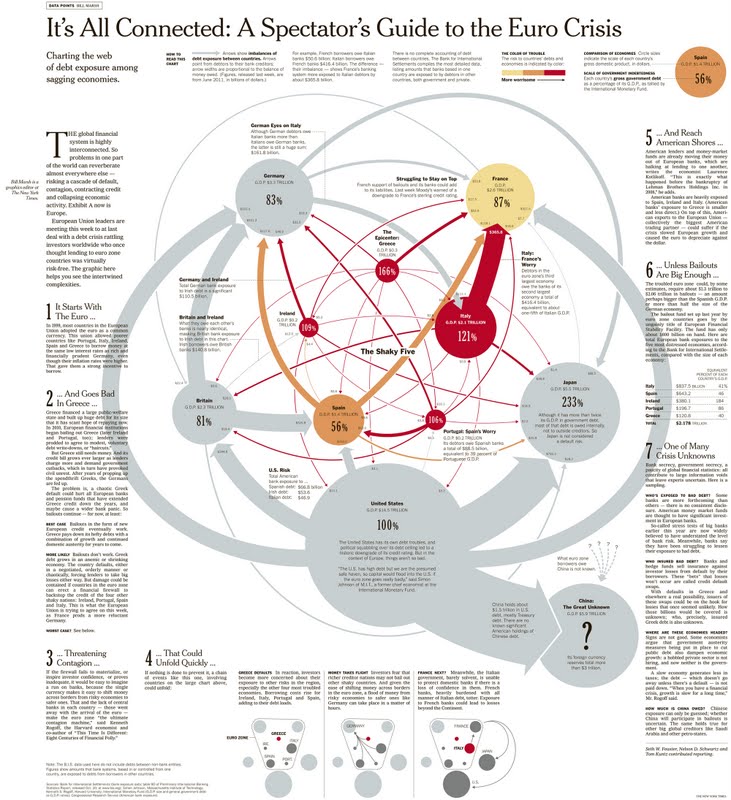
6. Interconnections - Here's a cracking graphic at the New York Times showing the interconnections in the European crisis.
Click on the image for a bigger more readable version.
7. Maybe default is the answer - Here's an academic paper saying that Argentina's sovereign default in 2001 was actually a great thing for the economy. HT Yves Smith at Naked Capitalism.
The paper makes the point that losing foreign investors and creditors is not always a disaster. Iceland's remarkable recovery suggests something similar.
As a result of the default, and the refusal of a minority of creditors to accept the eventual restructuring agreement in 2005, and subsequent legal action by these creditors and “vulture funds,” Argentina has faced difficulties borrowing in international financial markets over the last nine years. Since it has not been able to settle its debt with the government creditors of the Paris Club, it has also been denied some export credits. FDI has remained limited, averaging about 1.7 percent of GDP over the past eight years, with a number of serious legal actions taken by investors against the government.
Yet in spite of all of these adverse external conditions that Argentina faced during the past nine years, the country experienced this remarkable economic growth. This should give pause to those who argue, as is quite common in the business press, that pursuing policies that please bond markets and international investors, as well as attracting FDI, should be the most important policy priorities for any developing country government. While FDI can clearly play an important role in promoting growth through a variety of mechanisms, and foreign capital in general can, in some circumstances, boost growth by supplementing domestic savings, Argentina’s success suggests that these capital inflows are not necessarily as essential as is commonly believed. And it also suggests that macroeconomic policy may be more important that is generally recognized.

8. The secretive and huge world of commodity traders - Joshua Schneyer does a nice job at Reuters of exposing the enormously wealthy and well paid commodity traders at a few mostly Swiss-based companies that trade the world's commodities. HT Greg.
Here's some detail:
They form an exclusive group, whose loosely regulated members are often based in such tax havens as Switzerland. Together, they are worth over a trillion dollars in annual revenue and control more than half the world's freely traded commodities. The top five piled up $629 billion in revenues last year, just below the global top five financial companies and more than the combined sales of leading players in tech or telecoms. Many amass speculative positions worth billions in raw goods, or hoard commodities in warehouses and super-tankers during periods of tight supply.
U.S. and European regulators are cracking down on big banks and hedge funds that speculate in raw goods, but trading firms remain largely untouched. Many are unlisted or family run, and because they trade physical goods are largely impervious to financial regulators.
How big are the biggest trading houses? Put it this way: two of them, Vitol and Trafigura, sold a combined 8.1 million barrels a day of oil last year. That's equal to the combined oil exports of Saudi Arabia and Venezuela. Or this: Glencore in 2010 controlled 55 percent of the world's traded zinc market, and 36 percent of that for copper. Or this: publicity-shy Vitol's sales of $195 billion in 2010 were twice those at Apple Inc.

9. Suspended - China's NTDTV reports China's Ministry of Railways has suspended work on 6,000 miles of railways and many of the six million migrant workers on the projects have gone unpaid for months because of a funding squeeze. HT Macrobusiness.
10. Totally irrelevant Jon Stewart video on Rick Perry's nipple and why Eric Cantor is scared of the public. It made me laugh.
We welcome your comments below. If you are not already registered, please register to comment
Remember we welcome robust, respectful and insightful debate. We don't welcome abusive or defamatory comments and will de-register those repeatedly making such comments. Our current comment policy is here.