

Here's my Top 10 links from around the Internet at 7 pm in association with NZ Mint.
I welcome your additions in the comments below or via email tobernard.hickey@interest.co.nz.
I'll pop the extras into the comment stream. See all previous Top 10s here.
Sorry there was no Top 10 yesterday. All manner of news happened yesterday in Wellington and other places...Have a great weekend. Dilbert made me laugh out loud today.

1. Why Europe's 'Big Bazooka' is a lethal weapon - For the firer. Europe hasn't solved anything with its 'uber-plan' announced yesterday.
The markets may be celebrating, but they are premature again, as they have been after every other plan to 'end the crisis.'
To summarise: the bailout fund adds no new money (it is just a pledge to borrow more or insure bonds), the bank recapitalisations are half what is necessary and the Greek haircuts are both inadequate and likely to further freak out already freaked out bond investors.
At best, it buys some time for a real solution, which is some sort of European wide bond and a single fiscal authority.
Both these 'end games' are either impractical or politically unsustainable.
Many believe the only real solution is the break-up of the euro and the return to multiple currencies.
Here's Jeremy Warner at The Telegraph with some excellent points:
As Sir Mervyn King, Governor of the Bank of England, remarked before it had been signed, it might buy a little time, but it is no kind of long-term solution.
Before explaining why, let's first pick some holes in the plan itself, which amounts to pretty much a clean sweep for the German view on how to proceed and poses almost as many questions as it answers. The only bit which is done and dusted is the banking recapitalisations, where 70 banks have been stress tested and some very precise numbers have been put on the required additional capital.
The overall impact of the banking package is none the less somewhat underwhelming. The stress tests are widely thought wanting by many market participants and the additional capital therefore inadequate. BNP Paribas for one should be able to achieve its €2bn through earnings retention alone. The tests seem once again to have been designed so as to bring about the least possible commitment of new public money rather than once and for all to underpin banking solvency.
Furthermore, the statement seems to imply enforced bail-ins of subordinated debt holders before sovereign support is tapped. This is only going to further unnerve debt holders and will likely further enhance the difficulties many eurozone banks face in accessing wholesale market funding.
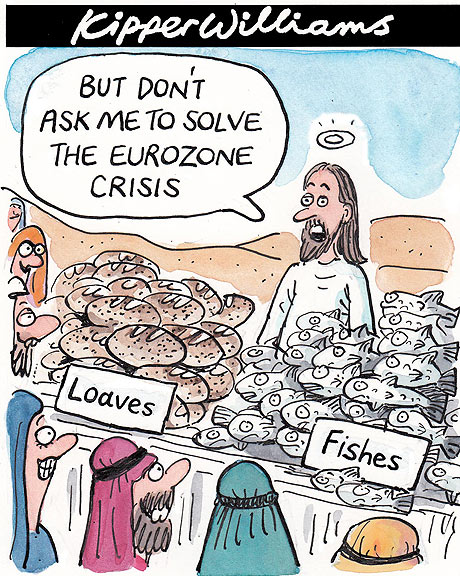
And here's the diagram that officials used to cook up the Big Bazooka during the 10 hour summit. The cartoon below below #3 tells the story even better. HT Reuters

2. Bernie feels happier and safer inside - Ponzi schemester Bernie Madoff has told Barbara Walters he is happier and safer inside prison than if he was still on the outside trying to cover up his scheme and deal with angry investors.
"I feel safer here than outside," said Walters, paraphrasing Madoff's comments from her interview at the Butner Federal Correctional Complex in North Carolina, where he is serving a 150-year sentence.
"I have people to talk to, no decisions to make. I know I will die in prison. I lived the last 20 years of my life in fear. Now I have no fear because I'm no longer in control."
Meanwhile, his wife Ruth has spoken for the first time about how she and Bernie tried to commit suicide before he was imprisoned. They are now estranged after their son Mark committed suicide last year.

3. Even Nigeria and Namibia are borrowing money - There's an awfully large appetite now for bonds being issued by governments anywhere other than in Europe.
Bloomberg reports Namibia has just offered its first international bond. It is selling US$500 million of bonds at yields of between 5.75% and 6%. It has a BBB minus credit rating.
It is financing a budget deficit headed for 10% of GDP...
Has the world gone mad?
The southern African nation, which borders South Africa, Botswana and Angola, follows Nigeria, sub- Saharan Africa’s second-largest economy, which sold its first dollar-denominated debt in January.
“It sounds relatively attractive compared to African peers,” Stuart Culverhouse, the chief economist at investment bank Exotix Ltd., said in a phone interview from London today. “It’s a relatively unknown name and may have to stimulate interest through the pricing.”
The government is raising funds to help finance a budget deficit that’s forecast to widen to 9.8 percent of gross domestic product in the year through March 2012 from 7 percent last year.

4. And the Japanese are printing again - BBC reports the Bank of Japan has announced plans to increase its government bond buying by US$66 billion.
Analysts said the bank's decision was an attempt to restore faith in the economy.
"Basically it is a message to international sovereign markets unsettled by the European debt crisis, that the BOJ is willing to bailout the Japanese bond market if it is necessary," Martin Schulz of the Fujitsu Research Institute told the BBC.

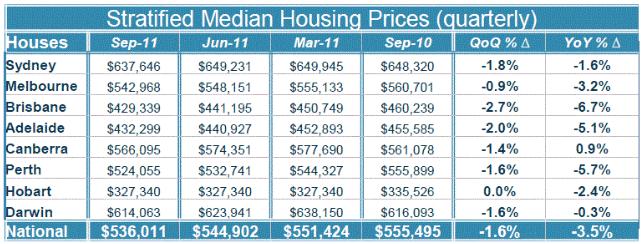
5. Australian house prices sliding - Leith van Onselen over at Macrobusiness.com.au reports Australian house prices are sliding fast, particularly in Brisbane and Perth.
6. 'Economic models are always wrong' - David Freedman writes over at Scientific American that economic models are always wrong. Constant re-calibration is the culprit.
When it comes to assigning blame for the current economic doldrums, the quants who build the complicated mathematic financial risk models, and the traders who rely on them, deserve their share of the blame. [See “A Formula For Economic Calamity” in the November 2011 issue]. But what if there were a way to come up with simpler models that perfectly reflected reality? And what if we had perfect financial data to plug into them?
Incredibly, even under those utterly unrealizable conditions, we'd still get bad predictions from models.
The reason is that current methods used to “calibrate” models often render them inaccurate.
7. Watch the Chinese - Europe is planning to take its EFSF begging bowl to China.
China will want several metric tonnes of flesh in return.
Here's ZeroHedge quoting from the FT on what the Chinese are demanding:
"It is in China’s long-term and intrinsic interest to help Europe because they are our biggest trading partner but the chief concern of the Chinese government is how to explain this decision to our own people,” said Professor Li. “The last thing China wants is to throw away the country’s wealth and be seen as just a source of dumb money.” Alas, that is precisely how the entire world sees China.
As for the final condition: "He added that Beijing might also ask European leaders to refrain from criticising China’s currency policy, a frequent source of tension with trade partners." And this is how you declare political check mate and shut up all voices that threaten to protest against mercantilist policies. And since it is only a matter of time before China will have to rescue the US, we hope Senate enjoys the time remaining in which it can debate whether or not China manipulates the CNY. That time is about to end.
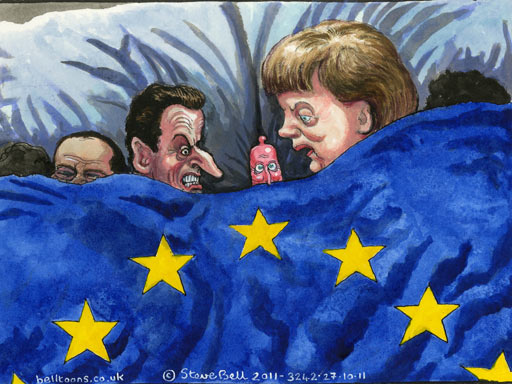
Couldn't resist this Steve Bell cartoon from The Guardian. The little man in the middle is David Cameron, who is always characterised by Bell as a rubber protective device...
8. NZ electricity demand falls off a cliff - Electricity market figures from WITS free service shows demand for electricity dived sharply in the last couple of weeks.
It could be fine weather, but it's one hell of a dive and well below at the same time last year, which is the light orange line.
Any ideas?

9. Here we go again - Ambrose Evans Pritchard points out at The Telegraph Portugal appears to be heading down into the Grecian vortex of rising debt, rising interest rates and a contracting economy...
Its money supply is contracting at a rate of 21% per annum and it has a debt to GDP ratio of 360%.
Data released by the European Central Bank show that real M1 deposits in Portugal have fallen at an annualised rate of 21pc over the past six months, buckling violently in September.
"Portugal appears to have entered a Grecian vortex and monetary trends have deteriorated sharply in Spain, with a decline of 8.4pc," said Simon Ward, from Henderson Global Investors. Mr Ward said the ECB must cut interest rates "immediately" and launch a full-scale blitz of quantitative easing of up to 10pc of eurozone GDP.
A mix of fiscal austerity and monetary tightening by the ECB earlier this year appear to have tipped the Iberian region into a downward slide. "The trends are less awful in Ireland and Italy, suggesting that both are rescuable if the ECB acts aggressively," said Mr Ward.
A shrinking money supply is dangerous for countries with a high debt stock. Portugal’s public and private debt will reach 360pc of GDP by next year, far higher than in Greece.
I'll leave the last word of reporting to Ambrose, just in case anyone really thinks Europe is solved:
Jean-Luc Mélenchon, leader of the French leftist Front, said Europe is now marching to Germany’s drum and "headed for disaster", a view gaining ground across Europe’s Left.
Albert Edwards from Société Générale said the ECB will have to act, over a German veto if necessary. "The increasingly frenzied attempts of eurozone governments to persuade financial markets that they can draw a line under this crisis will ultimately fail."
"The impending threat of a euro break-up will force the ECB to begin printing money, very reluctantly joining the global QE party. The question is whether Germany will leave the eurozone in the face of such monetary debauchery," he said.

10. Totally Clarke and Dawe on the problems with politicians in Canberra.
They're being looked after and made comfortable.
We welcome your comments below. If you are not already registered, please register to comment
Remember we welcome robust, respectful and insightful debate. We don't welcome abusive or defamatory comments and will de-register those repeatedly making such comments. Our current comment policy is here.