

Here's my Top 10 links from around the Internet at 4 pm in association with NZ Mint.
I welcome your additions in the comments below or via email tobernard.hickey@interest.co.nz.
I'll pop the extras into the comment stream. See all previous Top 10s here.
Number 7 from Jeremy Paxman is today's must read.

1. 'It's a con job' - Satyajit Das, the options expert who wrote the excellent book Traders, Guns and Money, talked in an interview with Andrew Patterson on Radio Live's Sunday Business about the European rescue deal.
He dismantles it comprehensively.
He sees another crisis coming.
There's no actual new money put into the deal.
The Germans won't add any money. Neither will the French.
There's just too much debt.
Have a listen. Well worth a click.
2. You don't say - Now business leaders in New Zealand are saying John Key's muddle through approach to restructuring New Zealand's economy and dealing with the global financial crisis is underwhelming.
A Deloitte survey of business leaders found over 80% wanted the government to signal an increase in the retirement age and make KiwiSaver compulsory.
Most also want cuts to interest free student loans and Working For Families. Fair enough.
Overwhelmingly business would like to see a coordinated plan to raise New Zealand’s economic performance. Disturbingly nearly two-thirds of businesses surveyed do not believe or are unsure that there is one. Often governments call for business to get behind their efforts to grow New Zealand’s economy – it helps if business has a clear line of sight on the pillars and levers of growth.

3. 'Quit Silvio' - Reuters reports the European crisis is taking another ugly turn as Italian bond yields rise over the unsustainable 6% mark, prompting calls from the likes of the Ferrari boss for Mr Bunga Bunga to resign (and presumably give up his immunity from prosecution.)
One of Italy's most prominent businessmen, Luca Cordero di Montezemolo, chairman of sports car maker Ferrari, said in a letter to the daily La Repubblica that Italy had reached "the point of no return" and urged Berlusconi to make way for a government of national unity.
The ECB kept up its intervention to cap Rome's borrowing costs by buying Italian bonds on the market on Monday but the risk premium continued to rise and 10-year Italian yields ended the day more than 407 basis points above benchmark German Bunds.
The jump in the yield reflected widening market skepticism about measures EU leaders agreed last week to stem the euro zone crisis and underlined Italy's position at the center of an emergency which threatens the entire bloc.
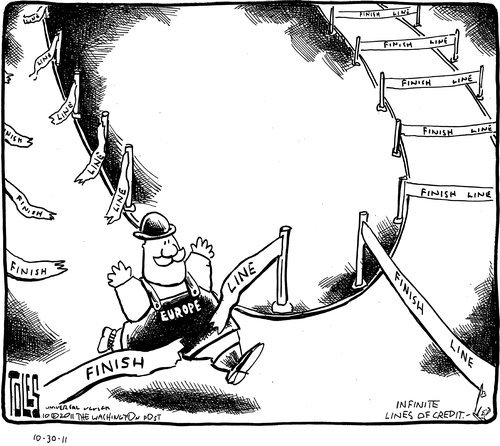
4. They're dreamin' - Bloomberg reports that European banks may raise just 10% of the fresh capital they need to stabilise their balance sheets.
Europe’s largest banks may raise just a tenth of the total capital shortfall estimated by regulators, fueling concern policy makers’ plans to bolster the region’s lenders could fail.
European Union leaders ordered banks last week to increase the ratio of “highest quality” capital they hold by the end of June, creating a shortfall of 106 billion euros ($148 billion). Of Europe’s 28 largest lenders, only eight will need to raise a total of 11 billion euros from investors, Huw Van Steenis, a Morgan Stanley analyst, wrote in an Oct. 28 report.
“Surely, no one thinks that by allowing banks to avoid raising capital in all these various ways it’s going to give investors more confidence,” said Peter Hahn, a professor of finance at London’s Cass Business School and a former managing director at New York-based Citigroup Inc. “Part of the issue for a long time has been the lack of credibility of bank balance sheets and their risk models. This isn’t going to help.”
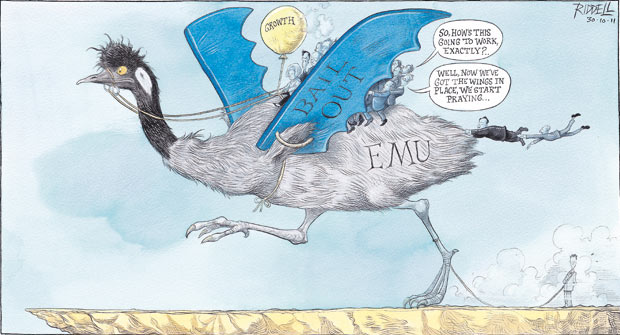
5. 'She's gonna blow' - Physicist Mark Buchanan writes at Bloomberg that a Credit Default Swap bomb is wired to explode inside Europe.
Essentially, these unregulated over the record contracts bind institutions closer together so that when one explodes it can quickly destroy the rest.
Here's the thinking:
The AIG case illustrates an important paradox that looms again in today’s European debt crisis. Like regular insurance, credit-default swaps offer a way to spread risks, and standard thinking in economics holds that “risk sharing” of this kind should make individual banks safer, and the entire banking system more stable. It isn’t true, though, at least not always. In fact, too much sharing of risks can actually create bigger problems.
This follows from a recent study by Italian physicist Stefano Battiston and colleagues (one of whom is the Columbia University economist Joseph Stiglitz, winner of the 2001 Nobel Memorial Prize in Economic Sciences). The researchers showed that too much risk sharing can make it easy for distress to spread like a virus.
As part of normal business, each institution faces occasional “shocks” -- threats to financial health stemming from loans made to failed businesses and the like. A firm’s ability to withstand such shocks reflects its financial resilience. But an institution’s sturdiness also depends on the resilience of its trading partners, because if one of them gets into trouble, its distress will spread to others to whom it owes money.
Within this schematic of the banking system, Battiston and colleagues studied the likely consequences of the sudden bankruptcy of one institution, and specifically, how what happens depends on the overall “connectivity” in the network -- the density of risk-sharing connections.
They found that when the connectivity is relatively low, if one bank suddenly goes bankrupt, the repercussions aren’t so serious; the failure causes problems for a few other institutions but doesn’t generally propagate too far. In such a case, the risk-sharing is beneficial, just as the economics textbooks say it should be. Contracts like credit-default swaps can indeed bring benefits.
However, with rising connectivity -- as webs of CDS contracts grow more dense, for example -- things change dramatically. Beyond a certain connectivity threshold, attempts to share risk actually increase the likelihood that a bank will go under.
So many pathways are created along which trouble can spread that system-wide collapse becomes more likely. The web of risk- sharing connections within which an institution operates only gives an illusion of security.

6. MF Global money goes missing - New York Times reports this could get real ugly for Goldman Sachs' former supremo and New Jersey senator Jon Corzine.
Federal regulators have discovered that hundreds of millions of dollars in customer money has gone missing from MF Global in recent days, prompting an investigation into the brokerage firm, which is run by Jon S. Corzine, the former New Jersey governor, several people briefed on the matter said on Monday.
The recognition that money was missing scuttled at the 11th hour an agreement to sell a major part of MF Global to a rival brokerage firm. MF Global had staked its survival on completing the deal. Instead, the New York-based firm filed for bankruptcy on Monday.
Regulators are examining whether MF Global diverted some customer funds to support its own trades as the firm teetered on the brink of collapse.

7. Mea Culpa - Famed British television interviewer/interrogator Jeremy Paxman has written a column in The Mail saying: "I am part of the most selfish generation in history and we should be ashamed of our legacy."
It's today's must read, I reckon.
A few years ago, an American author wrote a book about the men and women who endured the Depression and then fought in World War II. He testified to their courage, vision and resilience by calling his book The Greatest Generation.
If anyone attempted to name their children — those born between about 1945 and 1965 — the so-called Baby-Boomers, they might consider calling them The Worst Generation.
It is now received wisdom that today’s young people may be the first generation in modern history to expect to be poorer than their parents.
Earlier this month, a report suggested the young will be 25 per cent worse off than their parents when they reach the age of 65 — the so-called ‘baby bust’ generation, having accumulated £400,000 less by the time they retire.
This is my favourite bit:
The only explanation for the nation’s obsession with property prices is the Baby-Boomers’ smug conviction that, having entered the market, the only thing they need to do to become wealthy is to sit on their backsides. And who can blame them?
In 1968, when the first of the Baby-Boomers were beginning to think about settling down, 425,000 homes were built in Britain. Last year, the total was just over 100,000 — fewer than in any year since 1923. With figures like that, of course, the cost of putting a roof over your head rises.
Lucky Generation investors who followed the advice of property-porn television and got into buy-to-let schemes developed another way of taking money from the young and securing it for the old. Young people look at the out-of-reach property ladder from a swamp of debt, because by the Nineties, the former student leaders of the Lucky Generation had made their way into the Labour Cabinet.
As president of that characteristically Boomer outfit, the National Union of Students, Charles Clarke — a beneficiary of free higher education — demanded ‘adequate’ grants for students. As Education Secretary in the Noughties, he introduced top-up fees. Given control of the Treasury, the Boomers flogged public assets and frittered away the bounty provided by North Sea oil.

8. Great graphic on global population - Reuters has done a great job with this graphic. Click on the graphic for a bigger version.

9. Why the Italians are toast - Here's Barry Ritholz showing why Italy is toast with bond yields over 6%,
Italy needs to refinance about 310b euros of debt in 2012. I estimate the average interest rate they are paying on this maturing debt is 2.7% (short term rates collapsed in ’09-’10). With an average debt maturity of 7 years, Italy may be paying 6%+ on the refinancing. Assuming a 350 bps additional cost times the 310b euros of maturing debt, this adds 10.9b euros of interest expense to the 54b euros of interest payments scheduled to be made in 2012.
At the same time, Italy’s 2T economy is expected to grow REAL GDP.1% in 2012 and nominal around 3%. Thus, nominally 60b euros will be added to their economy with all of the incremental gain thus going to service interest expense.

10. Totally Stephen Colbert on Shockupy Wall St.
We welcome your comments below. If you are not already registered, please register to comment
Remember we welcome robust, respectful and insightful debate. We don't welcome abusive or defamatory comments and will de-register those repeatedly making such comments. Our current comment policy is here.