

Here's my Top 10 links from around the Internet at 11 am in association with NZ Mint.
I welcome your additions in the comments below or via email tobernard.hickey@interest.co.nz.
I'll pop the extras into the comment stream. See all previous Top 10s here.
Number 7 is well worth a read today on what's going on inside Greece. People are getting ready to fill their car boots with cash and head for the borders

1. It's always about the politics in the end - Gideon Rachman explains in this FT blog why the Greek referendum call was so significant.
He rightly points out that voters simply don't want the European project, while politicians do.
The unraveling of the European project, which is really what we're seeing, is inevitable without political support in functioning democracies.
HT to Gareth for pointing out Greece was the birthplace of democracy and the words chaos and drama are both Greek.
Here's Rachman
The Greek referendum would be a hammer blow aimed at the most sensitive spot of the whole European construction - its lack of popular support and legitimacy. It has been clear for some time that politicians at both ends of the euro-crisis – debtors and creditors, Greeks and Germans – have huge trouble bringing their electorates with them. As the crisis worsens, so voters will become more bitter and disillusioned. Allowing them a direct say, through the ballot box, will be a certain way of ensuring that the deal unravels.
European leaders know all this. The Brussels authorities react to the prospect of a referendum like a vampire to garlic. Little wonder - the record of the EU in referendums is dreadful.
The Irish and the Danes have voted several times to reject EU treaties. Most significantly of all, the Dutch and the French voted to reject the proposed EU constitution in 2005.

His conclusion is it only works with economic growth, which we have precious little of at the moment and haven't had for a decade.
His chart below of G7 growth rates shows a disturbing trend.
Policymakers have been striving to answer it in the affirmative ever since Lehman 2008 with an assorted array of bazookas and popguns: 0% interest rates, sequential QEs with a twist, and of course now the EU grand plan with its various initiatives involving debt write-offs for Greece, bank recapitalizations for Euroland depositories and the leveraging of their rather unique “EFSF” which requires 17 separate votes each and every time an amendment is required.
What a way to run a railroad. Still, investors hold to the premise that once a grand plan is in place in Euroland and for as long as the U.S., U.K. and Japan can play scrabble with the 10-point “Q” letter, then the markets are their oyster. Not being one to cast pearls before swine or little Euroland PIGS for that matter, I would tentatively agree with one huge qualifier: As long as these policies generate growth.
Growth is the elixir that seems to make every ache, pain or serious ailment go away. Sovereign debt too high? Just grow your way out of it. Unemployment rates hitting historical peaks? Growth produces jobs. Stock markets depressed? Nothing a lot of growth wouldn’t cure. But growth is the commodity that the world is short of at the moment, as shown in Chart 1. No country has enough of it – not even China – and many of the developed countries (specifically in Euroland) seem to be shrinking into recession.

3. Calling all fund managers - The conventional wisdom is that long term investors need to be in stocks because stocks outperform everything over the long term.
But....
Bloomberg reports bonds have now outperformed stocks bonds over the last 30 years. This is the first time it's happened since 1861.
Is that long term enough for everybody? And can this happen again, given yields surely can't go any lower and bond prices couldn't rise much more? Or can they?
Long-term government bonds have gained 11.5 percent a year on average over the past three decades, beating the 10.8 percent increase in the S&P 500, said Jim Bianco, president of Bianco Research in Chicago. The combination of a core U.S. inflation rate that has averaged 1.5 percent this year, the Federal Reserve’s decision to keep its target interest rate for overnight loans between banks near zero through 2013, slower economic growth and the highest savings rate since the global credit crisis have made bonds the best assets to own this year.
Stocks had risen more than bonds over every 30-year period from 1861, according to Jeremy Siegel, a finance professor at the University of Pennsylvania’s Wharton School in Philadelphia, until the period ending in Sept 30.

4. Deutche mark printing - Philippa Malmgren, a fund manager and former economic adviser to George Bush, is saying not so quietly that she believes the Bundesbank has quietly started printing Deutsche Marks again in preparation for a German withdrawal from the Euro.
This is very speculative, but it is the ultimate conclusion of the political forces gathering inside Germany to try to cut off the Southern Europeans from the debt life support cords to Germany.
Here's Malmgren via MoneyNews:
"My view is that it is Germany that will have to pull out of the euro," Malmgren said at an investors' conference in London recently, according to the Citywire news website.
"The decision has already been made by the government that leaving the euro is a possibility. I think they have already got the printing machines going and are bringing out the old deutsche marks they have left over from when the euro was introduced."
Malmgren, co-founder of Principalis Asset Management, acknowledged that leaving the euro would be a radical move that would cause Germany's export prices to jump, but said German industries are strong enough to handle price increases, Citywire reported.
5. Those bloody Porsche Cayennes - I'm no fan of the Porsche Cayenne. It is a pretentious barge of a car that sucks fuel and menaces cyclists like me.
Now Ian Cowie at The Telegraph reports there are more Porsche Cayennes registered in Greece than there are people who declared incomes over 50,000 euros (NZ$86,000).
I wonder how many Porsche Cayenne drivers in New Zealand declare personal incomes of over NZ$86,000.
Here's Cowie:
While German car workers may take pride in this evidence of their export success, German taxpayers may be less keen to bail out a nation whose population appears to take such a cavalier approach to paying its fiscal dues. Never mind all that macroeconomic talk about deficit distress, many Greeks are still plainly riding high on the hog.
Something can’t be right when the modest city of Larisa, capital of the agricultural region of Thessaly with 250,000 inhabitants, has more Porsches per head of the population than New York or London.
Perhaps the penny – or the euro – is already dropping, because Professor Herakles Polemarchakis, former head of the Greek prime minister’s economic department, writes that Larissa “is the talk of the town in Stuttgart, the cradle of the German automobile industry, and, particularly, in the Porsche headquarters there”, since it “tops the list, world-wide, for the per-capita ownership of Porsche Cayennes”.
6. Australia's elephant in the room - Leith van Onselen at Macrobusiness is doing a great job of unearthing the real problem in Australia's economy: the high cost of land.
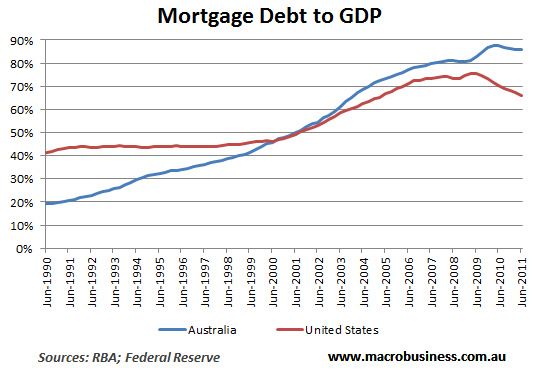
He makes some great points and has some lovely charts showing how land supply restrictions in Australia and some parts of America have pumped up land prices and made them more volatile.
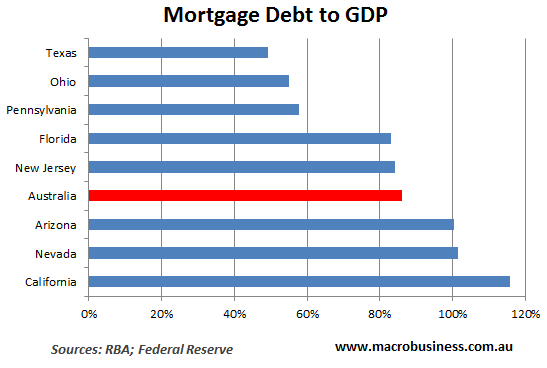
Although Australia’s level of mortgage debt-to-GDP is higher than the US average, it appears less extreme when compared against the epicentres of the US housing bubble/bust – California, Nevada, Arizona and Florida.
The key point to take away from this analysis is that the supply-side of the housing market is critical and is itself a key driver behind increasing levels of mortgage debt.
It is, therefore, paramount that authorities work to free-up the supply-side barriers that create the positive feedback loop of credit-fuelled demand feeding into higher prices and speculation. Only then can stable and affordable housing markets be achieved, and the painful deleveraging that typically follows the bursting of housing bubbles be avoided.
7. Greece's coin toss - Paul Mason, the economics editor at BBC's Newsnight, has a very detailed and caustic view on the Greek politics and economics of its crisis.
He says a referendum would actually be a vote on Euro zone membership.
He also suspects PM George Papandreou knows a lot more than he's saying about silent bank runs and capital flight.
Another potential reason is capital flight. Anecdotal evidence suggests that the Greek elite are buying up property in London just as fast as they can find berths in Poole for their yachts. They are voting with their spinnakers, on the basis that the game is up. In any future Greece on offer, they will have to start paying taxes and they do not want to. One banker told me the Greek super-rich have mostly left.
The one thing governments have that investment banks do not is intelligence services with the power to wiretap people. If you ever wonder why serving politicians go grey so quickly, it is in part because they see the intelligence. So Mr Papandreou may have looked at the file and said, I can't sell this to my party, nor to my voters, and the business elite are emigrating en masse, so throw the dice.
Referendums are, always, basically a coin-toss, an all-chips on the black romantic gesture. Right now, the scale of EU-level mobilisiation to dissuade Mr Papandreou is huge.
But if Greece votes no - and goes for euro-exit - there are several plans in the process of being published that explain what you have to do. Close the banks for days, ration food and energy, institute strict capital controls - with most probably a few fast patrol boats at Glyfada harbour to check every departing yacht for cash and bonds.
Later, you get massive devaluation, with inflation; your non-sovereign debts become instantly doubled so you cannot pay them (i.e., the stock of Greek private debt to external lenders, for example, or, intra-corporate debts).
Ambrose Evans Pritchard is also excellent on Greece's act of revenge for painful austerity.

8. Ever wondered why NZ is so popular with Chinese millionaires? - A Bank of China/Hurun report called "Private Banking White Paper 2011" shows nearly half of China's millionaires want to leave the country and 14% are in the process of emigrating, CNN reports.
Half of the investors said they want to leave for better overseas education opportunities for their children. About a third invest abroad as a step toward emigration, while a quarter of them do so to diversify and manage risk.
Observers believe that personal and capital safety is an increasing concern for the rich who are choosing to transfer their wealth overseas.
“We see too many worried entrepreneurs nowadays who are afraid that they would end up in prison for offending Chinese officials,” Beijing-based scholar Hu Xingdoutold Ming Pao, a Hong Kong newspaper. He believes the lack of legal protection in many areas has lead to the worsening of business environment in China, which is accelerating the emigration drive.
One-third of the rich surveyed own foreign assets, which accounts for 19% of their investment assets. Another one-third are planning to invest abroad. The most popular investment is property.
Here's the very useful Hurun Rich List for 2011 showing who is wealthiest in China and how they made their wealth.
9. 'The coming generational war' - Heidi Przybila writes at Bloomberg that another stalemate in the US Congress on how to reduce the budget deficit would inevitably hurt those most who current have no voice in the debate: the young.
With Democrats and the 37 million-member AARP seniors’ lobby working to protect Medicare and Social Security, and Republicans opposing tax increases to curb the deficit, programs for young people may be disproportionate targets if negotiators can’t reach a budget deal and automatic spending cuts kick in.
That’s sparking concern that lawmakers are sacrificing the U.S.’s future investment in children, education, infrastructure and other programs.
“I don’t think Congress on either end understands the consequence of their inaction,” said James Jones, an Oklahoma Democrat and former House Budget Committee chairman who is a board member of the bipartisan Committee for a Responsible Federal Budget. “You’re creating generational war.”
Title 1 funding for low-income students, the Head Start health and nutrition program, Child Welfare Services, and vaccines are among items likely to be hit by the automatic cuts if a congressional panel can’t agree on a debt-reduction package of at least $1.2 trillion. That’s according to a study by the nonpartisan Federal Funds Information for States, which analyzes the impact of federal policy on state budgets and is affiliated with the National Governors Association.
One reason child health and education programs are at risk is that those advocating for young people, many from low-income or impoverished homes, lack the political clout that the elderly or defense contractors have.

10. Totally Jon Stewart on the latest ructions inside the Republican race for the Presidential nomination. There is a lot of innuendo. It made me laugh.
We welcome your comments below. If you are not already registered, please register to comment
Remember we welcome robust, respectful and insightful debate. We don't welcome abusive or defamatory comments and will de-register those repeatedly making such comments. Our current comment policy is here.