

Here's my Top 10 links from around the Internet at 4 pm in association with NZ Mint.
I welcome your additions in the comments below or via email tobernard.hickey@interest.co.nz.
I'll pop the extras into the comment stream. See all previous Top 10s here.
Various cartoons are very disrepectful to Mr Silvio Berlusconi today...

1. 'Watch out below' - As the European financial system staggers on under the weight of enormous and unsustainable sovereign debt, banks are doing everything they can to offload the dreck, hopefully (for them) onto an unsuspecting (or just plain stupid or conflicted) central bank.
This is why Germany is so opposed to the European Central Bank buying these bonds.
The ECB is the crucial player here.
The only reason Italy is not already bankrupt is the the ECB has been buying bonds over the last five months.
The mere threat of the ECB stopping buying these bonds (on Sunday night) was enough to cause a revolt inside Silvio Berlusconi's government.
All this is going pear-shaped at a rapid rate.
Here's an idea of what's happening now under the covers of the bond markets via Bloomberg.
BNP Paribas SA and Commerzbank AG (CBK) are unloading sovereign bonds at a loss, leading European lenders in a government-debt flight that threatens to exacerbate the region’s crisis.
Banks are selling debt of southern European nations as investors punish companies with large holdings and regulators demand higher reserves to shoulder possible losses. The European Banking Authority is requiring lenders to boost capital by 106 billion euros after marking their government debt to market values. The trend may undermine European leaders’ efforts to lower borrowing costs for countries such as Greece and Italy, while generating larger writedowns and capital shortfalls.
“European regulators and leaders are shooting themselves in the foot because a big investor group for sovereign bonds has been taken out of the market,” said Otto Dichtl, a London-based credit analyst for financial companies at Knight Capital Europe Ltd. “The downward spiral will continue until policy makers find a back-up solution for the sovereigns.”
2. 'Eliminate the bonuses' - Nassim 'Black Swan' Taleb has written in the New York Times that bonuses for bankers should be eliminated.
Fair enough.
More than three years since the global financial crisis started, financial institutions are still blowing themselves up. The latest, MF Global, filed for bankruptcy protection last week after its chief executive, Jon S. Corzine, made risky investments in European bonds. So far, lenders and shareholders have been paying the price, not taxpayers. But it is only a matter of time before private risk-taking leads to another giant bailout like the ones the United States was forced to provide in 2008.
it’s time for a fundamental reform: Any person who works for a company that, regardless of its current financial health, would require a taxpayer-financed bailout if it failed, should not get a bonus, ever. In fact, all pay at systemically important financial institutions — big banks, but also some insurance companies and even huge hedge funds — should be strictly regulated.
Critics like the Occupy Wall Street demonstrators decry the bonus system for its lack of fairness and its contribution to widening inequality. But the greater problem is that it provides an incentive to take risks. The asymmetric nature of the bonus (an incentive for success without a corresponding disincentive for failure) causes hidden risks to accumulate in the financial system and become a catalyst for disaster. This violates the fundamental rules of capitalism; Adam Smith himself was wary of the effect of limiting liability, a bedrock principle of the modern corporation.

3. 'Let's not do that again' - Bryce Wilkinson writes at CapitalEconomics about the problems with New Zealand's Deposit Guarantee scheme. HT Eric Crampton.
Under-priced government guarantees for financial instruments potentially undermine the stability of the financial system by inducing excessive risk taking. The precedent created by the adopted scheme is very troubling in this respect.
The report considers the "necessary in the public interest" test and concludes that the scheme was justified because no run on the banks occurred, the economy was stabilised and some finance companies survived.
None of these reasons stacks up. First, the scheme cannot be given any credit for preventing the feared flight of deposits to Australia because under our freely-floating exchange rate regime the fear could never be realised. (Anyone wanting to exchange a New Zealand dollar asset for an Australian dollar asset must find a buyer for the New Zealand asset. As a result there can be no net outflow of funds from the banking system.)Second, credit for boosting confidence in the banks can be more readily attributed to the separate wholesale guarantee scheme since this scheme dealt directly to the real threat that the banks faced – the freezing up of the global wholesale market. Third, sound finance companies would plausibly have survived in the complete absence of a retail deposit scheme.

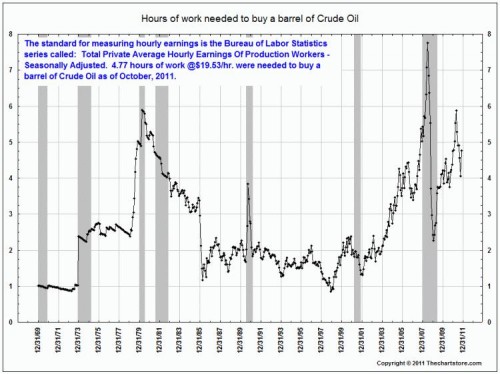
4. What inflation really looks like - Creditwritedowns points to an excellent chart showing the number of hours needed to buy a barrel of oil over the years going back to 1969.
The chart does illustrate how real wages whip around with the price of crude oil. As a rule of thumb one barrel of crude (42 gallons) produces around 20 gallons or about one tank of gasoline. So what took 2 hours of work to fill the tank 10 years ago now takes about 5 hours. Of course this is a simplification as other byproducts are produced from a barrel of crude, but it is does illustrate the point.
5. The problem with hot money - It goes cold very fast and destroys banks and brokers that rely on it even faster.
Investment banker and author William Cohan writes at Businessweek about the collapse of MF Global and how it should warrant the end of the hot overnight money that has kept investment banks afloat.
Oh and by the way New Zealand's banks rely on foreign hot money (matures in less than 90 days) for about NZ$63 billion (in NZ$ and non US$ terms from non-residents) or about 20% of fund.
Here's Cohan.
No self-respecting Wall Street banker would ever advise a client to personally take such short-term financing risks. And yet the industry itself was doing this very thing.That’s what makes the MF Global debacle so shocking. Jon Corzine, the firm’s former chairman and chief executive officer, had previously been CEO and CFO of Goldman Sachs. He understood exactly the fragile short-term funding dynamic of a securities firm.
His principal financial sponsor, the billionaire J. Christopher Flowers -- one of MF Global’s largest shareholders who installed Corzine as CEO in 2010 -- was a former financial institutions banker at Goldman Sachs.
Flowers made his fortune by buying and turning around a distressed Japanese bank. He also had a seat at the table during the collapses of Bear Stearns, Merrill and the rescue of American International Group Inc. Flowers knew exactly how fragile short-term funding could be. And yet both he and Corzine allowed MF Global to take the risk of financing a long-term bet -- its $6.3 billion gamble on European sovereign debt -- in the short-term markets.

6. And you guessed it - The Telegraph reports staff at MF Global were paid bonuses just hours before it went bankrupt...
Sigh. See #2 above and number #5.

7. Want a free BMW? - The FT reports one Chinese property developer has taken to spruiking his unsellable new apartments by offering a 'free' BMW to the 'lucky' first buyer of an apartment in his block.
My favourite line is the last quote:
The deal is a sign of the desperation felt by developers in China’s once-booming property market, which has been pounded by government measures aimed at heading off a bubble. The slowdown is a matter of international concern, with Chinese house construction driving demand for commodities and propping up growth in the sputtering global economy.
Chinese developers have been reluctant to cut prices as transactions have slowed this year, but some are finally capitulating after dreadful sales in October. Others, afraid of the stigma of slashing prices, are offering giveaways such as extra garden plots, Louis Vuitton handbags, cruise vacations and now cars.
“Whoever signs a contract and makes the downpayment will be able to drive away in a BMW,” said the sales assistant at Central Mansions, a cluster of brown towers with 868 apartments that have just come on to the Wenzhou market.
“No, it doesn’t mean that sales are bad. It’s just that we’re trying to attract customers,” she said.

8. Bankruptcy or hyper-inflation - Gold fan Eric Sprott talks at a German precious metals conference about precious metals and the outlook for gold and silver.
He worries a lot about banks. It lasts 30 minutes, but a bracing alternative view to the usual smiling, waving, muddling and reassuring we get publicly from the powers-that-be.
Other discussion topics include the choices between austerity and increasing stimulus and how both will bring on a meltdown, whether bankruptcy or hyperinflation brought on by money printing. They talk about the huge leverage in the banking system and the risk inherent in the system. People are only now starting to understand counterparty risk. They explain that 20-to-1 and even higher leverage is common in the banking system. They talk about the disparities between the physical market and the paper silver markets.
Eric talks about supply and demand and how the upward pressures on silver price from demand growing much faster than supply are not being accurately reflected. A 900 million ounce silver supply simply cannot cope with a 380 million ounce increase in demand and maintain current prices. Eric also explains that investment sales of silver are 50 to 1 in volume compared to gold and that this means a decreasing gold/silver ratio.
Also under discussion is Sprott's analysis which shows that the US government, with a GDP of 15 trillion, has liabilities of almost 80 trillion and that these promises will be broken just as the Greek government is breaking its commitments.
9. Spain is next - Sean Egan from credit rater Egan Jones talks in a CNBC interview below about the problems with Spain's economy and its debts, and how Greece and Italy are just part of a bigger picture, including Spain. The good stuff starts about 4:30 HT Credit Writedowns.
Egan sees 90% haircuts in Greece, eventually. And he says that 6% is the point of no return. If you look at the debt crises in Greece, Ireland, and Portugal, once you hit 6%, the interest rate death spiral kicked in as insolvency was self-fulfilling.
That’s how it works when no lender of last resort steps in. It works the same way for financial institutions too. You wanna know why MF Global went under? There it is.
10. Totally irrelevant Jon Stewart interview with Clint Eastwood about J Edgar Hoover below...
But first here's lots of jokes about Herman Cain's ... ahem... love life:
And Clint Eastwood:
We welcome your comments below. If you are not already registered, please register to comment
Remember we welcome robust, respectful and insightful debate. We don't welcome abusive or defamatory comments and will de-register those repeatedly making such comments. Our current comment policy is here.