

Here's my Top 10 links from around the Internet at 11.30 pm in association with NZ Mint.
I welcome your additions in the comments below or via email tobernard.hickey@interest.co.nz.
I'll pop the extras into the comment stream. See all previous Top 10s here.
Number 8 is today's must read on a third progressive movement from Jeffrey Sachs.

1. America hasn't solved its oil shortage - Ambrose Evans Pritchard from The Telegraph made some triumphant claims on October 23 about America having found new sources of oil that would help it save itself (and therefore the rest of us)
Gregor Macdonald does a great job at ChrisMartenson.com of debunking those ideas.
He says claims about the discovery of gas through fracking and the opening up of oil sands does nothing to change the fact American production peaked in 1970 and it remains utterly dependent on oil imports.
It's well worth a read by those thinking peak oil is not really peak oil.
Here's Macdonald and the chart below is sobering:
The production history laid out graphically here is instructive and gives a clear warning: It would be unwise to herald the recent uptick in domestic production with a "new era" headline. Deepwater drilling, Gulf of Mexico, and Alaska were all "new era" events in their day as well. Or so they seemed.
Now, three respectable publications have recently cast the advent of new oil extraction in America as a kind of miracle. And indeed, technologically, the refinement of hydraulic fracturing techniques -- first used to extract natural gas, and now used to extract oil -- is miraculous. But a technique such as this, although replicable and repeatable, will not change the fact that newer, unconventional resources are developed and produce oil at a much slower rate. One year after the Black Giant of East Texas was discovered in the early 1930s, it was producing just 1 mbpd. The US no longer has resources such as this to exploit. The history of US oil production over the past 40 years should make this clear.

2. What were they thinking? - The details coming out in the Bridgecorp trial are fascinating. Maria Slade reports at Stuff that some people didn't do much due diligence.
In his statement Rex Warren said he first invested with Bridgecorp in 2004 after being attracted by the company's newspaper advertisements.
He invested $150,000 in capital notes in January 2007. On the first of June that year he sold his house and invested the $1m proceeds with the financier while he decided what to do.
Hamilton dairy farmer Brian Gordon said he put $200,000 with Bridgecorp following a recommendation from the local golfing fraternity.

3. "National Socialist Underground" - Bloomberg reports on the rise of some right wing groups in Germany...
German authorities widened a probe into an underground neo-Nazi cell accused of a series of murders over the last decade, in what Chancellor Angela Merkel called a “disgrace for Germany.”
A suspect, identified as 37-year-old Holger G., was taken into custody yesterday near Hanover, Germany, and is accused of having ties to a group calling itself the “National Socialist Underground,” federal prosecutors said in a statement. Officials raised the specter of a terrorist threat.
4. It's already started - James Grant from Grant's Interest Rate Observer tells Bloomberg in this interview the ECB seems to have already started printing money to buy Italian bonds.
4. (Bonus) Inflation problem - Bloomberg reports India's inflation rate remained above 9% for the 11th straight month in October, meaning it will have to keep tightening monetary policy. Just like China, India may not be able to stoke demand in a slowing developed world.
Asian nations from Indonesia to South Korea are either cutting rates or keeping them on hold to protect expansion as Europe’s debt crisis threatens to trigger a global slump. India’s central bank last month signaled it’s nearing the end of monetary tightening, provided inflation slows, after it raised rates for the 13th time since mid-March 2010.
“Prices are not coming off,” said Madan Sabnavis, chief economist at Mumbai-based ratings company Credit Analysis & Research Ltd. “The RBI will have to probably revisit its guidance if inflation remains elevated.”

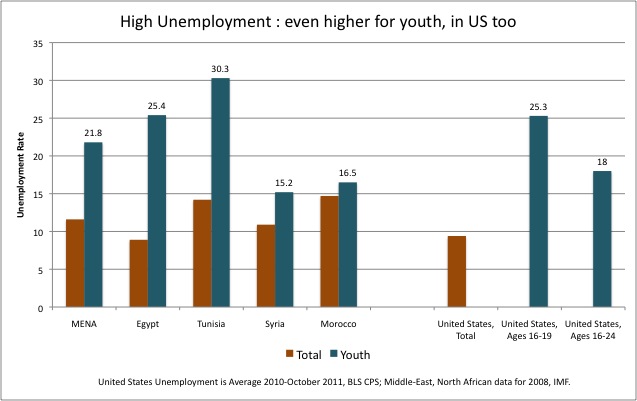
5. 'Just as bad as Egypt' - Rortybomb describes in detail how US youth unemployment at 25% is now just as bad as it is in some of the 'Arab Spring' countries that have just experienced revolts by the young.
Egypt's youth jobless rate ws 25.4% last year. Oh, and by the way, the unemployment rate for all youth in New Zealand in the September quarter was 23.4%. For Maori youth it was 25.7% and it was 29.8% for Pacific Island youth, Department of Labour figures show.
Here's Rorty:
Is it useful to think of the Occupy movement more as a “left” movement or a “youth” movement? To answer that question, it’s worth looking into data on the young, particularly as it relates to unemployment.
To leave the United States for a minute, one way people are trying to understand the Arab Spring is through the lens of mass youth unemployment and inequality. Given how high unemployment has been in these MENA – Middle-East and North African – countries, what else could we expect besides revolution?
6. A scandal is brewing - US congressional leaders got secret briefings from officials during the 2008 crisis and used that information to do insider trading to make profits.
And it's not illegal.
At the height of the financial crisis, Congressman Spencer Bachus (R-AL), then the ranking member of the House Financial Services Committee, netted tens of thousands of dollars while he was privy to private briefings about the global economic meltdown, according to a new book on congressional insider trading.
And here's Henry Blodget on this:
The fact that Bachus was a member of Congress and traded on private information he received as a result of his job is bad enough. The fact that he was the ranking member of the House Financial Services Committee at the time is simply outrageous.
In one case, the day after getting a private briefing on the collapsing economy and financial system from Ben Bernanke and Hank Paulson, Rep. Bachus effectively shorted the market (by buying options that would rise if the market tanked.)
A few days later, after the market tanked, Bachus sold his position and nearly doubled his money.
7. Stagnating social mobility - Time's Fareed Zakaria reports Europe (the corrupt old land of feudal systems and corrupt autocracies) now has more social mobility than America (where everyone migrated to to get away from the class structures and overlords).
Evidence shows pretty conclusively that social mobility has stalled in this country. This week, Time magazine’s cover asked, “Can you still move up in America?” The answer, citing a series of academic studies, was, no; not as much as you could in the past and — most devastatingly — not as much as you can in Europe.
The most comprehensive comparative study, done last year by the Organization for Economic Cooperation and Development, found that “upward mobility from the bottom” — Daniels’ definition — was significantly lower in the United States than in most major European countries, including Germany, Sweden, the Netherlands and Denmark.
A 2010 Economic Mobility Project study found that in almost every respect, the United States has a more rigid socioeconomic class structure than does Canada. More than a quarter of U.S. sons of top-earning fathers remain in the top tenth of earners as adults, compared to 18 percent of similarly situated Canadian sons. U.S. sons of fathers in the bottom tenth of earners are more likely to remain in the bottom tenth of earners as adults than are Canadian sons (22 percent vs. 16 percent). And U.S. sons of fathers in the bottom third of earnings distribution are less likely to make it into the top half as adults than are sons of low-earning Canadian fathers.
8. Today's must read - Jeffrey Sachs sums up a bunch of things at the New York Times. He describes the Occupy Wall St movement as the dawn of a new Progressive era.
The first age of inequality was the Gilded Age at the end of the 19th century, an era quite like today, when both political parties served the interests of the corporate robber barons. The progressive movement arose after the financial crisis of 1893. In the following decades Theodore Roosevelt and Woodrow Wilson came to power, and the movement pushed through a remarkable era of reform: trust busting, federal income taxation, fair labor standards, the direct election of senators and women’s suffrage.
The second gilded age was the Roaring Twenties. The pro-business administrations of Harding, Coolidge and Hoover once again opened up the floodgates of corruption and financial excess, this time culminating in the Great Depression. And once again the pendulum swung. F.D.R.’s New Deal marked the start of several decades of reducedincome inequality, strong trade unions, steep top tax rates and strict financial regulation. After 1981, Reagan began to dismantle each of these core features of the New Deal.
Following our recent financial calamity, a third progressive era is likely to be in the making. This one should aim for three things. The first is a revival of crucial public services, especially education, training, public investment and environmental protection. The second is the end of a climate of impunity that encouraged nearly every Wall Street firm to commit financial fraud. The third is to re-establish the supremacy of people votes over dollar votes in Washington.

Could this be a problem for New Zealand?
Here's Dubner citing the WSJ:
Italy’s economy today is only about 3% bigger than a decade ago. Many factors have contributed to the country’s stagnation—from its rickety education system to its low rates of employment among women, youths and older workers. But a central reason, say economists, is that its private sector consists mostly of small mom-and-pop businesses that seem unable to grow.
Behind the country’s stunted businesses lie the habits and fears of a long line of family entrepreneurs who cling to control of their companies late into life. Hemmed in by a thicket of regulation and legal restrictions, many of these families have learned to survive by doing business within networks of trusted customers and suppliers, rather than taking risks by dealing with outsiders.
“These firms have less propensity to innovate, engage less in research and development and rarely penetrate emerging markets,” said Mario Draghi, ECB President and former Bank of Italy head, in a recent speech.

10. Totally Asif Manvi on the Republican debates and the problem of knowing much more than a soundbite will allow.

We welcome your comments below. If you are not already registered, please register to comment
Remember we welcome robust, respectful and insightful debate. We don't welcome abusive or defamatory comments and will de-register those repeatedly making such comments. Our current comment policy is here.