
Here's my Top 10 links from around the Internet at 6.30 pm in association with NZ Mint.
I welcome your additions in the comments below or via email to bernard.hickey@interest.co.nz.
I'll pop the extras into the comment stream. See all previous Top 10s here.
Some light relief today at numbers 8, 9 and 10.

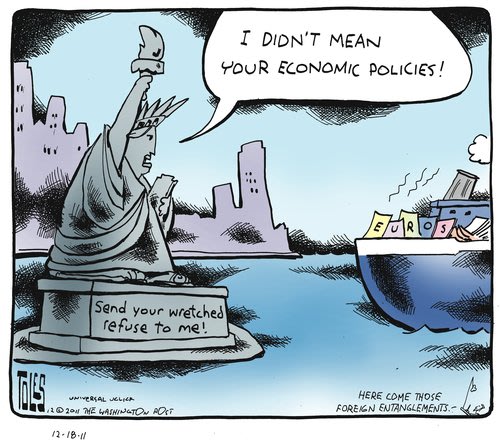
1. Now the revolt has started - It's been just over a week since European leaders agreed on a 'Fiscal Compact' designed to harmonise fiscal policies across 26 of the 27 European Union countries.
The aim was to reassure investors that Europe would be 'responsible' this time around, to ensure a single fiscal policy could be created to match a single monetary policy. They seemed to forget they ignored a similar arrangement set up last century.
But it was hamstrung from the start by Britain's decision to reject the plan.
Even though it's not part of the Eurozone, Britain's rejection made the plan much harder because it meant the 'Fiscal Compact' would have to done separately from the European Treaty, raising the prospects of new debates, parliamentary votes and referendums.
Now it's all starting to unravel.
Ireland is threatening to have a referendum unless its debt burden is eased by the European Union.
The Telegraph reports Poland, Hungary and the Czech Republic are against the plan.
Poland and The Czech Republic are against German plans to take over tax policy...there's some history there of resisting German expansion into Poland and Czechoslavakia...
Amid fresh warnings that Europe is triggering a 1930s-style global depression, the German chancellor faced open rebellion against the key plank of her Brussels accord. The leaders of Hungary and the Czech Republic told a joint conference in Budapest they were ready to reject the planned treaty changes and implied move towards a centralised tax system. Czech prime minister Petr Necas said he was “convinced that tax harmonisation would not mean anything good for us”.
Hungarian prime minister Viktor Orban said that central Europe had the potential to become the most competitive region in Europe.
“The only kind of co-operation we can have with the eurozone is one which does not damage Hungary’s competitiveness,” he said.
Poles marched under banners that read: “We want sovereignty, not the euro.” They were protesting against the Brussels deal that could see EU countries, including those outside the eurozone, face penalties for breaking tough centralised spending laws. Britain used its veto in Brussels, sparking an intense backlash. Ireland and Sweden are also nervous about the fiscal pact, but Germany and France still expect the other 26 members, minus the UK, to approve it.

2. The 'nuclear option' - Ambrose Evans Pritchard reports at the Telegraph that some elements of Portugal's opposition are threatening a default.
"We have an atomic bomb that we can use in the face of the Germans and the French: this atomic bomb is simply that we won't pay," said Pedro Nuno Santos, vice-president of the Socialist Party in the parliament.
"Debt is our only weapon and we must use it to impose better conditions, because recession itself is what is stopping us complying with the (EU-IMF Troika) accord. We should make the legs of the German bankers tremble," he said.
The comments came as Portugal slides deeper into recession, with the economy expected to contract by 3pc next year. Protesters marched through Lisbon on Thursday denouncing plans by the new conservative government to raise the working week to 42 hours. Wages are being cut 16pc for higher paid, and 8pc for lower paid public workers.
3. Niall Ferguson hammers the Germans - Here's the world's most popular economic historian talking to Andrew Patterson on Radio Live's Sunday Business about the global crisis and the potential for a lost decade.
He attacks the Germans for being clueless and Eurocrats for creating a Doomsday machine. He says the Germans are focused on the lessons of 1923 (hyperinflation) when the correct comparison is with 1931 (Depression).
He says the euro has days or weeks to live. He says US Treasuries are about as safe as Pearl Harbour was before the Japanese attacked. The good professor doesn't pull his punches. Good.

4. 'No urgency' - Further to the above, Bloomberg reports the Bundesbank doesn't seem very concerned about the impending end of the euro's world.
The Bundesbank said it sees no urgent need for a decision on a loan to the International Monetary Fund, suggesting the Dec. 19 deadline set by European Union leaders may be missed.
“We don’t see an urgent need for a final decision,” a spokesman for the Frankfurt-based Bundesbank said by telephone. “We want to evaluate the whole situation.”
EU leaders decided at a Dec. 9 summit to channel an additional 200 billion euros ($261 billion) in loans to the IMF so that it has the resources to help fight the euro region’s debt crisis. Central banks from the 17 euro nations would provide 150 billion euros and 50 billion euros would come from EU members outside the currency bloc. Bundesbank President Jens Weidmann has said the German central bank is ready to contribute as much as 45 billion euros if certain conditions are met.

5. The banks won't help - The thought that the ECB might sneakily encourage European banks to use cheap three year loans from the ECB to buy European bonds is fading fast, The Economist reports.
A few months ago, banks in peripheral countries were only too happy to fill their vaults with bonds issued by their own governments. The feeling at the time was that the banks would live or die along with their home countries so there was little point in trying to mitigate the risks. Moreover, most peripheral banks have seen their funding costs soar. They had little choice but to buy government bonds with similarly high yields. “What else can I do,” said the boss of a big Italian bank, in relation to its large holdings of Italian government bonds.
That ardour has cooled since the end of October, when the EBA first asked banks to set aside extra capital against the possibility of losses on euro-area government bonds. Some bankers now fret that their accountants may force them regularly to “mark to market” their holdings and set aside capital if bond prices fall. That would prevent even the most troubled banks from gambling for redemption by taking big bets on bonds.
Banks from richer countries will be even less inclined to help out. “Foreign banks have been prepared to take large charges to sell ‘toxic’ foreign sovereign debt, so the idea that they would reload seems fanciful,” says Jon Peace, an analyst at Nomura. Governments hoping for a helping hand in bond markets will have to look farther afield than their own tottering banks.

6. Kim Jong Il is dead - Here's my favourite Kim Jong Il video, courtesy of Team America...NSFW...HT Gareth.
7. He was lonely - Kim Jong Il was a very lonely man, says Trey Parker and Troy Stone.
8. Especially for your viewing pleasure - Dogs in cars. That is all.
Sometimes I think it would be fun to stick my head out the window of the car with my tongue out with a big smile on my face. Too much information.
It's one for those I think I don't have enough fun in my life.
Dogs in Cars from keith on Vimeo.
9. Especially for your viewing pleasure - This is time lapse photography from the International Space Station from 350kms above the Earth from August to October this year. Simply awesome. Makes me want to be an astronaut for at least five minutes.
Earth | Time Lapse View from Space, Fly Over | NASA, ISS from Michael König on Vimeo.
10. Totally relevant video that's worth watching again - John Clarke and Brian Dawe from 18 months ago on the European crisis. Remarkably prescient and fresh, yet still repetitive, all at the same time.

We welcome your comments below. If you are not already registered, please register to comment
Remember we welcome robust, respectful and insightful debate. We don't welcome abusive or defamatory comments and will de-register those repeatedly making such comments. Our current comment policy is here.