

Here's my Top 10 links from around the Internet at midday in association with NZ Mint.
I welcome your additions in the comments below or via email tobernard.hickey@interest.co.nz.
I'll pop the extras into the comment stream. See all previous Top 10s here.
I've been galavanting around for the last couple of days so no Top 10. Here's a bumper edition to end the year. This is the last one for 2011. I'll return on January 16. Best wishes to you and your family.

1. Catching the American disease - This one is out of left field.
Australia's Liberal opposition is threatening to block the Labor government's plan to raise its debt ceiling from A$250 billion.
This is, of course, shades of the fight over the debt ceiling in America this year that eventually saw Standard and Poor's downgrade the US credit rating from AAA to AA+.
Australia's public debt to GDP ratio at 15% is much, much lower than America's 100%, but this could cause some drama.
Interestingly, the revelation courtesy of the The Australian came just a day after Moody's reaffirmed Australia's AAA rating. HT Gareth via Yammer.
Here's David Uren at The Australian:
THE Coalition has threatened to block any effort by the government to raise the $250 billion limit on public sector borrowing, potentially forcing the government to run out of money.
Writing in The Australian today, opposition Treasury spokesman Joe Hockey warns that he will demand a high price for the Coalition's support for increased debt.
"Whilst the Coalition has supported this in the past, the government should not expect a rubber stamp this time," Mr Hockey says in his article.
The Coalition demands could include scrapping the carbon tax and the mining tax, along with the benefits they are intended to finance, such as personal tax cuts and increased superannuation.

2. Watch the protests in Wukan - They seem to be spreading.
Here's The Telegraph on unrest in a larger town near the 'rebel' and besieged town on Wukan in China where townspeople have have protested illegal land seizures.
Residents of Haimen, a 130,000-strong town in the province of Guangdong, are demanding a coal-fired plant be moved, claiming it is damaging their health.
Web photos show a large gathering of people and riot police in a public square, and it is reported about 30,000 people in the town have gone on strike
Demonstrators are claiming a 15-year-old boy had been killed and more than 100 others badly beaten by riot police, but this has yet to be confirmed. Haimen is located around 90 minutes away to the northeast of Wukan village, where residents are in open revolt against the local government after what they say is years of illegal land grabs. There is no indication that the protests are related, but they are part of an upsurge in social unrest in Guangdong, China's wealthiest province and the country's manufacturing hub.
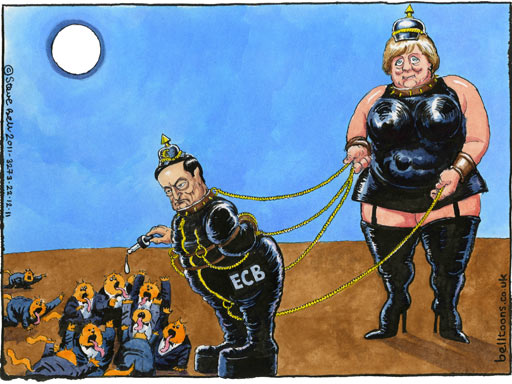
3. A financial system for its own benefit - Atlantic Capital Management CIO Jeffrey Snider writes a wide ranging comment piece here on the reliance of America's and Europe's banking systems on synthetic credit after looking in depth at Bank of America's accounts.
The pyramid of money into shadow money into synthetic money has grown immense. Central banks have created an inefficient Frankenstein of a financial system that no longer can operate within the bounds of the traditional notions of intermediation and banking. There is simply not enough real credit in existence to generate the cash flows and profits banks need to maintain the capital ratios that keep the system from imploding.
If we think about the banking system in terms of being able to grow retained earnings, and thereby strengthen their weakened capital ratios, the $107 trillion increase represents obviously necessary cash flows that would be impossible without the synthetic option. Therefore, the financial system is simply unable to make enough money off the real economy in order to even survive its past episodic spasm of over-speculation, describing the scale of dysfunction as something far greater than anyone perhaps realizes.
In many ways the system is at a terminal crossroads, as it cannot function without the synthesization of so much credit, but the real economy may not be able to survive the resource drain and monetary inefficiency that this much synthesization requires. Intermediation was supposed to be a tool for the real economy. Now the real economy is nothing more than a support system for the global investment banking regime.
In bailing out the banking system, central banks have put their money on the wrong horse since banks are almost completely disconnected from their true role as a tool of the real economy. The labyrinth of complexity and intentional opacity is designed to hide this fact. Real credit is shrinking throughout the system, but synthetic credit is alive, well and flourishing. The financial system now exists to its own exclusive benefit.

4. 'Global banking glut' - Princeton University Economics Professor Hyun Song Shin talks in this VoxEU piece about the global banking glut being more responsible than any global savings glut for the financial and economic problems now facing the globe.
The chart showing explosive growth in cross border lending is plenty scary.
It has become commonplace to assert that current-account imbalances were a key factor in stoking subprime lending in the US. This column says the ‘global banking glut’, i.e. the rise in cross-border lending, may have been more culpable for the crisis than the ‘global savings glut’. As the European banking crisis deepens, the deleveraging of the European global banks will have far-reaching implications not only for the Eurozone, but also for credit supply conditions in the US and capital flows to the emerging economies.
Just as the expansion stage of the global banking glut relaxed credit conditions in the US and elsewhere, its reversal will tighten US credit conditions. Its impact in the emerging economies (especially in emerging Europe) could be devastating. In this sense, there is a huge amount at stake in the successful resolution of the European crisis, not only for Europe but for the rest of the world.

5. Imbalances aplenty - PIMCO's Mohamed El Irian writes via Project Syndicate about the imbalances now built into the global financial system that are causing so many problems.
He reckons a loss of confidence by emerging economies in Asia and Latin America in the 1990s and 2000 in the International Monetary Fund (IMF) is partly to blame.
Many emerging-market economies lost confidence in the “pooled insurance” that the global system supposedly put at their disposal, especially at times of great need.
This change in sentiment was catalyzed by the financial crises in Asia, Eastern Europe, and Latin America in the late 1990’s and early 2000’s, and by what many in these regions regarded as the West’s inadequate and poorly designed responses. With their trust in bilateral assistance and multilateral institutions such as the International Monetary Fund shaken, emerging-market economies – led by those in Asia – embarked on a sustained drive toward greater financial self-reliance.
Once they succeeded in overcoming a painful crisis-management phase, many of these countries accumulated previously unthinkable levels of international reserves as precautionary cushions. They extinguished billions in external indebtedness by generating and sustaining large current-account surpluses. And they increased the scale and scope of domestic financial intermediation in order to reduce their vulnerability to external storms.
These developments stood in stark contrast to what was happening in the West. There, unprecedented leverage, massive debt creation, and a seemingly infinite sense of credit entitlement prevailed. Financial excesses become the rule rather than the exception, facilitated by financial innovation and the erosion of lending standards and prudential regulation.
Suddenly, the world turned upside down: “rich” countries were running large deficits and, in some cases, tipping from net creditor status to net indebtedness, while “poor” countries were running surpluses and accumulating large stocks of external assets, including financial claims on Western economies.
Little did these countries know that their divergent paths would end up fueling large global imbalances, and eventually trigger a financial crisis that has shaken the prevailing international economic order to its foundations.

It will become clear in 2012 that this game of “kicking the can down the road” is a zero-sum game. When domestic demand is weak, and either deleveraging or structural constraints are holding back private and public consumption, every country would rather have a weak currency to restore growth by boosting net exports. But if one currency is weaker another needs to be stronger; and if one country’s trade balance is improved another is worsened. So currency tensions can lead to currency wars and eventually to trade wars.
So in 2012, the combination of market pressures and conflicting political constraints will make it more difficult to kick the can down the road. A few eurozone members may need to coercively restructure their debts and even consider exiting the currency union. A slowdown in China’s growth may come close to being a hard landing. Markets in the US may become more concerned about the political gridlock that stops policymakers taking the necessary actions and maintains the unsustainable US twin deficits.
If the world’s biggest economies continue to play the same game and try to kick the cans further down the road for another year, the cans will become bigger and heavier and eventually hit a brick wall. By 2013 at the latest, but possibly already in 2012, a perfect storm of a double-dip recession in the US, a disorderly scenario in the eurozone and a hard landing in China could materialise.

7. Debt: The first 5,000 years - I'm reading this book by University of London anthropologist David Graeber at the moment. He writes about the history of debt and money. He challenges a few shibboleths, particularly around the morality of debt, how credit preceded money and how bartering didn't exist in the beginning.
Here's an interview he gave RT a while ago.
8. Fancy some North Korean debt ? - This is fun. There are still North Korean bonds trading on international debt markets.
North Korea defaulted on them a few decades ago but there's a few hedge fundies keen to take a punt that the new Kim might repay them at some stage.
Good luck guys.
Here's Dow Jones:
The defaulted bonds, which were created in 1997 when French bank BNP repackaged a series of non-performing syndicated bank loans that were granted to North Korea in the seventies, have suddenly sparked interest among speculators. The sporadically traded bonds, which trade at a deep discount to their face value, saw a tick up this week and were recently quoted at between 14 and 18 cents on the dollar, compared with 13 to 15 cents, according to London-based sales and brokerage house Exotix.
Those who have bought the bonds are making nothing less than a bet that the transfer of power to Kim's son Kim Jong Eun will usher in a moment akin to that of the Berlin Wall's collapse for the tightly controlled communist country.
"Investors are looking at this as an unlimited option trade with enormous potential gains," said Andrew Chappell, head of European, African and Middle Eastern fixed income trading and sales at brokerage house Exotix in London, who says that inquiries into the bonds have increased in recent days.
According to Chappell's calculations, investors' claims extend to the principal and interest accrued from 1984 when the original loans defaulted. That amounts to anywhere between 300% to 600% in unpaid interest.

9. The problem with China's banks - Leland Miller, an international economics fellow at the American Foreign Policy Council, has written this detailed piece at Institutional Risk Analyst on China's banking system and its vulnerabilities.
He makes some excellent points about the structure of China's banking system and the blowout in lending by so-called policy banks in recent years.
With over three trillion dollars in foreign exchange reserves, China controls a substantial amount of monetary firepower to wield inthe event of a crisis. In theory, while those reserves could be used to recapitalize any policy bank with significant forex exposure (an option not available for the primarily yuan-denominated obligations of the commercial banks, because of China's closed capital account), such a bailout would hardly be a demonstration of these banks' viability to global investors.A bailout would almost certainly force policy banks to forswear the market and continue as wards of the state, but that in turn would force commercial banks to either dramatically restructure their portfolios to handle the new(above-zero) risk weightings of policy bank bonds or else SFB issuance authority would need to be extended indefinitely, further undermining Beijing's attempt to modernize and deleverage its financial system. In other words, these systemic problems have no easy solution.
Looking to 2012, China's banking system will be entering a transformative, but also highly vulnerable, period. Until Beijing finds a way to disentangle its policy bank hybrids from the current subsidy structure that bankrolls their excesses while disguising their true liabilities, investors should find little solace in the record-breaking profit announcements of Chinese banks. In fact, should the global downturn continue to accelerate, these problems will likely show up on Beijing's doorstep sooner than anyone expects.

10. Totally Stephen Colbert doing the Grinch thing. Merry Christmas.
We welcome your comments below. If you are not already registered, please register to comment
Remember we welcome robust, respectful and insightful debate. We don't welcome abusive or defamatory comments and will de-register those repeatedly making such comments. Our current comment policy is here.