

Here's my Top 10 links from around the Internet at 6 pm in association with NZ Mint.
I welcome your additions in the comments below or via email tobernard.hickey@interest.co.nz.
I'll pop the extras into the comment stream. See all previous Top 10s here.
My must watch today is #9. Ya gotta laugh.

1. Firewall full of holes - That's the Economist's conclusion about the European firewall set up to stop the Greek problem spreading to the rest of Southern Europe.
This celebratory mood sweeping Europe in the wake of the European Central Bank's two money dumps is premature.
The basic problems haven't been fixed.
The austerity packages are now ravaging Southern Europe.
All it will take is another bad election result and another failure to meet targets for the markets to get the nervous nellies again.
Here's The Economist, muttering darkly:
To get properly on top of its debt problem, Europe needs to be bolder. A growing chorus argues that this must entail some form of joint liability for countries’ debts. A proposal from the German Council of Economic Experts for a European Debt Redemption Fund, which would mutualise all euro-zone members’ debts above 60% of GDP, with strict rules to pay them off over 25 years, is gaining traction in some quarters.
Germany itself remains staunchly opposed to anything that smells of Eurobonds, and the current period of calm has only reinforced that resistance. Meanwhile, the clock ticks.

2. A compelling story - NPR has an amazing story on the engineers who vented the hydrogen built up from the meltdown of the Fukishima nuclear reactor.
By the time Reactor 3 exploded three days after the tsunami, there were only 250 people remaining onsite.
Had these workers not stayed, says Edge, it's hard to predict what would have happened. There was talk in Tokyo of evacuating everyone within 125 to 190 miles of the plant, which included the capital. That would have ground Japan to a halt, he says. And one worst-case scenario involved not only a meltdown of the reactors, but a melt-through, where the nuclear rods could have melted through their containment vessels and into the ground.
"Essentially then, they are in the water table and the radioactive contamination is much worse than it turned out to be," says Edge. "It's called China syndrome, on the basis that if such a thing were to happen in the States, you could have nuclear fuel melting all the way through to China. That would never happen — but it's the worst nightmare of someone who works at a nuclear power plant."
3. China's reform push - The leadership transition in China later this year will be crucial. The Economist looks here at whether reformers will get their way.
Few analysts expect Chinese leaders suddenly to start adopting the reforms that the central bank, World Bank and the DRC suggest. But in recent weeks there have been signs that reformers are trying to influence the policy choices facing the incoming leadership.
Several articles have appeared in the Chinese press noting the 20th anniversary of a tour of southern China in January and February 1992 by Deng Xiaoping. Deng used that trip to attack hardliners and press for faster market reforms. These articles have urged a bolder approach. Some have suggested the need for a “second southern tour”.
4. A bigger share of the economy - James Kwak writes at baselinescenario about how the profit share of the US economy taken by financial institutions is due largely to increased trading of stocks, bonds and derivatives...

The main reason why finance’s share of GDP has outstripped its production of intermediation services, according to Philippon, is a huge increase in trading volumes in recent years. Trading, of course, generates fees for financial institutions, with limited marginal social benefits. Yes, we need some trading to have price discovery.
But if I sell you a share of Apple on top of the other 33 million shares that were traded today, is that really helping determine what the price of Apple should be? The more that financial institutions can convince us to trade securities, the larger their share of the economy, whether or not that activity improves financial intermediation.
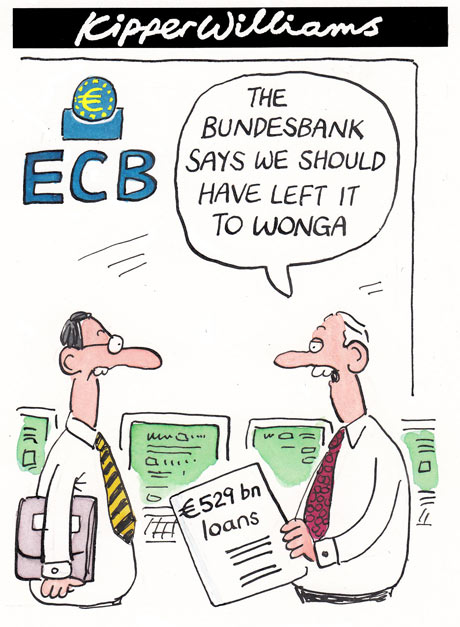
5. Grumpiness grows - Another reason the problems in Europe may be far from over is that some of the Germans within the European Central Bank are increasingly grumpy, Reuters reports.
There may not be much more easy, cheap money thrown into the abyss.
Some European Central Bank policymakers are alarmed that a dramatic loosening of lending policy stemming from a 1-trillion-euro (835 billion pound) wave of cash unleashed into the financial system will fuel imbalances in the euro zone and stoke inflationary pressures.
Led by Bundesbank chief Jens Weidmann, who was previously a top advisor to German Chancellor Angela Merkel, they are pushing for the central bank to think about an exit strategy after it fed banks 530 billion euros on Wednesday in the second of two cheap, ultra-long funding operations.
The signs of internal division add weight to what sources have already told Reuters: that the central bank does not intend to offer any more cheap three-year cash. The chances of interest rates dropping below their record low one percent also appear to be diminishing.
6. Boom, boom, boom, boom - Rodney Dickens writes at SRA that New Zealand faces the prospect of a North Sea style boom or shock if it finds oil offshore.
When and how big will future oil and gas finds be in NZ? Answer: I have no way of telling but the potential of large finds and the risk it could result in a significantly higher NZD should be taken seriously. This issue should continue to be monitored by any firms that are impacted significantly by the NZD, including exporters and importers.

7. American dairy lobby tactics - America's dairy lobby dropped their opposition to lettting in more Fonterra imports via the Trans Pacific Partnership this week.
But there's a catch, as Radio NZ reports.
The US Dairy Export Council has dropped its long-standing objection to the dairy industry being included in the nine-country TransPacific Partnership free trade talks.
But it says any concessions on tariffs should only be in exchange for steps by New Zealand to water down Fonterra's export dominance.
8. 'Pick me' - Jeffrey Sachs has launched his bid to become the next President of the World Bank in a Washington Post op-ed. Good on him.
9. Totally Stephen Colbert on the new class warfare in America and the trickle down economy.
The Colbert Report
Get More: Colbert Report Full Episodes,Political Humor & Satire Blog,Video Archive
10. Totally Clarke and Dawe - Jeremiah was a bullfrog speaks on the history of circuses. And Rudd vs Gillard.

We welcome your comments below. If you are not already registered, please register to comment
Remember we welcome robust, respectful and insightful debate. We don't welcome abusive or defamatory comments and will de-register those repeatedly making such comments. Our current comment policy is here.