

Here's my Top 10 links from around the Internet at 7.30 pm (sorry/bit frantic today) in association with NZ Mint.
I welcome your additions in the comments below or via email tobernard.hickey@interest.co.nz.
I'll pop the extras into the comment stream. See all previous Top 10s here.
My must read today is #2, which is a slightly wonky but very scary look at China's slumping housing market.

1. Way too lax - Michael Field reports at Fairfax about how New Zealand (and Russia) have been kicked off a European Union white list for countries safe from money laundering because our controls on fraudulent companies opening up through our Companies Office are too lax.
Gareth Vaughan has also done multiple articles on our site about our Companies Office company formation system being abused.
Now we've paid the price by being tarred with the same brush as Russia as a haven for money launderers.
This follows up on a case Michael Field cited of a NZ registered company that washed US$680 million through a Latvian account.
The comments below from Commerce Minister Craig Foss are a worry. This Latvian scam company was only struck off after it failed to file an annual return.
And Foss says there's a crack unit at the Companies Office keeping New Zealand safe...
Sounds like a Tui ad to me.
Here's the detail from Michael Field:
On the Auckland shell company accused of laundering $680m at a Riga bank, Foss said it was removed from the register in 2010 because it failed to file an annual return.
"As part of these efforts, the Ministry of Economic Development's Companies Office operates a dedicated Corporate Risk Profiling team to mitigate and, where possible, prevent the misuse of New Zealand-registered companies for overseas criminal activity," Foss said.
"Where a potential high-risk company is identified, the Corporate Risk Profiling team verifies the identity of the shareholders and directors concerned, and the residential address of the directors.
"The team also undertakes compliance visits to ensure that high-risk companies comply with the requirements of the Companies Act, particularly around the keeping of company records at the company's registered address."

2. It's going pear shaped - Michael Pettis writes from China about how the property market there is unravelling, courtesty of Macrobusiness.com.au.
The market is not poised to recover, but will continue to see greater downward pressure on prices; and real estate investment is likely to flatten out or start falling, erasing several percentage points of GDP growth.
At the end of 2011, total floor space “under construction” was roughly 4.6 times the floor space sold that year. Assuming it typically takes three years to build a unit, from start to finish, that suggests about a year and a half worth of excess inventory hidden somewhere in the pipeline. The ratio for residential property was 4.0, which suggests that, while there may be about a year’s worth of unsold inventory in the housing market, the overhang in commercial real estate is even steeper. Although in absolute terms, it’s the housing overhang that matters).

3. Oh dear - New York Times reports JP Morgan's 'Whale' of a synthetic credit trading loss has grown US$1 billion in recent days...
4. 'Don't even think about it' - There's been quite a few Germans talking aloud lately about letting Greece exit the Euro as if it it wouldn't hurt anyone much.
Malaysia's central bank governor tells Bloomberg here that the consequences could be apocalyptic. And he should know.
“The consequences for that to happen I believe will be unimaginable for Europe, therefore a solution has to be found to address the situation,” Zeti said. “I believe that such a solution can be found.”
Zeti was assistant central bank governor responsible for economics, reserves management, money market and foreign exchange operations when Thailand devalued the baht on July 2, 1997. The ringgit fell 89 percent in the next six months, and it was Zeti who announced Malaysia’s capital controls in 1998 as acting governor, drawing the ire of the International Monetary Fund.
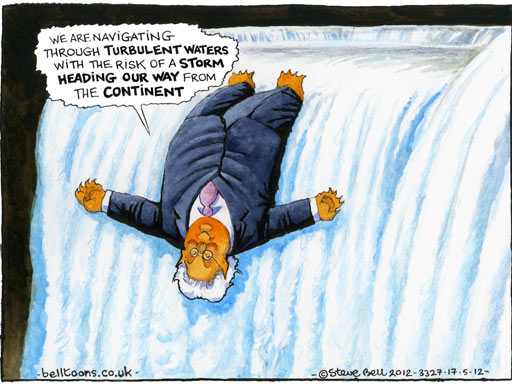
5. 'Be afraid. Be very afraid' - British Prime Minister David Cameron is also more than a little worried about what 'Grexit' would mean.
Here's the FT.com from a clearly nervous Cameron:
David Cameron, Britain’s prime minister, will on Thursday warn that the single European currency could unravel in a way that “carries huge risks for everyone” unless the eurozone’s 17 members move rapidly towards full fiscal and political union.
“The eurozone is at a crossroads,” Mr Cameron will tell a business audience in the north-west of England. “It either has to make up or it is looking at a potential break-up.

And here's the latest via Reuters on a big outflow of deposits from Spain's 4th largest bank in the last week.
And, agagin via Reuters, here's the head of the International Institute of Finance, Charles Dallara, saying 'Grexit' would be 'somewhere between catastrophic and Armageddon'.
The damage to the rest of Europe from Greece leaving the euro would be "somewhere between catastrophic and Armageddon", the chief negotiator for the body representing private sector holders of Greek bonds said on Wednesday.
"There has been a pickup of deposit flight from Greece," Dallara told reporters, but added he thought this could be stabilised "once you get a new government in place, if that government reaffirms its intention to remain in the euro zone".
"I think that it (a Greek exit) is possible, but I wouldn't call it inevitable and I wouldn't even call it likely because the costs for Greece, for Europe and for the global economy are likely each in their own way to be immense," Dallara said in a speech. "The pressures on Spain, Portugal, even Italy and conceivably Ireland could be immense and the need for Europe to step up with much greater support for the banking systems would be substantial."
6. Something's very wrong in China - The WSJ reports on a collapse in state bank lending in China in April.
When growth in China's economy slows, government leaders typically call on state-owned banks to make loans to rev up activity. But that tactic may not work this time. Bank lending plunged in April, according to the People's Bank of China, and has remained weak in May, bankers and borrowers said.
The decline owes to companies being wary about borrowing when demand is uncertain and profits are evaporating. The fall also is due to Chinese banks' unwillingness to lend to companies in problem markets—like exporters, or companies out of favor with the Chinese government, such as property developers, and practical difficulty shifting loans to new priority areas like small businesses.
The result: China's banks can't turbocharge the economy as they have in the past.

It seems the average debt overhang after financial crises since the early 1800s has been 23 years. I wonder if Reserve Banks and Treasuries have rebuilt their economic models to take account of this.
“Wishful thinking,” said Carmen Reinhart, a senior fellow at the Peterson Institute for International Economics in Washington, who knows a thing or two about debt. “You seldom grow your way out of debt. The historic experience is very rare.”
Reinhart, along with husband Vincent R. Reinhart, chief U.S. economist at Morgan Stanley, and Harvard University economist Kenneth Rogoff offer some sobering advice for the struggling euro countries, as well as other nations, in an April working paper, “Debt Overhangs: Past and Present.”
To summarize the major findings: Forget about growing your way out of debt. Too much debt depresses growth, often for as long as two decades. Debt isn’t solely a cyclical phenomenon. Real interest rates may be as low during debt overhangs as they were before.
8. Here's a link to that paper - And the abstract below
We identify the major public debt overhang episodes in the advanced economies since the early 1800s, characterized by public debt to GDP levels exceeding 90% for at least five years. Consistent with Reinhart and Rogoff (2010) and other more recent research, we find that public debt overhang episodes are associated with growth over one percent lower than during other periods. Perhaps the most striking new finding here is the duration of the average debt overhang episode.
Among the 26 episodes we identify, 20 lasted more than a decade. Five of the six shorter episodes were immediately after World Wars I and II. Across all 26 cases, the average duration in years is about 23 years. The long duration belies the view that the correlation is caused mainly by debt buildups during business cycle recessions. The long duration also implies that cumulative shortfall in output from debt overhang is potentially massive. We find that growth effects are significant even in the many episodes where debtor countries were able to secure continual access to capital markets at relatively low real interest rates. That is, growth-reducing effects of high public debt are apparently not transmitted exclusively through high real interest rates.
9. Will China grow old before it grows rich? - That's the question posed in this in-depth BBC feature on China's ageing population (and economy)
The average age goes up as countries develop, because people live longer and have fewer children. But in China, the one-child policy has triggered a rapid decline in the birth rate.
"The speed of ageing in China is unique," says Professor Peng Xizhe, a leading demographer at Fudan University. China has taken just 20 years to reach an age profile that took Britain or France 60 or 70 years, he says. New figures show that one in four permanent Shanghai residents is now retired.
The rest of China is catching up - by the year 2050, a third of Chinese people, 450 million, will be aged over 60.
10. Totally a 12 year old Canadian girl talking about Canada's debt, its banking system and the 'financial enslavement of Canadians.' Hope Amanda is watching.
Included without comment, except to say Canada was one place where the Social Credit movement was strong in the 1920s and 1930s. There is more and more of this talk bubbling up from the netherworld.
We welcome your comments below. If you are not already registered, please register to comment
Remember we welcome robust, respectful and insightful debate. We don't welcome abusive or defamatory comments and will de-register those repeatedly making such comments. Our current comment policy is here.