

Here's my Top 10 links from around the Internet at 2 pm in association with NZ Mint.
I welcome your additions in the comments below or via email tobernard.hickey@interest.co.nz.
I'll pop the extras into the comment stream. See all previous Top 10s here.
My must reads today are numbers 6 and 7 on China and Wall St.

1. History repeats in America - Ambrose Evans Pritchard writes at The Telegraph about a slowing of growth in America similar to the double-dip recession seen there most infamously in 1937.
The question is now: where is the growth going to come from?
Southern Europe is in recession.
China slowed markedly in April and there are doubts about its ability to restart the engine. See #7 below.
Emerging Asia, Australasia and Latin America depend on China for growth.
Let's hope Africa can save us...
Here's Ambrose:
The Philly Fed’s manufacturing index dropped suddenly to minus 5.8 in May. The US Conference Board’s index of leading indicators fell in April. Job creation has slipped from 250,000 a month to nearer 130,000 in March and April.
The Economic Cycle Research Institute (ECRI) says post-War personal income growth in the US has never been this weak for three months in a row without triggering a recession. It has happened ten out of ten times.
It is this fresh menace - combined with China’s failure to calibrate its heralded soft-landing - that poses the real danger to southern Europe’s arc of depression over the next year. Greece is just a poignant detail.
And here's the context:
The Euro zone’s fiscal and monetary levers are set on synchronized, mutually reinforcing contraction. The system still has no lender of last resort. The ECB is gelded. This is surreal. It is also extremely irresponsible, and we all know who is to blame.
A global relapse on top of Europe’s self-imposed wasting disease would be the coup de grace for Spain and Portugal, and perhaps Italy. They can weather a Greek ejection from the euro. They cannot defy a volley of macro-economic shocks.
2. European bank stress - The Telegraph reports on cracks appearing across banks in France and Southern Europe.
In France, the authorities are racing to avoid having to rescue Caisse Centrale du Credit Immobilier (3CIF) after Moody’s downgraded the mortgage lender last week, warning it could become totally reliant on taxpayer support within months.
The lender is one of France’s largest mortgage providers and is owned by a collection of local authorities and mutuals, giving it implicit government support.
But the troubles at 3CIF are seen as evidence of far wider problems that are likely to face a range of quasi-government borrowers across Europe, as investors become more nervous about exposing themselves to the risk of a break-up of the euro area.

3. It's bubble time - Brent Hoberman, the co-founder of Internet bubble darling Lastminute.com, writes here about Facebook's IPO.
Lastminute.com also lifted its IPO price just before the float and also saw its share price slump after its IPO. Most people now see Lastminute's IPO as the height of the Internet bubble.
Was Facebook's Friday night failure the latest bubble bursting moment?
Here's Hoberman at The Guardian:
In a similar way the lastminute.com IPO valuation was based on a belief that the business was not about selling low-margin cheap flights but would continue its expansion into a greater share of customers' leisure spend across different devices and into different nations.
The night we went public and raised £120m, Martha and I were very subdued. It felt as if we had the weight of the world, and our employees, on our shoulders, and that the company was priced for perfection. That was massive pressure. However, now I look at Zuckerberg and see someone who really does have the weight of the world on his shoulders, is only 28, and doesn't have a proper business partner.
I had hoped Facebook would resist the temptation that we also felt, to raise the price too much. In our case I'm not sure the added pressure was worth it, and in theirs they really don't need the extra money. I suspect Zuckerberg will feel that pressure, that his world is surreal.

4. God help us all - Reuters reports on the fast-growing hedge funds that use computer algorithms to trade the market. It profiles one in London, Winton, that has employed 90 people to track prices back as far as 1209 (wheat in Britain) and then build programmes to trade commodities and other assets.
The types of people employed are highly intelligent, brilliantly trained people. Many are literally rocket scientists. No wonder the world has stopped travelling into space and developing faster and more efficient aircraft.
All the bright boys and girls are developing financial market trading algorithms. And it's getting worse. Not better.
Here's the detail. Sigh.
Winton sends researchers to libraries and archives across the world to find numbers held in books and on microfilms. It has found barley and sesame prices from ancient Babylon, and English wheat prices going back to 1209.
It now employs more than 90 researchers, including extragalactic astrophysicists, computer scientists and climatologists. The company hired a meteorologist who had researched the "El Nino" phenomenon. The physics graduate - Winton wants to keep his name secret for fear a rival might poach him - works in London correlating weather data to crops such as corn, wheat and soybeans. That data can be used to forecast how prices might fluctuate with the weather.

5. Capitalism on Trial - Robert Samuelson, not the Paul Samuelson that wrote the economics textbook, writes at the Washington Post that America's new ugly, hoarding version of capitalism will be on trial in the coming election.
Until the late 1970s, executives tried harder to balance workers’ well-being and higher profits. After 1980, the emphasis shifted to “maximizing shareholder value.” That’s one reason profits recovered quickly.
The bargain that capitalism makes with society is that profits won’t simply be consumed but will also be reinvested. Jobs and living standards will increase. One reason for the recovery’s weakness is that there’s been a partial disconnect between swelling profits and higher investment. Companies are hoarding earnings. At year-end 2011, non-financial corporations had $2.2 trillion in cash and short-term securities, up 60 percent from 2008.
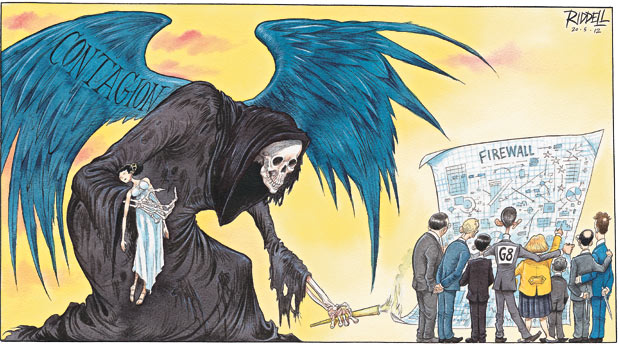
6. 'Heist of the century' - Charles Ferguson, the director of the Inside Job movie, writes at The Guardian that Wall St executives should be prosecuted.
He points out Goldman Sachs, JP Morgan and UBS either knew or suspected Bernie Madoff was running a Ponzi scheme. Yet none of them told the regulator. This is today's must-read.
Here's his thinking:
The Securities and Exchanges Commission has been deservedly criticised for not following up on years of complaints about Madoff, many of which came from a Boston investigator, Harry Markopolos, whom they treated as a crank. But suppose a senior executive at Goldman Sachs, UBS or JPMorgan Chase had called the SEC and said: "You really need to take a close look at Bernard Madoff. He must be working a scam."
But not a single bank that had suspicions about Madoff made such a call. Instead, they assumed he was probably a crook, but either just left him alone or were happy to make money from him.
It is no exaggeration to say that since the 1980s, much of the global financial sector has become criminalised, creating an industry culture that tolerates or even encourages systematic fraud. The behaviour that caused the mortgage bubble and financial crisis of 2008 was a natural outcome and continuation of this pattern, rather than some kind of economic accident.
This behaviour is criminal. We are talking about deliberate concealment of financial transactions that aided terrorism, nuclear weapons proliferation and large-scale tax evasion; assisting in major financial frauds and in concealment of criminal assets; and committing frauds that substantially worsened the worst financial bubbles and crises since the Depression.
And yet none of this conduct has been punished in any significant way.

He says don't expect an easy rebound. He even talks about stagflation. Yikes.
While the economy may bottom this year, it is difficult to see how it can easily come back. In the past 15 years, China has resorted to investment pushes to cushion the economy during an export downturn. It works if the investment sector isn't too overextended, inflation isn't serious enough to complicate pump-priming and exports come back soon. None is true now.
Local governments are overleveraged and having trouble meeting their debt services. They depend on banks rolling over the loans to stay liquid. Most state-owned enterprises are heavily in debt too. The investment push is usually finding someone to increase debt and turn it into investment demand. More debt to stimulate the economy doesn't seem right now.
The global economy is likely to remain weak for several years. Debt supported Western consumption for the past decade. The current crisis is as much about the future as the past. No matter how the crisis is solved, debt won't support Western consumption anymore. Hence, China's export downturn isn't just cyclical and may last for several years.

8. Vietnamese slowdown - This Bloomberg piece is a bit off the beaten track, but well worth a look.
“There’s no way we can meet the economic growth target of 6 percent this year when so many companies are in serious trouble,” said Le Dang Doanh, an economist who has advised Prime Minister Nguyen Tan Dung and who estimates 2012 expansion may slow to as low as 5 percent, the least since 1999. “Many businesses are on their last breath.”
With almost 18,000 companies idled in four months and the government stepping in to prevent a banking collapse, Vietnam is trying to find a sustainable path to growth after years of easy credit funded makers of cheap goods and triggered Asia’s highest inflation. Parliament meets this week to debate an economic plan that would draw more investment from foreign manufacturers such as Samsung Electronics Co. (005930), better regulate banks, and foster more domestic demand from its 88 million people.
9. Cutting out the middle man - Reuters reports the US Government has formed a special direct sales link with the Peoples Bank of China to sell US Treasuries to China, cutting out the Wall Street investment banks.
That's kind of fun. US citizens must buy US government bonds through the big investment banks, but China's government can go direct.
The relationship means the People's Bank of China buys U.S. debt using a different method than any other central bank in the world.
The other central banks, including the Bank of Japan, which has a large appetite for Treasuries, place orders for U.S. debt with major Wall Street banks designated by the government as primary dealers. Those dealers then bid on their behalf at Treasury auctions.
China, which holds $1.17 trillion in U.S. Treasuries, still buys some Treasuries through primary dealers, but since June 2011, that route hasn't been necessary.
The documents viewed by Reuters show the U.S. Treasury Department has given the People's Bank of China a direct computer link to its auction system, which the Chinese first used to buy two-year notes in late June 2011.
10. Totally Jon Stewart on the Power of the Press. Too right.
We welcome your comments below. If you are not already registered, please register to comment
Remember we welcome robust, respectful and insightful debate. We don't welcome abusive or defamatory comments and will de-register those repeatedly making such comments. Our current comment policy is here.