

Here's my Top 10 links from around the Internet at 11.30 am in association with NZ Mint.
I welcome your additions in the comments below or via email tobernard.hickey@interest.co.nz.
I'll pop the extras into the comment stream. See all previous Top 10s here.
My must read today is #1. McWilliams describes austerity well for Europe: like putting an anorexic economy on a diet.

1. Prescribing chemotherapy for heart disease - Irish economist David McWilliams has written a withering critique in the FT of Ireland's austerity plans as a way to solve its banking and property meltdowns.
The same critique could be written of any of the fringe European economies trying to cut budget deficits to get out of this mess.
All it is doing is driving their economies deeper into the mire.
Yet that seems the only strategy being pursued at the moment.
I wonder if John Key is watching this.
Here's McWilliams, who has a lovely turn of phrase:
“Don’t piss down my back and tell me it’s raining.” This line from The Outlaw Josey Wales, the classic Clint Eastwood western, is self-explanatory. In contending that the fiscal treaty will solve our dilemma, the European Commission and European Central Bank are pissing down Ireland’s back and telling us it’s raining.
The fiscal treaty will not solve Europe’s crisis. The Spanish and Irish crises stem from too much cross-border private sector borrowing and lending. Ireland’s financial crisis didn’t destroy our nation’s wealth; it just revealed how much wealth had already been destroyed by reckless lending, borrowing and speculation.
Prescribing government deficit reductions to fix these private capital imbalances is like prescribing chemotherapy for heart disease. Today’s large fiscal deficits are a result of, not the cause of, Ireland’s and Spain’s crises. Both countries’ public debt ratios were actually lower than Germany’s in 2008 – but private debts exploded. Since Ireland adopted the euro, its ratio of household debt to income has risen from 93 per cent to 220 per cent.
Such huge consumer debts indicate that without growth, more mortgage defaults beckon. Ireland has too much debt, exacerbated by the ECB’s insistence that our government continue to pay unsecured bondholders of our bust banks. The bond market shut down to Ireland not because we threatened to default but because we threatened not to.
Now Ireland is experiencing an old-fashioned liquidity trap made worse by vicious deleveraging, which is destroying asset prices. Imposing more austerity now will be as useful as putting an anorexic on a diet and expecting her to become voluptuous.
2. Just plain ugly - FTAlphaville points to this chart showing the spread between Spain's 10 year bond yield and the Germany 10 year bund yield over the last five years.
This is a picture of capital flight from Southern Europe to Germany.

3. Feeding the planet - The Economist points to this useful chart supplied by Cargill showing where the surpluses and deficits are in global food production and consumption.
Africa is a real problem still, while Asia is a big importer, which must be good for us.

4. Chinese real estate near tipping point? - Here's FTAlphaville with a roundup of the latest on the world's most important and interesting property market.
The key issues remain high inventory and competition, which could lead to a price war. In our view, the government is unlikely to materially change its stance on curbing speculation in the property sector. This is because there are lingering concerns about inflation and the government’s social housing program has made limited progress in addressing the needs of low-income families.
Property developers in China face tough choices in 2012. Those companies with large maturing debts and refinancing risks on their offshore debt and trust loans are likely to push property sales by cutting prices aggressively or sell assets. As a result, we stand by our base-case forecast calling for average selling prices to drop by about 10% in 2012 due to rising inventory and liquidity pressure.
5. China real estate unravels - Here's Patrick Chovanec from inside China on what's going wrong in the housing market there. It's long and detailed. Well worth a read.
I’m seeing some rather striking patterns in the data that tell us two main things: The market is not poised to recover, but will continue to see greater downward pressure on prices; and Real estate investment is likely to flatten out or start falling, erasing several percentage points of GDP growth.
Developers, burdened by 70% leverage ratios and loans threatening to come due, were rushing to complete whatever projects were already in their pipeline, in order to put those units onto the market and raise cash. Completions (measured in floor space) were up 39.3% in Q1, compared to last year (residential completions were similarly up 40.0%). But, of course, those completed units weren’t selling like last year, so unsold inventories expanded.
At the close of Q1, the total amount of floor space “for sale” was up 35.5%, compared to the same date last year, while the floor space of residential units “for sale” grew 47.4%. (That’s just the floor space that developers admitted was for sale. There are plenty of tricks they can use to hold units off the market, in order to massage the official data and avoid spooking buyers. At the end of 2011, total floor space “under construction” was roughly 4.6 times the floor space sold that year.
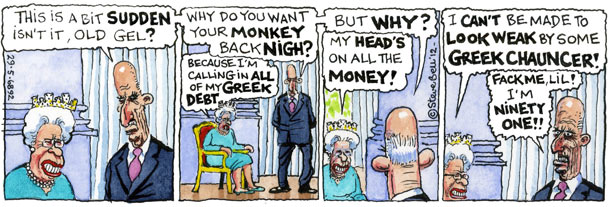
6.' Spain runs out of money' - Here's Ambrose Evans Pritchard with the argument at The Telegraph.
He says the Germans need to pull finger or get out of the euro.
Bloodcurdling stuff.
El Mundo reports that the country can no longer resist the bond markets as 10-year yields flirt with 6.5pc again, and the spread over Bunds – or `prima de riesgo' — hits a fresh record each day.
Premier Mariano Rajoy and his inner circle have allegedly accepted that Spain will have to call on Europe's EFSF bail-out fund to rescue the banking system, even though this means subjecting his country to foreign suzerainty.

Reports suggest Spain may need an extra €30bn for banks - Spain may need another €30bn to clean up its banking system on top of the €19bn required by Bankia according to El Mundo. The money would be split along the following lines: €10bn for a balance sheet cleanup and €20bn to raise capital levels, citing government sources. The newspaper argues that the €30bn would go mainly to CatalunyaCaixa, Novagalicia and Banco de Valencia.
The newspaper also quoted government sources suggesting that, should the Greece crisis continue and Spanish 10-yr bond spread remain around 500bps, Spain could seek aid from European funds.
8. China's blogging demerits system - Anyone famliar with New Zealand's speeding tickets demerits system will understand the incentives at work in this plan from China to award 'demerit' points for bloggers who use the 'wrong' words on Weibo.
Now there's an idea. Maybe we should do the same thing on Interest.co.nz. Any use of the phrase: 'Ya can't lose with property maaaate...' and you get docked 10 points. Just kidding...
Maybe we could sell points to cancel out the demerits. New business model?
One of China’s largest hosts of Twitter-like microblogs decreed new punishments on Monday for users who post comments that its editors — and by extension, China’s government censors — deem inappropriate. The service, Sina Weibo, imposed “user contracts” that award each of its 300 million microbloggers a starting score of 80 points.
Points can be deducted for online comments that are judged to be offensive. When a blogger reaches zero, the service stated, a user’s account will be canceled. Users who suffer lesser penalties can restore their 80 points by avoiding violations for two months.
Deductions will cover a wide range of sins, including spreading rumors, calling for protests, promoting cults or superstitions and impugning China’s honor, the service stated. One of China’s largest hosts of Twitter-like microblogs decreed new punishments on Monday for users who post comments that its editors — and by extension, China’s government censors — deem inappropriate.
9. Germany's Mr Sense - Reuters profiles a prominent German economist, Hans Werner Sinn, who has been arguing strongly for Germany to exit the euro. It appears he's getting some traction.
The president of the influential Ifo think tank has been advocating for Greece's exit from the euro zone in newspapers and talk shows for two years, convinced this is the only way for the debt-laden country to avoid economic disaster and for Germany to stop pouring money into a black hole. Policymakers in Berlin do not act on all of his advice. But he has had huge influence on the tone of the euro zone crisis debate in the bloc's biggest member and paymaster.
Sinn, whose name means "sense" in German, believes he has a duty to explain complex realities to voters in layman terms and lay out the best policies from an economic viewpoint, free from ideological bias.
Sinn compares Greece's situation to that of Germany during the Weimar Republic, when it too had to drastically cut wages and prices, fuelling the rise of the Nazis.
"Austerity programs in the euro zone of this order of magnitude are not possible and should not be demanded," he said, noting that youth unemployment was already over 50 percent. "The alternative, however, cannot be to simply fund Greece forever. If you take everything together - the public rescue programs, the haircut on its debt, and Target credit-, the country has so far received 460 billion euros altogether, equaling 116 Marshall Plans," he said.
"And what have you got to show for it? Nothing, just a catastrophe. How much longer must we go on before politicians understand it is a dead end?"
10. Here's Jon Stewart with his latest compilation on alternative energy. Hope he's back soon with some fresh stuff.
We welcome your comments below. If you are not already registered, please register to comment
Remember we welcome robust, respectful and insightful debate. We don't welcome abusive or defamatory comments and will de-register those repeatedly making such comments. Our current comment policy is here.