

Here's my Top 10 links from around the Internet at 5 pm today in association with NZ Mint.
We welcome your additions in the comments below or via email to bernard.hickey@interest.co.nz.
See all previous Top 10s here.
My must reads today is #7 and #8, both of which talk a lot of sense about the Euro crisis and any solutions.

1. 'Those mad Americans' - Reuters reports in detail from Inland Revenue Service records on 6 families in America that paid no federal income tax despite making more than US$200 million each in income.
This sort of thing explains this chart below. Yet still the Tea Party Republicans in Congress are arguing for tax cuts for the rich and benefit cuts for the poor.
Now all this money is accumulating in the hands of the few, who are hoarding it in government bonds.
There is a problem with this sort of capitalism. Resources such as labour, housing and offices are left empty while trillions of dollars sits on the sidelines. That cash needs to be deployed to put those resources together to get people back to work.
What's wrong with these people?
The annual report (link.reuters.com/vec68s), which the IRS typically releases with a two-year delay, covers the 400 tax returns reporting the highest incomes in 2009. These families reported an average income of $202.4 million, down for the second year as the Great Recession slashed their capital gains.
In addition to the six who paid no tax, another 110 families paid 15 percent or less in federal income taxes. That's the same federal tax rate as a single worker who made $61,500 in 2009.
Overall, the top 400 paid an average income tax rate of 19.9 percent, the same rate paid by a single worker who made $110,000 in 2009. The top 400 earned five times that much every day.

2. Not so much hoarding? - Aside from the individuals and families sitting on cash hoards, there is plenty sitting in corporate bank accounts un-deployed.
However, WSJ reports from Federal Reserve figures that the cash pile may not be as big as first thought.

To be sure, companies are still holding onto an unprecedented amount of cash. As of the end of March, nonfinancial corporations had $1.74 trillion in liquid assets on their balance sheets, $12.6 billion more than at the end of the year. A decade ago they had barely $1 trillion on hand.
3. 'Don't look at us' - David Weidner writes at Wall St Journal about why those expecting the central bank cavalry to save the world from financial armageddon may be putting too much hope in the powers of monetary policy.
Central Bankers seem keen to flick the hospital pass back to politicians.
This is one very hot potato/grenade they are tossing between each other.
"Monetary policy is not a panacea," Mr. Bernanke told Congress Thursday. "I would be much more comfortable if Congress would take some of this burden from us," he said, almost begging lawmakers to act soon to cancel across-the-board spending cuts and tax increases due to hit at year-end and to agree to a longer-term deficit-reduction scheme.
Mr. Draghi, pressed by reporters Wednesday, argued, "I do not think it would be right for monetary policy to compensate for other institutions' lack of action."
Yet with the global economy slowing to the point where unemployment is likely to rise and with little developed-country inflation in sight, several private economists say central banks can and should do more. "I think they should [take action], although not necessarily in equal measure," said Bruce Kasman of J. P. Morgan Chase. "But I don't think you can look at central banks as having the kind of ammunition to turn this around."
In the past when global growth was so slow, he said, central banks have cut short-term interest rates by about two full percentage points. With ECB rates at 1% and U.S. and Japanese rates near zero, that's now impossible.
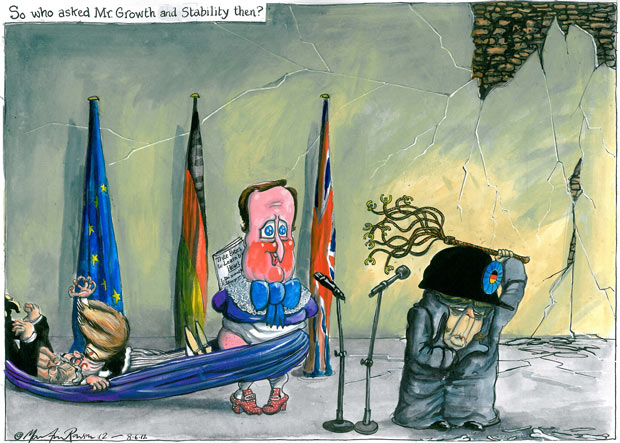
4. Watch out for China's shadow banks - Reuters reports on fears Dallas Federal Reserve President Richard Fisher has about China's financial system.
During the recent credit boom fueled by the 4-trillion-yuan fiscal stimulus, off-balance-sheet lending by banks and private loans by nonbanks exploded. This shadow-banking lending activity accounted for an estimated 20 percent of China’s total loans in 2011.
With the cooling of the real estate market and with slower economic growth likely in the near term, a large share of these loans could turn bad. And because these loans took place outside the view of regulators, the effect of a sudden disruption in repayment is virtually impossible to predict.
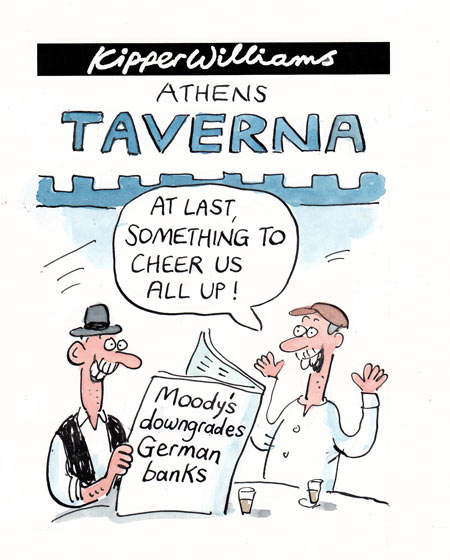
5. The financial guns of August - John Quiggan writes at Foreign Policy that Europe's financial and political systems seem to have created a doomsday machine that is ticking down to disaster. He compares the current Euro-zone mess to August of 1914...
In Europe, as in the United States, the problem underlying the crisis was an excessive buildup of debt, partly public, but mostly private. The rub is that whereas the United States was able to resolve the most critical problems through quantitative easing (large-scale purchases of public debt by the U.S. Federal Reserve), this option has been closed off in Europe because the ECB refuses to buy government bonds and remains fixated on controlling inflation.
In retrospect, the ECB's creation looks like a repetition of the systems of military mobilization built up before 1914, or of the doomsday switches built into the MAD system. The ECB's design reflected the policy preoccupations of the 1990s, most notably the belief that low inflation would ensure macroeconomic instability, and fears that a common currency would encourage national profligacy. These preoccupations produced an institution carefully insulated from any kind of democratic control and explicitly precluded from any action that could sustain fiscal stimulus. As long as the ECB remains on its current course, disaster is inevitable.
But even in 1914, there were a few weeks between the assassination of Archduke Franz Ferdinand in June and the general mobilization at the end of July, during which determined action could have prevented war. The time is similarly short today, and there are few signs of hope. But there is still time for European leaders to act to save themselves.

6. 'Our best students end up in finance' - Professor Joseph Stiglitz talks about the numbers of researchers and bright young kids who get sucked into the financial sector.
7.' It wos not the rat wot did it' - Simon Jenkins at The Guardian compares the Euro to the black rat in the Plagues of the Middle Ages in Europe.
The coming of the Black Death to 14th-century Europe meant the church needed someone to blame. Since God was exonerated ex officio, the obvious culprit was human sin, though some theologians favoured Mongol hordes, the waning power of Rome, not enough austerity and the alarming junction of Mars and Saturn in Aquarius. No one thought it was just a plague.
The same is true of today's Black Death: the euro crisis. Pundits attribute its woes to wicked debt, insufficient austerity and the need for more power to Brussels. Were Geoffrey de Meaux alive today he would also blame Venus's transit of the sun. As in the 14th century, these wiseacres assure us that redemption will come from giving more control to superior authority and from a more drastic austerity than any yet attempted. National self-flagellation is also much recommended.
As for the euro, like the black rat it gets off scot-free. It survives every debacle as that apogee of dogma, a "good idea in principle". A generation of European politicians have worshipped at its shrine and they are now too old to recant. To be "for" the euro was to be progressive, international, indulgent of the rich and munificent to the poor. It was a symbol of futurist sophistication, waved like a holy rood in the face of crabby, narrow-minded Eurosceptics.

8. A whole lotta sense - Economist Jeffrey Sachs has written a useful piece in the FT which, surprisingly (and successfully) criticises both the Krugmanesque Keynesianism and the Laissez Fairesque approach of the Germans and Brits.
Here's his view, which I agree with:
First, the US (and Europe) needs a new source of long-term growth, not a short-term Keynesian bridge to consumer-led growth.
Second, the highest social returns can be achieved by bringing the new technologies – information, communications, transportation, materials, and genomics – to bear on the problems of sustainability and the quality of life. Long-term growth (and quality of life) should be based on an investment-led transition to a low-carbon, low-pollution, and high-amenity built environment, drawing upon the cutting-edge advances of science and engineering.
Third, the transition to sustainability requires a mix of public and private investments. As one example, private investments in low-carbon energy (wind, solar, nuclear) need to be linked to public investments in long-distance transmission grids. Similarly, the transition to smart electric-powered urban mobility will require a mix of private investments and public infrastructure. The public investments should be financed in part through long-term borrowing backed by dedicated future revenue streams (e.g. public-sector tariffs and gradually rising carbon taxes).
Fourth, rather high levels of taxation as a share of national income (as in the highly successful economies of northern Europe) are needed to keep budget deficits low while also ensuring adequate public revenues for universal coverage of high-quality public services and human capital investments that span early childhood through public education, apprenticeships, and job training.
While there are absolutely urgent short-term matters to face — notably putting out the fire of bank runs in the eurozone — the deep solution to the crisis of the high-income countries lies in a long-term vision of sustainable development, one that promotes a mix of complementary public and private investments. To get there, we need to move beyond the stale US political debate pitting short-run Keynesian stimulus on one side versus trickle-down economics on the other.

9. What the locusts ate - Thomas Friedman is in good from at the New York Times in usual sweeping style: this time on the global financial crisis.
The truth, alas, is that four of the pillars of today’s global economy — Europe, America, China and the Arab world — have, each in their own way, squandered huge dividends they enjoyed in recent decades, and now they have to dig out of their respective holes with fewer resources, less time and, almost certainly, more pain. There is no easy way out. But, as confronting these hard truths becomes unavoidable, I think we’re likely to see some wild, angry and destabilizing politics that could make the economic recovery even more difficult. Deep holes and weak leaders are a bad combination.

10. Totally Clarke and Dawe - They're totally excited about the Jubilee...and the rain...dampening the celebrations....
Pun alert Gummy!
We welcome your comments below. If you are not already registered, please register to comment
Remember we welcome robust, respectful and insightful debate. We don't welcome abusive or defamatory comments and will de-register those repeatedly making such comments. Our current comment policy is here.