

Here's my Top 10 links from around the Internet at 8.30 pm today in association with NZ Mint.
We welcome your additions in the comments below or via email to bernard.hickey@interest.co.nz.
See all previous Top 10s here.
My must read today is #3 on a German Europe. The wars are mentioned.

1. Not so much of a supply problem - The conventional thinking in Australia is that house prices are so high there because there is a shortage of new houses being built, particularly in Sydney, and hordes of new people are arriving.
So, the theory goes, the painfully high multiples of house prices to incomes can be justified by excess demand and supply shortages, not necessarily a surplus of credit.
Now, it seems, the theory may be wrong.
Bloomberg reports from figures from the Australian census that there are actually almost 1 milllion fewer households in Australia than previously thought. There's only 7.8 million households, not the 8.7 million previously estimated.
And Australia's population is 300,000 fewer than previously thought at 21.5 million.
Woops.
That might explain the 5-10% fall in house prices across much of Australia in the last year.
But that still leaves an affordability problem, which is reflected in high rents and people moving back in with there families.
The increase in the number of people living in group households and in apartments and townhouses backs this up, said David Collyer, campaign manager at tax reform advocacy group Prosper Australia.
“Young adults have gone back home with mum and dad, or are sharing houses,” said Collyer, who argues that Australia has an oversupply of housing based on statistics showing water usage and new building data. “Household sizes have gone up even more than people think, and the oversupply of housing will be revealed to be even worse than we thought.”
As more Australians live with friends or parents to combat falling affordability, the number of vacant dwellings rose to 934,471 in the 2011 census from 830,376 in 2006.
The increase was at least partly due to more Australians owning second or holiday homes, said Matthew Hassan, Sydney- based senior economist at Westpac
2. The problem in Italy -Bloomberg reports Italians are already creating an art of not paying a new tax designed to bring Italy back towards surplus.
Sigh.
What is it with old rich people who don't want to pay their taxes?
Luciano Di Pardo, a lawyer in Milan, is dodging Italian Prime Minister Mario Monti’s new real estate tax.
“I didn’t pay it,” Di Pardo, 75, said of the levy that was the centerpiece of Monti’s austerity budget. “I get that we are on the edge of failure and disaster, but you can’t keep taking from ordinary people.”
The new levy, which should have cost Di Pardo about 500 euros ($630) when the first payment was due on June 18, may mark the limit of how much Monti can squeeze out of taxpayers. The belt-tightening is also sinking the prospects of Monti’s supporters in parliament and deepening Italy’s fourth recession since 2001.
Italy’s main political parties, which agreed to suspend their rivalries and back the unelected Monti when he was appointed in November, have seen their support plummet to the lowest in about two decades. Soured voters like Di Pardo are turning to Beppe Grillo, the comic-turned-politician, who called the euro an “ever-tightening noose” and urged policy makers to consider default.

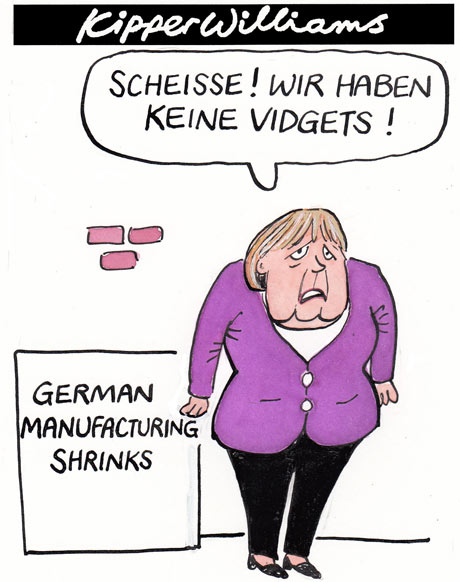
3. Can't the rest of Europe stand up to Germany? - Anatole Kaletsky writes at Reuters about Germany as a threat to Europe.
He even mentions the wars. Both of them.
He even suggests kicking the Germans out of Euro zone if they don't give up their pseudo-imperial ambitions.
Nobody should be surprised that Germany has become the greatest threat to Europe. After all, this has happened twice before since 1914. To state this unmentionable fact is not to impugn Germans with original sin, but merely to note Germany’s unusual geopolitical situation. Germany is too big and powerful to coexist comfortably with its European neighbors in any political structure ruled purely by national interests. Yet it isn’t big and powerful enough to dominate its neighbors decisively, as the U.S. dominates North America or China will dominate the Far East.
Wise German politicians recognized this inherent instability after 1945 and abandoned the realpolitik of national interest in favor of the idealism of European unification. Instead of trying to create a “German Europe” the new national goal was to build a “European Germany.” Unfortunately, this lesson seems to have been forgotten by Angela Merkel. Whatever the intellectual arguments for or against German-imposed austerity or the German-designed fiscal compact, there can be no dispute about their political import. Merkel’s stated goal is now to create a “German Europe,” with every nation living, working and running its government according to German rules.
Merkel doubtless believes that she is helping Europe when she maternally instructs the Greeks, Italians and Spaniards to “do their homework” and so become good little Germans. But like its less benign predecessors, this effort to impose German hegemony is guaranteed to fail. Europe’s leaders must therefore start considering a previously unmentionable question, perhaps as soon as next week’s summit, if the euro crisis intensifies. This question is not whether Europe will agree to live under German leadership, but whether Germany will agree to live under EU leadership – or whether the other nations must form a united front against Germany to prevent the destruction of Europe, as they have repeatedly in the past.
4. China is a Kleptocracy - Sydney Hedge Fund Blogger John Hempton wrote a provocative post last week that said China had essentially created a system where regular savers were forced to save into a system that guaranteed cheap funds for State Owned Enterprises which then 'stole' from them through the process of inflation.
It cooked up a storm.
Here's his followup and this intriquing conclusion.
Deflation of course will challenge the status-quo anyway. If 400-500 percent of the profitability of SOEs comes from financial repression then the end of financial repression will result in the collapse of the State Owned sector and the collapse of the wealth and privilege led by "hundreds of thousands of Communist Party members and their families". I suspect that the centre would find it increasingly hard to control their regional elites and the regional elites would revolt. [Revolution is almost always an affair of the second-tier elite versus the first-tier elite - the masses rarely drive it. This would be no exception.]
However in the face of that the centre would do anything to keep the inflation rate high. Ben Bernanke might not literally be prepared to throw dollars out of helicopters. The Central Committee - they might go there...
5. Let's all invest in hedge funds - FT reports Even CERN, the physics experiment in Europe employing the best and brightest, now wants to invest in hedge funds, who, by the way, are trying to employ those same best and brightest to invent new black boxes to trade the markets.
Read this and weep.
“This is a golden age of hedge fund investing,” James Dunn, chief investment officer of the Wake Forest University endowment, which manages $1.5bn and has over half its money allocated to hedge funds said. Mr Dunn was also in Monaco to meet fund managers.
According to a survey of institutional investors by Russell Investments, the US$2.4 trillion mutual fund manager, nearly a third of respondents said their allocations to hedge funds were still too low.
Those surveyed collectively had $246bn invested in alternatives including private equity, real estate and hedge funds, and had begun to ditch traditional allocations to bonds and equities.

6. Here's a good deal - BBC reports an EU court has just ruled that European workers who get sick during their annual leave can take the sick leave once they get back to work...
The European Court of Justice ruling is legally binding throughout the EU.
Thursday's ruling was prompted by a Spanish trade union case against a group of department stores.
"The right to paid annual leave cannot be interpreted restrictively," the court says. The UK does not have an opt-out in this area of EU labour law.
7. The problem with Europe version 93 - Nomura's Richard 'balance sheet recession' Koo reckons the European Central Bank eased monetary policy too much in 2000 just to help Germany out of its hole after its own dotcom bubble (bet that was Kim's fault) burst. HT Joe Wiesenthal at BusinessInsider.
That inflated southern Europe and made Germany relatively more competitive.
Here's the thinking on what now is a godawful mess:
As Germany became increasingly competitive relative to the strong economies of southern Europe, exports grew sharply and pulled the nation out of recession. Germany’s trade surplus quickly overtook those of Japan and China to become the world’s largest, with much of the growth fueled by exports to other European markets.
In 2005, I told a senior ECB official that it was unfair to force other countries to rescue Germany by boosting their economies with loose monetary policy without requiring Germany to administer fiscal stimulus, when it was Germany that had become so deeply overextended in the bubble. The official responded that that is what a unified currency means: because Germany could not be granted an exception on fiscal stimulus, the only option was to lift the entire region with monetary policy.
In other words, there would have been no need for such dramatic easing by the ECB—and hence no reason for the competitiveness gap with the rest of the eurozone to widen to current levels—if Germany had used fiscal stimulus to address its balance sheet recession.
The creators of the Maastricht Treaty made no provision for balance sheet recessions when drawing up the document, and today’s “competitiveness problem” is solely attributable to the Treaty’s 3% cap on fiscal deficits, which placed unreasonable demands on ECB monetary policy during this type of recessions. The countries of southern Europe are not to blame.
8. Europe is doomed - The FT's Martin Wolf recently spelt out in detail why the current moves to a fiscal union in Europe are doomed. HT BusinessInsider.
That's because the popular political will to suppress sovereignty in countries simply isn't there, even if Germany finally concedes to make more drastic changes.
"If they agree a federal constitution, a genuinely federal constitution, there will be referendums...[Euro supporters] are going to lose those referendums. This resolution will not be enacted."
Wolf explained that recent developments have completely changed his view of how the crisis will pan out. "I regard a partial break up at least--and it's not the view i took a few months ago--as extremely likely in the next few years."
A "balance sheet recession [in which countries build up too much public and private debt] runs right through the middle of the eurozone...and Europe is almost perfectly designed not to be able to respond to that crisis," he explained. What's more, "the idea that standard austerity programs will work seems to be a fantasy."
9. 'Just relax the rules' - As soon as the pressure comes on, European and American banks argue for the shackles to be loosened on their need for more capital and to have tighter lending and funding rules.
Here we go again at the ECB, courtesy of Reuters:
With the ECB not yet ready to take over the technical but highly political responsibility for rating sovereigns, the bank's policymakers also agreed more immediate ways to help Spain and its banks at their meeting on Thursday.
One source who requested anonymity said the bank would further soften the rules governing debt and mortgage-backed securities - collateral often put forward by Spain's banks, adding that fuller details would be published on Friday.
The discussions come as Spain braces for a downgrade from small ratings firm DBRS, which without a change in ECB rules would trigger an extra 5 percent penalty on Spanish government bonds when used to get ultra-cheap ECB funding.
10. Totally Jon Stewart on the 'Fast and Furious' scandal in America.
We welcome your comments below. If you are not already registered, please register to comment
Remember we welcome robust, respectful and insightful debate. We don't welcome abusive or defamatory comments and will de-register those repeatedly making such comments. Our current comment policy is here.