
By Bernard Hickey
Large parts of New Zealand's economy have settled down into a series of monopolies and duopolies, often foreign owned.
The relatively small size of our population and a consistent trend over the last three decades of deregulation towards consolidation and economies of scale has seen a series of industries coagulate into the hands of a few dominant players.
New Zealand's media scene now has just two major newspaper groups, two major radio networks and 3 television operations. In supermarkets we have two major chains and in shopping malls Westfield is the dominant player.
Some argue this is one reason why consumers lack choice and that prices are higher than they are in more competitive markets such as Australia, Britain and the United States.
Some argue this lack of competition and price inflation in our so-called non-tradable sectors of finance, retailing, media, health and education has been a factor in the unbalancing of our economy away from exporting and production and towards consumption and importing over the last decade.
So it's great to see a new enterprise trying to shake up two of these sectors and lower the barriers to entry for smaller manufacturers and retailers.
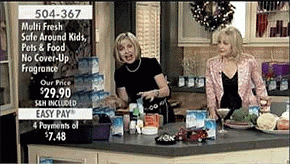
Advertising man Greg Partington, the Managing Director of Ogilvy, is launching the Shopping Channel on Sky 18 (24/7) and late at nights and mornings on Prime from October 1. He wants to create a platform for retailers and manufacturers, small and large, to show off their wares to hundreds of thousands of women in their homes.
The channel, based on the Home Shopping Channel and QVC in the United States, will sell advertising slots by the minute to anyone who wants to reach this audience. It also provides a shopping and delivery system so shoppers can order the products they see on the television over the phone or the internet and have it delivered to their doors.
This challenges the entrenched players in the shopping mall and the media business.
Currently it's expensive for anyone with an interesting new line of cosmetics or shoes or household gadgets to reach an audience and then get into a distribution system for that audience.
It's currently locked up by a few players and the barriers to entry are high. New Zealand's shopping malls are dominated by a relatively small number of chains with limited selections of products, often determined by just a few buyers who prefer to deal with the really big suppliers.
Advertising campaigns on our New Zealand's two free-to-air television networks are too expensive for most small manufacturers and retailers.
The advent of the Shopping Channel is therefore challenging the dominance of the shopping malls and the free to air networks in retailing and media. It also may help turn around a disturbing shift in shopping habits offshore.
A PwC survey out this week showed almost 6% of New Zealand's retail sales are now done online, with 35% of that online shopping done on offshore sites, often in a way that reduces employment and the tax take here.
New Zealand women now spend more than NZ$1 billion offshore on shoes and clothes.
Partington's Shopping Channel will employ 50-80 people in New Zealand and aims to open up wider ranges of cosmetics, shoes, clothing and household goods to women shoppers that are currently getting that variety through online stores offshore.
Extra competition has got to be good for consumers and the local economy, particularly when it lowers the barriers to entry to New Zealand manufacturers wanting a launch pad for a wider audience offshore.
I'm not much of a shopper, but it's great to see these established players being challenged in the worlds of retailing and media.
We welcome your comments below. If you are not already registered, please register to comment
Remember we welcome robust, respectful and insightful debate. We don't welcome abusive or defamatory comments and will de-register those repeatedly making such comments. Our current comment policy is here.