

Here's my Top 10 links from around the Internet this week. As always, we welcome your additions in the comments below or via email to bernard.hickey@interest.co.nz.
See all previous Top 10s here.
My must read today is #6 on how New Zealand is number 3 in the world for housing market over-valuation. We may well become the first in the OECD to raise our rates.

1. 'The rent is too damn high' - There's a lot of scratching of heads around the developed world right now about why economies just aren't firing into action as they should after years of near 0% interest rates and money printing.
One theory is that lower to middle income groups, who were the engine room of consumer spending in the likes of America and Europe through the 1950s, 60s, 70s and 1980s, are unable to ramp up their spending because their real incomes have been flat to falling and they have run out of borrowing room.
Without certainty that there will be buyers for products and services, those at the top of the scale making the investment decisions are sitting on their cash piles or putting it into unproductive places such as high art, pink diamonds, super yachts and beachfront property in Auckland.
The noise is building about redistributing income to those lower to middle income groups to get consumer spending going again, and therefore creating the buyers for products and services so investment can get started with some certainty. Various measures are touted, including Guaranteed Minimum Incomes, Living Wages and higher minimum wages.
Adding some fuel to that theory is this piece in Bloomberg BusinessWeek about incomes and rents for those in America towards the bottom of the scale. It says after paying rents the poor have even less money left over to buy stuff. It cites a study by the Joint Center for Housing Studies of Harvard University.
The chart below tells the story well.
“In 1960, about one in four renters paid more than 30 percent of income for housing. Today, one in two are cost burdened,” according to the study, America’s Rental Housing.
“Cost-burdened” means you’re paying more than 30 percent of income for housing and “severely cost-burdened” means you’re paying more than half. “By 2011, 28 percent of renters paid more than half their incomes for housing, bringing the number with severe cost burdens up by 2.5 million in just four years, to 11.3 million,” according to the Harvard study, which was conducted with partial funding from the MacArthur Foundation.

2. Progressive Capitalism - The billionaire former chair of Sainsbury, Lord David Sainsbury, has written an interesting book about how capitalism needs to adjust to become sustainable.
I agree with David Chaston's assessment in Monday's Top 10 (4) that capitalism is the best system, as long as it is based on a democratic system with regulation. I'd also add that capitalism's tendency to inexorably shift income to the top is self-defeating in the long run and has to be softened with a good dose of income redistribution and investment in public infrastructure such as health and education to ensure the poorest don't get stuck in poverty traps.
It's good to see many of the great and the good are questioning the neo-liberal economists' view that dominated between the mid 1980s and 2008.
Here's BusinessWeek again on the debate focused around lifting the minimum wage.
Raising the minimum wage is neither as wonderful as its advocates claim nor as dangerous as its detractors warn. On the upside, it would increase pay for millions of Americans, not only those earning the minimum but also those at fixed increments above it. These are people who could really use a raise. Contrary to what generations of students were taught in freshman econ, new research finds that minimum-wage increases at the state level have caused little, if any, harm to employment.
“Outside of the simple Econ 101-type environment, increasing workers’ pay can improve the functioning of the low-wage labor market,” Arindrajit Dube, a University of Massachusetts economist, testified before Congress in March.
3. A new centre ground - More of the detail in Sainsbury's plan is in this New Statesman piece.
It is a powerful and cogent critique. Sainsbury was an effective science minister under Tony Blair who greatly increased state support for science. However, he writes: “It was only after I left government . . . that I began to question fundamentally the neoliberal political economy which had dominated governments in the western world for the last 35 years.”
Partly this was because of the 2008 crash and a growing conviction that competitiveness required a “race to the top” – not neo - liberalism’s “race to the bottom” – with state support for employment, innovation and skills. But there was also a telling personal dimension: the private equity takeover bid for his family firm, Sainsbury’s, in the summer of 2007. “There was not the slightest pretence of trying to improve the performance of the company,” he claims. The bidders proposed “to sell off all the properties and replace them with massive debts. Then they would put the company back on the market . . . and walk away with £1bn of profit.” The City was wildly keen, salivating at the £100m in fees the investment banks stood to earn: “a perfect example of wealth appropriation as opposed to wealth creation”.
4. The 'Welfare Queens at Walmart and McDonalds - Here's Barry Ritholz at Bloomberg railing against those big companies that pay low wages, thanks largely to effective government subsidies.
You could say the same for Working for Families in New Zealand and how it is helping to support very low wages in areas such as fast food and residential care.
Ritholz suggests raising the minimum wage or charging back the subsidies to companies in the form of an extra tax. He also suggests a Swiss-style Guaranteed Minimum Income.
The new welfare queens are even bigger, richer and less deserving of taxpayer support. The two biggest welfare queens in America today are Wal-Mart and McDonald's.
This issue has become more known as we learn just how far some companies have gone in putting their employees on public assistance. According to one study, American fast food workers receive more than $7 billion dollars in public assistance. As it turns out, McDonald's has a “McResource” line that helps employees and their families enroll in various state and local assistance programs. It exploded into the public when a recording of the McResource lineadvocated that full-time employees sign up for food stamps and welfare.
The most radical idea is bit of pure fantasy: Guarantee every person in America a minimum salary. That is a proposal under discussion today in Switzerland. Its hard to even imagine such a concept gaining traction in the U.S. outside of the Great Depression era.
My politics are pretty middle-of-the-road, and I find myself offended by subsidizing profitable companies this way. As a taxpayer, there are much better things I would like to see my monies go towards. Some rule changes are needed to end this wasteful spending.
5. 'My country is a horror show' - Fans of the TV series called 'The Wire' may have heard of David Simon, the writer of the show. Here's a good old rant he's published about his own country. Simon is nostalgic for the American economy of the 1960s, 1970s and early 1980s.
Labour doesn’t get to win all its arguments, capital doesn’t get to. But it’s in the tension, it’s in the actual fight between the two, that capitalism actually becomes functional, that it becomes something that every stratum in society has a stake in, that they all share.
The unions actually mattered. The unions were part of the equation. It didn’t matter that they won all the time, it didn’t matter that they lost all the time, it just mattered that they had to win some of the time and they had to put up a fight and they had to argue for the demand and the equation and for the idea that workers were not worth less, they were worth more.
Ultimately we abandoned that and believed in the idea of trickle-down and the idea of the market economy and the market knows best, to the point where now libertarianism in my country is actually being taken seriously as an intelligent mode of political thought. It’s astonishing to me. But it is. People are saying I don’t need anything but my own ability to earn a profit. I’m not connected to society. I don’t care how the road got built, I don’t care where the firefighter comes from, I don’t care who educates the kids other than my kids. I am me. It’s the triumph of the self. I am me, hear me roar.
6. Third best/worst in the world - WSJ reports on this Deutsche Bank analysis showing New Zealand's housing market is the third most over-valued in the world, just behind Canada and Belgium.
These data also underscore the dilemmas central banks face in various countries. Canada’s, for example, is grappling with a slowdown in its economy and a worrying stagnation in consumer prices that’s raising the risk of deflation. But sky-high house valuations make it difficult for the Bank of Canada to cut rates to spur aggregate demand. A similar problem exists in Australia, where the Reserve Bank of Australia would probably love to cut rates in order to drive down what it believes to be an overvalued Aussie dollar but must instead keep a wary eye on home prices.

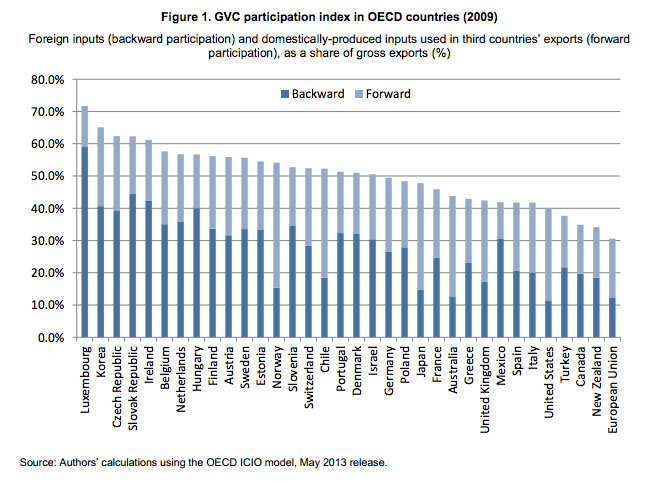
7. At the end of the world - The OECD has published a research paper on how 'global' the supply chains are in various countries. It looks at how much of a product sold in a country includes bits and pieces sources from lots of countries.
It turns out New Zealand has the lowest 'intensity' of globalisation in our 'global value chain' or GVC of any in the OECD. Somehow, the European Union (but not individual European countries) is worse.
8. The deflationary genie - Everyone, in New Zealand at least, is focused on inflation and the risks of it returning.
“Most significantly, there has been an unusually wide divergence just recently,” he continued. “Whereas the closely watched core PCE deflator has risen by 0.1% in each of the last four months, the market-based measure of core PCE deflator was flat in both October and September. Now we are dealing with very small numbers here, but that still means an annualised rate of inflation was 0.5% rather than 1% (see chart below).”
“If the market had any idea that we were starting to register zeros on this measure, I think there would be panic aplenty,” said Edwards.

9. The rise of Blackrock and the junk bond kings - Prior to the 2008 crisis it was the global investment banks shunting money around the world that caused so much grief.
Now it is the big fund managers such as Blackrock and Pimco. It also explains the Septaper Tantrum, says Martin Wolf at FT.com.
The purchasers of these bonds search for yield in a low-yield world by lending longer and riskier. Borrowers take advantage of the lower cost of foreign-currency bonds. But in the process, they assume a currency mismatch: foreign currency debt against domestic currency assets. These borrowers are speculating on their domestic currencies. Students of the Asian financial crisis of 1997-98 will find this disturbingly familiar. Non-financial companies have taken on a “carry trade”, by financing local assets with apparently cheap dollars.
When funding conditions turn, such trades can become lethal. As the Fed is expected to tighten, the dollar will rise, prices of dollar bonds will fall and dollar funding will reverse. As the bonds they issued lose value, borrowers will be forced to post more domestic currency as collateral. That will squeeze their cash flows and trigger a downturn in corporate spending. A fall in the exchange rate will exacerbate the squeeze upon them. Highly indebted non-financial corporations may even go bankrupt, imperilling domestic creditors, including the banks.
The Mangere-Otahuhu local board area has seen its median income drop from $19,900 to 19,700 between 2006 and 2013. When adjusted for inflation over the same period, the median income for the board dropped by 16 per cent.
The same comparison in the neighbouring Otara-Papatoetoe and Manurewa local boards reveals a decrease of 17 per cent each.
But Orakei, which includes Remuera, Mission Bay and St Heliers, has the highest median income of $42,700 among the local boards created after the 2010 Supercity elections.
We welcome your comments below. If you are not already registered, please register to comment
Remember we welcome robust, respectful and insightful debate. We don't welcome abusive or defamatory comments and will de-register those repeatedly making such comments. Our current comment policy is here.