

Here's my Top 10 links from around the Internet this week. It is my last of the year. As always, we welcome your additions in the comments below or via email to bernard.hickey@interest.co.nz.
See all previous Top 10s here.
My must read today is #7 on the causes of autism. It's eye and brain opening. Merry Christmas everyone and see you next year.

1. The cheek of them - The Americans are determined to use the Trans Pacific Partnership to clamp down on what they see as currency manipulation.
Their main targets are the likes of Malaysia and Singapore, but if they're not careful they'll pull in the Japanese as well.
This from a country that is printing US$75 billion a month...
This push to turn TPP into an anti-currency manipulation vehicle is another reason why it will struggle to happen next year, or at all.
The Japanese are still refusing to drop their agricultural barriers and the Americans are still trying to gut Pharmac and impose investor protection clauses that do things such as block anti-tobacco laws. This may not end well.
Here's Fred Bergsten arguing in the FT for TPP to include measures to stop currency manipulators. There seems to be an irony bypass powered by good dose of exceptionalism.
The US and most of its main economic partners are aggressively negotiating large regional trade agreements. Taken together the Trans Pacific Partnership and the Transatlantic Trade and Investment Partnership could produce the largest trade liberalisation in history. They also aim to become templates for global trade rules for the 21st century.
The US Congress, however, has raised a challenge to the successful completion of this agenda, writing to President Barack Obama to demand that “strong and enforceable” foreign currency manipulation disciplines be included in all trade deals. The bipartisan majorities from both houses are right to make that link. Paul Volcker once noted that trade is more affected by 10 minutes of movements in exchange rates than by 10 years of trade negotiations. Allowing members of free-trade pacts to offset liberalisation through deliberately undervalued currencies can destroy the benefits of those agreements to their partners.
2. GRATuitous tax avoidance - This Bloomberg BusinessWeek article explains perfectly how a large chunk of the wealth in America simply refuses to trickle down. Or anywhere.
Federal law requires billionaires such as Adelson who want to leave fortunes to their children to pay estate or gift taxes of 40 percent on those assets. Adelson has blunted that bite by exploiting a loophole that Congress unintentionally created and that the Internal Revenue Service unsuccessfully challenged. By shuffling his company stock in and out of more than 30 trusts, he’s given at least $7.9 billion to his heirs while legally avoiding about $2.8 billion in U.S. gift taxes since 2010, according to calculations based on data in Adelson’s U.S. Securities and Exchange Commission filings.
The popularity of the shelter, known as the Walton grantor retained annuity trust, or GRAT, shows how easy it is for the wealthy to bypass estate and gift taxes.
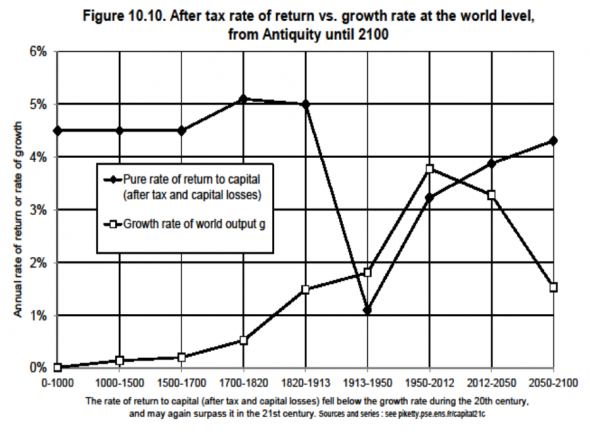
3. The amazingly long run - FTAlphaville points out French economist Thomas Piketty has written a book called Inequality and Capitalism in the Long Run suggesting that when the rate of return on capital exceeds the wider economic growth rate than inequality is widened.
He has the longest term economics chart I've ever seen. It goes back to BC. Here's the full presentation referred to in the quote below.
The idea is that in the time since the end of the first World War, global wealth inequality has declined as world output growth has outpaced the capital return rate. But the combination of a projected global growth slowdown (Piketty cites UN forecasts for global output per capita and for a declining population growth rate) and continued competition between countries to lower their top income and inheritance tax rates (boosting net capital returns) implies a renewed climb in global wealth inequality.
There’s a lot more in the presentation, but Piketty’s ideal solution (slide 31) is a “progressive wealth tax at the global scale, based upon automatic exchange of bank information”.
4. The Shipping News - Reuters reports the German banks are awfully exposed to loss-making container ships. If anything bad is going to happen next year it's going to happen in Europe's banking sector.
Germany's leading shipping lenders face 16 billion euros ($22 billion) in credit losses in the coming year as a severe sector slump makes it increasingly difficult for shipowners to repay their loans, ratings agency Moody's said.
Germany's eight major ship financiers have lent a total of 105 billion euros to the sector, a fifth of which are categorized as non-performing, Moody's said in a report.
"We expect the extended downward shipping cycle to cause rising problem loans in the shipping sector during 2013-14, requiring German banks to increase their loan-loss provisions. This will challenge their earnings power", the agency said.
5. Is Globalisation good? - The latest academic work suggests the globalisation of manufacturing has reduced the labour share of national income in America.
I think we're on the brink of another wave of globalisation in services such as health, education, finance and media companies and individuals look to cut costs by using services delivered on their mobile phones via the cloud. Xero is the perfect example. That's one of the reasons I think deflation and slow growth will remain big problems for much of the developed world for some time.
Here's the research.
In “The Decline of the U.S. Labor Share,” authors Michael Elsby of the University of Edinburgh, Bart Hobijn of the Federal Reserve Bank of San Francisco, and Aysegul Sahin of the Federal Reserve Bank of New York find that the decline of the labor share, which has been driven by a decline in the share of payroll compensation in national income over the last 25 years, is likely due to the offshoring of the labor-intensive component of the U.S. supply chain.
Comparing the mean payroll shares for the time blocks of 1948-1987 to 2010-2012, the authors find an almost 4 percentage point drop, from 57.1 to 53.3 percent, and then further posit that the majority (about 3.3 of the 3.9 percent) of the decline is related to the import exposure of U.S. businesses. Looking at other pieces of business sector income over those two time periods, they find that the decline of the labor share does not reflect an increase in corporate profit rates but rather an increase in the share of income paid for the use of structures and equipment.
6. Stagnation is the new normal - This argument from Larry Summers has been around for a few weeks now, but his latest opinion piece in the FT on it is fresh.
It's all very topical, even if in New Zealand the economy feels like it's about to have a really big partay.
Is it possible that the US and other major global economies might not return to full employment and strong growth without the help of unconventional policy support? I raised that notion – the old idea of “secular stagnation” – recently in a talk hosted by the International Monetary Fund.
My concern rests on a number of considerations. First, even though financial repair had largely taken place four years ago, recovery has only kept up with population growth and normal productivity growth in the US, and has been worse elsewhere in the industrial world.
Second, manifestly unsustainable bubbles and loosening of credit standards during the middle of the past decade, along with very easy money, were sufficient to drive only moderate economic growth. Third, short-term interest rates are severely constrained by the zero lower bound: real rates may not be able to fall far enough to spur enough investment to lead to full employment.
Fourth, in such situations falling wages and prices or lower-than-expected are likely to worsen performance by encouraging consumers and investors to delay spending, and to redistribute income and wealth from high-spending debtors to low-spending creditors.
The implication of these thoughts is that the presumption that normal economic and policy conditions will return at some point cannot be maintained.
The behavior that results is not due to cognitive deficits—the prevailing view in autism research circles today—but the opposite, they say. Rather than being oblivious, autistic people take in too much and learn too fast. While they may appear bereft of emotion, the Markrams insist they are actually overwhelmed not only by their own emotions, but by the emotions of others.
Consequently, the brain architecture of autism is not just defined by its weaknesses, but also by its inherent strengths. The developmental disorder now believed to affect around 1 percent of the population is not characterized by lack of empathy, the Markrams claim. Social difficulties and odd behavior result from trying to cope with a world that’s just too much.
8. I love a good chart - Quartz have come up with their favourite charts of 2013.
This is my favourite from America on jobs growth by industry and by wages since 2007. It explains a lot.

9. A dispatch from a broken town - Matt Taibbi has written an apocalyptic piece here at Rolling Stone from a town in New Jersey, just to give you a sense of where it's gone wrong over there.
Camden is just across the Delaware River from the brick and polished cobblestone streets of downtown Philadelphia, where oblivious tourists pour in every year, gobbling cheese steaks and gazing at the Liberty Bell, having no idea that they're a short walk over the Ben Franklin Bridge from a full-blown sovereignty crisis – an un-Fantasy Island of extreme poverty and violence where the police just a few years ago essentially surrendered a city of 77,000.
All over America, communities are failing. Once-mighty Rust Belt capitals that made steel or cars are now wastelands. Elsewhere, struggling white rural America is stocking up on canned goods and embracing the politics of chaos, sending pols to Washington ready to hit the default button and start the whole national experiment all over again.
But in Camden, chaos is already here. In September, its last supermarket closed, and the city has been declared a "food desert" by the USDA. The place is literally dying, its population having plummeted from above 120,000 in the Fifties to less than 80,000 today. Thirty percent of the remaining population is under 18, an astonishing number that's 10 to 15 percent higher than any other "very challenged" city, to use the police euphemism. Their home is a city with thousands of abandoned houses but no money to demolish them, leaving whole blocks full of Ninth Ward-style wreckage to gather waste and rats.
We welcome your comments below. If you are not already registered, please register to comment
Remember we welcome robust, respectful and insightful debate. We don't welcome abusive or defamatory comments and will de-register those repeatedly making such comments. Our current comment policy is here.