

Here's my Top 10 items from around the Internet over the last week or so. As always, we welcome your additions in the comments below or via email to bernard.hickey@interest.co.nz.
See all previous Top 10s here.
My must read today is #1.

1, Relax - It will never happen. For the sake of balance, here's American Enterprise Institute Scholar Derek Scissors explaining at SCMP why he thinks China will never have a Lehman moment.
The Government would never allow it, he says.
His column is worth reading though for the insights into how China's financial system works.
He may be right about the lack of a Lehman-style freeze, but the chronic weaknesses of China's banking system he describes are disturbing nonetheless.
The chart below courtesy of Ambrose Evans Pritchard suggests all is not well in China.
But here's the guts of Scissor's argument:
An uncharitable characterisation is that the situation of disingenuous accounting and insolvency fears among American, European, and other rich-economy financials in 2008 is the normal operating environment for their Chinese counterparts.
There is no chance of a Chinese credit freeze lasting longer than a few days, because orders to lend would come down from on high.
What about other sharp financial shocks, such as a conventional bank run?
A commercial banking system is only as strong as its weakest link, with a single troubled bank potentially triggering a string of failures.
A non-commercial system ultimately controlled by the state may be stunningly inefficient but is probably only as weak as its strongest link, since the most solvent institution can simply be commanded to absorb losses elsewhere.
It is quite easy to imagine the financial system progressively weighing down the economy over time with wasted money and unpaid debt. It is difficult to imagine any acute shock.

2. Two hundred million degress celcius - This piece by Raffi Katchadourian in the New Yorker is practically science fiction, but it gives some idea how the problem of peak energy is being worked on.
He's talking about the 23,000 tonne International Thermonuclear Experimental Reactor (ITER) being built in Southern France:
At its core, densely packed high-precision equipment will encase a cavernous vacuum chamber, in which a super-hot cloud of heavy hydrogen will rotate faster than the speed of sound, twisting like a strand of DNA as it circulates. The cloud will be scorched by electric current (a surge so forceful that it will make lightning seem like a tiny arc of static electricity), and bombarded by concentrated waves of radiation. Beams of uncharged particles—the energy in them so great it could vaporize a car in seconds—will pour into the chamber, adding tremendous heat. In this way, the circulating hydrogen will become ionized, and achieve temperatures exceeding two hundred million degrees Celsius—more than ten times as hot as the sun at its blazing core.
No one knows iter’s true cost, which may be incalculable, but estimates have been rising steadily, and a conservative figure rests at twenty billion dollars—a sum that makes iter the most expensive scientific instrument on Earth. But if it is truly possible to bottle up a star, and to do so economically, the technology could solve the world’s energy problems for the next thirty million years, and help save the planet from environmental catastrophe. Hydrogen, a primordial element, is the most abundant atom in the universe, a potential fuel that poses little risk of scarcity. Eventually, physicists hope, commercial reactors modelled on iter will be built, too—generating terawatts of power with no carbon, virtually no pollution, and scant radioactive waste. The reactor would run on no more than seawater and lithium. It would never melt down. It would realize a yearning, as old as the story of Prometheus, to bring the light of the heavens to Earth, and bend it to humanity’s will. iter, in Latin, means “the way.”
Remind me to put on some sunglasses and look the other way when they turn it on because it seems there's an awful lot of politics at the heart of the design. It reminded me of the famous Hubble telescope that was sent up fuzzy and had to be repaired in space.
3. The people dimension - This is a bit off the beaten track for the Top 10, but here's the exhaustive story of what went wrong with the Hubble telescope and how it was fixed, via Techworld. I hope the ITER people have read it.
It's a fascinating look at what goes wrong in big projects and big companies. I hope the people at Kiwibank and SAP NZ read it too. ;)
This question of the emphasis on individual abilities versus the context in which individuals and teams operate is something that has consumed Pellerin's energies in his time since leaving NASA, and is the foundation of the training system used by the company he founded, 4-D Systems.
"There's a bunch of research I've come across in this work, where people say that the social context is a 78-80 per cent determinant of performance; individual abilities are 10 per cent. So why do we make this mistake? Because we spend all of these years in higher education being trained that it's about individual abilities."
4. A Universal Basic Income - I enjoy Tim Harford's writings about economics and here he does an excellent job of explaining why a Universal Basic Income is not as radical or as silly as some people think. It's a similar idea to the one Gareth Morgan has been pushing in his Big Kahuna package.
This sounds like some communist plot. How can anyone take seriously the idea of paying people to sit around on their backsides?
The idea is endorsed not only by experts on inequality such as Oxford’s Sir Tony Atkinson, but by the late Milton Friedman, an unlikely communist. The idea of a basic income is one that unites many left- and rightwingers while commanding very little support in the mainstream.
What on earth did Friedman see in the idea?
He saw an alternative to the current welfare state. We pay money to certain people of working age, but often only on the condition that they’re not working. Then, in an attempt to overcome the obvious problem that we’re paying people not to work, we chivvy them to get a job. Our efforts are demeaning and bureaucratic without being particularly effective. A basic income goes to all, whether they work or not.
5. Not as austere as they'd like to think - Zee Germans are fond of saying zee rest of Europe should be just as severe on their budgets and just as reforming of their economies as Germany was and is.
The problem is the data shows, as Paul Krugman points out, Zee Germans are not as austere as they'd like to think.
Yes, you often hear people talking about austerity, and the Germans are big on praising and demanding austerity. But have they actually imposed a lot of it on themselves? Not so much. Again, my euro area austerity versus growth plot for 2009-13.

6. The problem with self-managing - Michael West writes at SMH about the amazing growth of Self Managed Superannuation Funds in Australia, and in particular the amount of funds that are being geared up and pumped into property. It's one of the reasons why Australia's housing market is taking off right now.
Unfortunately, it's happening mostly because Australian investors are grumpy about big management fees.
It's a good warning for us here in New Zealand as, inevitably, the banks increase their dominance of the Kiwisaver sector, just as they have in Australia. Luckily for us, at the moment, we don't allow self-managing.
When the SMSF leveraged property caper blows up, as it inevitably will, it will place further stress on the pensions system. So it was with the $20 billion obliterated in mortgage funds, the debentures debacle and other managed investment scheme collapses.
The superannuation system, now vertically integrated and controlled by the big banks and AMP, is failing investors. The fees are simply too high. Rather than building wealth for their customers, the majors are preying on them, hence the flight to self-managed super.
Both the magnitude and the layers of fees are at issue. A Vanguard/Morningstar report details the average financial adviser fee at 75 basis points (0.75 per cent of a customer's super), then there is the average platform fee of 50 basis points and the product management fees on top.
As evidenced here at the turn of the year, the big funds are also up-streaming their clients' cash balances straight into the parent banks and questionably low rates, and with no pretence of shopping around for better rates. It's cheap funding for the banks.
7. A golden goose - Here's more on the subject of Australia's pension scheme from Adele Ferguson at SMH, pointing again to the vertical integration of the banks and fund managers in Australia. It seems the new Liberal Government is going to water down some planned reforms in a way that strengthens and embeds that vertical integration, specifically by allowing the banks to charge for 'general advice'.
Given the banks and AMP own or are affiliated with up to 80 per cent of financial planners, the ability to earn a commission on general advice can be likened to owning a golden goose.
It means the bank tellers - now known as customer service operators or customer service representatives - can sell products and collect commissions as long as they issue general advice, or advice that is not specific to a customer's needs. If they issue a disclaimer, their advice is not personal, they can collect the commission.
This rule sounds a lot like the one that allows New Zealand's banks to operate as Qualifying Financial Entities (QFE) and their tellers to be QFE advisors, as opposed to full independent Authorised Financial Advisors.
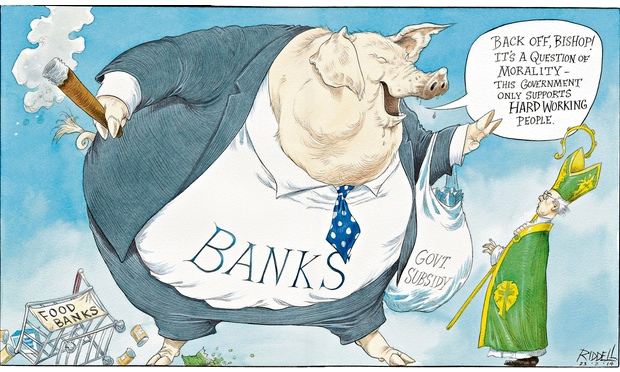
The cartoon below is via the Guardian and refers to a British situation. No banking subsidies in New Zealand. (Except for the implicit and unfunded government guarantee that everyone pretends will never be used....shhhhh)
8. Capital account liberalisation - There's a lot of talk that New Zealand's open borders regime for capital movements is great and that if only the rest of the world was like us everything would be fine.
Here's Adair Turner, the former head of Britain's FSA, pointing out at Project Syndicate that capital account liberalisation isn't all it's cracked up to be.
Empirical support for the benefits of capital-account liberalization is weak. The most successful development stories in economic history – Japan and South Korea – featured significant domestic financial repression and capital controls, which accompanied several decades of rapid growth.
Likewise, most cross-country studies have found no evidence that capital-account liberalization is good for growth. As the economist Jagdish Bhagwati pointed out 16 years ago in his article “The Capital Myth,” there are fundamental differences between trade in widgets and trade in dollars. The case for liberalizing trade in goods and services is strong; the case for complete capital-account liberalization is not.
Here's Turner's recommendation:
The required policy response should integrate domestic financial regulation with capital-account management. Tax instruments and reserve requirements that put sand in the wheels of short-term capital inflows should be combined with strong countercyclical measures, such as additional capital requirements, to slow domestic credit creation.
The effectiveness of such measures can be undermined if global banks operate in emerging countries in branch form, providing domestic credit financed by global funding pools. But this danger can be countered by requiring banks to operate as legally incorporated subsidiaries, with locally regulated capital and liquidity reserves, and strong regulatory limits on the maturity of their funding.
9. A Google tax - Nick Denton is the guy behind Gawker and an insightful thinker on the topics of technology, media, markets and monopolies.
Here's a fascinating ramble of a chat he had with a correspondent from a certain magazine. Gawker has a view on Google's monopoly and what might eventually be done about it.
PLAYBOY: What does that world look like, where everything is a perfectly efficient market and we're all both buyers and sellers?
DENTON: It will become more atomized. The Silicon Valley elite will control all the marketplaces. Uber, Amazon, Google—all these things are natural monopolies. There are massive network effects, as economists call them. The more drivers you have, the more passengers you'll get; the more passengers you get, the more drivers you'll have. And there will be room for only one player in every major category.
PLAYBOY: So we're moving back to an age of monopolies?
DENTON: Absolutely, there's no question about that. The political question is what you do about those monopolies.
PLAYBOY: Aren't monopolies inherently inefficient?
DENTON: Well, they result in income inequality, above all, and abuse of power. There's a concentration of power and wealth among the managers, owners and employees of monopolies, and usually the political system steps in to limit the power of those monopolies. But I'm pretty sure we'll end up with monopoly taxation or nationalization. That is ultimately the only answer to the concurrent concentration of power and money in this country—a Google tax.
10. Totally Clarke and Dawe reporting from Sochi. The Australians didn't do very well either. Tony Abbott went down hill quite fast.
We welcome your comments below. If you are not already registered, please register to comment
Remember we welcome robust, respectful and insightful debate. We don't welcome abusive or defamatory comments and will de-register those repeatedly making such comments. Our current comment policy is here.