

Here's my Top 10 items from around the Internet over the last week or so. As always, we welcome your additions in the comments below or via email to bernard.hickey@interest.co.nz.
See all previous Top 10s here.
My must reads today are #1 and #2 from Martin Wolf and Phillip Booth on the nature of money and banking.

1. Sheer blasphemy - Just imagine if the chief economics correspondent for the most famous business newspaper in the world suggested that the government take back the power to create money from private banks.
That's just what Martin Wolf does in this FT column published on Anzac day called "Strip private banks of their power to create money."
It is monumentally radical.
It is also supported by ideas argued by world famous economists Irving Fisher and Laurence Kotlikoff over the last 80 years or so.
Even if you think it is a funny money idea, you should read about it.
The column has come about because of the publication of a truly eye-opening paper by the Bank of England in its March quarterly bulletin.
It pointed out most money is created by banks.
Wolf goes on to explain what should be done:
The transition to a system in which money creation is separated from financial intermediation would be feasible, albeit complex. But it would bring huge advantages. It would be possible to increase the money supply without encouraging people to borrow to the hilt. It would end “too big to fail” in banking. It would also transfer seignorage – the benefits from creating money – to the public. In 2013, for example, sterling M1 (transactions money) was 80 per cent of gross domestic product. If the central bank decided this could grow at 5 per cent a year, the government could run a fiscal deficit of 4 per cent of GDP without borrowing or taxing. The right might decide to cut taxes, the left to raise spending. The choice would be political, as it should be.
Opponents will argue that the economy would die for lack of credit. I was once sympathetic to that argument. But only about 10 per cent of UK bank lending has financed business investment in sectors other than commercial property. We could find other ways of funding this.
Our financial system is so unstable because the state first allowed it to create almost all the money in the economy and was then forced to insure it when performing that function. This is a giant hole at the heart of our market economies. It could be closed by separating the provision of money, rightly a function of the state, from the provision of finance, a function of the private sector.
It's a fascinating debate that should make you question what you think you know about banking and economics.
In the UK, notes and coins adorned with images of the Queen’s head may be the most visible instruments of economic exchange, but they comprise less than a 20th of the money supply. Much of the rest consists of bank deposits – in effect, private debts that financial institutions owe their customers. These deposits function like money; they can be transferred from person to person with the flick of a pen, the wave of a card or even a mobile phone. Yet they are created by private contracts between citizens, not by government fiat.
Writing in these pages, Martin Wolf has argued for the abolition of such “private money”. Our economies would be more stable, he believes, if money creation were left entirely to the state. It is an alluring proposal; the monetary system is fiendishly complicated, and simple solutions to complex problems are often attractive. But it is misguided.
Abolishing private money would stop “fractional reserve” banking in its tracks. Banks would have to match deposits pound for pound with cash instead of loans. Account holders would have to pay charges and would receive no interest on their deposits. The gains from creating money that currently accrue to banks and their customers would instead be pocketed by the state. This could help fund public spending, reducing the government’s borrowing requirement or perhaps eliminating it altogether.
But this is no recipe for monetary stability. On the contrary: it is striking how many of the great inflations of the past were caused by profligate or greedy governments indulging in deficit financing – and destructive wars have been financed this way, too.
Since the 1970s economists have been persuaded that government borrowing should be funded transparently through bond issues and not stealthily through money creation. Allowing the state to pay for its activities by minting fresh cash would undo the progress that has been made.
3. Cracking down on shadow financing - China's Government is working hard to crack down on the shadow financing that exploded over the last five years. One of its first targets has been the way companies have stockpiled commodities such as iron ore and copper to use it as collateral to borrow money.
Lucy Hornby reports for the FT from China about a warning from the banking regulator to tighten controls for letters of credit for iron ore imports. Australians will be watching this stuff nervously.
Steel mills and traders have used iron ore imports to raise money as other sources of credit dry up, in yet another channel for off-book or “shadow” financing. Part of the attraction of the practice is that mills benefit from lower international interest rates compared to those in China.
Chinese firms have developed a number of creative channels for raising money thanks to years of capital controls meant to starve the real estate sector of speculative funds. But the bulk and difficulty of transporting iron ore makes it a cumbersome material for raising money, limiting its flexibility as a financing tool compared with copper or gold.
Regulators are worried that the collapse of a heavily indebted mill could endanger a chain of local bank branches and even local governments, since steel mills are often the largest employers, taxpayers and debtors in their area.
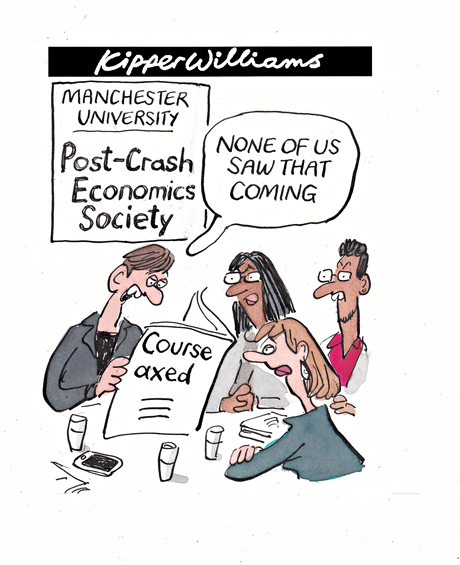
4. They've finally worked it out - Robert Gottliebsen writes at BusinessSpectator about how the Chinese regulatory attack on its shadow banking system is in a sense an attack on demand for the goods that Australia exports to China.
Luckily for us no-one is stockpiling milk powder as collateral to borrow money or borrowing money to build apartments made with milk powder. Yet. That we know of.
The Chinese shadow banking system used a similar method of crazy financing to enable property developers to build apartments in major cities. This time they used copper and gold, rather than iron ore, as the financing tools so there are large stocks of both metals -- particularly copper -- funding real estate. Many of the apartments are empty (The trouble with China's hot property, April 21). This is a Chinese version of the subprime loans in the US which caused the global financial crisis.
Again, it’s no surprise that apartment prices in Shanghai are falling and some reports even claim the discounts are up to 40 per cent. And if the shadow banking clamps continue, that property price fall in Shanghai will spread around the country -- certainly into the largest 10 or 20 cities, led by Beijing. That will, of course, slow development dramatically and affect demand for steel and other building products.
But a fall in Chinese property prices could have a more serious impact on Australia. Right now we are seeing a boom in Chinese buying and developing of apartments in Sydney and Melbourne and to a lesser extent Brisbane. We are looking at a Chinese-style glut of one and two bedroom apartments.

5. Big problems in little China - Bloomberg reports how China's provinces have failed to meet their 2014 growth targets.
Almost all Chinese provinces failed to meet their growth targets in the first quarter even after scaling back their ambitions as the government instructs officials to focus on reining in debt and curbing pollution.
Thirty of 31 provinces and municipalities reported missing their goals, with the biggest shortfall in northeastern Heilongjiang, where an expansion of 4.1 percent compared with an 8.5 percent target for the year. Most localities’ targets are lower than in 2013. The latest data were released by government websites and newspapers.
Premier Li Keqiang risks the nation sliding into a deeper slowdown as the government cracks down on overcapacity in the steel industry, wrestles with shadow banking risks and rolls out economic restructuring measures. While the government has supported expansion with measures such as reserve-ratio cuts for rural banks, it has so far avoided broader stimulus as Li chases a national growth target of about 7.5 percent.

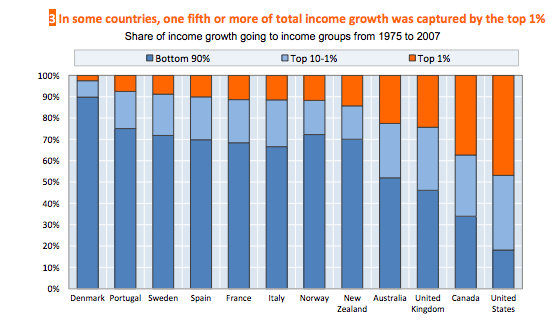
6. The rising income share of the 1% - The OECD has just released a report showing how the incomes of the top 1% have risen dramatically in the last thirty years in most of the OECD.
New Zealand is not as bad as some. The chart below shows we were fourth worst of those measured, with 14.3% of income growth from 1975 to 2007 going to the top 1%. It was 46.9% in the United States.
Tax reforms in almost all OECD countries over the past 30 years have substantially cut top personal income tax rates, the average rate in OECD falling from 66% in 1981 to 43% in 2013. This reduction has been closely associated with rising top income shares. Other taxes which play a role for top incomes were also lowered: the average statutory corporate income tax rate declined from 47% to 25% and taxes on dividend income for distributions of domestic source profits fell from 75% to 42%.
“Without concerted policy action, the gap between the rich and poor is likely to grow even wider in the years ahead,” said OECD Secretary-General Angel Gurría. “Therefore, it is all the more important to ensure that top earners contribute their fair share of taxes”.
7. For the sake of balance - Here's Allister Heath at the Telegraph arguing that Thomas Piketty's manifesto for a global wealth tax is "horrendously flawed."
The fact that Piketty’s book is selling so well busts several myths. The first is about American intellectual exceptionalism: the idea that US Left and Right differ only marginally in their support of capitalism, unlike in Europe. That certainly isn’t the case today. Parts of the US intelligentsia now advocate the same ideas that are to be found on Europe’s Left-wing fringes; Piketty and his adoring fans would go much further even than Ed Miliband.
The second incorrect idea is that the recent episode of banker-bashing from Occupy Wall Street et al was merely a reaction to the bail-outs, or to the financial sector’s role in the crisis. It was perfectly possible, we were told, to slam bankers but to embrace entrepreneurs. It was a case of Wall Street bad, Silicon Valley good; money accrued through finance was supposedly “undeserved” and that accrued by building a business wasn’t.
The truth, as I long suspected and as the almost delirious reception that this book has received confirms, is altogether different. Envy is back, disguised as a concern about “inequality”, and the bail-outs and QE were merely a convenient excuse to bash the rich. It is shocking how many intelligent people now support seizing most of the wealth created by entrepreneurs, including the founders of the great software companies (which is what a 10pc annual tax on the assets of billionaires would soon achieve).
The third myth is that there is such a thing as the “1pc”. This was always nonsense: someone earning £150,000 a year (the threshold at which a UK income taxpayer joins the club) has nothing in common with a billionaire. The Left now has another enemy, the top 0.1pc or even 0.01pc, which is just as well given that plenty of those waxing lyrical about Piketty are in the lower reaches of the top 1pc themselves. It is a case of the rich waging war on the extremely rich.
8. Communism with Capitalist characteristics - Researchers at University of Michigan have found China's Gini coefficient, the internationally accepted measure of income inequality, is now around 0.55 and up from 0.30 in 1980. A Gini above 0.5 is seen as severely unequal. America's Gini is about 0.45 and New Zealand's is around 0.33.
We document a rapid increase in income inequality in China’s recent past, capitalizing on newly available survey data collected by several Chinese university survey organizations. By now, China’s income inequality not only surpasses that of the United States by a large margin but also ranks among the highest in the world, especially in comparison with countries with comparable or higher standards of living.
We argue that China’s current high income inequality is significantly driven by structural factors attributable to the Chinese political system, the main structural determinants being the rural-urban divide and the regional variation in economic well-being.
9. We're short of truck drivers - Auckland's Chamber of Commerce has called for more training and migration to deal with a chronic skills shortage in the transport industry, and in truck driving in particular.
It's an interesting issue for the economy. Should it suck in more migrants in a quick fix that holds down wages? Or should it invest heavily in skills training and use higher wages to encourage more locals to become truck drivers?
10. Totally Jon Stewart explaining the LA Clippers racism story.
We welcome your comments below. If you are not already registered, please register to comment
Remember we welcome robust, respectful and insightful debate. We don't welcome abusive or defamatory comments and will de-register those repeatedly making such comments. Our current comment policy is here.