

Here's my Top 10 items from around the Internet over the last week or so. As always, we welcome your additions in the comments below or via email to bernard.hickey@interest.co.nz.
See all previous Top 10s here.
My must read today is #3 on China's debt juggernaut. It's a particularly clear view of the track.

1. Where supply is more than demand - If only New Zealand had this problem.
There are growing signs in China's secondary cities (and even in some of their biggest cities) that the apartment building booms seen since 2008 have generated more supply than demand, which is now pressuring prices lower.
A lot of the development was fueled by shadow banks or, as we'd call them, finance companies offering lots and lots of easy credit. Now the credit is drying up and ....
Now where have we seen this story before?
Now that China's Government is trying to rein in the shadow banks, the cat is coming home to roost among the pigeons, or some similarly ugly mixed metaphor.
Here's FTAlphaville with the chatter from the experts in and around China. The chart below is the clincher.
Every property market leading indicator at the national level turned down in Q1, and for most monthly indicators the rate of decline accelerated through the quarter. That, says Nomura, means the question is no longer “if” or “when”, but rather “how much” China’s structurally oversupplied property market will correct.
The problem at root is monetary policy tightening since mid-2013 which has severely limited the supply of hot money available to property developers from the banking system.
As Anne Stevenson-Yang at JCapital said, the end game here can really only be defaults as cash-starved property developers everywhere drop their prices to drive cash flow, while also slowing delivery of new property to the market.
Nomura have, via CREIS a private data vendor, 45 of the 100 cities surveyed in April experiencing month-on-month property price declines, up from 37 cities in March.

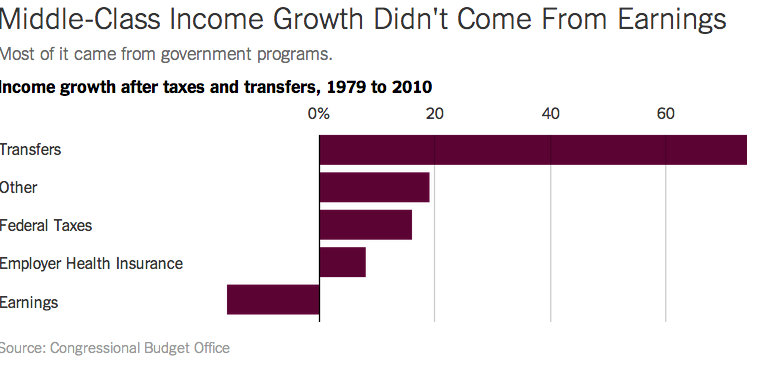
2. The effects of transfers - The big debate offshore over Thomas Piketty's book is now getting down to details about what has happened to incomes before and after taxes.
In New Zealand, the big 'middle class' welfare transfers in Working For Families, Accommodation Supplements and interest free student loans have helped keep income inequality broadly flat since the mid-2000s, along with the hit to the incomes of the rich during the GFC.
But how long can the redistribution work?
The chart below on US middle class post-tax earnings shows the scale of the issue over there.
Here's Jared Bernstein at the New York Times:
If the argument is “don’t worry about market outcomes — we’ll fix the inequalities of the primary distribution in the secondary one,” then every year that market inequality goes up, we’ll have to ratchet up the redistribution function. It is theoretically conceivable that a beneficent top 1 percent might be fine with that, but practically speaking, there’s a limit to such an aggressive strategy of income redistribution.
In fact, comprehensive income data assembled by the Congressional Budget Office show that for middle-income households, transfers and lower taxes explain the vast majority of their income growth in recent decades. Their earnings have declined in real terms 7 percent from 1979 to 2010, but Social Security, Medicare, unemployment insurance and lower taxes have more than made up the difference.
3. 'The debt train is running out of track in Asia' - Josh Noble writes for the FT from Hong Kong about the growing concerns about Asia's debt-fueled growth engine.
Even during the financial crisis, Asia powered ahead on the back of China’s mammoth stimulus package and record low borrowing costs as central banks across the world slashed rates. Those measures boosted demand for Asian exports but, more importantly, helped companies and consumers fuel domestic growth with cheap credit.
While much has been written about China’s debt addiction, the experience is far from unique within Asia. Credit levels have risen sharply since 2008 in Hong Kong, Singapore, Thailand and Malaysia, while already high levels of household debt in South Korea and Taiwan have tracked even higher.
During times of accelerating growth, that might not be a cause for concern. But now much of Asia is faltering. Credit intensity – the amount of borrowing needed to generate a unit of output – has surged, while productivity growth has tumbled. The debt train appears to be fast running out of track just as the world prepares for higher interest rates.

4. Prepare for deflationary forces - Former Chief UBS Economist George Magnus has a warning about what a China property slump might mean for the rest of the world.
If activity levels and prices weaken further, Beijing’s resolve not to respond with traditional stimulus programmes is unlikely to hold. We should expect a potpourri that might include: extra spending on infrastructure and environment programmes; faster urbanisation in inland and western provinces; some relaxation on restraints on homebuying, such as mortgage deposits; and, ultimately, new monetary easing.
Such steps may provide financial markets and the economy with some short-term relief. But if Beijing goes too far it will undermine the essential strategy of rebalancing the economy, in which case the negative economic impact would be larger and last longer. China is different from the west in many ways but the real economic effects of a burst property bubble are the same the world over. Beijing will have to cope with them in the next two years but the rest of us should be prepared for the deflationary consequences in a still fractious global recovery phase.

5. Corrosive effect of slowing payments - This Reuters article on the time it's taking to get paid inside China is a good illustration of what happens when growth momentum turns in an economy built on credit.
As China's economy continues to cool, companies are waiting longer and finding it harder to get paid for goods and services they've already sold, leading to record amounts of receivables - and potential write-offs - on corporate balance sheets.
At Longyuan Construction Group Co, an east China builder of high-rise offices, apartments and highways, receivables last year inched up 4.9 percent to 4.1 billion yuan ($657.3 million), while on average collection times extended to 95.2 days, compared with 76.3 days for 2011.
Slow collection of money owed is causing Longyuan to delay its own payments to steel and cement suppliers, Zhang Li, the company's board secretary, told Reuters, in a ripple effect that is being repeated across the economy. "If you don't pay me and I pay others, aren't I just a sucker?" said Zhang. "I'm not that stupid."
6. The Chinese buyers are back in Australia - After a wee while on the sidelines, the big Chinese buyers of overseas infrastructure and raw materials assets are back on the bidding trail in Australia, reports Business Spectator.
The implications for us are interesting. If China is now actively encouraging companies to get out there and buy things, then we can expect plenty more capital flows into New Zealand.
Since May 8, Beijing has relaxed its grip on outbound foreign investment system. For deals that are under $US1 billion and not in sensitive sectors, Chinese investors are no longer required to get regulatory approval from the NDRC, the main regulator for foreign investments.
the significant relaxation of the rule means it will be much easier for Chinese companies to invest abroad than ever before. Chinese outbound investment is also likely to be supported by Beijing’s large foreign reserve, which is about $4 trillion.
China’s huge cash pile is no longer seen as a source of strength but a burden for the country’s policy-makers. Premier Li Keqiang said recently during a visit to Africa that China’s foreign reserve had become a burden for the country. Yes, you can have too much money.
Beijing has been actively looking for ways to diversify its cash pile away from the slowing and eroding low interest investment in the US treasury bonds and turning that money into equity -- resources assets abroad is one of the better options.

7. 'Economic possibilities' - Back in 1928 John Maynard Keynes wrote a piece speculating about how fast growing economies powered by amazing new technologies would mean few of us would have to work by 2028 -- 100 years hence.
Elizabeth Kolbert wonders in ths New Yorker review of a book called 'Overwhelmed' about what went wrong, given developed economies are now full of wealthy but time-poor and leisure-poor people.
According to Keynes, the nineteenth century had unleashed such a torrent of technological innovation—“electricity, petrol, steel, rubber, cotton, the chemical industries, automatic machinery and the methods of mass production”—that further growth was inevitable. The size of the global economy, he forecast, would increase sevenfold in the following century, and this, in concert with ever greater “technical improvements,” would usher in the fifteen-hour week.
Four-fifths of the way through Keynes’s century, half of his vision has been realized. Since “Economic Possibilities for Our Grandchildren” was published, the U.S. gross domestic product has grown, in real terms, by a factor of sixteen, and G.D.P. per capita by a factor of six. And what holds for the United States goes for the rest of the world, too: in the past eighty years, the global economy has grown at a similar rate.
Burnett has concluded that keeping up with the Joneses now means trying to outschedule them. (In one recent letter, a mother boasts of schlepping her kids to so many activities that she drives “a hundred miles a day.”) “There’s a real ‘busier than thou’ attitude,” Burnett says.
A second theory that Schulte considers is that “the overwhelm” is a function not so much of how many things Americans have to do but of how much time they spend thinking about how many things they have to do.
8. 'Get ready to move inland' - This New Republic piece takes a long look at rising sea levels and how this shift might force us to spend enormous amounts of money to fend off the seas, or to move.
While actual abandonment would not happen for many years (we’re talking centuries), the studies warned that our actions now are irrevocable and will lock in these future sea level rises. In other words, our descendants will be dealing with irreversible damage that we are committing today.
So, fast forward a few centuries from now, what will the world look like? What will the United States look like? Will people still live in Miami? Boston? New York? We don’t know what technology we will have then and we aren’t able to predict the pattern of storms. We do know that sea levels are rising and will threaten cities along the coasts of the United States.
“Barring some extraordinary advances in technology that we currently do not foresee,” Robert Hartwig, the president of the Insurance Information Institute, said, “you are left with the options of retreating from coastal areas not only in the United States, but around the world, or building fortifications against rising sea levels that would make the projects that we now see in places like the Netherlands look like child’s play.”

9. What Narendra Modi should do - David was right on Monday to say the election of Narendra Modi was big news for New Zealand in much the same way the appointment of Xi Jingping was big news for New Zealand. Certainly bigger than any re-election of Barack Obama or the election of David Cameron.
The chart below courtesy of the Reserve Bank on projected global demand for dairy imports explains why.
Here's Graeme Wheeler's comments in his speech:
India, rather than China, is forecast by the Australian Bureau of Agricultural and Resource Economics and Sciences to be the major new market opportunity for dairy exports in the future. The Bureau projects global demand for dairy products to increase from USD7 billion in 2007 to USD85 billion in 2050 (in 2007 US$) By 2050, India’s import demand for dairy products is projected to be USD48 billion – more than three times China’s USD15 billion, given the projected growth in China’s domestic production. World Bank projections suggest that China and India could be the world’s largest and third largest economies at that time.
Here's Quartz with 5 things Modi should do to India's economy and why he won't be able to do them.

10. Totally Clarke and Dawe on the Australian Budget. Tony Abbott is building a better Great Nation.


We welcome your comments below. If you are not already registered, please register to comment
Remember we welcome robust, respectful and insightful debate. We don't welcome abusive or defamatory comments and will de-register those repeatedly making such comments. Our current comment policy is here.