

By Bernard Hickey
Decisions about voting for a party or employing a person or investing in some new system or machine or product are difficult things at the best of times.
So changing the way we make these decisions makes them doubly difficult, but it can create a big payoff.
Let me make the case for changing the way these decisions are made in a fundamental way.
Collectively, by the time you read this column, you will have made one of those difficult and irregular decisions about who to vote for. Now the decision is made, it's worth reflecting on how you made that decision.
Did you analyse the pros and cons in any rational sense?
Did you look at the trade-offs involved and the likely outcomes of the various scenarios?
Did you create a spreadsheet that looked at the costs and the benefits?
Did you come up with number which said you would be better off with one party or another?
Did you look at just the cashflow implications or just the balance sheet implications?
How long was your forecast horizon and who's interests did you consider?
I'll assume you were all perfectly rational and informed voters who spent the time and effort to do that analysis. Some might say that's being generous, but let's give everyone the benefit of the doubt on what should be a day of celebration for some - or at least relief that it's over.
So you might have worked out what a change of Government might have meant relative to the status quo.
You could have worked out what a 15% Capital Gains Tax, a 36% top income tax rate and trust rate, compulsory KiwiSaver, lower (or higher) interest rates and more (or less) Government debt meant for you personally.
Politicians are often fond of characterising these decisions in a way that a certain policy would increase your take home pay by x or reduce your costs by y, or increase the value of your home or the country by z.
That boils the decision down to a simple number and often assumes something quite dangerous - that the voter only cares about their own immediate incomes and costs.
Sadly, that's often how votes and spending and investment decisions are made - for the short term and from the point of view of today's consumer.
That seems natural in a world that celebrates the individual and the now, but it's not how everyone has done it for all time.
Just imagine if those decision horizons and points of view were changed.
This question cuts right to the heart of how personal finances and governments and societies and companies evolve, and often whether they succeed in the long run.
For example, investment decisions in China, for example, and by many family owned businesses are taken from the point of view of a family over multiple generations.
Assumptions are made about investment returns and current consumption that would make no sense to a consumption-focused individual today.
Decisions to invest in land or business assets or education make complete sense when you take into account the effect over decades and centuries rather than weeks or years.
Assumptions about likely investment returns, or in the jargon - discount rates, make massive differences to the projected outcomes.
So let's have a thought experiment.
If you had taken into account the multi-generational impact of the decision you made this weekend and assumed very low investment returns (perhaps as low as 2% or 3% over the long run) for the societal 'assets and liabilities' you invested in, would it have been different?
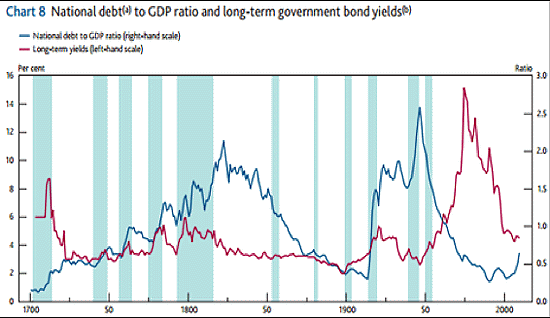
For most of the last three hundred years, long term interest rates have been between 2-5%, not the 5-15% seen for the forty years from 1960 to 2000.
Families, companies and societies that invest in assets that offer steady returns for the very long term, but not necessarily instant gratification, often generate the best results over the very long term.
So why don't we make all our decisions that way?
Some societies and families and companies do, but in New Zealand in 2014 most don't.
As you sit back and reflect on the election result, have a think about whether it would have been different if everyone had taken a multi-generational and long-term investment approach.
Would your vote have been different and would the overall result have been different?
--------------------------------------------------------
A version of this article first ran in the Herald on Sunday. It is here with permission.
We welcome your comments below. If you are not already registered, please register to comment
Remember we welcome robust, respectful and insightful debate. We don't welcome abusive or defamatory comments and will de-register those repeatedly making such comments. Our current comment policy is here.