

Financial advisory firm National Capital says women in New Zealand could be facing a KiwiSaver retirement shortfall of up to $61 billion compared to men.
National Capital’s latest Value for Money report for the January to March quarter reveals there were significant differences between the fund levels of women’s and men’s KiwiSaver funds which could lead to large disparities in savings by retirement at age 65.
The firm analysed data from the Financial Markets Authority’s 2023 KiwiSaver report and the Retirement Commission’s KiwiSaver balances.
National Capital was founded in 2018 and currently advises on over $130 million of KiwiSaver investments.
The financial advisory firm said women usually earn 25% less on average than men when it comes to salary, and are more likely to choose less risk-averse investments than men.
“Because of this, the difference in retirement savings between men and women could grow to $61 billion.”
National Capital’s report findings support similar research from the Retirement Commission in April, which found men contribute 36% more to KiwiSaver each year than women, even though both contribute the same percentage of their salaries on average.
That 36% gap in KiwiSaver contributions was mainly due to the gender pay gap, according to the Commission, which said women were missing out on KiwiSaver returns because they earned less, not because they contributed less.
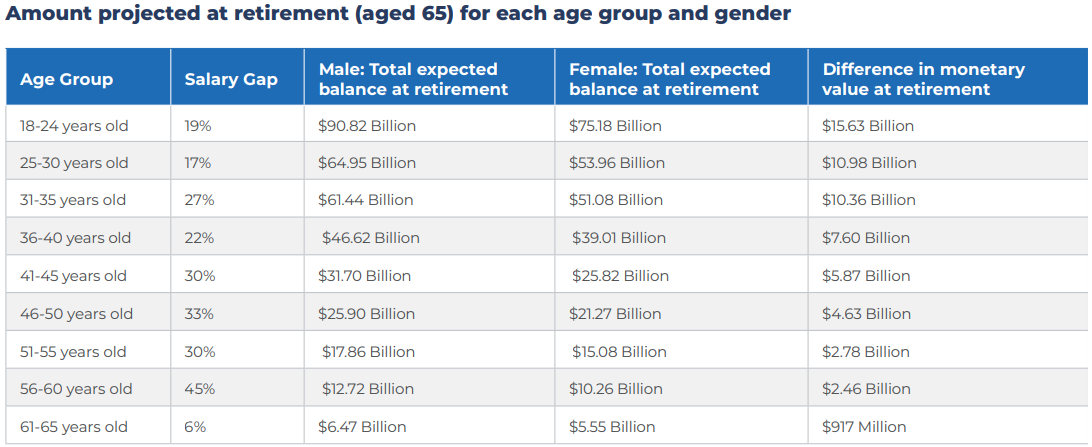
National Capital provided a breakdown of expected retirement funds for men and women aged 18-65 and their differences at retirement across different age categories.
The largest difference in KiwiSaver fund amounts was between men and women aged 18-24, with a 19% salary gap. This could mean a $15.63 billion difference in KiwiSaver funds for women and men by retirement age.
The smallest difference was between women and men aged 61-65, with a 6% salary gap. This could result in a $917 million gap between them by retirement age.
In the January to March quarter, National Capital said the typical cash reserves in KiwiSaver Growth funds decreased from 7.70% to 7.57%. The firm said this suggested managers seized some investment opportunities.
The report also noted most KiwiSaver funds had slightly boosted their bond investments in the quarter, with the increase being funded by reduced equity allocation.
On the fees front, Simplicity kept its position with the lowest fees across growth, balanced, and conservative categories, National Capital said.
Fees varied widely, with high growth having the highest at 1.12%, and conservative the lowest at 0.61%. The Milford Cash Fund had the lowest fees at 0.20%.
National Capital said although some providers are eliminating fixed monthly membership fees, 12 out of 24 still mention charging them.
The Milford Cash Fund had fees of 0.20%, making it the lowest fee KiwiSaver fund if we include the cash category.
Research firm Morningstar reported KiwiSaver funds under management rose by $4.6 billion in the March 2024 quarter, while the gap between the two biggest KiwiSaver funds closed in.
KiwiSaver assets under management are now at $108.6 billion, up from $104 billion in December.
We welcome your comments below. If you are not already registered, please register to comment
Remember we welcome robust, respectful and insightful debate. We don't welcome abusive or defamatory comments and will de-register those repeatedly making such comments. Our current comment policy is here.