
In a world of fake news, reliable statistics are an increasingly scarce commodity. Hopefully, last week Australia received a great raft of them with the release of data from the latest ‘Census of Population and Housing’.
That census was conducted on 10 August 2021 by the Australian Bureau of Statistics (ABS). It provides an invaluable overview of the state of Australia and how it’s changing over time.
Last year, the population reached nearly 25.5 million, an increase of more than two million people, or 8.6% since the previous census in 2016. Interestingly, two thirds of the population now live in Australia’s capital cities – 40% in Sydney (5.2 million) and Melbourne (4.9 million) alone.
Contrary to the impression created by icons like Crocodile Dundee and the Man from Snowy River and brands like Akubra and RM Williams, Australia is a highly urbanised country.
The latest population increase included over a million immigrants, the bulk of whom arrived in 2017-2019 before the country closed down for Covid-19. Debate is now heating up in Australia about the wisdom or otherwise of ratcheting up immigration to make up for the shortfall caused by the pandemic over the last two years.
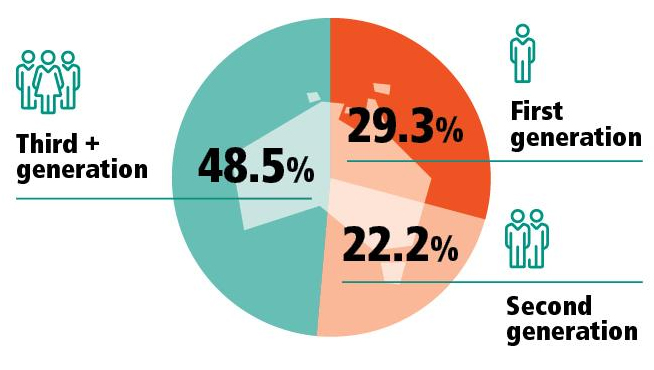
One of the most remarkable aspects of Australia revealed by the 2021 census is the extent to which it is an immigrant nation. 51.5% of Australians, more than half the population, were either born overseas or have at least one parent who was born overseas.
Source: ABS
First generation refers to a person born overseas, and second generation refers to a person with one or both parents born overseas.
The 48.5% described as ‘Third + generation’ includes the 3.2% of Australians who are Aboriginal and Torres Strait Islander people. Their ancestors have been here for literally thousands of generations.
In a fascinating comparison with Te Reo Māori, there were 167 different Aboriginal and Torres Strait Islander languages in use in Australia in 2021.
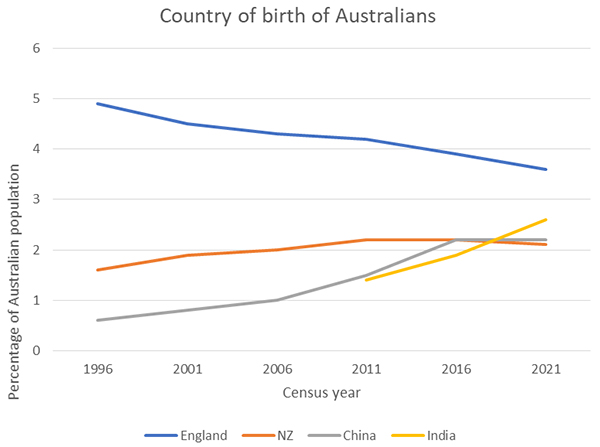
The source of Australia’s immigrants has been shifting over the decades. Last century there were waves of people from a range of countries including England, Greece, Italy, and Vietnam. According to the latest census, the four countries that have provided the largest proportion of today’s foreign-born Australian residents are England, India, China, and New Zealand.
The following graph tracks the size of each of these groups as a proportion of the total Australian population across the last six censuses.
Source: ABS
The trend is clear. Over the last quarter century, Australia has become less English and more Asian. The ‘ten pound poms’ are dying out and not being replaced by large numbers of new migrants from England while immigration from Asia is steadily increasing. In just the last decade, the proportion of people living in Australia who were born in India has soared from 1.4% to 2.6%. In actual numbers, that represents a jump from less than 300,000 in 2011 to 673,000 in 2021.
The position of kiwis living in the ‘West Island’ has been relatively stable for the last twenty years at around 2% of the Australian population. Given that that population is increasing, maintaining that 2% requires a regular stream of kiwis crossing the ditch.
There are currently about 530,000 NZ-born people resident in Australia. That number will likely rise as Australian employers are now looking to New Zealand as a source of workers to ease chronic labour shortages nationwide.
In the 2021 census, the changing nature of Australia’s demography is reflected in the nation’s religious diversity. In the five years since the 2016 census, the numbers of Australians reporting affiliation with Hinduism, Buddhism, and Islam have increased significantly. By contrast, affiliation with Christianity has dropped both in numbers and as a percentage of the population. Less than 44% of Australians now describe themselves as Christian.
The biggest gain has been in ‘No religious affiliation’, rising from 30.1% to 38.9% of the population in just five years.
The 2021 census provides a wealth of information on another topic that is a quasi-religion for many Australians – housing. The census recorded 10.8 million private dwellings in Australia. Interestingly, the average number of people in each household was 2.5, a drop from 2.6 in the previous census. That drop may partly explain why there is a rental crisis even after two years of a Covid-19- induced immigration freeze.
More than a quarter of Australians now live alone.
Two thirds of households live in a home they own while one third rent.

Source: ABS
70% of dwellings are separate houses, 13% townhouses, and 16% apartments.
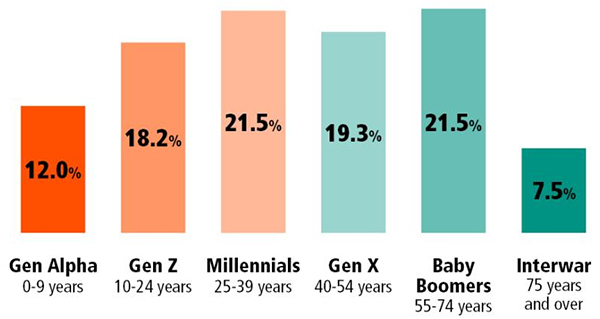
There’s much discussion in Australia about the privileged position of the baby boomer generation. They are constantly attacked for their gains from the decades-long housing boom and their domination of the political arena. The 2021 census reveals that change is coming, albeit slowly.
Source: ABS
In demographic terms at least, the Millenials are finally catching up with the baby boomers.
Just in time to deal with federal government debt approaching one trillion dollars, tumbling house prices, a deteriorating geopolitical outlook in the Indo-Pacific, and an increasingly unpredictable climate.
Ross Stitt is a freelance writer and tax lawyer with a PhD in political science. He is a New Zealander based in Sydney. His articles are part of our 'Understanding Australia' series.
We welcome your comments below. If you are not already registered, please register to comment
Remember we welcome robust, respectful and insightful debate. We don't welcome abusive or defamatory comments and will de-register those repeatedly making such comments. Our current comment policy is here.