
House prices in both New Zealand and Australia are now well off their pandemic peaks. However, housing affordability remains a significant social (and political) problem. Increasing numbers of people, particularly but not only the young, view home ownership as unattainable.
That situation looks set to deteriorate further in Australia as, contrary to most predictions, house prices appear to have already bottomed and are now on the rise again. Absent a return to falling house prices or a dramatic decline in interest rates, buying a house is not going to be an option for many Australians any time soon.
Unfortunately, renting is also becoming more difficult. Vacancy rates in most Australian capital cities are currently at near record lows and rents continue to climb.
Unsurprisingly, the Labor government of Anthony Albanese recognises the political risk of a housing crisis. It’s promoting a number of initiatives to facilitate more dwelling construction. These include two steps announced in the latest federal budget to encourage the ‘build-to-rent’ (BTR) market.
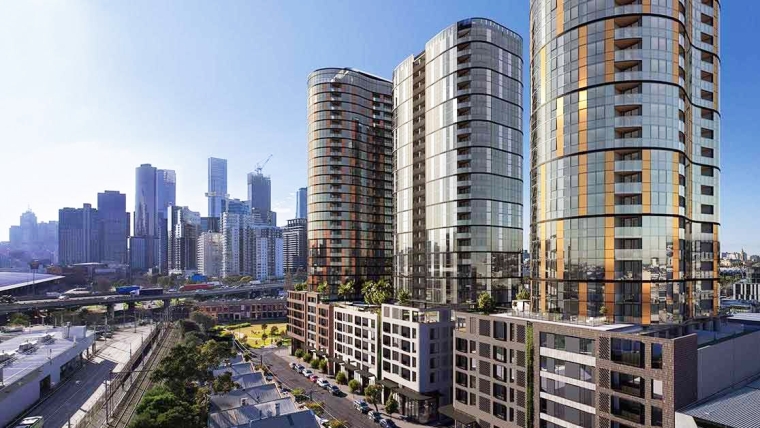
BTR, known in most jurisdictions as ‘multi-family residential’, refers to large-scale residential projects developed for rental to long term tenants. They are usually owned and funded by institutions and frequently offer a higher level of amenity for residents than most ‘build-to-sell’ (BTS) projects.
The BTR market is much more established in Europe, the US, and Japan than in Australia (or NZ). It has more acceptance in those countries as an institutional investment asset class.
What’s causing Australia’s housing crisis and will BTR be part of the solution?
According to the most recent report from the National Housing Finance and Investment Corporation (NHFIC), over the five years from 2023 to 2027 new household formation will exceed new supply of housing by 106,000.
Supply is being adversely affected by a range of factors including rising interest rates, rising construction costs, supply chain delays, long lead times for delivering new projects, planning restrictions, and NIMBYism.
Demand for housing is the result of strong population growth and an ongoing trend of smaller households. The former is being driven by a massive increase in net immigration – 400,000 plus in the current financial year, 315,000 next year, and a forecast total of 1.5 million over five years.
The key question is whether the BTR model has any specific features that can facilitate the supply of new dwellings and help close the housing gap.
Two stand out.
The first is scale. JLL’s report in March on the state of the BTR market identifies the operational BTR assets of ‘prime or institutional grade’ in Australia. The developments are predominantly large scale, the largest comprising 1,250 apartments.
The second, and perhaps the most beneficial feature in the current economy, is funding. Most BTR projects are backed by deep-pocketed institutions, many of them foreign. This has a number of advantages including a low cost of funds and a long-term investment perspective. Significantly, unlike BTS projects, commencement does not require the pre-selling of apartments to third party buyers.
The JLL report identifies some of the key BTR funds in the market, including six with a fund size in excess of $1 billion and eight with an initial target of more than 5,000 apartments. Key foreign institutions involved in these funds include GIC, the Singaporean sovereign wealth fund, PGGM, a giant Dutch pension fund, and Blackstone, the international asset manager.
The graph below shows the BTR supply pipeline at the end of last year.
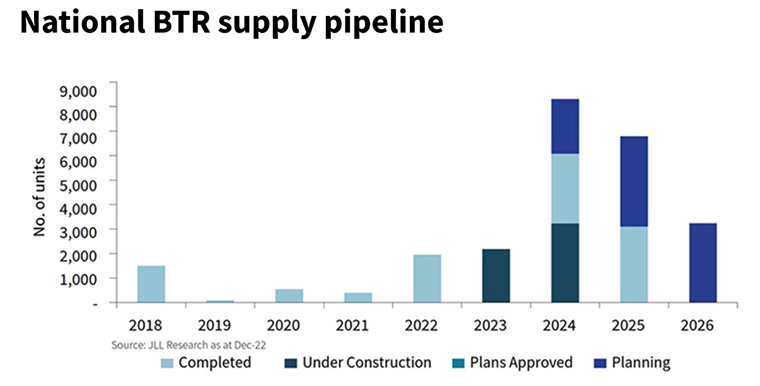
That pipeline, already promising, is likely to increase significantly due to two substantive changes announced in the latest budget. To incentivise the supply of BTR housing, the federal government is
- increasing the depreciation rate for eligible BTR projects from 2.5% to 4%, and
- reducing the ‘managed investment trust’ withholding tax rate for eligible BTR projects from 30% to 15%.
A BTR project will qualify for these concessions if it involves at least 50 apartments, the apartments remain under single ownership for at least ten years, and tenants are offered a lease term of at least three years.
These targeted concessions will lift the after-tax return for BTR projects and were provided by the government in response to lobbying from the industry. The budget document specifically referenced industry estimates that ‘this could unlock 150,000 rental properties over 10 years, boosting the supply of high-quality, long-term rentals in the Australian market’.
The descriptor ‘high-quality’ reflects the desired positioning of most BTR projects. The concept is a high standard of apartment in a complex with generous amenities, often in sought-after inner-city suburbs. A key feature is long term leases to provide tenants with greater security of tenure.
The quid pro quo of ‘high-quality’ is of course a premium rental rate for the landlord. That’s the element that makes BTR attractive to institutional investors.
The rapid rise in rents currently occurring across the Australian housing market, and particularly in the capital cities, enhances the prospects for the BTR market. So too does the expectation that the current tight conditions are likely to continue for some time, in part because of the slowdown in BTS activity. The latter has the added advantage of suppressing prices for the type of large-scale sites needed to undertake BTR projects.
All things considered, the outlook for BTR in Australia looks promising. That perception is backed up by the regular stream of announcements from new international players entering the market here. Just this month, Canadian property powerhouse Brookfield has lodged an application for a 560-unit BTR development in Brisbane. Brookfield manages real estate assets worth US$270 billion worldwide, including tens of thousands of BTR units.
Presumably, investors of this calibre know what they’re doing. The only question is whether enough Australians will be able to afford the higher rents demanded by BTR.
*Ross Stitt is a freelance writer with a PhD in political science. He is a New Zealander based in Sydney. His articles are part of our 'Understanding Australia' series.
We welcome your comments below. If you are not already registered, please register to comment
Remember we welcome robust, respectful and insightful debate. We don't welcome abusive or defamatory comments and will de-register those repeatedly making such comments. Our current comment policy is here.