
By Brendon Harre*
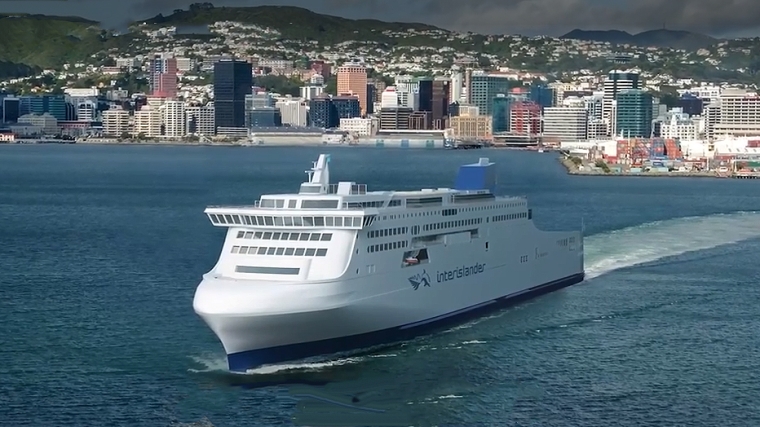
In December the newly elected government cancelled its support for KiwiRail’s iReX (Interisland Resiliency Connection) project due to its excessive cost, forcing KiwiRail to cancel its build order for the mega-ferries that would have delivered new ships in the beginning of 2026.
This has proved to be controversial because it has implications for the viability of the entire rail network. Dr Bryce Edwards aggregates the various perspectives in an excellent summative article. From that article it can be seen that there has been no public discussion of simplifying the design of the port upgrades to cut costs to an affordable level.
This discussion piece will make the case that taking a minimum viable design approach could have enabled the mega-ferries project to be progressed.
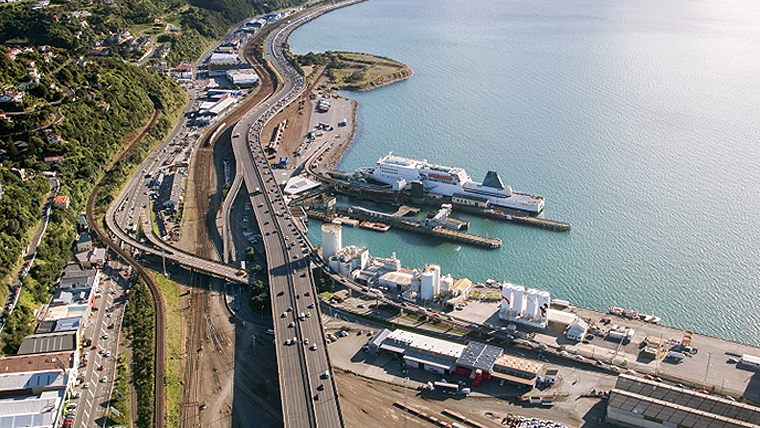
KiwiRail’s current Kaiwharawhara port terminal
The Finance Minister Nicola Willis has said New Zealand should consider Toyota Corolla ships instead of Ferraris for KiwiRail’s interisland shipping. This is understandable because the iReX project had ballooned in cost to over $3 bln.
Yet the new ferries were less than 20% of the iReX cost and had a fixed contract so they were not the direct source of the cost escalation. The thinking seems to be the two larger ships that were to replace KiwiRail’s three smaller ships would need larger loading yards, which explains the escalated cost for the port upgrades.
Yet, there hasn’t been a public examination if this premise is true. What if New Zealand should have considered Toyota ports rather than Toyota ferries?
What if the port upgrades were over-engineered? What if they included unnecessary design features?
At first glance the port upgrades in Wellington and Picton have an extraordinary cost compared to other Wellington infrastructure. To my mind this should have raised eyebrows.
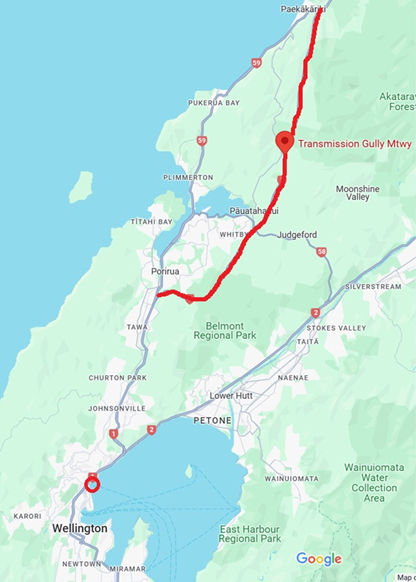
The red circle is the location of Kaiwharawhara Port where the port facilities in Wellington were to be upgraded for new ferries. The red line is the Transmission Gully Motorway.
Upgrading the port facilities in Wellington and Picton escalated in price to $2.5 billion by time the project was cancelled and threatened to escalate further. This is double the cost of the nearby Transmission Gully motorway! It is surprising that upgrading port loading facilities could be more expensive than 27km of motorway construction. A quick look at the above map shows the port upgrades should be significantly smaller projects.
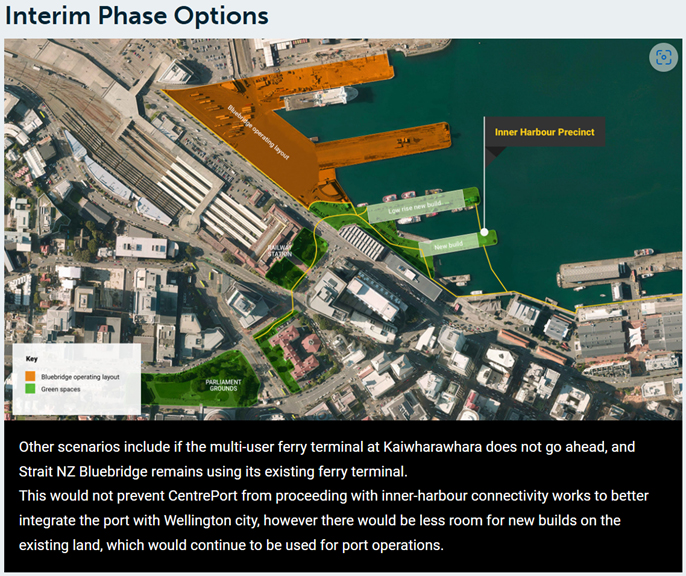
Wellington’s CentrePort has a interim plan if the new multi-user port at Kaiwharawhara is cancelled. Perhaps, KiwiRail should have prepared a similar contingency plan.
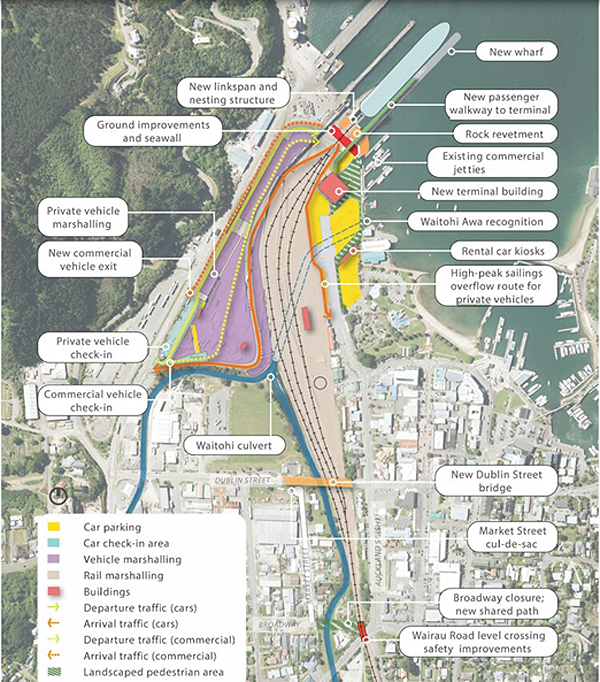
The Picton port upgrade is mainly a renovation of its existing services. There is a extended new wharf, some ground improvements, and a new seawall around the docking area, but no major land reclamation or expansion of the ports footprint.
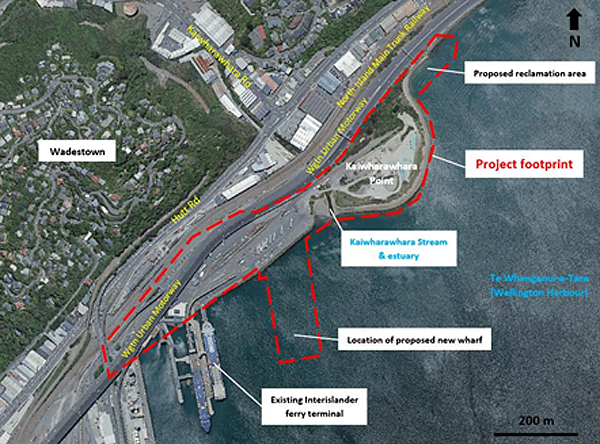
Whereas in Wellington there would have been a significant expansion of port land area at Kaiwharawhara, some of which included land reclamation. Basically, in the above consent application, everything north of Kaiwharawhara stream and estuary is an expansion of the ports footprint.
A large reason for this expansion was the design spec for the Wellington Port upgrade to be a combined KiwiRail and Bluebridge ‘multi-user’ facility. So Kaiwharawhara had to accommodate new loading yards and a new wharf for Bluebridge as well as facilities for KiwiRail’s new mega-ferries. This would be a significant increase in the ports footprint, about a doubling of the required land area.
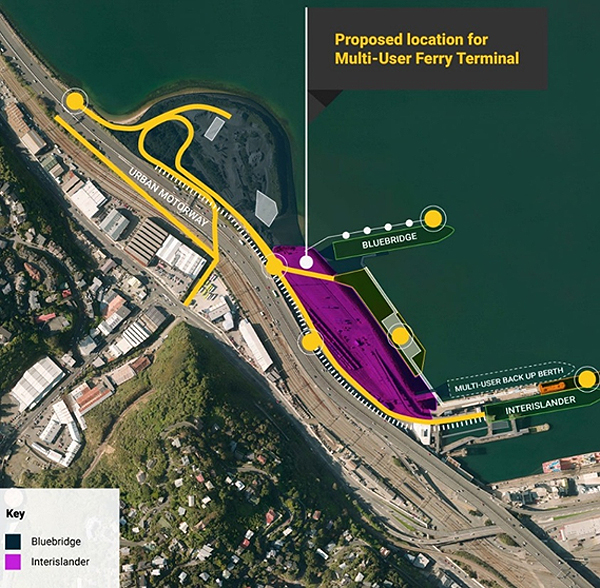
Yet this specification is not strictly necessary. CentrePort has a contingency plan for KiwiRail and Bluebridge to stay in their current separate locations.
If Bluebridge were to stay, could KiwiRail then just upgrade Kaiwharawhara on its existing footprint as a minimum viable solution? The savings could be significant. Pilings for instance were to be 70m deep due to the earthquake risk. Also expanding past Kaiwharawhara stream and estuary meant raising the site by 1 metre due to the flooding risk. The cost for earthquake strengthening, flood protection, land reclamation and a second wharf for Bluebridge must have been significant, the seismic risk alone was a $250 million cost.
A minimum viable solution would not be the perfect 100-year resiliency project that iReX attempted to be and it certainly wouldn’t allow CentrePort to redesign as much of the inner harbour for non-industrial purposes as it wants. But maybe the perfect was the enemy of the good? Because the iReX project was too expensive and therefore not viable, this has exposed New Zealand to other risks.
For instance Gary Taylor the CEO of the Environment Defence Society writes.
“It’s vital for our future emissions profile that we retain rail links across the country. Having rail-enabled ferries is part of that. It would be tragic if we lost that capacity, especially as we are transitioning to a low carbon economy and transport network. As rail technologies evolve, our interisland connections must be compatible with that modality. Ferries that can only carry trucks are 20th century solutions and that, unfortunately, may be where we are headed.”
Also KiwiRail’s three existing ships are between 26 and 29 years old and their service life is 30 years. There have been several near misses, where these ships have temporarily lost power, or their steering has malfunctioned. Any replacement new ships are at a minimum 4 or 5 years away because they will need to be re-ordered with new design specs. Purchasing second hand truck-only ships has been done in the past but is reliant on what is internationally available, which currently is limited.
Purchasing new smaller ferries will cost more than the cancelled ferries because of significant post-covid price inflation. Also cancelling the $550m mega-ferries may have incurred contract break fees of $300m or more. The cost of three smaller ships and the contract break fee will likely exceed $1 bln for a lower specification outcome. Also some sort of upgrade to the 60 year old port and terminal facilities will still be necessary. This cost may be similar to what a minimum viable design for the mega ferries could have been.
The freight carried across the Cook Straight has an annual value of about $15 bln. Both the North and South Islands are growing (interestingly since 2018 the South Island population has grown faster) so the volume of trade should be growing.
If there is a disaster with KiwiRail’s current ships due to their old age not only will it threaten life and limb, it will impact on New Zealand’s cost-of-living, especially in the South Island. It will add a bottleneck to our already lengthy supply lines.
Even if disaster is averted, only having a truck freight connection between the islands has the potential to limit capacity and competition.
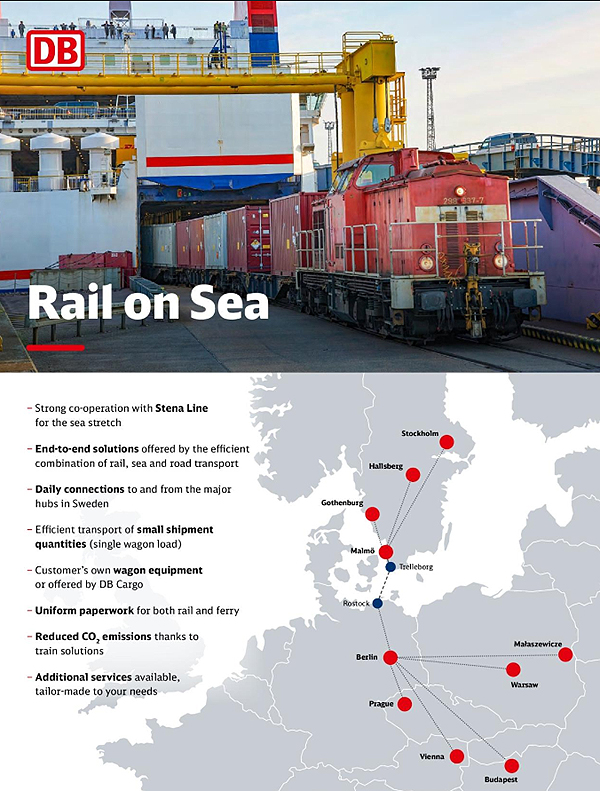
Rail enabled ships as the above picture illustrates are not unusual overseas. I recently took a train trip from Stockholm to Copenhagen to Berlin using a longer non-ferry route than the one depicted above. This is informative because despite there being an alternative route available, rail enabled shipping is a competitive option. Only in the 2030’s will the shipping routes connecting Denmark and Southern Sweden with Germany be cancelled. This is because the Fehmarn rail and road tunnel that is currently under construction will provide a faster, safer, more reliable, and higher capacity alternative.
As things stand New Zealand doesn’t have anything positive like this to look forward to with its interisland transport connection.
It has been suggested that KiwiRail misread the room after the change in government, that it should have been aware of the increased importance of fiscal constraint.
Perhaps if it had taken a minimal viable solution approach it would have made more progress. This could have helped KiwiRail and the country. Is this the real lesson of the sorry mega-ferry upgrade saga?
We welcome your comments below. If you are not already registered, please register to comment
Remember we welcome robust, respectful and insightful debate. We don't welcome abusive or defamatory comments and will de-register those repeatedly making such comments. Our current comment policy is here.