
The gigantic costs and organisational difficulties of improving New Zealand roads, bridges, pipes and other necessities have been laid bare in a new official report.
Its dramatic details include suggestions that New Zealand’s state debt could double in real terms if New Zealand is to get on top of this problem once and for all.
The consequence of years of neglect have been published often in the past. But the report, Testing our Thinking: Developing an Enduring National Infrastructure Plan, lays out the challenge in stark detail and tries to come up with a way forward.
The report was issued by the New Zealand Infrastructure Commission and has been welcomed by the Infrastructure Minister, Chris Bishop, who wants bi partisan support and a final version of the plan ready by the end of next year.
Dealing with this problem is vital, according to the Commission’s Acting General Manager of Strategy, Peter Nunns.
"The infrastructure we depend on today was built and paid for by previous generations,” he says.
“We need to leave future generations with just as strong a legacy, while making sure we don’t overly burden them with the costs.”
There have been multiple descriptions of New Zealand’s inadequate infrastructure. For example, the electricity grid is insufficient to handle the quantity of power that would go through it if the energy system were to be fully decarbonised. More work needs to be done on New Zealand ports to handle freight volumes and bigger container ships. Many roads are either potholed, or have been upgraded at huge cost.
According to the Infrastructure Commission report, these problems stem not from spending too little but from spending unwisely.
“One of New Zealand’s biggest infrastructure challenges is investment efficiency,” the report reads.
“New Zealand spends an average of 5.8% of GDP on public and private infrastructure. International comparisons show that is higher than Australia and the median OECD country. However, New Zealand ranks near the bottom 10% of high-income countries for the efficiency of that spend.”
The report blames this problem on rising costs of labour and materials, low productivity and inadequate means of assessing the effectiveness of spending on new projects.
The impact of all these problems is that spending on infrastructure needs to double in real terms for New Zealand to catch up. But the report says that would push up state debt by 98%, taxes by 21% or user charges by 38%, depending on which of these three alternative methods are chosen to pay for the work.
The report is not all negative about New Zealand. An accompanying graph shows infrastructure spending rising steadily over 150 years.
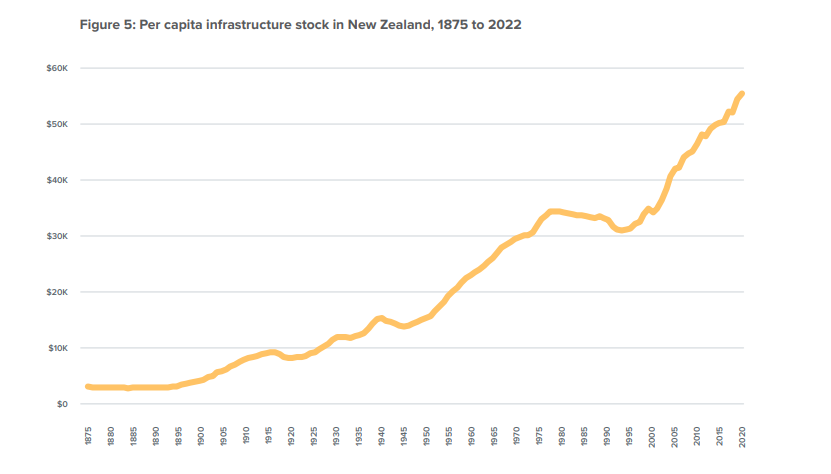
But that brings both the good and the bad. Pushing up the value of infrastructure steadily over many decades means some of it is bound to need to be replaced.
“Over the last few decades, for every $10 of new or improved infrastructure we built, around $6 of existing infrastructure became worn out or reached the end of its usable life,” the report reads.
“This suggests that in the long term, almost 60% of investment is needed to renew and replace existing infrastructure.”
In issuing proposals to deal with these multiple challenges, the commission’s document has several ideas. It says there should be clear forecasts of future needs, independent reviews of unfunded proposals to give decision makers a “high quality menu”, and advice on how to take better care of existing assets. There should also be work on reducing the costs of projects as well as a steady build-up of a workforce and leadership capacity to handle projects efficiently.
The Commission stresses it does not have a monopoly of good ideas and so wants feedback from the public on these matters.
This latest document has a rich context. In 2022, the Commission published New Zealand’s first Infrastructure Strategy, and has been asked by the Government to lead the development of that plan. In addition, the National Party’s coalition agreement with New Zealand First gave emphasis to infrastructure, with 13 roads of national significance to be built. The agreement with Act also stressed infrastructure though much of it was focused on cutting costs and red tape.
In addition, the Government is re-organising the delivery of infrastructure, setting up a National Infrastructure Agency, as required by its coalition deal with NZ First. The Infrastructure Commission will separately give the Government high level advice, and another agency, Rau Paenga, will give lower-level assistance. The Government has also made plain it expects there will be plenty of private sector finance involved in these developments.
We welcome your comments below. If you are not already registered, please register to comment
Remember we welcome robust, respectful and insightful debate. We don't welcome abusive or defamatory comments and will de-register those repeatedly making such comments. Our current comment policy is here.