
By Gary Blick, Chao Li, and James Stewart*
How much difference could Auckland’s planning rules make to housing supply? Auckland Council's proposed changes to Plan Change 120 are focused on enabling more homes near larger centres and public transport stations and routes. Using the Auckland Housing Supply Model, this paper examines how these changes could affect the number and location of new homes, and what this could mean for house prices and productivity.
A revised proposal
The revised proposal would amend the Auckland Unitary Plan (the operative plan) by enabling housing capacity in places with good access to transport, jobs and services. These include locations around the city centre, metropolitan centres, town centres, rapid transit stations, and frequent transit routes within 10 km of the city centre. In other areas, the additional housing capacity proposed when Plan Change 120 was notified in November 2025 has been removed.
How might the market respond?
Planning rules determine where and how intensively housing can be built. More enabling rules create development opportunities, often referred to as housing capacity. By allowing more intensive development on some sites, planning rules can make redevelopment more commercially feasible.
However, housing capacity and housing supply are not the same thing. Whether these opportunities result in new homes depends on market conditions, such as demand for housing, as well as existing land use and the willingness of landowners to redevelop.
Experience since the Auckland Unitary Plan became operative in 2016 provides evidence of how housing supply responds to more enabling planning rules. Research finds that housing supply increased, with more homes being consented than would otherwise have occurred, after accounting for other factors that influence housing development.
This evidence provides a foundation for forecasting the effects of further planning rule changes. Drawing on observed relationships between planning rules, housing demand and development, the Auckland Housing Supply Model estimates how the revised proposal could influence the number and location of new homes over the next decade.
More homes in different places
The model indicates that the revised proposal would increase housing supply relative to the operative plan, with a greater share of new homes in higher-demand, well-connected locations.
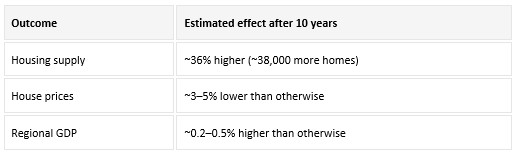
The revised proposal is forecast to result in 143,000 new homes over 10 years, compared with 105,000 under the operative plan (Figure 1). This would represent an increase of 36%, equivalent to around 38,000 additional homes over a decade.
Figure 1: Forecast new homes over 10 years
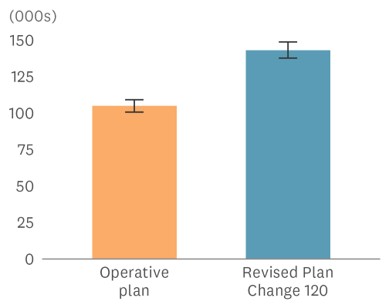
Notes: Error bars indicate forecast ranges: operative plan 101,000–109,000 homes; revised proposal 138,000–149,000. This equates to around 29,000–48,000 additional homes over 10 years, or a 27–48% increase in housing supply relative to the operative plan. Dwelling estimates are derived from forecast residential floorspace.
Source: Auckland Council Chief Economist Unit
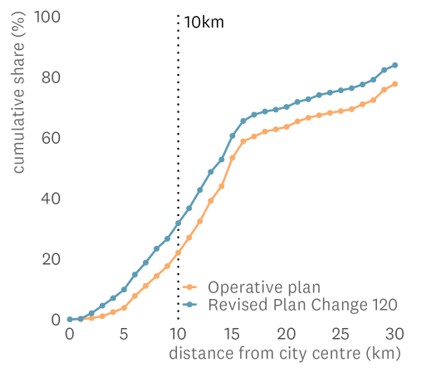
Development is also forecast to be more spatially concentrated. Around 32% of new homes are forecast to be built within 10 kilometres of the city centre under the revised proposal, compared with 22% under the operative plan (Figure 2).
Figure 2: Distribution of forecast new homes by distance
Source: Auckland Council Chief Economist Unit
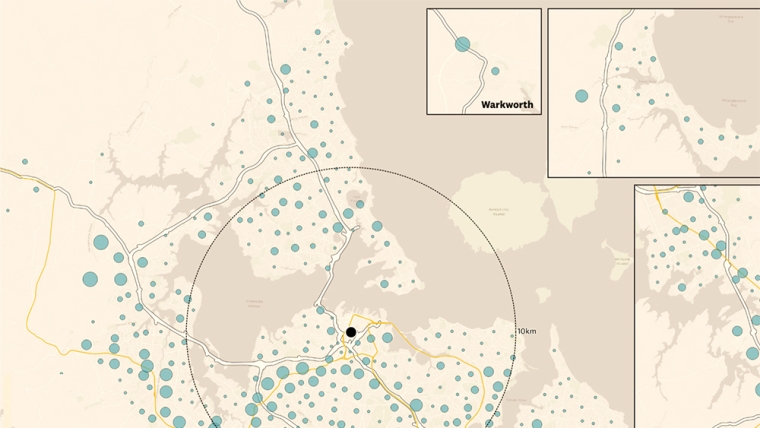
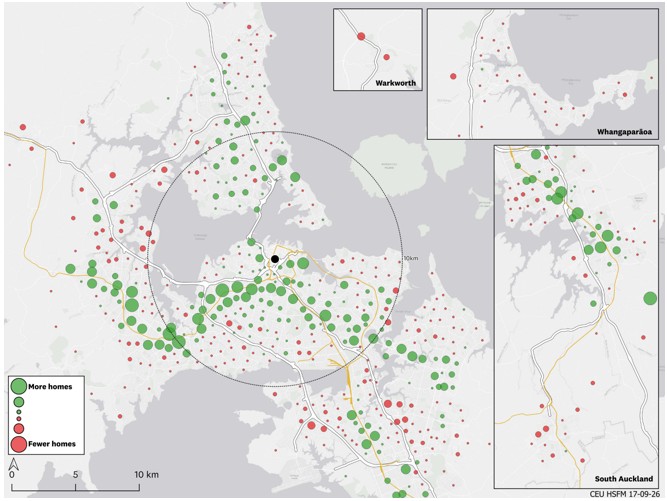
Additional housing is forecast across the urban area over the next decade, with larger increases around centres and public transport stations and routes. Figures 3 and 4 show the distribution of forecast new homes and where the revised proposal is expected to have the greatest effect relative to the operative plan.
Why might more homes be built?
Demand for housing arises not only from population growth but also from within the existing population. A period of housing shortages and high prices can lead to more people sharing accommodation, delaying household formation or living further from jobs and services than they would prefer. Planning rules influence the extent to which this demand can be met.
More enabling rules can make development feasible on more sites by allowing more homes to be built where demand is strong. Redevelopment costs can be spread across more homes, making more projects financially worthwhile. Creating more development opportunities can also increase competition among landowners, reducing upward pressure on the value of those opportunities and helping housing supply respond more readily to demand.
These mechanisms help explain why Auckland experienced a strong increase in housing supply following the Auckland Unitary Plan. They also help explain why supply is forecast to increase under the revised proposal relative to the operative plan.
Figure 3: Forecast average annual new homes under the revised proposal
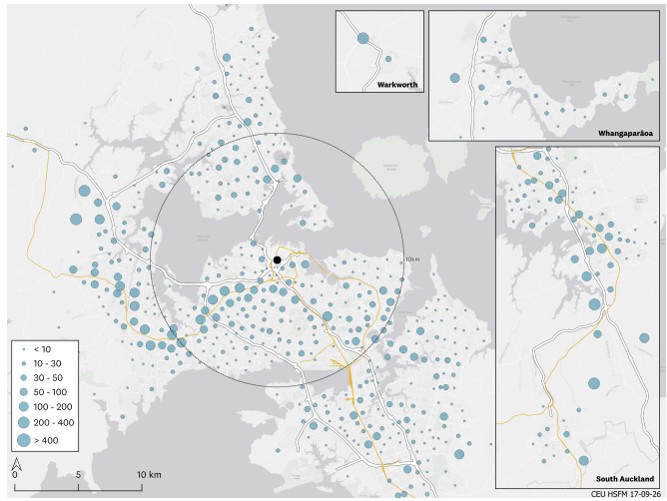
Figure 4: Forecast change in new homes under the revised proposal relative to the operative plan
House prices and productivity outcomes
Auckland house prices remain high relative to incomes. When housing supply is constrained and slow to respond to demand, competition for existing homes tends to place upward pressure on prices.
The revised proposal is forecast to increase housing supply relative to the operative plan, reducing upward pressure on house prices. The scale of the effect is uncertain but future house prices could be around 3–5% lower than they would otherwise be. This does not necessarily mean house prices would fall in absolute terms.
The location of housing can be just as important as the number of homes built. Higher-density housing in accessible locations can improve access to services and employment, support better matching between workers and jobs, and make more efficient use of existing infrastructure. These effects have the potential to improve Auckland's productivity.
Annual regional GDP within ten years is estimated to be around 0.2–0.5% higher under the revised proposal relative to the operative plan. It reflects productivity gains as the economy becomes better connected. Table 1 summarises the estimated outcomes.
Table 1: Outcomes relative to the operative plan
Note: A 0.2–0.5% increase in Auckland’s annual GDP equates to approximately $400–800 million per year in today's prices.
Source: Auckland Council Chief Economist Unit
Broader considerations
Market outcomes such as housing supply, house prices and productivity are important, but urban planning decisions also involve other considerations. Communities also place value on other urban and natural amenity outcomes. The market outcomes examined in this paper represent one part of the broader trade-offs involved in planning decisions.
When more homes become possible
More enabling planning rules can allow housing supply to respond more readily to demand. While the magnitude of the response remains uncertain, the direction of the effect is clearer: housing supply is expected to be higher under the revised proposal than under the operative plan, with more of that growth occurring in accessible locations. This could reduce upward pressure on house prices and support productivity by enabling more people to live closer to jobs, services and public transport.
* Gary Blick is the Chief Economist at Auckland Council. Chao Li, Senior Econometrician, James Stewart, Economist. This article is here with permission. Find out more at Auckland Council Chief Economist webpage.
We welcome your comments below. If you are not already registered, please register to comment
Remember we welcome robust, respectful and insightful debate. We don't welcome abusive or defamatory comments and will de-register those repeatedly making such comments. Our current comment policy is here.