
By Earl Bardsley*
Importing LNG has been advocated by the Government as a means for providing electricity security against dry winters. Not unexpectedly, a recent poll showed a preference for using renewables instead.
However, the mechanism by which renewables could provide dry winter security needs to be considered.
A popular idea is to have new solar generation playing the dominant role. That is, more solar power enables reduced hydro generation so hydro lakes start off winter at higher levels.
Additional solar power would help. However, there is a seasonality problem. Solar power output is highest in summer but so too are the South Island hydro lake levels.
This means that there will be situations when having more solar power in summer cannot be translated into significant additional stored hydro energy because lakes would spill.
In short, summer solar power is reliable in itself but there is no guarantee that summer hydro lake levels in any given year will be low enough so that energy can be stored as higher lake levels for winter use.
Lake Hawea
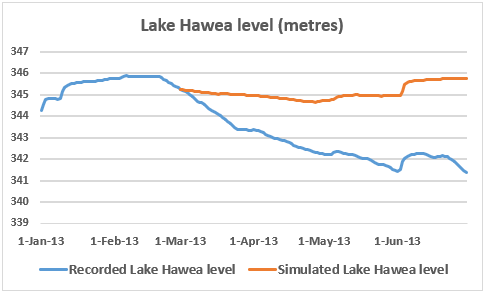
The water level record of Lake Hawea in the first half of the 2013 dry year gives an illustration of the solar/hydro seasonality issue.
This Otago lake is the main hydro storage for Contact Energy. It allows controlled water release to Contact’s Clyde and Roxburgh power stations on the Clutha River.
The lake is operated within the consented water level range of 338 and 346 metres asl. There is also a minimum required outflow rate so that the Hawea River flow does not go below 10 cubic metres per second.
Lake Hawea’s water level was at 344.3 metres at the start of 2013. It then rose to almost the 346-metre upper level and remained near that level until late February.
If solar power had been available, any solar-induced additional water storage before February would have been lost as lake spill.
The evident declining water level trend to the end of June would give opportunity for energy storage in the lake by releasing water at a reduced rate. The upper line in the figure shows what the Lake Hawea water level would have been if the lake outflow rate had been fixed at 40 cubic metres per second from the start of March.
The lake would have ended up 97% full at the start of July, as opposed the 41% that happened in reality.
The power requirement here is the need for about 50 MW from another source over the four months of March to June. This represents the reduced electricity output for this period at the Clyde and Roxburgh stations because less water is released from Lake Hawea.
The value of offshore wind
Lake Hawea is only about 8% of New Zealand’s hydro storage capacity. Carrying out concurrent decreases in lake outflows over all the main hydro lakes is likely to require additional autumn and early winter power generation greater than 1000 MW.
As mentioned, new solar can contribute here but has seasonal drawbacks.
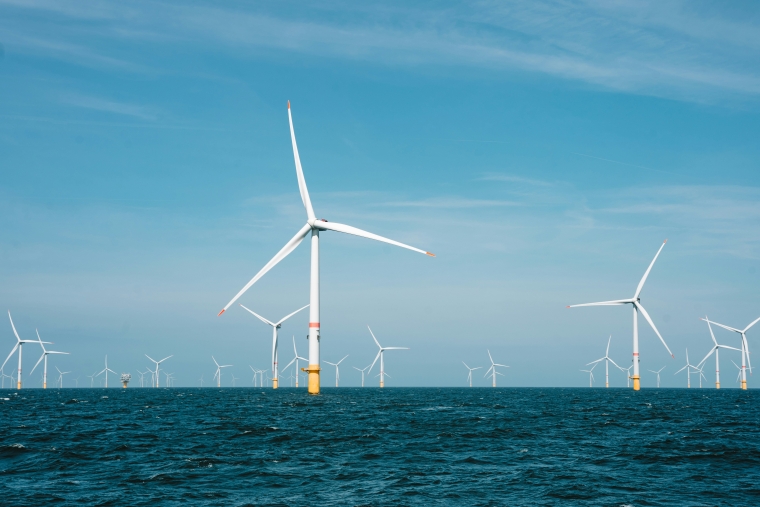
The needed additional generation could come from a fast mega-build of wind farms offshore from Taranaki and Waikato, with installed capacity of some 2000 MW.
When deciding to import LNG for dry winter security, election results permitting, the Government gave up on its previous free market approach of not picking energy winners.
Instead, it could happen now that the considerable costs associated with LNG importing will be funded entirely by the taxpayer. Constructing the LNG import facility would even be given its own enabling legislation to bypass possible delays in the fast track process.
In contrast, the Government’s treatment to date of offshore wind proposals has not been helpful. No subsidies have been offered, the necessary regulations have only now been set up, and some offshore wind developers have departed the country in the face of a government-favoured alternative of an eventually rejected offshore sand mining operation in the South Taranaki Bight.
Unfortunately, these delays mean that there would be a few years of waiting time before large-scale offshore wind farms are operational. In the meantime, precautionary burning of fossil fuels to ward off dry winters might be implemented.
The waiting time to mega-wind should therefore be kept as short as possible for multiple reasons.
Given that the Coalition Government was willing to provide enabling legislation and subsidies for LNG, would a new government consider the same for offshore wind projects?
Acknowledgement: Lake Hawea hydrological data was provided by Contact Energy.
*Earl Bardsley is a Research Associate at the University of Waikato's School of Science Teaching and Research.
We welcome your comments below. If you are not already registered, please register to comment
Remember we welcome robust, respectful and insightful debate. We don't welcome abusive or defamatory comments and will de-register those repeatedly making such comments. Our current comment policy is here.