
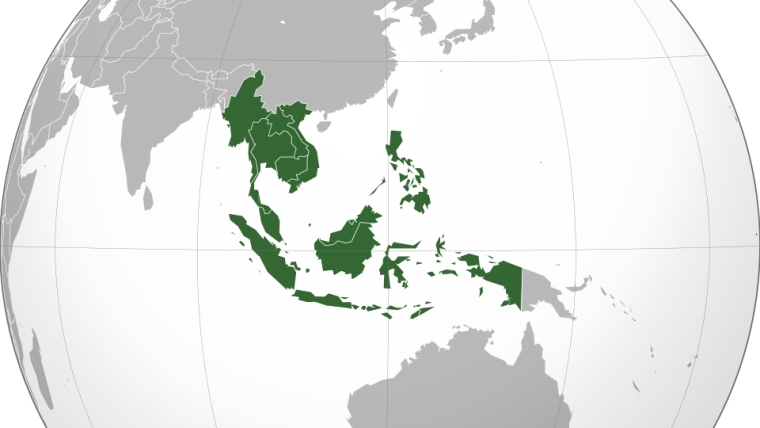
When Southeast Asia’s leaders link arms for their customary family photo at the Association of Southeast Asian Nations Summit in Manila on November 16–18, the show of unity will belie the fact that, on the eve of the organization’s 60th anniversary, the group is more divided and less effective than ever. Amid a fracturing global order, ASEAN has a choice: turn its convening authority into concerted action or be reduced to an arena for great-power rivalry.
The fault lines are numerous. Indonesia’s wildfire haze has choked Singapore and Malaysia in recent months. Thailand and Cambodia fought border skirmishes that came close to outright war last year. Myanmar is led by a putschist-turned-president who wants his seat back at the leaders’ table. And the Philippines, the summit’s host, is locked in a standoff with China that most of its neighbors would rather avoid.
And yet Southeast Asia needs ASEAN more than ever because it gives member countries visibility and a voice on the global stage.
To be sure, ASEAN is not in danger of collapse. The risk is subtler. Each fissure exposes an institutional shortcoming. On Myanmar, it is enforcement: Min Aung Hlaing, the general who ousted and detained the democratic leader Aung San Suu Kyi in February 2021, signed ASEAN’s Five-Point Consensus in April of that year, only to disregard it. The group responded by barring the junta leader from attending ASEAN summits.
But after winning Myanmar’s military-organized elections—with voting confined to junta-controlled areas, excluding large swaths of the country—in December and January, Min Aung Hlaing swapped his general’s uniform for civilian garb in April. Hard-headed realpolitik compelled China and India to recognize him, while half of ASEAN members, led by Thailand, have also now officially received him, amounting to de facto normalization.
Likewise, the Thai-Cambodian conflict has exposed the limits of ASEAN’s much-touted capacity to sustain peace. Fighting in July 2025 killed dozens and displaced some 300,000 people. The first ceasefire came after US President Donald Trump threatened tariffs, leading to the “truce for trade” accord signed in October 2025. But it unraveled only a couple months later, with border clashes uprooting many more people. Without pressure from the United States, ASEAN could not end the fighting on its own. Both sides are now using the “compulsory conciliation” process under the United Nations Convention on the Law of the Sea to resolve their bilateral conflict.
Meanwhile, tensions in the South China Sea reveal the absence of common external positions in ASEAN. China exploits member states’ differing views of it to pursue its maritime claims, leaving the Philippines exposed, particularly given America’s unpredictability under Trump. The Philippines wants to complete a long-promised code of conduct for the South China Sea at this month’s summit. But even if the code is finalized, a text without teeth will not do much to stop China’s incursions.
Indonesian peatland fires have exposed the most telling rift, because great powers play no part in it. The haze closed schools in Malaysia and resulted in Singapore’s longest period of toxic air since 2015, triggering consumer boycotts, ministerial barbs, and a reduction in Indonesia’s pipeline gas exports to Singapore.
But Indonesia alone cannot address the problem. The ASEAN Agreement on Transboundary Haze Pollution has been in force since 2003, yet its 2020 target for a smoke-free region was pushed back to 2030. Singapore has issued notices to ten locally-based companies over their links to the fires causing the current haze. A treaty that fails to reach those boardrooms will do little to protect the region’s people from hazardous smoke.
These fault lines matter more than ever because the US-China contest has turned coercive, with tariffs, export controls, critical minerals, and supply chains wielded as weapons, at the same time as the multilateralism that once cushioned smaller countries is being eroded. Here ASEAN’s value as a buffer, bridge, and broker is easily overlooked. Despite lacking a unified foreign policy and a joint military, ASEAN serves as a single interlocutor representing nearly 700 million people and some $4 trillion in output. It also brings together the US, China, Russia, Japan, India, and others at its East Asia Summit and related forums.
While leaders call for like-minded countries to form coalitions of the willing amid a “rupture” in the global order, ASEAN member states have already started hedging: Indonesia is now a full member of BRICS, while Malaysia, Thailand, and Vietnam are partner countries. But these countries need an anchor at home, lest diversification turns into fragmentation. The task now is to demonstrate ASEAN’s centrality.
Singapore’s 2027 chairmanship offers an opening for several major reforms. ASEAN should hold fewer summits, with one leaders’ meeting per year and ministers held responsible for delivery. The group also should hire a secretary-general based on merit and for shorter, performance-dependent contracts, rather than appointing someone for a five-year term, based on alphabetical rotation. And flexible participation should be the norm, extending the “ASEAN Minus X” formula used for economic integration to coalitions of the willing on issues such as maritime security, haze enforcement, and scam centers. ASEAN would also benefit from empowering past, present, and incoming chairs to mediate conflicts, advance existing agreements, and launch new initiatives.
Lastly, Myanmar’s return to the leaders’ summit should be tied to measurable benchmarks, such as an end to air strikes on civilians, humanitarian access, the release of political prisoners including Aung San Suu Kyi, and an envoy acceptable to all sides.
The aim is not to turn ASEAN into a supranational authority or geopolitical bloc, but to recover the founding aspiration of 1967, when five wary neighbors judged their quarrels less dangerous than facing outside pressure alone. Their number has since grown to 11, and member states must remember that endurance does not amount to agency; the choice now is between strengthening their partnership or being picked apart one by one.
*Thitinan Pongsudhirak, a professor at Chulalongkorn University’s Faculty of Political Science, is a senior fellow at its Institute of Security and International Studies. Project Syndicate, (c) 2026, published here with permission.
We welcome your comments below. If you are not already registered, please register to comment
Remember we welcome robust, respectful and insightful debate. We don't welcome abusive or defamatory comments and will de-register those repeatedly making such comments. Our current comment policy is here.