
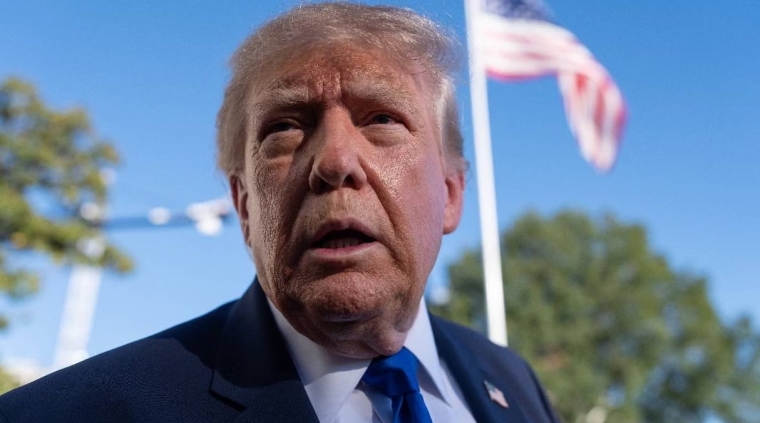
Like many authoritarians, US President Donald Trump cannot stand it when the spotlight is on anyone other than him. So, before this month’s midterm elections, he instructed voters to pretend it was him on the ballot. And that is what they did, though the result was not what Trump expected: Americans voted in record numbers—the second-highest turnout for a midterm election since 1914—to reject Trump’s Republican Party.
The results amounted to a sharp rebuke of Trump’s ruinous economic policies, blatant corruption, use of taxpayer dollars for vanity projects, disastrous war against Iran, devastation of American science and research, vicious immigration crackdown, and more. Though Trump scrambled to save face—“If I was [on the ballot],” he bellowed, “we would have won IN A LANDSLIDE!”—he is furious. And he is about to take it out on everyone else.
When autocrats suffer a defeat, they usually double down, intensifying repression at home or behaving more recklessly abroad. They want to prove the doubters wrong and create a lasting place for themselves in history, no matter the cost. When authoritarians “gamble for resurrection,” they usually lose. Nonetheless, this is the road Trump appears to be taking.
Every authoritarian regime has at its heart an ideological agenda, which it advances through personnel and policy decisions. For the Trump administration, the central aspiration is to convert the world’s largest multifaith, multiracial democracy into an autocratic ethnostate dominated by white Christian men.
Trump’s second administration has imposed an extreme immigration crackdown, characterized by violence, mass detentions, and deportations. Meanwhile, officials have systematically demoted, reassigned, or dismissed civil servants who lacked the “right” loyalties, skin color, gender, or race.
These purges have been particularly visible in the military under Secretary of Defense Pete Hegseth, the white Christian extremist who misquotes the Bible while firing and removing from promotion lists Black and female officers. As a former Fox News on-air host, the self-professed secretary of war is particularly concerned with the optics of power: “Diversity is not our strength. Unity is our strength,” he told military leaders at Quantico last year while touting his testosterone-testing policy.
As it turns out, however, US voters are not on board with the Trump administration’s population-engineering scheme. Throughout the country—including in states with long histories of slavery and race-based disenfranchisement—Americans voted in new leaders who reflect the nation’s diversity.
In Texas, where the Republican Party refused to recognize President Joe Biden’s 2021 electoral victory, a Latina Democrat, Gina Hinojosa, will now be governor, and Democrats will hold other key offices, including lieutenant governor and attorney general. In Georgia, Black Democratic women will now hold seven of eight state leadership roles, including governor, secretary of state, and attorney general. Mississippi elected its first Black senator since 1881, Michigan elected America’s first Muslim senator, and New Mexico voted in the country’s first Native American woman governor. Native American women will also represent Alaska and Minnesota in the US Senate.
True to authoritarian form, Trump responded by promoting Stephen Miller—his administration’s most zealous white nationalist—to White House chief of staff. The architect of the Trump administration’s population-engineering scheme, who considers the Democratic Party a “domestic extremist organization,” Miller will almost certainly move to scale up the immigration crackdown while advocating yet more draconian measures in all areas of public life.
Dangerous times lie ahead on the foreign-policy front as well. I have argued since March 2025 that solving Russian President Vladimir Putin’s problems would be a high priority of Trump’s second administration. US representatives, including Trump’s son-in-law Jared Kushner, have regularly parroted talking points designed to normalize Russia’s destruction of Ukraine. As former senior US diplomat Bruce Berton recently observed, Putin’s wish list has become America’s negotiating position.
The Trump administration’s collaboration with the Kremlin will only grow more flagrant, owing to Trump’s political weakness. Trump might have lost the affection of most Americans, but he can still prove useful to America’s enemies. Like vultures circling their prey, the Russians are losing no time in making sure that the lame duck fulfills his duties.
Russia’s capture of the White House became evident just two days after the midterms, when First Lady Melania Trump held an event that ostensibly celebrated progress toward a ceasefire in the Ukrainian city of Oleshky. The Kremlin has no interest in ceasefires in Ukraine, yet there stood Kirill Dmitriev—Putin’s special envoy and a leading kleptocrat as head of Russia’s US-sanctioned sovereign-wealth fund—behind a podium adorned with a US presidential seal and flanked by American flags to address his fellow guests.
Then there is Iran. The war Trump started there was a key reason why voters turned against him. But recent comments by Secretary of State Marco Rubio suggest that the Trump administration is doubling down here, too. Iran has been “waging war on the United States since 1979,” Rubio told the Federalist Society last week, and while the war is “unpopular,” ensuring that Iran “never [acquires] a nuclear weapon” is essential.
Rubio went on to express sympathy for North Korean dictator Kim Jong-un, saying that, unlike Iran’s leaders, he is no “expansionist.” (Rubio conveniently neglected to mention North Korea’s deployment of thousands of troops to help Russia in Ukraine.)
The US Rubio describes, however, is fundamentally expansionist: “America has always and, I believe, will always be a nation of irrepressible ambition,” which extends “far beyond our borders.” Moreover, the international legal order that might rein in America’s irrepressible ambition is deserving of scorn. “We are told that our determination to act in our own interests, on our own terms, is an assault on the universal, quote-unquote, ‘rules-based order’.”
A decade ago, when I warned that Trump was preparing to use an authoritarian playbook that dated back to fascism, I cautioned the GOP against helping him, pointing out that the conservative party that backed Benito Mussolini’s rise in Italy “never recovered.” Now, the Republicans who backed Trump are facing two years with an unpopular president who feels he has nothing to lose—and appears poised to do as much damage as possible before January 20, 2029.
Ruth Ben-Ghiat, Professor of History and Italian Studies at New York University, is the author of Strongmen: Mussolini to the Present (W.W. Norton & Company, 2020). Copyright: Project Syndicate, 2026, published here with permission.
We welcome your comments below. If you are not already registered, please register to comment
Remember we welcome robust, respectful and insightful debate. We don't welcome abusive or defamatory comments and will de-register those repeatedly making such comments. Our current comment policy is here.