
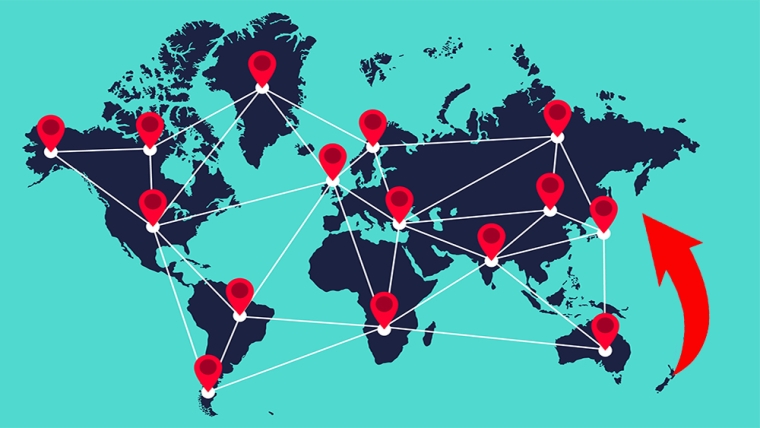
A closer look at export destinations for beef and lamb reveals how diverse the markets are. From the United States, China, the UK and EU at the top of the list to American Samoa, Suriname, Palau, Micronesia and the Solomon Islands at the bottom, our exporters sell lamb to 99 countries and beef to 84 different markets.
It is obviously not cost-effective for exporters to visit every country on the list, with the smallest markets being covered by agents, traders or importers. Most major exporting companies have their own parent company relationships, importers and sales offices in market, such as the Silver Fern Farms, Alliance and ANZCO owned Lamb Company, now Greenstone Meats, in Canada and the USA, Silver Fern Farms in China, ANZCO in Japan, and Alliance in the UK and most recently in Ireland.
Conversely other exporters, notably AFFCO, have chosen an alternative route to market, preferring not to set up costly overseas offices. AFFCO’s strategy of adopting a low overhead approach while maintaining close contact with its customers appears to have been very successful. The inconsistent profit performance of Alliance and SFF in particular means the jury is still out on a strategy which focuses on paying farmers a premium for individual carcase traits with the objective of attracting a higher end price.
The contrasting market prices for both beef and lamb prove the main variations arise because of the differing products preferred by individual markets. For example China which is the second largest market by tonnage pays the lowest average price for both beef and lamb, whereas the USA pays among the highest prices for them.
But what this proves conclusively is that both markets are indispensable to the overall fortunes of the red meat sector. Without either one of them, there would be a surplus of product, not all of which could be sold for its full value.
The meat industry may be more complex than most others, given the infinite number of cuts and co-products, but it is no different from any other industry: anybody can command a good price for a premium product, but it’s how much is earned from the less sought-after cuts and co-products that determines the final profit from each carcase.
The perpetual volatility of global trade has been very obvious during and since the Covid pandemic, but especially during the last year with the imposition then withdrawal of tariffs, shipping problems because of the Iran war and terrorist activity. At least New Zealand, unlike Australia and Brazil, has not had to deal with one of its largest beef markets, China, imposing a 55% tariff on shipments for the last five months of the year because it has filled its quota.
The effect of this is not yet clear, although Australia may seek to send more product into the USA which could well apply downward pressure on the beef price. On a positive note, the UK has become a useful destination for beef since the FTA was signed and is now worth half as much as lamb exports to the UK, a situation completely inconceivable less than five years ago.
Also demonstrating how circumstances change in a relatively short period, 15 years ago China was taking very little beef, but has since grown to be our second biggest market, while lamb exports to China rose to number one by volume over a four year period during and after Covid. Other solid and growing markets contributing to the grand total include South East Asia and the Gulf States which are certain to benefit from the recently signed FTA.
Sheepmeat, mainly lamb, has shown no volume growth, but the value has risen markedly in the past year. The EU countries offer the best returns, but after some growth over 10 years, the volume shipped there has been flat for the last two years due to the difficult economic situation in Europe. The UK has also been flat for the same reason.
North America has recently been the bright spot, although the USTR’s investigation into lamb imports from New Zealand and Australia may result in a higher tariff being imposed which will hurt our exports.
The American love for hamburgers at a time of lower herd numbers has cushioned New Zealand from the imposition of tariffs which means the USA exceeds every other market for revenue and volume by a huge margin. Canada, the UK and North Asian markets are the next largest customers for our beef, although each has different characteristics and demands.
This large diversity between markets, coupled with satisfying customer needs, enables New Zealand’s red meat exporters to capture the best value possible from every head of livestock. This contrasts significantly with what may have been true 50 years ago when lamb was exported mainly frozen and in carcase form and beef exports were smaller, mainly because the dairy herd was nowhere near as big as it is today.
The removal of subsidies brought pain to the whole sector, but the end result is a more efficient and customer-focused industry.
We welcome your comments below. If you are not already registered, please register to comment
Remember we welcome robust, respectful and insightful debate. We don't welcome abusive or defamatory comments and will de-register those repeatedly making such comments. Our current comment policy is here.