
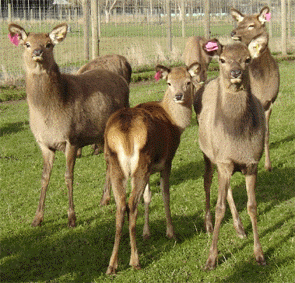
Deer Improvements genetic research farm is a valuable asset for the deer industry, as it's size and speciality allows it to push the boundaries, in improving the industrys genetics.
The "heavier and earlier"goal for yearling animals is an industry focus and if by breeding and management, fawns can be calved earlier there is more potential to reach heavier weights.
With premiums now paid for animals in the 50-85kg carcass range, and the industry average for young animals only in the late 50's, there is a big opportunity for extra revenue. A 10kg lift in carcass weight colud be worth $80/hd and make a large improvement in venison gross margins for deer farmers, and allow them to compete with dairy support which has encroached into its traditional finishing land.
Running a fully stocked farm is one challenge; tackling genetics and moving to a yield-based return is another. Five years ago Deer Improvement opened its research farm at Balfour, which is now fully stocked reports The Southland Times. It has facilities for semen collection and processing and embryo transfer work. It operates under strict biosecurity protocols that involve a quarantine block, an isolation block, doubled-fenced boundaries, vehicle wash-down bay, contract pest control and continous disease testing.
Deer Improvement general manager Bruce McGregor says the farm is "strong" and it has been the work on embryo transfer that is driving genetic gain and as a result, the 394ha farm is now fully stocked. Farm manager Des Ford said: " We are now fully stocked with 1300 hinds in the isolation block. We also have a couple of hundred two-year-old stags and 1100 weaners. "We have some spectacular stags and their sons are coming through even better than them."
Tarryn Walsh, who started work on the farm in March, provided Mr Ford with a "much-needed" pair of hands.Miss Walsh grew up in Southland at Mount Linton Station and completed her degree in agri-cultural science with honours at Lincoln University. A focus of Deer Improvement is to help deer farmers achieve killable weights more quickly andefficiently by removing any genetic barriers.
"We have now moved into yield and do a lot of work with the CT scanner at Invermay, and ultra scanning eye muscle to select for higher yielding animals."All first and second-calvers are naturally mated with stags joined before March 21. They are then pregnancy scanned and fetal aged to get conception date. "We are hopeful that venison meat processors will be paying for yield sooner rather later," Mr Ford said.
We welcome your comments below. If you are not already registered, please register to comment
Remember we welcome robust, respectful and insightful debate. We don't welcome abusive or defamatory comments and will de-register those repeatedly making such comments. Our current comment policy is here.