
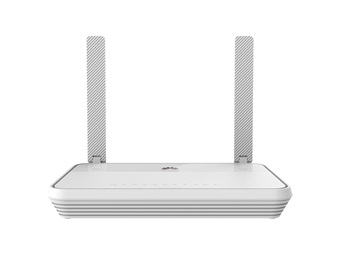
Here’s some cool network tech that popped up on the radar in a roundabout way: fibre to the room, or FTTR. The roundabout way was a presentation by Huawei at the recent New Zealand Network Operators Group (NZNOG) conference, which showed how to deploy FTTR in a neat and easy manner.
The long story short here is that Huawei and others have worked out how to extend the fibre to the premises (FTTP) network that your Internet provider offers, and make it reach inside your home or business.
This is the point where many in the audience reflexively go “nobody needs that!” but cool your jets: there will be a separate piece on dimensioning IT stuff and getting by with the minimum required; this is not the one, so please be patient.
OK, so why bother with FTTR? To understand that, take a look at this device:
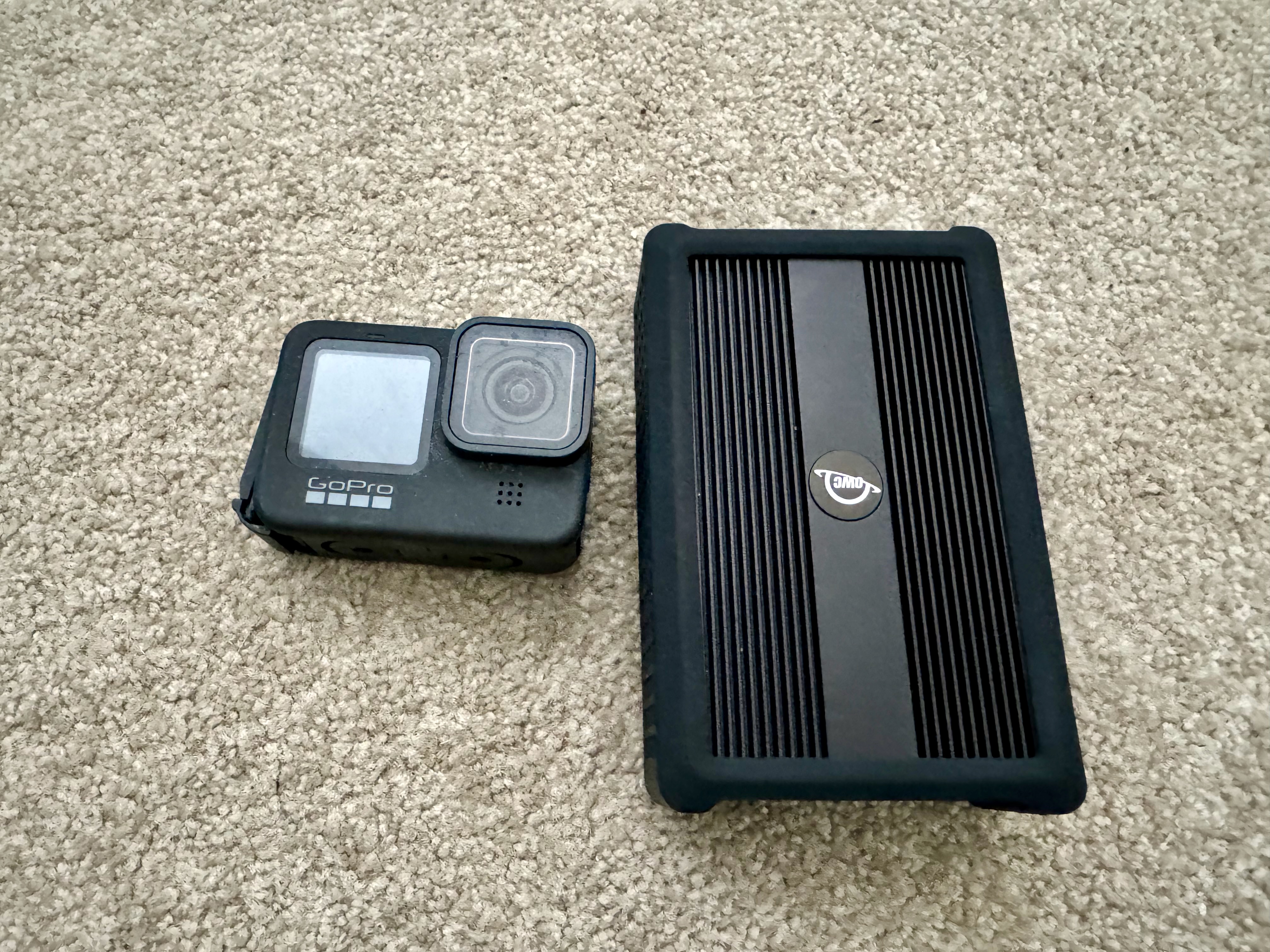
That’s the excellent Other World Computing 10 gigabit per second Ethernet adapter with a GoPro Hero 9 next to it for scale. The OWC 10GE brick gets you those fast network speeds to max out an Orcon 8/8 Gbps HyperFibre connection, but it’s quite a lump that totally harshes your laptop mobility mellow.
And of course, it needs a copper Ethernet cable, chunky category 6a or better. One issue with 10GE networking gear is that it uses more power than for example, gigabit equipment. The 10GE gear can run hot, and you don’t really want to use buzzing fans to cool it in a home or office environment.
It’s entirely doable to set up a wired 10GE network inside homes and business premises and lots of people do. The Ethernet cable reach is still a more than adequate 100 metres. Such a network will provide great performance to the machines you connect to it, and it’ll work better than a wireless mesh set up for Wi-Fi, where the signal transferring data to the router is subject to the usual hindrances like distance, wall and floor thickness, and so forth.
Retro-fitting premises that don’t have existing ducting or service conduits that are easily accessible means the brave sparky who accepts the wiring job will charge a lot for it as well because it’s likely to require a great deal of creativity so as not to look ugly.
We’re getting faster and faster Wi-Fi but wouldn’t it be great to bring that fast fibre-optic connection as close to the client devices as possible?
The good thing is that the above is not news to the networking and telecommunications industry, which is fully aware of people being adverse to cables snaking around everywhere. Ye olde International Telecommunication Union (ITU) released the g.fin standard for FTTR which gives vendors something to work with.
From a user’s perspective, you put in a fast Wi-Fi 7 access point and it connects to the world over fibre-optic data backhaul.
The result? Data-driven WfHers and colleagues will get a superbly consistent wireless multi–gigabit experience, along with always-on family members. They might even cease to throw their devices at you, The Involuntary Sysadmin, to protest the Wi-Fi not working well while Zooming. 8K streams in every room! One can always dream.
Here’s a Huawei promo video for its OptixStar system. What’s notable in the clip is the slimness of the transparent passive optical network (PON) cable, and that it’s bendable to a degree. Normally, you don’t bend fibre-optic cabling as this causes light signal losses.
The Huawei PON cable is heat-glued to skirting boards and where you route it along walls and corners, and it looks like a fair bit of toolkit is required. There are other systems in the works, including ones that have self-adhesive cabling so that customers can DIY the whole thing.
It’s also possible to get FTTR PON cabling that includes power wires, similar to current PoE copper cables. This lets you power devices connected to the end of the cable with no electricity plugs required for wall warts, which makes installation heaps easier.
Essentially, you’d be building a simplified PON with a master optical network terminal and slave ones in a residence or a small business site. While the installation of the Optix gear and cable doesn’t look too bad, we’ll see if Huawei gets back to us with some answers on how interoperable the FTTR PON is with other vendors so that you’re not locked into the Chinese telco giant’s on-premises equipment. Which of course Huawei wants everyone to buy.
Either way, this looks like Tidy Tech that’s unobtrusive, and which should work well with New Zealand’s fast UFB fibre optic connections, and help Internet providers deliver a consistently fast user broadband experience. China's already installing the tech in millions of premises, along with telcos in Europe and Latin America.
We welcome your comments below. If you are not already registered, please register to comment
Remember we welcome robust, respectful and insightful debate. We don't welcome abusive or defamatory comments and will de-register those repeatedly making such comments. Our current comment policy is here.