

Facebook parent Meta is not going down the proprietary software route with its artificial intelligence (AI) efforts, preferring instead to release the new Llama 3.1 large language models (LLMs) as open source.
This is unlike OpenAI, Microsoft, Anthropic, and Google, which is developing commercial AI products and services, on a subscription basis.
Founder of the Social Network and chief executive of Meta, Mark Zuckerberg, wrote a detailed blog post on the launch of the new Llama models, drawing parallels with Linux which is also open source, and which has created a huge eco system, ranging from personal devices to the cloud.
Zuckerberg took a dig at Apple: "One of my formative experiences has been to building our services constrained what Apple will let us build on their platforms," he said.
The background here is that Apple is gearing up towards products and services with AI in earnest this year. One way to compete against Apple and other companies like AI is release what you have as free and open source.
Back to the new models: three versions are available of Llama 3.1: one with 8 billion parameters, another one with 70 billion, and the big dog with 405 billion. The context length has also been bumped up to 128,000, and the models are said to have stronger reasoning capabilities.
Parameters are the numerical values the model learns during training; the more you have, the more complex responses are possible. Here's Llama 3.1's explanation:
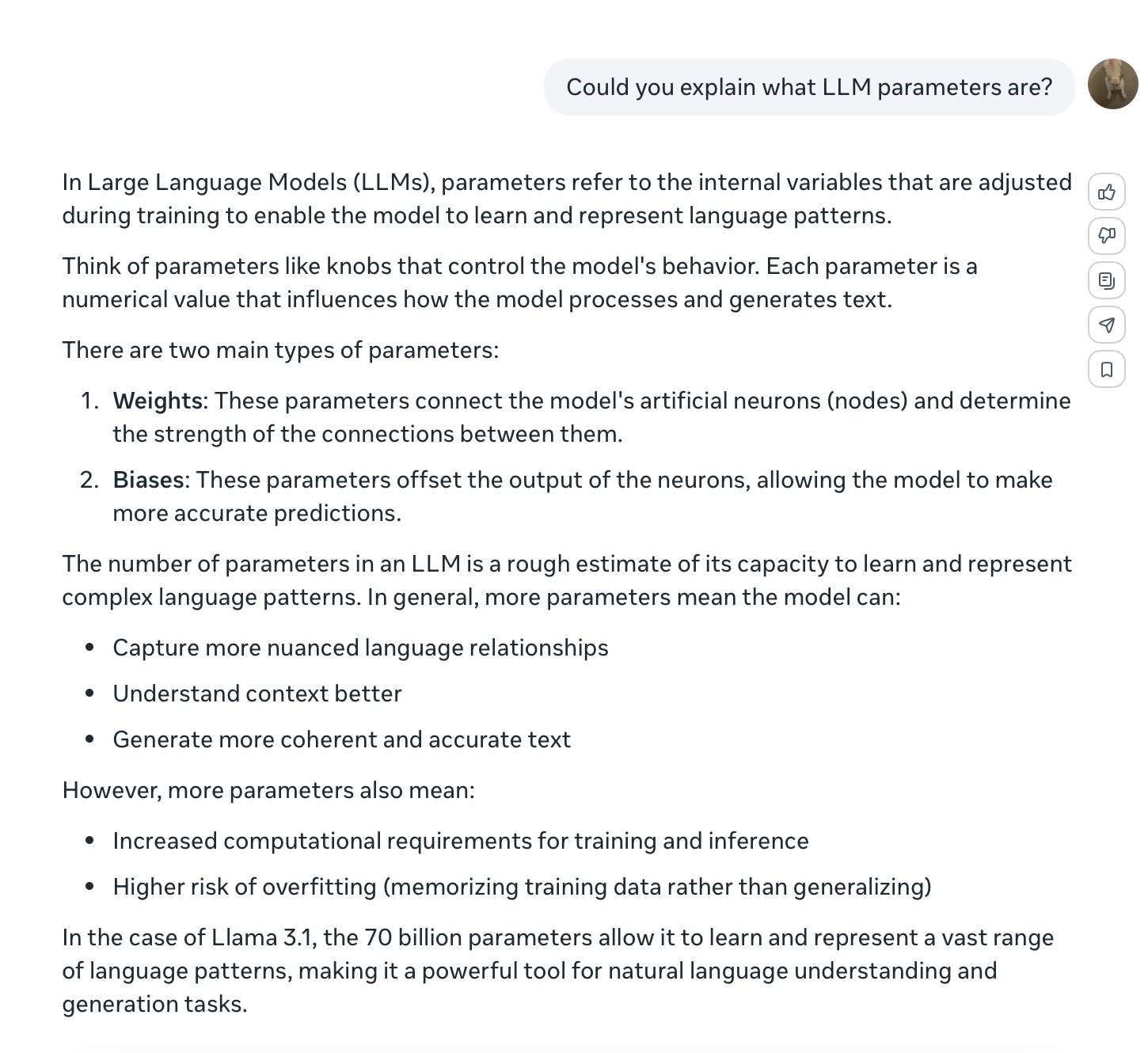
There is some argument as to how open source and free to use Llama is, but the models are multilingual and fairly fresh, with a training data cut-off date of December 2023. It appears to perform well against competing models too.
OpenAI, Microsoft and Google probably don't want to see this, but there are no strings attached to running Llama 3.1 as such.
That is, no monthly fees, and no restrictive licensing terms. Instead, Llama 3.1 is released under the permissive Apache 2.0 license, which allows for free use, modification, and distribution of the model. So yes, it is open-source in the truest sense of the word.
To get started with Llama 3.1, users can simply download the model and run it on their own machines. Use for example Ollama that lets you run multiple LLMs, accessing them from the command line in a terminal emulator.
In terms of hardware requirements, Llama 3.1 is surprisingly flexible. While it can take advantage of high-end graphics cards (which are well-suited for AI work) and large amounts of memory, it can also run on more modest hardware. This makes it accessible to a wide range of users, from researchers and developers to hobbyists and enthusiasts.
That doesn't apply for the chunky 405 billion parameter version of Llama 3.1 though. Running that locally would be extremely challenging, if not impossible, for most users. This model requires significant computational resources and memory, far beyond what most personal computers or even high-end workstations can provide.
A model of that size requires multiple high-end graphics cards with tens of gigabytes of memory each though, and a high-performance computing cluster or a cloud-based infrastructure. It also needs large amounts of storage like hundreds of terabytes for the model and the training data for it.
For most users, it's more practical to use cloud-based services like at meta.ai or access the model through application programming interfaces, which allow you to tap into the power of large language models without the need for local infrastructure.
There's the electricity required as well. If you want to read more on what it takes to train the models, including the time, power consumption and CO2 greenhouse gas emissions (in tonnes!), Meta's Github has you covered.
So, what can you do with Llama 3.1? That depends on how much of a Deep Geek you are. The Llama 3.1 model can be fine-tuned for a variety of applications, from chatbots and virtual assistants to content and image generation, and language translation. See Meta's use cases for more examples.
We welcome your comments below. If you are not already registered, please register to comment
Remember we welcome robust, respectful and insightful debate. We don't welcome abusive or defamatory comments and will de-register those repeatedly making such comments. Our current comment policy is here.