
All right, so the timing of this piece isn't the best, what with the nation being angsty about electricity prices going up again. We could segue into whether or not it was the Bradford Reforms causing the price hikes, but let's not. It upsets Max to have his name attached to them.
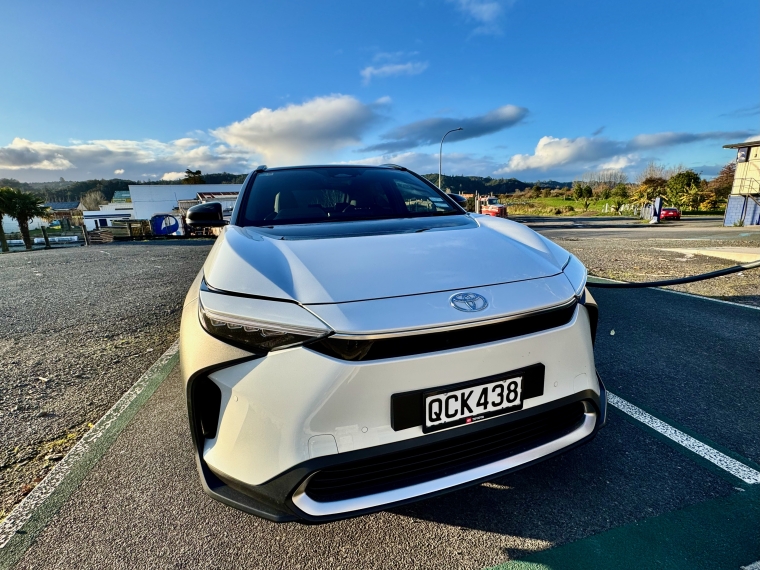
Anyway, Toyota had the fully electric bZ4X available for a test drive so ignoring the electricity issues, behind the steering wheel yours truly went, setting off in the white Motion spec vehicle that costs $83,990 with two-tone paint optioned.
This is Toyota's first fully electric car, with seven other models promised for 2026.
It's not a cheap car in other words but the pricier Motion variant is the one to go for instead of the lower-spec Pure version, which is about ten grand less.
The added $10k for the Motion buys all-wheel drive instead of front-wheel drive, with two 80 kilowatt motors driving each axle, instead of a single engine. Output goes up to 160 kW in the Motion vis-à-vis 150 kW in the Pure. Each motor produces 168 Newton metres of torque in the Motion; apparently you can't just double that figure, but it'll be more than the 266 Nm that the Pure has.
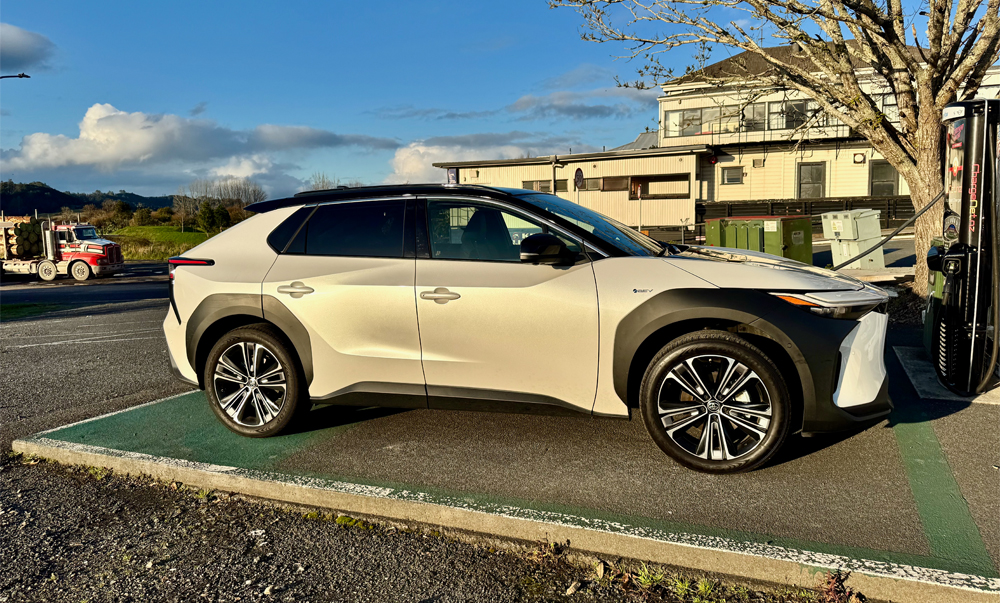
Motion also adds a panoramic roof, JBL audio (that sounds pretty good), the X-Mode settings with snow/dirt (reduces power to the wheels to minimise slippage) and deep snow/mud (increases power to the wheels to maintain momentum). Both cars have the full compliment of Toyota Safety Sense driver aids, including lane tracing, very good 360 degree plus front and rear cameras, traction control, self-parking (parallel and perpendicular), adaptive cruise control, pre-collision warning, wireless Apple CarPlay and Android Auto with Qi-pad charging, a big 12.3-inch multi-information display and this para is too long so I'd better start a new one.
Heatpump air conditioning, power tailgate, automatic headlights, wipers, foldable mirrors, big 20-inch wheels, a Level 2 charging cable, heated and ventilated front synthetic leather seats - although only the driver's slide-away one is power adjustable with memory, like in the Toyota Prius PHEV. Passengers have to yank levers instead.
That's quite a bit of tech and I may have left something out but honestly, it's a well-thought out set of features that you will use for daily driving. I know there are people out there who turn off the car automation, but why oh why do that? Things work better if you just accept the automation and let the car help with the driving. Bar one thing, see further down.
Cocooned inside
The interior is somewhat similar to the Prius, with a small-ish steering wheel that's adjustable for rake and tilt. As the wheel covers parts of the dashboard, just drop it down (the wheel, not the dashboard) and look over it (again, the wheel, not the dashboard).
A high middle console with piano gloss finish (it wasn't a finger print magnet) separates the driver from the passenger and it all looks lovely and modern. The ergonomics are better than in the Prius with physical buttons (which are much better than poking at a screen) clustered in the middle console and not below the steering wheel. They're easy to reach and to memorise their positions.
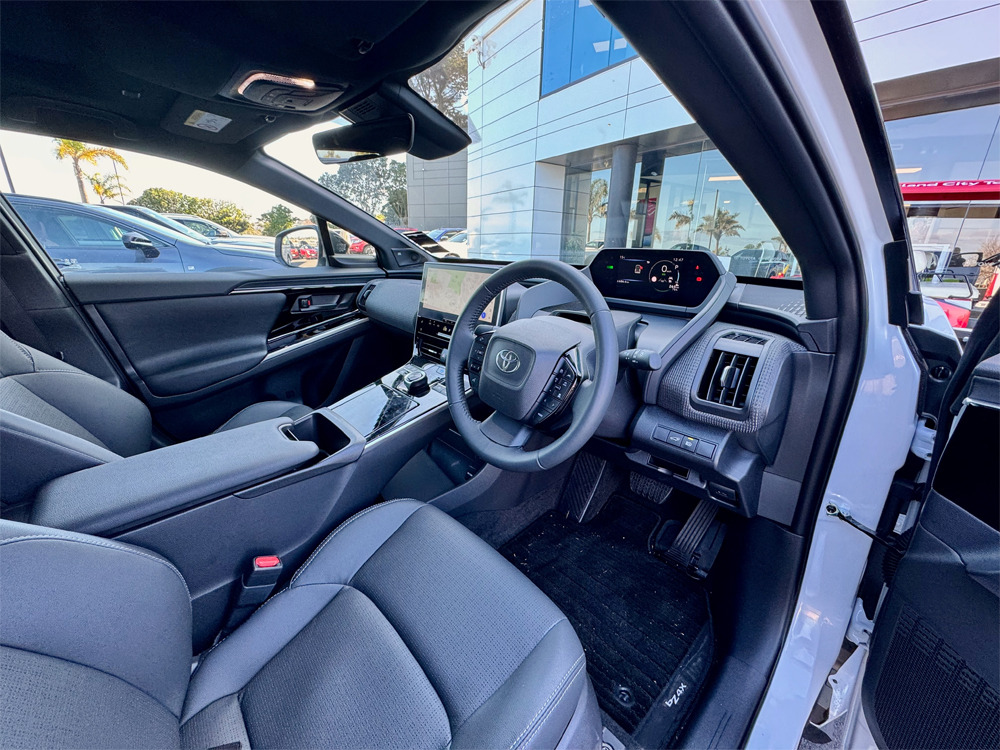
As a related aside, I noticed that while Toyota's infotainment screens keep the important buttons on the driver's side, Apple CarPlay is being an American cultural imperialist in its user interface design, which is clearly set up for travelling on the wrong side of the road.
Google Maps has the same annoying flaw. Apple and Google: please fix. Don't you know which side of the road we drive on here?
The front seats are great, particularly for longer journeys. Supportive and soft and if you use the ventilation, there's not much need to turn on the air-conditioning which, if activated, drops the indicated range by 10-20 km.
At the back there's plenty of room, but the rear seats are bit flat for taller people.
Plush with plenty of push
The Prius that I drove earlier was really rather nice, but EVs take the whole motoring experience up quite a few notches. On good pavement, the bZ4X is simply serene. It's built on similar underpinnings to the new RAV-4 so if you've tried one of those, the bZ4X will feel similar despite weighing about 250 kg more.
That EV "schuss" with torque from zero revs per minute is exhilarating, of course. However, it also makes it easier to drive smoothly. I'm a fan of EVs; the Motion bZ4X can do 0-100 km/h in 6.9 seconds but it feels quicker than that. AWD means no tyre squeal even with hard acceleration, and the car is nicely planted while cornering.
There's good visibility in the bZ4X as well, and with the cameras it's easy to place the car while driving and parking.
Toyota's suspension engineers have done a commendable job with the bZ4X and kept jiggle and roll both at minimal levels. Broken pavement and potholes didn't upset the car, and there was quite a bit of that on my 700 km or so drive through Te Tai Tokerau where heavy rains had been unkind to the roads. In those conditions you do get a bit of road noise from the 20-inch wheels, but nothing too bad.
This is a Sports Utility Vehicle, another incomprehensible American term that we should stop using, but it can do a bit of offroading.
However, because of the big wheels and street tyres with skinny sidewalls I didn't hit the gnarly logging roads up north. On returning the car, the Toyota rep seemed disappointed in my not having gone off the tarmac to get stuck in the muddy middle of nowhere without mobile phone reception. Apologies. Will do better next time.
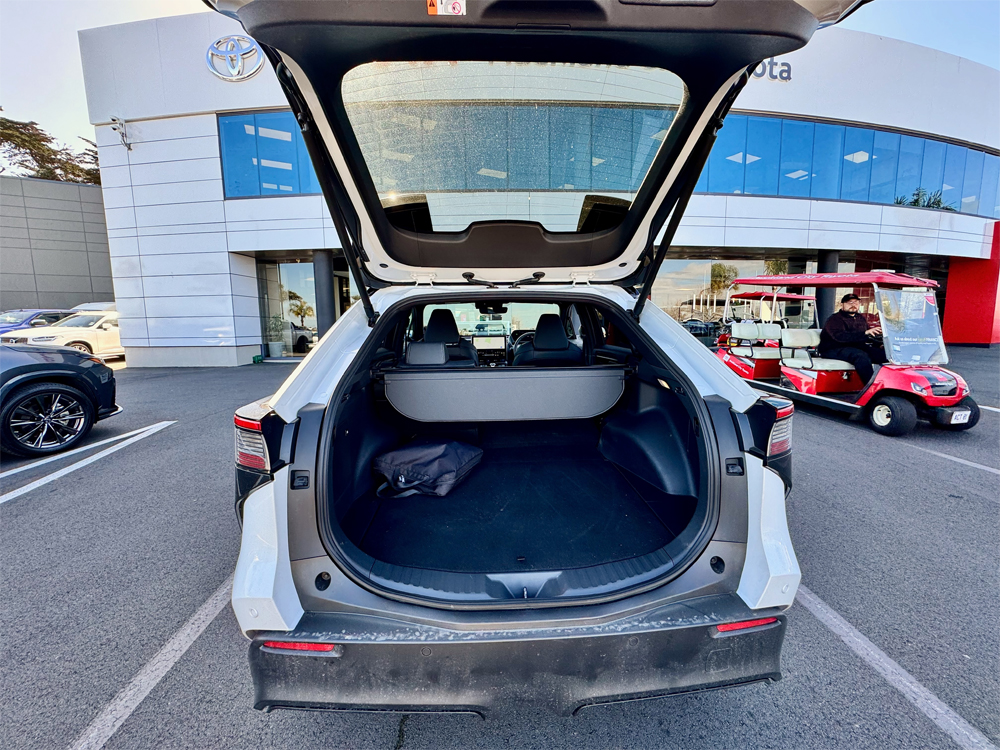
Towing capacity meanwhile is 750 kg with a braked trailer.
The bZ4v is a little longer than the RAV-4 at 4.69 metres versus 4.61, and the height is 1.65 metres and the width 1.86 metres; the RAV-4 is 1.69 metres tall and 1.865 metres wide. Why go on about the RAV-4? Well, apparently the bZ4X stands for Beyond Zero, the 4 refers to the RAV-4 form factor, and the X is for crossover. You can appreciate why Toyota abbreviated all that instead of spelling it out.
Anyway, the measurements above is a long-winded way to say the car's not exactly small, but works really well for Auckland driving. And parking, if you ignore the aggressive Auckland drivers who speed up while you position the bZ4X for self-parking jollies, their vehicles misting up on the inside with the steam coming out of the drivers' ears because of the 30-second delay you're causing.
A range of anxieties but not for lasting the distance
EV drivers can be a really sociable lot, and generally very pleasant to deal wth in my experience. Like Rahul, a true gentleman who operates five Mövenpick franchises, including the one in Paihia. I hadn't figured out that the bZ4X insists that you lock the car after you insert the cable too is locked in and charging can start. It's a safety feature, and Rahul gave me a hand working it out but not only that, he let me take over his charging session at ChargeNet's Kaiwaka station.
Which brings us to the range of the bZ4V which is given as 485 kilometres under the New European Driving Cycle (NEDC). In reality, the bZ4V showed an indicated 375 km on full charge. Not going beyond the recommended 80 per cent charge, you get around 300 km. Ample for most purposes, but neurotic old me would like longer range.
How far you can actually go depends on where you drive.
In Auckland, I bested Toyota's official 14.1 kWh/100 km figure and got 13.5 kWh/100 km indicated with a mix of city and motorway driving, on one trip.
Highways across Northland hills eat battery though, and you don't stop as often which meant I saw 18-21 kWh/100 km indicated. I ran the car with the regeneration maximisation active. It doesn't do one-pedal driving, but I like using it. Otherwise, keeping the air conditioning off as much a possible and the car set to help with the driving through adaptive cruise and lane keeping make a positive difference for the range, it appears.
The bZ4X seemed to "sleep" well, with whatever systems that were active while parked not using lots of energy.
I used ChargeNet's stations, namely the 50, 150 and 300 kW ones. The Motion has a high voltage 72.8 kWh battery setup, with 11 kW AC, and up to 150 kW DC charging with a Combined Charging System (CCS) type 1 plug.
At the high powered DC chargers, 150 kW and above, you're looking at at spending somewhere between 30 to 45 minutes to reach 80 per cent if the battery is low. The first 400 buyers of the bZ4X get a free Pulsar Mx wallbox for AC charging which gets you from 10 per cent to full battery per cent in 9 1/2 hours. It's valued at $2250 with installation on top, and you want one of those to make the most of the bZ4X.
As for AC charging from a regular 230 Volt outlet with the supplied 8 amp Level 2 charger cable, that'll take a while. It's useful to have as a backup, of course.
There are plenty of DC chargers around and with other players joining the fray, plus wallboxes, range anxiety is a thing of the past - and that's before National's firm promise of 10,000 more chargers materialises. What to do when you top up? Go for a walk and look around, or sit in the car and type away at a story and watch the world go by:
They're totally not deal breakers but...
No car is perfect. There are a few "arghs" in the bZ4X. The first one is the driver monitoring system which uses a camera in the steering wheel binnacle. As you face right at a roundabout trying to figure out where people who like to leave you guessing by not using their indicators are going, the car will flash "Driver inattention detected. Look forward" on the dashboard.
If you move your hands up on the wheel and accidentally cover the camera, you'll be told off because the driver isn't detected. Sit up! the car says. Do people drive lying down or something?
Anyway, this is a funky one, because on the one hand you can understand why it's a good safety measure to warn if drivers get distracted (ahem, smartphones); on the other, if you're warned too frequently, there's a possibility that you stop taking notice of the alerts, which defeats their purpose.
I'd want to turn off the driver monitoring for happy motoring in the bZ4X.
The 20-inch alloys look great, but I'm going to forever be *that* boring person who'll say smaller wheels are more sensible. Like the 18-inch wheels on the Pure bZ4X. They should make the ride quieter, and lower the car's energy consumption. Toyota's own figures suggests the Pure with 18-inch wheels goes 50 km further than the Motion with 20-inchers. Switching to 18-inch wheels on the Motion model won't extend the range quite that much thanks its AWD and dual-motor setup, but it should add 10-15 per cent which is not to be spat at.
If nothing else, it would let you use the air-conditioning more often without the range penalty, and be less neurotic about dinging the hoops. A rear windscreen wiper wouldn't go amiss either.
A great first BEV-fort from Toyota
While the price is on the high side the quality of the bZ4X is top notch. It's a Toyota, basically, and there's the company's luxe Lexus brand sitting above it, with BEVs that cost quite a bit more.
Service intervals are once a year or 15,000 km whichever comes first at $220 per visit, and unlike petrol/diesel/hybrid cars, there's much less maintenance work for an EV.
Warranty is three years, and the battery capacity guarantee is eight years, or 160,000 kilometres (whichever comes first again) by which time a minimum of 70 per cent should be left. Toyota also adds five years of round-the-clock AA Roadside Assistance that covers flat battery situations as well.
If it fits the budget, a bZ4X is that car which would work well for most drivers - particularly in town. It's very easy to live with, comfortable, fast, spacious and fully-featured. Turn off the driver monitoring, make sure there's a wallbox installed in the garage for off-peak charging, and you're set for pleasant, tailpipe emission-free driving for the next years.
It'll be interesting to see where Toyota takes the battery-powered car concept in the near future, particularly with lithium-iron phosphate (LiFePo) electricity storage.

We welcome your comments below. If you are not already registered, please register to comment
Remember we welcome robust, respectful and insightful debate. We don't welcome abusive or defamatory comments and will de-register those repeatedly making such comments. Our current comment policy is here.