
The tech news isn't all about artificial intelligence (AI), you'll be pleased to know. There's quantum computing as well to report on. That emerging field of computing isn't the easiest to understand, with quantum bits (qubits) not necessarily having either 0 or 1 values, but multiple states simultaneously.
Said phenomenon is known as superposition, and allows quantum computers to perform complex operations more efficiently than traditional computers. The qubits can also be interconnected through entanglement; long story short, quantum computers will one day be able to solve problems that are beyond traditional IT hardware currently.
That's the idea at least, because building working and practical quantum computers has been an elusive endeavour for goodness knows how many years now.
Not that it has stopped researchers and well-heeled companies from trying to construct quantum computers and the hardware needed for them. The promise of quantum computing is tremendous: a powerful quantum computer might be able to derive private digital keys from public ones, using Shor's algorithm.
That algorithm is named after Peter Shor, a mathematician. In 1994, Shor developed a method of efficiently factoring large numbers into primes, using quantum computers. Without going into too much headspinning detail, some commonly used cryptography relies on factoring big numbers being difficult for traditional computers.
One day when it becomes easy to factor large numbers, it's goodbye, Bitcoin, as quantum computers can be used for unauthorised access to funds secured with cryptography. That, and much much more.
First there needs to be a working quantum computer though, one that has the power required for crypto breaking and what have you. For that, many a qubit is needed. Microsoft is big on quantum computing, along with Google, IBM and a select number of tech companies.
It has now announced another breakthrough that will bring into reality quantum computers "capable of solving meaningful, industrial-scale problems in years, not decades." Well, that's what Microsoft expects at least.
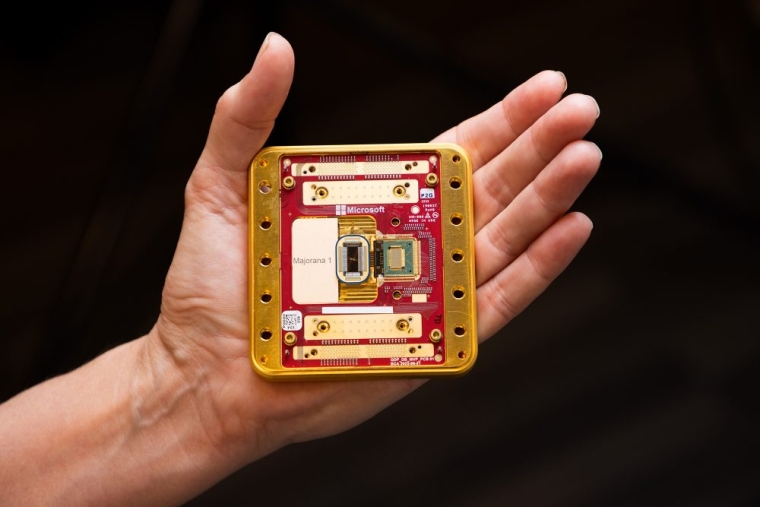
We're talking about the Majorana 1 quantum processing unit, which Microsoft chief executive Satya Nadella is very excited about. It's taken nearly 20 years apparently, but now a new class of materials called topoconductors can be used to create qubits.
Because topoconductors are small, relatively speaking, at 1/100th of a millimetre, Microsoft now reckons it's on the path to stuffing a million qubits into a processor. See above why that's meant to be a great advance.
Here's Microsoft scientist Krysta Svore with more details:
So... topoconductors? Nadella believes they're an entirely new state of matter, so not solid, liquid or gas. Scientists might have something to say about that, but here's how Microsoft's VP of quantum hardware Chetan Nayak defines it:
"This revolutionary class of materials enables us to create topological superconductivity, a new state of matter that previously existed only in theory. The advance stems from Microsoft’s innovations in the design and fabrication of gate-defined devices that combine indium arsenide (a semiconductor) and aluminium (a superconductor). When cooled to near absolute zero and tuned with magnetic fields, these devices form topological superconducting nanowires with Majorana Zero Modes (MZMs) at the wires’ ends."
Cooling quantum computers to near-absolute zero temperatures is required to stop disturbances like thermal energy interfering with quantum states. That's obviously not practical outside a research lab, and all the big players are trying to figure out how to build stable quantum computers that are usable at room temperature.
But wait, there's more: in 1937, Italian physicist Ettore Majorana came up with the notion of fermions that are their own anti-particles. Fermions are of course subatomic particles, named after famed physicist Enrico Fermi, who created the world's first artificial nuclear reactor.
We'll have to wait a few more years to see what comes out of the above research, but it is quite cool that Microsoft is so deeply into it. Maybe factoring big numbers will be a Shor thing fairly soon? All right, all right. I'll see my self out.
We welcome your comments below. If you are not already registered, please register to comment
Remember we welcome robust, respectful and insightful debate. We don't welcome abusive or defamatory comments and will de-register those repeatedly making such comments. Our current comment policy is here.