
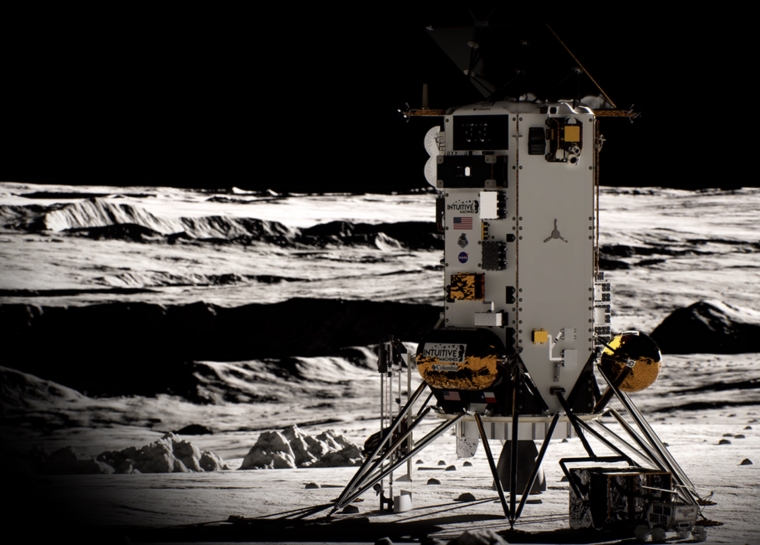
The commercial space industry is going gang busters at the moment, with a huge amount of rocket launches taking place everywhere. It seems routine, but we shouldn't forget how difficult it is to fire huge rocket engines into the void.
One company that can attest to it is NASDAQ listed Intuitive Machines. The Houston, Texas based company was set up for commercial and government exploration of the Moon, and has won contracts with the United States National Aeronautics and Space Administration (NASA) for that purpose.
And, Intuitive Machines has landed on the Moon: its Odysseus lander was delivered by the IM-1 craft in February last year, the first commercial landing on the Moon ever. It was also the first Moon landing since 1972 by a US space craft, after Apollo astronauts Gene Cernan and Harrison Schmitt walked on the surface of the planet, with Ronald Evans orbiting above.
Odysseus fell on its side unfortunately when landing, but as it was able to communicate with Mission Control on Earth, the trip to the Moon was deemed a success, albeit in reduced capacity. Odysseus ("Odie") eventually ran out of battery power on the Moon, and went to sleep in the extreme cold.
The IM-2 mission last weekend didn't go so well. The Athena lunar lander ended up in a crater near the Moon's South Pole. That was 250 metres away from the intended landing site, and to make matters worse, Athena too fell on its side.
"With the direction of the sun, the orientation of the solar panels, and extreme cold temperatures in the crater, Intuitive Machines does not expect Athena to recharge. The mission has concluded and teams are continuing to assess the data collected throughout the mission," Intuitive Machines wrote.
A soft landing on the Moon is a spectacular feat, but investors in the company weren't impressed. They lost faith in Intuitive Machines after Athena's sideways landing and the company's share price is now down by over a fifth.
SpaceX Starship fails again
Billionaire Elon Musk's SpaceX has enjoyed much success with the Low Earth Orbit (LEO) satellite programme Starlink, which provides broadband across the world, and recently, limited telco services.
SpaceX's reusable super heavy launch vehicle, Starship, has been beset by catastrophic mishaps, however. The most recent eighth test flight saw the craft break up over the Caribbean, again disrupting commercial air traffic in that area.
Contradicting his fans, Musk acknowledged the test flight failure on Twitter-X:
It was an upper stage / ship failure tbh.
— Elon Musk (@elonmusk) March 7, 2025
But we learned a good amount in building the new ship design and the flight.
Right now, the launch success rate is just 50 per cent. It may be that human colonisation of Mars, if it is at all possible, is further off through Starship than Musk imagined.
We welcome your comments below. If you are not already registered, please register to comment
Remember we welcome robust, respectful and insightful debate. We don't welcome abusive or defamatory comments and will de-register those repeatedly making such comments. Our current comment policy is here.